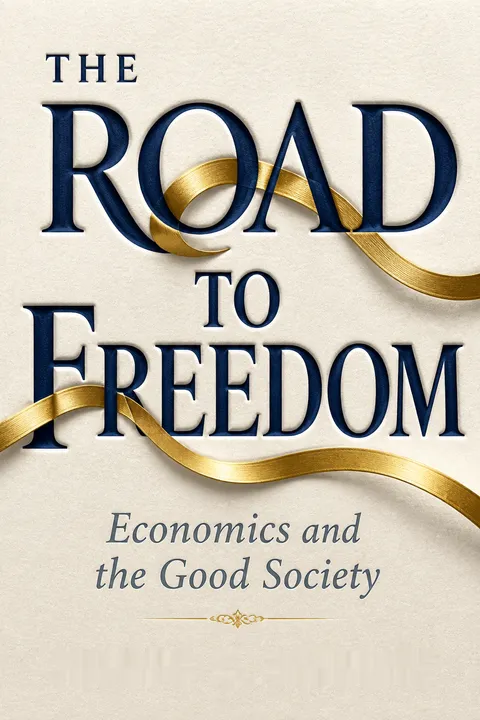


Key Takeaways
Measure freedom by real choices, not by how little government interferes
Freedom means available choices. Stiglitz defines economic freedom through a person’s opportunity set: the options she can genuinely afford and pursue. Someone with the formal right to choose but no food, health care, education, or safe work has little practical freedom. That is why freedom from want and fear matters alongside freedom from state interference. Growing up in Gary, Indiana, Stiglitz saw classmates who had planned to work in steel mills instead join the military when jobs disappeared, then return to an economy with few alternatives.
Opportunity is not evenly distributed. Taxes may narrow the choices of wealthy people while publicly funded education, health care, and security expand the choices of people with less. The right question is not simply whether government restricts someone, but whose options its rules enlarge or diminish.
This reframing makes freedom concrete: it asks what people can actually do, not only what the law permits. It also clarifies why political rights and material conditions cannot be cleanly separated. A vote matters, but so do the resources and security needed to exercise agency. The framework is strongest as a way to expose hidden constraints. It still requires judgments about which choices matter most, and how to weigh one person’s expanded options against another’s loss.
When one group gains freedom, ask who inherits the cost
Choices spill across lives. An externality is a cost or benefit that someone’s action imposes on people outside the transaction. A driver may value speed; pedestrians and other drivers bear some of the risk. A company may profit from pollution; nearby residents bear the health costs, while future generations inherit a warmer climate. In Stiglitz’s account, modern life makes these effects pervasive, from crowded cities to interconnected financial markets.
The costs can travel widely. The 2008 financial crisis began with risky decisions by financial firms, but its damage reached workers, homeowners, and retirees around the world. The government then faced pressure to rescue the system because collapse would have harmed everyone. Asking whose freedom is at stake reveals what a narrow focus on the decision-maker’s liberty leaves out.
The externality lens is valuable because it makes absent parties visible, including people not yet born. It also helps distinguish private choice from private consequence: a decision is not purely personal when its risks are shifted onto others. The hard part is measurement. Harms such as pollution, financial fragility, and loss of life differ in scale and certainty, so public decisions need evidence as well as moral judgment.
Use collective rules when markets cannot coordinate or protect everyone
Some constraints help everyone. A traffic light limits each driver’s immediate freedom, yet lets people cross an intersection without competing for space at once. The same logic applies when citizens must contribute to public goods, services that many people can benefit from whether or not each person pays voluntarily. Without taxes, each person may hope others will fund the service. If everyone does, the service is underprovided or absent. This is the free-rider problem.
Public investment opens possibilities. Stiglitz points to the internet and medical research as products of sustained public funding, including research that supported rapid development of Covid-19 vaccines. Collective action also helps solve coordination problems, such as rules that prevent every shop from feeling forced to open on a day when owners would prefer to close. Coercion can reduce one choice while expanding the choices available to a whole community.
The examples show why coercion and freedom are not simple opposites. Shared rules can solve coordination failures that voluntary individual decisions cannot, especially when the benefit is widely shared. This is not a blank check for public action: governments can choose badly, and the people who pay may not receive equal benefits. The useful test is whether the rule solves a real collective problem and whether its design distributes burdens and gains fairly.
Judge property and contracts by the rules they impose on everyone
Markets depend on public rules. Property rights determine who may use an asset, exclude others, or earn income from it. They are not fixed by nature. The enclosure of common grazing land in Britain transferred access from villagers to landowners; communities could instead have limited grazing to protect the shared resource. Both arrangements constrained someone, but they distributed freedom and wealth differently.
Consent alone is not enough. A social contract is a way to reason about the obligations and rules that people accept as members of a society, not a document anyone literally signed. John Rawls’s veil of ignorance asks people to choose rules without knowing whether they will be rich or poor, powerful or vulnerable. From that position, people might reject exploitative contracts, child labor, or secrecy clauses that shield abuse, even if the parties formally agreed to them.
The veil of ignorance is a practical check on self-serving rulemaking. It shifts attention from whether a rule protects an existing entitlement to whether people would accept it without knowing their place in the system. That does not settle every dispute: people may disagree about risk, fairness, or what counts as exploitation. But it exposes a frequent sleight of hand, treating current property arrangements as natural while treating changes to them as political interference.
Separate genuine competition from permission to exploit
Power changes the meaning of choice. A dominant firm can raise prices, restrict workers’ alternatives, or bury consumers in contract terms they cannot realistically negotiate. Stiglitz calls the extra returns gained through market power rents, and efforts to secure those gains rent-seeking. Such income may reflect the ability to control access, not a contribution that benefits society. He cites evidence that US manufacturers’ insulin prices averaged five to ten times those in other OECD countries.
Rules can restore options. Competition laws, truthful disclosures, and limits on compulsory arbitration can reduce a firm’s ability to exploit information gaps or weak bargaining power. Patents pose a more complicated case because temporary exclusivity can encourage innovation, but overly broad rights can block access to useful knowledge. The question is how to reward invention without letting the reward become an enduring license to exclude others.
The distinction between producing value and capturing value is central to evaluating modern corporate profits. A company can earn returns through useful innovation, but it can also profit by making alternatives harder to reach. Policy must distinguish the two rather than treating every high return as either deserved or abusive. That is especially important for patents, where incentives matter, but so do affordability, follow-on research, and access to knowledge.
Design institutions with an eye to the people they produce
Preferences are shaped, not fixed. Endogenous preferences are wants and beliefs that can change through experience, social norms, education, and institutions. Schools do more than teach skills: they also shape civic habits and ideas about cooperation. Markets shape people too. An economy that rewards ruthless self-interest may encourage behavior that spreads beyond the workplace, weakening trust and honesty.
Incentives can change the norm. At an Israeli daycare, parents were charged for late pickups. Instead of arriving earlier, more parents arrived late. The fee reframed lateness as a purchasable service, weakening the prior sense of obligation. Stiglitz uses the example to warn that putting a price on behavior can sometimes crowd out social responsibility. He also points to credit unions, which behaved more responsibly than many profit-oriented banks during the financial crisis.
The argument deepens the usual question of whether an institution produces efficient outcomes. It asks what kinds of people and expectations the institution cultivates, and whether those habits support the institution itself. The daycare example captures a real design hazard: incentives can alter the meaning of an action, not just its cost. Yet norms can also enforce conformity or discrimination, so social cohesion is not automatically virtuous. Institutions need room for dissent and revision.
Defend open inquiry without letting powerful platforms manufacture reality
Information markets are not neutral. A marketplace of ideas cannot reliably select the best information when people have limited time, sellers can mislead, and platforms control what becomes visible. Social media firms use algorithms that determine which messages reach which users. Their business incentives can favor attention and anger over accuracy, while the rapid spread of falsehoods makes correction difficult.
Protect thought, scrutinize harmful action. Stiglitz distinguishes private belief from speech and conduct that affect others. People should be free to hold mistaken or unpopular views, but false claims can cause public harm when they shape decisions about health, elections, or climate policy. The challenge is to reduce amplification and demand transparency without handing governments unchecked power to decide what may be said. Independent courts, research institutions, and a diverse press matter because societies need credible ways to assess claims.
This is a particularly difficult freedom problem because platforms are both private companies and powerful editors of public attention. Their claim to be neutral transmitters ignores the choices built into ranking and recommendation systems. At the same time, official truth enforcement can be abused, especially where institutions lack independence. The most defensible response therefore emphasizes transparent rules, accountable procedures, and limits on amplification, rather than assuming either markets or governments can be trusted without checks.
Treat neoliberalism as a policy choice, not an economic law
The promised gains did not arrive broadly. Neoliberalism is the belief that liberalized markets, deregulation, and privatization should dominate economic life. Stiglitz argues that decades of this approach produced slower growth, greater inequality, weakened opportunity, and repeated crises. In the United States, the share of people born around 1940 who earned more than their parents was about 90 percent; for those born after 1980, it was about half. Financial deregulation helped set the stage for the 2008 crisis and the public rescue of banks.
The experiment had international costs. Washington Consensus policies pushed austerity, privatization, and liberalization on developing countries. Stiglitz associates them with financial crises, deindustrialization, and reduced policy freedom. These results, he argues, were not inevitable consequences of economics. They reflected political decisions about which rules to adopt and whose interests those rules served.
The book’s strongest analytical move is to treat policy regimes as revisable arrangements rather than expressions of economic nature. That makes outcomes politically accountable: if the rules produce concentrated gains and widespread insecurity, alternatives can be debated. A caution is that national experiences vary, and no single statistic can isolate the effects of one policy from every other cause. The argument is most persuasive when it connects broad trends to specific mechanisms, such as financial risk-taking or weakened worker bargaining power.
Make international agreements answer to the people who bear their costs
National freedom has an international counterpart. Countries can be constrained by debt conditions, trade rules, investment agreements, and intellectual property protections. A government may formally consent while having few realistic alternatives, especially when it needs emergency financing. Stiglitz argues that these arrangements often give wealthy countries and multinational firms more room to act while limiting developing countries’ ability to regulate, tax, or build industries.
The Covid-19 vaccine dispute shows the stakes. During the pandemic, developing countries sought wider access to relevant intellectual property so they could produce vaccines and treatments. Stiglitz argues that protecting exclusive rights over public-health tools placed corporate profits above access to lifesaving products. He calls for fairer debt restructuring, rules that preserve countries’ ability to regulate in the public interest, and international cooperation focused on genuine cross-border harms such as climate change.
The international argument usefully distinguishes mutual restraint from unequal bargaining disguised as consent. A treaty can expand shared security or trade, but its legitimacy depends on who shaped it, who can challenge it, and who bears the downside. This is especially important where global problems require cooperation, since rules perceived as one-sided can erode trust. The analysis also raises a design challenge: fairer agreements need credible enforcement, not merely better language or more seats at negotiations.
Build a learning economy that limits power and makes security real
Progressive capitalism is an institutional mix. Stiglitz uses this term for a system with private firms, public investment, regulation, social protection, and a wider range of organizations, including cooperatives and nonprofits. It aims to restrain concentrated power, expand opportunity, and let people live with greater security. Public health care, education, research, infrastructure, and retirement protection are part of the economic foundation, not optional extras.
A learning society can adapt. A learning society continually improves both people’s knowledge and the institutions that organize economic life. Policy will make mistakes, Stiglitz argues, but the answer is to learn from them rather than abandon collective action. The US loan to Tesla, for example, supported electric-car development, but the government could have negotiated a share of the potential gains. Progressive capitalism also needs democratic checks, a diverse press, and limits on the influence of wealth in politics.
The alternative is not simply a larger state. It is a more plural system in which different institutions can experiment, check one another, and serve purposes that profit alone may neglect. The learning-society idea supplies an important safeguard against policy dogma: public programs should be judged and redesigned as evidence accumulates. Its success depends, however, on capable administration and democratic oversight. Public power can also concentrate, so the same scrutiny applied to corporations must apply to government.
Analysis
The book’s organizing achievement is to turn freedom from a slogan into a question about institutions: who has which options, under what rules, and at whose expense? That shift links familiar economic topics, such as externalities and public goods, to political legitimacy, social norms, media power, and international sovereignty. Its central contribution is not the claim that government is inherently liberating, but that markets are already constituted by law, public investment, and bargaining power. Calling a system “free” can conceal these choices.
The argument is strongest when it identifies mechanisms. Risk-taking in interconnected finance can impose costs on people outside a transaction. A dominant employer can make formal consent compatible with few alternatives. A platform’s ranking system can shape public attention while escaping the accountability expected of traditional publishers. These cases make the book’s broad thesis concrete and show why efficiency cannot be separated neatly from distribution.
The main analytical pressure point is the assumption that democratic collective action can be designed well enough to correct market power without creating its own. Stiglitz acknowledges government failure, but the proposed remedy depends on trustworthy institutions, public reasoning, and checks that are themselves vulnerable to wealth and polarization. The framework therefore needs institutional detail, not merely a change in policy preference. Its emphasis on opportunity also leaves a live philosophical question: whether expanding a person’s options is sufficient for freedom when choices are shaped by dependency, manipulation, or social pressure.
The book offers no frictionless formula for balancing liberties. Its practical value is a disciplined habit of asking who benefits, who pays, what evidence can establish harm, and whether a rule would seem fair from an unknown social position. That method is more durable than any fixed equation of freedom with either markets or government.
Review Summary
The Road to Freedom receives mixed reviews, with praise for its critique of neoliberalism and exploration of freedom's complexities. Stiglitz's arguments on progressive capitalism and social democracy resonate with many readers. However, some find the book repetitive, lacking in concrete solutions, or overly biased. Critics appreciate Stiglitz's economic insights but question his legal analysis and political philosophy. Overall, the book is seen as a valuable contribution to economic discourse, particularly for those new to the subject.
People Also Read





Glossary
Opportunity set
Available real choicesThe set of actions, goods, and services a person can genuinely access, given their resources and circumstances. In Stiglitz’s account, economic freedom depends substantially on the size and quality of this set. A legal right to choose means little if poverty or insecurity leaves someone with almost no viable options.
Externality
Spillover cost or benefitA cost or benefit created by an action that affects people who are not directly part of the transaction. Pollution, contagious disease, and financial instability are examples of harmful spillovers. Because decision-makers may not bear the full consequences of their choices, markets can produce too much harmful activity and too little socially beneficial activity.
Free-rider problem
Benefit without contributionA problem that arises when people can benefit from a shared good without contributing to its cost. Each person may reason that others will pay, but if enough people do so, the good is underfunded or not provided. Stiglitz uses this logic to explain why taxation can be necessary for public goods and collective action.
Social contract
Shared rules and obligationsA philosophical idea for considering the obligations individuals owe one another and the powers and duties assigned to government. It is a metaphor, not a historical document signed by citizens. Stiglitz uses it to examine which rules, protections, and limits people could reasonably accept as members of a society.
Veil of ignorance
Choose without knowing your positionA thought experiment associated with philosopher John Rawls. People choose society’s basic rules without knowing whether they will be wealthy or poor, powerful or vulnerable. The device encourages impartial judgment by preventing people from designing rules solely for their own expected advantage. Stiglitz applies it to contracts, property, taxation, and economic regulation.
Endogenous preferences
Socially shaped wants and beliefsPreferences and beliefs that are influenced by experience, institutions, education, family, media, and social norms rather than treated as fixed from birth. The concept challenges economic models that assume people’s desires remain unchanged. It matters because economic arrangements can shape behavior and values, not merely satisfy existing wants.
Neoliberalism
Market-first policy doctrineA policy approach favoring liberalization, deregulation, privatization, and a restricted role for government. Stiglitz uses the term for the dominant economic direction of recent decades, arguing that it treated markets as self-correcting while overlooking market power, externalities, and unequal bargaining. He links it to concentrated wealth, instability, and weakened opportunity.
Progressive capitalism
Regulated, inclusive market economyStiglitz’s name for an economic system in which private, profit-oriented firms operate alongside public investment, regulation, social protection, cooperatives, and nonprofits. The system aims to restrain exploitation and concentrated power while expanding opportunity and security. It retains markets but rejects the idea that markets alone can deliver a just or well-functioning society.
Learning society
Institutions that adapt through learningA society that treats learning as continuous, both for individuals and for the institutions that organize economic and political life. It recognizes that technology, knowledge, and social conditions change, and that policies will need revision. The aim is to build institutions capable of learning from results and adapting rather than assuming one fixed model will always work.
Metanarrative
Shared story about how society worksA broad story or interpretive lens through which people understand the economy, government, and social problems. Media organizations and platforms can influence this story by selecting and amplifying information. Stiglitz argues that concentrated control over communication can shape beliefs about markets, taxation, and collective action, with consequences for democratic choices.
FAQ
What's The Road to Freedom: Economics and the Good Society about?
- Exploration of Freedom: The book examines the complex nature of freedom, highlighting its misinterpretation in political discourse. Stiglitz argues that true freedom is deeply connected to economic and social contexts.
- Critique of Neoliberal Capitalism: Stiglitz critiques neoliberal capitalism for failing to deliver freedom and prosperity for all. He proposes "progressive capitalism" as a more equitable system balancing market efficiency with social justice.
- Interdependence of Freedoms: The author emphasizes that one person's freedom can come at the expense of another's, advocating for collective action and government intervention to ensure a just society.
Why should I read The Road to Freedom: Economics and the Good Society?
- Critical Perspective: The book offers a critical analysis of contemporary economic systems and their impact on freedom, challenging conventional wisdom.
- Real-World Applications: Stiglitz connects theoretical concepts to real-world issues like the 2008 financial crisis and inequality, making the book relevant to current societal challenges.
- Thought-Provoking Arguments: Readers are encouraged to engage with complex ideas about freedom, coercion, and social responsibility, fostering a deeper understanding of economic policies' effects on individual lives.
What are the key takeaways of The Road to Freedom: Economics and the Good Society?
- Complex Nature of Freedom: Freedom is intertwined with economic and social conditions, requiring a broader understanding of its implications.
- Role of Government: Government intervention in markets and public goods provision can enhance overall freedom, sometimes requiring "mild coercion" for societal benefits.
- Critique of Neoliberalism: Neoliberal capitalism is criticized for increasing inequality and failing to deliver on its promises, necessitating a shift towards progressive capitalism.
What are the best quotes from The Road to Freedom: Economics and the Good Society and what do they mean?
- “Freedom for the wolves...”: This quote warns against unregulated freedom that benefits the powerful at the expense of the vulnerable.
- “The Right claims to be...”: Stiglitz critiques the Right's interpretation of freedom, suggesting it often prioritizes the wealthy's interests over the majority's needs.
- “A good society must incorporate...”: This emphasizes society's responsibility to create conditions that allow all individuals to thrive, linking freedom with social justice.
How does Joseph E. Stiglitz define freedom in The Road to Freedom: Economics and the Good Society?
- Freedom as Opportunity: Stiglitz defines freedom as the presence of opportunities to pursue one's potential, influenced by economic conditions.
- Interconnected Freedoms: Political and economic freedoms are interconnected, with one unable to exist without the other.
- Freedom from Fear and Want: True freedom includes security and well-being, requiring social safety nets to address extremes of want and fear.
What is the free-rider problem discussed in The Road to Freedom: Economics and the Good Society?
- Definition: The free-rider problem occurs when individuals benefit from resources without paying, leading to under-provision of public goods.
- Impact on Society: Without collective action, essential services like education and healthcare would be underfunded, necessitating government intervention.
- Examples: Stiglitz discusses environmental protection and public health initiatives, advocating for policies that encourage participation in public goods.
How does Joseph E. Stiglitz critique neoliberal capitalism in The Road to Freedom: Economics and the Good Society?
- Failure to Deliver: Neoliberal capitalism has increased inequality and social unrest, failing to provide promised economic growth and freedom for all.
- Concentration of Power: Neoliberal policies have concentrated economic power, undermining democracy and social justice.
- Call for Progressive Capitalism: Stiglitz advocates for progressive capitalism, balancing market efficiency with social equity to create a more just society.
What role does government play in promoting freedom according to The Road to Freedom: Economics and the Good Society?
- Regulation and Public Goods: Government regulation and public goods provision are essential for enhancing individual freedoms.
- Addressing Externalities: Government intervention is necessary to manage externalities, like pollution, that limit others' freedoms.
- Social Safety Nets: Social safety nets funded through taxation expand opportunities for the less fortunate, ensuring resources for fulfilling lives.
How does Joseph E. Stiglitz connect freedom to social justice in The Road to Freedom: Economics and the Good Society?
- Freedom and Equity: True freedom cannot exist without social justice, as economic disparities limit opportunities.
- Redistribution of Wealth: Progressive taxation and wealth redistribution address inequalities that restrict freedom.
- Moral Legitimacy of Wealth: Wealth derived from unjust practices lacks moral legitimacy and should be redistributed for the greater good.
What is progressive capitalism as defined in The Road to Freedom: Economics and the Good Society?
- Rejuvenated Social Democracy: Progressive capitalism combines capitalism with social democratic principles, prioritizing citizens' well-being.
- Focus on Equality and Justice: It emphasizes reducing inequality and promoting social justice for a healthier society.
- Role of Collective Action: Advocates for government and collective action in addressing societal challenges and ensuring economic policies benefit the majority.
How does The Road to Freedom: Economics and the Good Society address the concept of externalities?
- Definition of Externalities: Externalities are costs or benefits affecting third parties not involved in a transaction, often unaccounted for in unregulated markets.
- Need for Regulation: Government intervention is necessary to manage externalities, ensuring businesses consider societal and environmental impacts.
- Examples: Pollution and public health crises illustrate negative externalities, with policies needed to mitigate these effects.
How does The Road to Freedom: Economics and the Good Society propose to address climate change?
- Government Intervention is Crucial: Strong government action and regulation are necessary to address climate change effectively.
- Investment in Public Goods: Increased public investment in renewable energy and sustainable practices is essential for a greener economy.
- Global Cooperation: International cooperation is vital, with developed countries supporting developing nations in combating climate change.
About the Author
Other books by Joseph E. Stiglitz
Download PDF
Download EPUB
.epub digital book format is ideal for reading ebooks on phones, tablets, and e-readers.








