

Key Takeaways
Interpret populist anger as a demand for recognition, not only money
More than material loss. Fukuyama argues that many political movements are fueled by the feeling that a person, group, or nation is being ignored or treated as lesser. Economic shocks matter, but they become especially potent when people read them as evidence that their contribution and place in society no longer count. Putin’s appeals to Russia’s lost great-power status, and Trump voters’ anger at distant elites, differ in scale but share this structure.
A wider political lens. In the 2010s, economic inequality and globalization helped explain discontent, but not why it so often gathered around nationalism, religion, or group recognition rather than redistribution. The book calls this politics of resentment: a demand to repair public disrespect. It helps explain why a symbolic slight can mobilize people as powerfully as a material loss.
What's striking is how recognition converts diffuse frustration into a legible political story: someone has wronged us, and someone must restore our standing. That story can reveal genuine exclusion that economic indicators miss. It can also direct anger toward convenient scapegoats rather than causes such as technological change, weak labor protections, or policy failure. The distinction matters for political diagnosis. Leaders who treat every grievance as mere irrationality miss real injuries, while leaders who validate resentment without testing its claims can turn status anxiety into hostility toward outsiders.
Add dignity to any theory of what motivates political behavior
A third motive. Drawing on Plato, Fukuyama argues that human beings are moved not only by desire and reason, but also by thymos, the part of the psyche that seeks judgments of worth. It can produce pride when people believe they meet their own standards, shame when they fall short, and anger when they feel undervalued. Plato illustrates this with Leontius, who gives in to curiosity about corpses, then berates himself for acting beneath his own sense of dignity.
Politics beyond money. A person may accept economic costs to defend a group, a principle, or a sense of honor. The soldier who risks death for comrades, and people who insist on equal recognition for same-sex marriage, are difficult to explain through material gain alone. Thymos helps account for why respect, not simply resources, becomes a political stake.
This model corrects a familiar blind spot: people care about what they can obtain, but also about what their actions say about who they are. That distinction helps explain costly cooperation, protest, and sacrifice. It also warns against treating every preference as a hidden economic calculation. Still, thymos is a broad explanatory category, not a complete prediction tool. The same craving for esteem can support courage, solidarity, vanity, or aggression. Understanding the motive does not settle whether a particular demand is just.
Defend equal civic worth without pretending every achievement is equal
Two forms of recognition. Isothymia is the demand to be respected as an equal. Megalothymia is the wish to be recognized as superior. Fukuyama sees modern democracy as a historic expansion of equal recognition beyond aristocrats and warriors, to citizens once excluded by class, race, or sex. Yet equality of basic dignity does not mean equal skill, virtue, or achievement. A society can honor exceptional service without denying anyone’s standing as a person.
The democratic tension. Megalothymia can motivate extraordinary effort, but it can also concentrate power in leaders who want personal supremacy. Isothymia corrects inherited hierarchy, yet can become a demand that every difference in esteem disappear. Democratic institutions, including rights and checks on power, seek to recognize equal citizens while preventing ambition from turning into domination.
The distinction is useful because it separates equality before the law from sameness in every human quality. Confusing the two produces opposite errors: defending status hierarchies as deserved, or treating any judgment of excellence as an attack on dignity. The harder question is who gets to define excellence. Standards can reflect genuine contribution, but they can also preserve inherited advantage. A robust democratic culture therefore needs both room to honor achievement and scrutiny of the institutions that distribute prestige.
See modern identity as the inner self asking society to change
A modern idea of self. The book distinguishes the enduring human desire for recognition from modern identity, which grows from a sense that an authentic inner self conflicts with society’s expectations. Martin Luther helped establish the importance of inner belief over external religious performance. Jean-Jacques Rousseau secularized the inward turn, arguing that social conventions could deform a person’s natural self. Later thinkers connected personal dignity to public recognition and political rights.
Choice makes identity urgent. In settled village life, occupation, religion, and social role were largely inherited, leaving little room to ask who one might become. Commercial growth, urbanization, literacy, and religious upheaval expanded people’s choices. That freedom opened possibilities, but also made social roles feel imposed and the self feel unsettled. Identity became a way to name both the inner conflict and the demand that society respond.
The historical account makes identity neither a timeless illusion nor a wholly private discovery. It is a modern way of interpreting the friction between personal aspiration and social rules. That perspective explains why calls for authenticity often seek institutional change, not just self-acceptance. It also complicates the idea of a completely private inner self: people acquire language, values, and even self-understanding through relationships. Personal freedom is real, but it develops inside social worlds rather than outside them.
Notice when universal rights give way to narrower national or religious pride
Two political directions. The demand for dignity can support universal rights for individuals, or recognition for a particular group. Fukuyama traces the first path through liberal ideas of equal citizenship. The second appears in nationalism and political religion, which promise belonging to a people or community whose identity has been disrespected. Johann Gottfried Herder valued the distinctiveness of cultures, while later nationalists could turn cultural pride into exclusion.
Belonging has risks. Modernization can uproot people from local communities and leave them searching for a wider source of meaning. National or religious movements offer a ready answer: a proud shared history, a community, and an explanation for humiliation. That appeal does not make every such movement extremist. But when recognition is limited to insiders, and outsiders are blamed for decline, group solidarity can become illiberal or violent.
Collective identity can supply trust and purpose that abstract rights alone may not generate. It can also make political membership conditional on ancestry, faith, or cultural conformity. The key distinction is not between identity and no identity, but between identities that permit plural membership and those that require an enemy. Grievance alone does not explain radical movements: institutions, leadership, and specific doctrines shape how resentment is expressed. That is why understanding identity should deepen analysis, not replace it.
Read economic loss as a threat to status and visibility
Income carries social meaning. Fukuyama draws on Adam Smith’s observation that wealth brings attention and approval, while poverty can place people outside public notice. A salary can signal whether an employer regards someone as valuable, just as a job can confirm that a person contributes to society. This helps explain why a professional woman may object to unequal pay even when she is not materially deprived, and why a guaranteed income alone may not replace the standing attached to work.
Relative position stings. The book notes that half of Americans saw no real income gains from 2000 to 2016, while the share of national output going to the top 1 percent rose from 9 percent in 1974 to 24 percent in 2008. Rural voters interviewed by researchers described feeling unseen by urban elites. Their frustration mixed economic decline with lost respect and fear of slipping down the social ladder.
The connection between income and recognition explains why policies can improve purchasing power yet leave resentment intact. Work, titles, and public respect are forms of social membership, not merely paychecks. At the same time, status-centered explanations should not obscure material deprivation: poor health care, unstable work, and inadequate schools are not just symbols. The strongest account holds both levels together. A policy can address resources directly while also treating people as participants whose knowledge and contribution deserve attention.
Keep recognition politics connected to material reform and shared debate
Inclusion matters, but has limits. Civil rights, feminist, and other movements made previously neglected experiences visible and challenged real discrimination. Fukuyama argues that identity politics becomes counterproductive when social recognition substitutes for efforts to reduce economic inequality, or when groups are divided into ever narrower categories that struggle to communicate. He also describes the therapeutic turn: institutions increasingly treated self-esteem and emotional affirmation as public goals, sometimes without a clear account of what conduct merits respect.
A political backlash. As parts of the left focused on more specific identities, some working-class voters felt ignored. The right then adopted the language of victimhood and disrespect, including opposition to political correctness. This does not make all grievances equivalent: discrimination against marginalized groups remains real. But treating disagreement as proof of injury can weaken the open debate needed to build policies that benefit people across group lines.
Recognition claims can correct harms that broad economic programs overlook, especially when supposedly universal policies were designed around a dominant group’s experience. Yet a coalition organized only around separate injuries struggles to agree on shared priorities. The same is true when institutions promise affirmation without standards or accountability. A useful test is whether recognition expands people’s capacity to participate together, or turns identity into a boundary that makes persuasion impossible. The first strengthens democracy; the second leaves both policy and solidarity harder to achieve.
Build national belonging around democratic commitments, not ancestry
A common political home. Fukuyama argues that liberal democracy needs a national community whose members accept the legitimacy of its institutions and see one another as participants in a shared project. Such identity can support public trust, effective government, social insurance, and willingness to accept electoral outcomes. Syria illustrates the danger of weak common belonging: sectarian and ethnic loyalties overwhelmed attachment to the state as repression weakened. By contrast, the book points to East Asian countries that entered modernization with established national identities.
Civic, not ethnic. National identity need not be based on race or religion. The United States gradually moved toward a creedal account centered on constitutional government, equal rights, and democratic participation, though this was achieved through prolonged conflict and remained incomplete. Diversity can enrich a society, but diversity alone is not a shared political purpose. An inclusive national identity makes difference compatible with common citizenship.
National identity is often treated as either inherently exclusionary or automatically unifying. Fukuyama’s more useful claim is conditional: belonging helps when it supports equal membership and common rules, and harms when it ranks citizens by origin. The difficult work lies in making civic principles credible in daily life, not merely reciting them. A constitutional ideal cannot compensate indefinitely for unequal enforcement or exclusion. National stories gain legitimacy when they acknowledge past failures while showing how political membership can widen.
Make assimilation reciprocal: newcomers need access, and institutions must open
Peoplehood is made. Nations were formed through varied means, including border changes, population transfers, assimilation, and deliberate construction of shared stories. In the film Invictus, Nelson Mandela encouraged black South Africans to support the largely white national rugby team after apartheid. He understood that common symbols could help build a new political bond, but he had to persuade people rather than simply impose one.
Belonging needs policy. Fukuyama favors inclusive civic identity supported by accessible citizenship, language learning, common civic education, and institutions that bring groups together. He argues that host societies must also address discrimination and barriers to jobs. Immigration rates and institutional capacity matter, and democracies may control borders, but blanket exclusion and unrealistic mass deportation are not workable answers. Integration requires newcomers to learn shared civic norms and established institutions to make genuine membership possible.
The Mandela example shows that national unity is not simply inherited; it can be built through shared practices that people once associated with different groups. But integration is not a one-way test imposed on newcomers. Schools, labor markets, and public institutions determine whether a person can plausibly belong. Civic requirements can clarify common obligations, yet they can also become selective hurdles if applied inconsistently. The most credible approach combines clear expectations with visible fairness and real routes into participation.
Turn separate experiences into common citizenship without denying injustice
Repair and reconnect. Fukuyama’s practical answer is not to abandon identity politics, but to widen the identities through which people cooperate. Concrete abuses, including police violence and sexual harassment, require direct remedies. At the same time, societies need shared civic education, a national narrative open to diverse citizens, and policies that address job loss, poverty, and insecurity. A politics focused only on cultural recognition leaves the material sources of resentment intact.
Keep democracy workable. The book also warns that digital communication can intensify fragmentation by surrounding people with like-minded communities and hostile caricatures of opponents. Citizens need common institutions and enough trust to deliberate, compromise, and accept decisions they dislike. Fukuyama proposes measures such as national service to bring people from different backgrounds into shared work. The goal is not to erase difference, but to make different experiences compatible with collective action.
The closing proposal treats democratic cohesion as something that requires both fairness and shared practice. Common citizenship is not a demand that everyone tell the same story about their life; it is a commitment to resolve differences through legitimate institutions. That commitment is fragile when groups experience institutions as biased or unresponsive. Shared service and civic education may help, but they cannot manufacture trust on their own. Trust grows when public rules are applied fairly and citizens see that participation can change outcomes.
Analysis
The book’s central achievement is to make dignity a bridge between personal psychology and political institutions. Economic models explain incentives and resource conflicts, but they often struggle to explain why people accept costs, seek public recognition, or mobilize around identities that do not promise material gain. Fukuyama’s account of thymos gives those actions a coherent motive: people want to be seen as worthy, whether as equals or as exceptional. That framework illuminates the emotional force behind populist nationalism, protest movements, and struggles for civil rights.
Its historical narrative is equally important. Modern identity is not presented as a timeless essence waiting to be discovered, but as an idea shaped by religious change, new social choices, and the growth of modern economies. This lets the book explain why identity can feel deeply personal while also being politically constructed. The progression from inner self to public recognition, then to group identity and national politics, gives the argument a strong spine across otherwise diverse cases.
The framework is strongest as a supplement to material explanations, not a replacement for them. Fukuyama sometimes draws a broad line from resentment to nationalism, but similar feelings can produce democratic solidarity or exclusionary politics depending on institutions, leaders, and available ideas. The book acknowledges this complexity, especially in its discussion of Islamist radicalism, yet the general concept of recognition can still become so capacious that it explains almost any political passion after the fact.
The normative solution, inclusive civic identity, is compelling but difficult. A civic creed can bind diverse citizens only if it is practiced through fair laws, genuine access, and a public narrative that does not hide historical exclusion. Assimilation can create shared belonging, but it can also become a polite name for requiring minorities to absorb the dominant group’s habits. The book’s best practical implication is therefore reciprocal: citizens need common commitments, while institutions must earn the allegiance they ask citizens to give. Recognition and redistribution are not rival remedies. Durable democracy requires both.
Review Summary
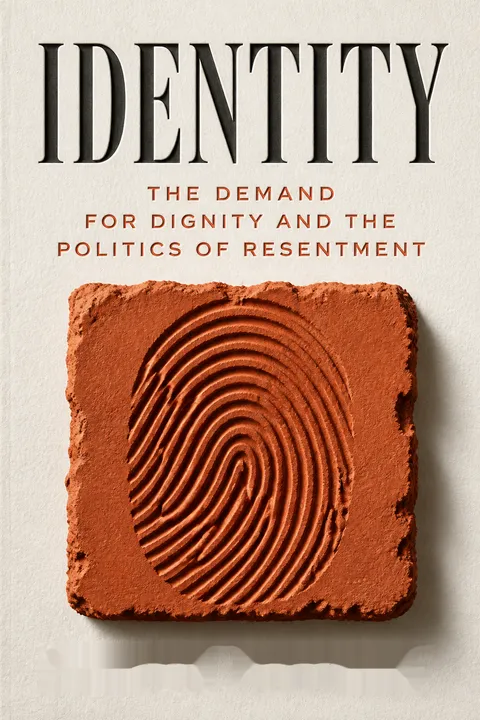
Identity explores the rise of identity politics and its impact on modern societies. Fukuyama traces the concept's historical and philosophical roots, examining how the human desire for recognition shapes political movements. He argues that both left-wing and right-wing identity politics threaten liberal democracy and social cohesion. The book offers insights into nationalism, multiculturalism, and the challenges of globalization. While some reviewers praise Fukuyama's analysis and proposed solutions, others criticize his simplifications and perceived biases. Overall, the book is seen as a thought-provoking examination of a critical contemporary issue.
People Also Read









Glossary
thymos
desire for recognitionA part of the human psyche that seeks judgments of worth and dignity. It can appear as pride when a person believes they have lived up to a standard, shame when they have fallen short, or anger when they feel undervalued. Fukuyama uses thymos to explain political motives that cannot be reduced to material desire or rational calculation.
isothymia
demand for equal respectThe desire to be recognized as equal in dignity to other people. Fukuyama uses the term to describe the drive behind democratic struggles to expand the circle of people entitled to rights and respect. Isothymia challenges inherited hierarchies, though demands for equal standing can conflict with distinctions based on achievement or virtue.
megalothymia
desire for superior recognitionThe desire to be recognized as greater or superior to others. Fukuyama treats it as a lasting human motive that can inspire extraordinary achievement or public service, but can also fuel domination and authoritarian leadership. Liberal institutions cannot eliminate this desire, but can channel ambition and prevent it from concentrating unchecked power.
identity politics
politics of group recognitionPolitical activity organized around demands that a person or group receive public recognition and respect for its identity. Fukuyama applies the term broadly, from movements seeking rights for marginalized groups to nationalism and political religion. Such movements can correct real exclusion, but can also narrow belonging and intensify competition between groups.
expressive individualism
freedom to define oneselfA view of autonomy in which freedom includes expressing and shaping one’s authentic inner self, rather than only choosing within established moral rules. Fukuyama traces this idea to modern shifts in thought about the self. It can support personal freedom, but may weaken shared norms when individual self-definition is treated as the only source of authority.
Gemeinschaft and Gesellschaft
community and modern societyA distinction associated with Ferdinand Tönnies. Gemeinschaft describes close-knit, traditional community, where relationships and social roles are familiar and relatively fixed. Gesellschaft describes a more mobile, impersonal society organized through formal institutions and changing relationships. Fukuyama uses the shift between them to explain why modernization can unsettle inherited identity and create a search for new forms of belonging.
vetocracy
system of mutual vetoesA political condition in which many organized groups or institutional players can block collective decisions, making reform difficult even when a majority supports action. Fukuyama uses the term to describe how checks and balances can become excessive, especially in the United States. The result is gridlock that can fuel public frustration with democratic institutions.
Leitkultur
shared civic cultureA German term meaning leading culture, used in the book for a proposed national identity based on liberal and democratic commitments rather than ethnicity. The idea is that newcomers and established citizens can share core political principles while retaining distinct backgrounds. Fukuyama presents it as one way to make national belonging more inclusive.
jus soli and jus sanguinis
territory or descent citizenshipTwo principles for assigning citizenship. Jus soli grants citizenship based on birth within a country's territory. Jus sanguinis bases citizenship on descent from a citizen parent. Fukuyama discusses these rules as ways states define national membership, noting that laws based heavily on ancestry can make incorporation of immigrant communities more difficult.
creedal national identity
belonging through shared principlesA national identity based on adherence to political principles and institutions rather than common ancestry or religion. In the book's account of the United States, this includes constitutional government, the rule of law, democratic accountability, and equal rights. Such an identity can unite a diverse population, but requires institutions to uphold its principles in practice.
FAQ
What is "Identity: The Demand for Dignity and the Politics of Resentment" by Francis Fukuyama about?
- Explores the rise of identity politics: The book examines how demands for recognition of identity have become central to political life globally, shaping both left- and right-wing movements.
- Analyzes the concept of dignity: Fukuyama traces the philosophical and historical roots of dignity, recognition, and identity, showing how these ideas have evolved and influenced modern politics.
- Connects identity to political instability: The author argues that the demand for dignity and recognition is a key driver behind recent populist, nationalist, and religious movements, as well as the decline of liberal democracy.
- Offers a framework for understanding current events: By linking identity politics to broader social, economic, and psychological trends, Fukuyama provides a lens for interpreting phenomena like Brexit, Trump’s election, and the global rise of populism.
Why should I read "Identity: The Demand for Dignity and the Politics of Resentment" by Francis Fukuyama?
- Timely analysis of global politics: The book addresses pressing issues such as populism, nationalism, and the polarization of democracies, making it highly relevant to current events.
- Deep philosophical grounding: Fukuyama draws on thinkers like Plato, Hegel, Rousseau, and Kant to provide a rich intellectual context for understanding identity.
- Bridges theory and practice: The book connects abstract concepts like thymos and dignity to real-world political movements and policy debates.
- Offers solutions and hope: Fukuyama not only diagnoses the problems but also suggests ways to rebuild inclusive national identities and strengthen liberal democracy.
What are the key takeaways from "Identity: The Demand for Dignity and the Politics of Resentment"?
- Identity is central to politics: The demand for recognition of dignity is a powerful motivator for individuals and groups, often outweighing material concerns.
- Rise of identity politics: Both left and right have shifted from economic/class-based politics to identity-based movements, leading to increased polarization.
- Dangers of fragmentation: Excessive focus on narrow group identities can undermine social cohesion, trust, and the functioning of liberal democracy.
- Need for inclusive national identity: Fukuyama advocates for a creedal, civic-based national identity that can integrate diversity while upholding democratic values.
How does Francis Fukuyama define "identity" and "dignity" in this book?
- Identity as inner and outer self: Fukuyama defines identity as the relationship between an individual’s authentic inner self and the external social world, with modern identity politics arising from a perceived mismatch between the two.
- Dignity as recognition: Dignity is the acknowledgment of an individual’s or group’s worth, rooted in the philosophical concept of thymos—the part of the soul that craves recognition.
- Isothymia and megalothymia: He distinguishes between isothymia (the desire for equal recognition) and megalothymia (the desire to be recognized as superior), both of which drive political behavior.
- Evolution of dignity: The book traces how dignity expanded from being reserved for elites (warriors, aristocrats) to a universal principle underpinning modern liberal democracies.
What is "thymos" and why is it important in Fukuyama's analysis of identity politics?
- Thymos as the third part of the soul: Borrowing from Plato, Fukuyama describes thymos as the aspect of human psychology that seeks recognition and respect, distinct from reason and desire.
- Drives political action: Thymos motivates people to demand acknowledgment of their worth, fueling both individual and collective struggles for dignity.
- Explains non-material motivations: It helps account for political movements and conflicts that cannot be explained by economic self-interest alone.
- Foundation of identity politics: The modern quest for recognition—whether for equality or superiority—stems from thymotic desires, making thymos central to understanding contemporary politics.
How does "Identity" by Francis Fukuyama explain the rise of populism and nationalism in recent years?
- Reaction to globalization and inequality: Populist and nationalist movements are partly responses to economic dislocation and perceived loss of status among certain groups.
- Demand for recognition: These movements are fueled by groups who feel their identity, culture, or way of life is being disrespected or threatened by elites, immigrants, or globalization.
- Shift from class to identity: Traditional left-right politics based on economic class have been supplanted by struggles over national, religious, or cultural identity.
- Leaders exploit resentment: Populist leaders use the language of dignity and recognition to mobilize support, often by defining "the people" in exclusionary terms.
What is Fukuyama's critique of identity politics on the left and the right?
- Left: Focuses on ever-narrower marginalized groups, sometimes at the expense of broader solidarity and universal principles, leading to fragmentation and alienation of the working class.
- Right: Adopts the language and tactics of identity politics, often in the form of white nationalism or religious conservatism, which can be exclusionary and illiberal.
- Mutual reinforcement: Identity politics on one side tends to provoke a reaction on the other, escalating polarization and undermining democratic discourse.
- Threat to liberal democracy: Both forms risk eroding the shared values and trust necessary for a functioning democracy.
How does "Identity" by Francis Fukuyama connect economic issues to the politics of recognition and resentment?
- Economic distress as loss of status: Economic changes are often experienced not just as material deprivation but as a loss of dignity and social recognition.
- Status anxiety: Middle classes who feel they are losing ground become politically mobilized, not just for economic reasons but to reclaim respect and visibility.
- Money as a marker of dignity: Fukuyama argues that much economic motivation is actually about status and recognition, not just material gain.
- Policy implications: Solutions like universal basic income may not address the underlying need for recognition that comes from meaningful work and social contribution.
What solutions does Francis Fukuyama propose for the challenges posed by identity politics?
- Rebuild inclusive national identities: He advocates for creedal, civic-based national identities that can integrate diverse populations while upholding liberal democratic values.
- Assimilation and integration: Policies should focus on integrating immigrants and minorities into the national community, emphasizing shared values and citizenship.
- Address real grievances: Governments must tackle concrete issues like police violence, discrimination, and economic inequality that fuel identity-based resentment.
- Balance diversity and unity: Societies should celebrate diversity but also foster common experiences, values, and narratives that bind citizens together.
How does Fukuyama use historical and philosophical ideas to frame his argument in "Identity"?
- Draws on Plato, Hegel, Rousseau, Kant: Fukuyama traces the evolution of ideas about dignity, recognition, and the self from ancient philosophy to modern times.
- Historical case studies: He examines revolutions (French, Arab Spring, Ukraine), nationalism, and religious movements to illustrate how identity politics has shaped history.
- Theoretical framework: The book situates current events within a broader story of modernization, social change, and the expansion of the concept of dignity.
- Critique of past and present: Fukuyama uses history and philosophy to critique both the excesses of identity politics and the failures of liberal democracies to deliver on their promises.
What are the best quotes from "Identity: The Demand for Dignity and the Politics of Resentment" and what do they mean?
- “Demand for recognition of one’s identity is a master concept that unifies much of what is going on in world politics today.”
- This highlights Fukuyama’s central thesis that the quest for dignity and recognition underpins many contemporary political movements.
- “Economic grievances become much more acute when they are attached to feelings of indignity and disrespect.”
- Fukuyama emphasizes that material issues are often inseparable from psychological and status concerns.
- “The rise of identity politics in modern liberal democracies is one of the chief threats that they face, and unless we can work our way back to more universal understandings of human dignity, we will doom ourselves to continuing conflict.”
- He warns that without a return to inclusive, universal values, societies risk endless division.
- “Identity can be used to divide, but it can and has also been used to integrate.”
- Fukuyama suggests that identity politics is not inherently negative; it can be a force for unity if channeled constructively.
What is Francis Fukuyama’s overall message or advice in "Identity: The Demand for Dignity and the Politics of Resentment"?
- Identity is unavoidable: Modern societies cannot escape thinking in terms of identity, but must be careful about how identities are defined and mobilized.
- Inclusive national identity is key: Liberal democracies need to foster a sense of shared citizenship and values that can accommodate diversity without fragmenting.
- Address both recognition and material needs: Policies should aim to provide both dignity and economic security, recognizing the interplay between status and resources.
- Avoid extremes: Societies should resist both the retreat into narrow group identities and the nostalgia for ethnically or religiously exclusive nationalisms, seeking instead a balance that supports democracy and social cohesion.
About the Author
Other books by Francis Fukuyama



Download PDF
Download EPUB
.epub digital book format is ideal for reading ebooks on phones, tablets, and e-readers.








