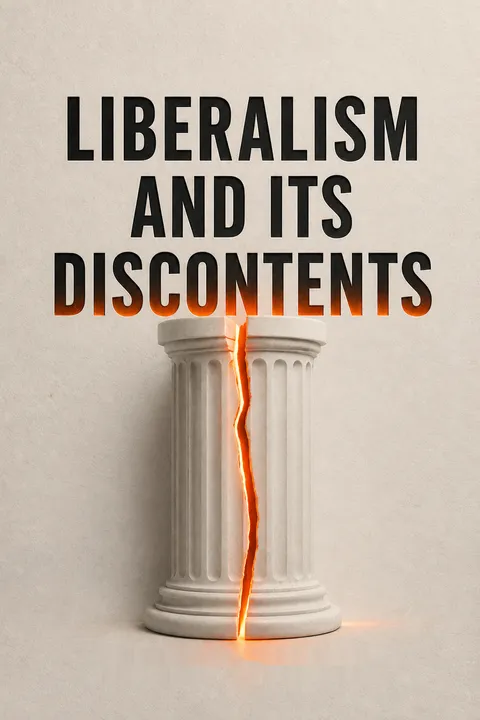


Key Takeaways
Defend liberalism as a peace pact, not a blueprint for virtue.
A truce for pluralism. Classical liberalism limits government through law and protects equal rights for individuals. It does not require citizens to share one religion or definition of a good life. Its case rests on three promises: reducing conflict, respecting personal dignity and choice, and enabling prosperity through secure rights and exchange. Democracy and liberalism are related but distinct: elections let people choose leaders, while liberal institutions constrain what those leaders can do, even with an electoral mandate.
A lesson from religious war. Liberal ideas emerged amid Europe’s brutal religious conflicts. The Thirty Years’ War alone may have killed as much as a third of Central Europe’s population. Hobbes argued that government’s first duty was to prevent violent disorder; Locke added that government itself must be limited. Liberalism’s central bargain is that people may disagree profoundly, but cannot impose their beliefs by force.
The peace-pact framing clarifies why liberalism is not simply a celebration of individual preference. It is a political technology for keeping disputes over ultimate truth from becoming struggles for state control. This resonates with the logic of pluralist institutions: groups tolerate rules that protect them from domination, even when they lose a particular contest. The bargain is not self-enforcing, however. It depends on citizens accepting that opponents retain rights after winning power, and on institutions applying those rules credibly. A society can remain legally plural while still producing deep moral or economic grievances.
Keep markets inside rules; laissez-faire can manufacture oligarchs.
Markets need scaffolding. Neoliberalism is a late twentieth-century approach that treats free markets and a smaller economic role for government as especially reliable paths to growth. Some reforms corrected genuine problems: deregulating airlines and trucking lowered prices, while privatizing inefficient British industries helped revive the economy. The mistake was treating market solutions as a universal rule. Russia’s transition from central planning showed why: without courts and enforceable rules, insiders captured public assets instead of fair markets emerging on their own.
Order is not magic. The idea of spontaneous order holds that coordination can grow from many decentralized choices rather than a central plan. Markets often work this way, but they still depend on public rules. Financial deregulation helped set the stage for the 2008 crisis, and free trade left some workers bearing losses that were promised, but not adequately addressed, through retraining and support.
This distinction separates markets as useful coordination systems from the ideological claim that government is always an obstacle. Institutional economics reinforces the point: exchange depends on predictable contracts, reliable enforcement, and limits on fraud and monopoly. Public investment also helped create technologies later associated with private innovation, including foundations of the internet. Yet the correction should not romanticize government. Public agencies can be captured or incompetent, and protection can preserve inefficient incumbents. The relevant question is not market versus state in the abstract, but which arrangement produces accountable rules and broadly shared gains.
Treat people as social creatures, not self-interest calculators.
Incentives explain part. A common economic model pictures people as rational individuals who maximize their own advantage. It captures something real: when Chinese farmers were allowed to keep earnings from family plots, wheat production rose from 55 to 87 million tons in four years. But incentives do not explain the whole person. People also care about dignity, loyalty, fairness, and how others regard them.
Fairness can beat money. In the ultimatum game, one player divides a sum and another may accept or reject the offer. When the split is sharply unequal, people often reject money rather than accept an arrangement they see as disrespectful. That choice makes sense if self-respect matters, even when it costs materially. Social norms and solidarity also help explain why people vote, cooperate at work, or risk their lives for others, actions a narrow self-interest model struggles to explain.
The argument aligns with behavioral economics and social psychology, which find that people judge outcomes through norms of fairness, identity, and reciprocity, not just personal payoff. It also matters for policy: a compensation cheque may not repair the loss of a community’s jobs, status, or sense of contribution. Still, social motivations do not always produce benevolence. Group loyalty can fuel exclusion, and norms can punish dissent as readily as they encourage cooperation. Institutions need to make room for belonging while protecting people who challenge a group’s expectations.
Protect choice without making autonomy the only human good.
The self has roots. Autonomy, the ability to make meaningful choices, grounds liberal claims to human dignity. The danger comes when choice is treated as the only good, detached from relationships, inherited obligations, or ideas of character. Philosopher John Rawls gave this priority a powerful formulation: fair rules should protect people’s freedom to pursue different visions of a good life. Critics such as Michael Sandel argue that a person imagined apart from every attachment risks becoming a thin abstraction, rather than a socially formed human being.
Choice is not character. Fukuyama contrasts a disengaged person who avoids study and civic responsibilities with a hard-working, generous woman who pursues education and helps others. A state should not deny either person basic rights, but a republic still depends on qualities such as public spirit and responsibility. The challenge is to value those virtues without turning one approved lifestyle into a condition of citizenship.
The distinction between protecting a person’s freedom and declaring every choice equally admirable is politically important. Rights prevent coercion; they need not require moral silence about every action. At the same time, appeals to civic virtue can become a respectable cover for imposing religious, class, or cultural preferences. A defensible approach distinguishes legal equality from social evaluation: citizens receive equal protection, while communities remain free to praise service, learning, or care, provided praise does not become state coercion or civic exclusion.
Use group identity to expose exclusion, not erase shared human standing.
Recognition can repair injustice. Identity politics began as a way for excluded groups to make shared mistreatment visible and demand equal rights. The US Civil Rights movement challenged segregation, while #MeToo showed how sexual harassment, often endured privately, was a common experience that could be challenged collectively. These efforts pressed liberal societies to honor their stated commitment to equal dignity.
Group categories can harden. Some critics move beyond exposing unequal treatment to rejecting liberal individualism and universal rights themselves. They argue that people are shaped by group membership and that supposedly neutral rules can preserve old power. Fukuyama accepts that liberal societies have histories of slavery, colonialism, and discrimination, but argues that the ideal of equality also supplied grounds for reform. He warns that assigning rights primarily to fixed groups can obscure differences within those groups and raise the difficult question of who speaks for them.
Group-based analysis can reveal patterns that individual cases conceal. Without shared categories, discrimination may look like a string of unrelated incidents rather than a durable institutional pattern. But categories designed to diagnose disadvantage can become political boxes that flatten internal differences or reward gatekeepers who claim to represent a whole population. The strongest version of the liberal response is not to dismiss group experience, but to use it as evidence while preserving equal individual standing. That requires judging institutions by their actual effects, not by their neutral wording alone.
Demand shared fact-finding without pretending science is infallible.
Knowledge needs procedures. The scientific method builds claims through observation, testing, and correction. The associated constitution of knowledge is the informal system in which courts, journalists, and researchers assess evidence without granting any one speaker the final word. Such systems are fallible, but an unsupported online claim should not automatically carry the same weight as a carefully checked investigation or a large study.
Bias is real, relativism is not a cure. Research often relies on WEIRD participants, meaning people who are Western, educated, industrialized, rich, and democratic. Their behavior may not represent humanity as a whole. The critique of biased expertise is valuable; the leap to the idea that all facts are merely expressions of power is not. Motivated reasoning, the tendency to select evidence that supports a preferred view, helps explain why this leap has appealed across the political spectrum.
The useful alternative to blind trust is organized skepticism. Peer review, legal standards of evidence, and journalistic verification are imperfect filters, but they create routes for correction that isolated intuition cannot provide. Research on replication and publication bias shows that scientific institutions need continued scrutiny, not reverence. The WEIRD example is especially instructive: a claim can be rigorously measured and still be too culturally narrow. Epistemic humility should therefore ask who was studied, what evidence could overturn the claim, and whether competing explanations have been tested.
Protect speech by limiting concentrated power and preserving private space.
More speech is not always freer. Fukuyama identifies two conditions for meaningful freedom of speech: no actor should monopolize communication, and people need some privacy in which to speak without every remark becoming permanent public evidence. The internet seemed to distribute publishing power, but network effects and platforms’ pursuit of viral engagement concentrated influence and rewarded sensational claims over careful verification.
Privacy protects candor. Donald McNeil, a New York Times reporter, lost his job after students reported that he had used a racial slur while quoting it during a school trip. The episode became a public controversy online, although the newspaper’s editor said he did not believe McNeil intended hate. The point is not that private organizations cannot discipline staff, but that permanent exposure and online pressure can overwhelm careful internal judgment.
The tension between transparency and privacy is often miscast as a choice between accountability and secrecy. Deliberation requires both: misconduct needs to be exposed, while private discussion can help people test ideas, negotiate, and revise their views without instant punishment. Digital platforms alter that balance because a remark can travel far beyond its original audience, stripped of context. The case also raises a hard question: who should set speech standards when platforms, employers, and online crowds each wield influence? Clear procedures and appeal rights matter as much as any single content rule.
Constrain power without confusing procedural delay with justice.
Checks are insurance. Liberal institutions limit executives, protect courts and independent agencies, and make political change slower. That friction can frustrate reform, but it also guards against leaders who use electoral victories to entrench themselves. Fukuyama calls an accumulation of veto points that makes government unable to act a vetocracy. The term names a real risk, but removing all restraints creates a more dangerous one: unchecked power can deliver reform or disaster.
Majorities can violate rights. Before the Civil War, many white voters supported slavery; after it, Southern majorities defended segregation. Courts and federal action helped protect rights when local democracy failed. Yet courts and administrative agencies can also get ahead of public consent, provoking backlash and undermining trust. The aim is not to sanctify procedure or bypass it at will, but to keep both democratic choice and basic rights in view.
The insurance analogy captures the asymmetry between reversible delay and irreversible abuse. A cumbersome process can be redesigned; repression, once institutionalized, can make correction much harder. But procedural safeguards are not automatically just: they can protect existing wealth and power while presenting themselves as neutral. The practical design problem is to preserve independent checks while creating credible paths for change. That means evaluating institutions both by how well they prevent domination and by whether citizens can still hold them accountable for persistent failures.
Build national belonging around citizenship, not inherited identity.
Rights need a jurisdiction. Universal human rights still depend on states to enforce them. A nation-state governs a defined territory, controls legitimate force, and makes people subject to shared laws. Citizens have a special role in that political compact, including the right to vote, while everyone in the territory is entitled to legal protection.
Solidarity can be civic. National identity can rest on shared political principles and traditions rather than race, ethnicity, or religion. Canada and Australia moved away from explicitly racial immigration policies and built more inclusive national identities. In societies with entrenched cultural groups, federal arrangements or consociationalism, a system that shares political power among groups, may help; the approach has worked unevenly and has intensified division in places such as Lebanon and Bosnia. Identity based on fixed traits is especially risky where groups see politics as a zero-sum contest.
The account explains why universal moral concern does not erase the practical role of political membership. Taxes, law enforcement, and public services require institutions with defined responsibilities, while solidarity helps make those institutions legitimate. Yet civic identity is never perfectly neutral: a national story may privilege a majority language, history, or custom even without explicit racial rules. Inclusive citizenship therefore requires continual renegotiation, not a declaration that the national question has been solved. A shared identity is most liberal when people can join it without abandoning their other attachments.
Keep markets and autonomy bounded, or liberalism corrodes its own supports.
Moderation is a political skill. Fukuyama’s closing argument is that a sound principle can become destructive when treated as absolute. Markets create wealth, but need rules, public goods, and protections against ruinous inequality. Autonomy protects dignity, but cannot replace every source of meaning or obligation. A liberal society also needs capable government, public-spirited citizens, tolerance, and active participation.
Repair the foundations. The book favors competent, impersonal state institutions over arguments about government size alone; sustainable social protections over neglect; and federalism, or decisions made at the lowest workable level, where local variation is useful. It also favors antitrust enforcement against concentrated private power, privacy and free speech, and individual rights over fixed group entitlements. These principles do not remove political conflict. They give conflict rules that preserve a diverse society without demanding uniformity.
Moderation here is not a call to split every difference. It is a warning against turning market efficiency, personal choice, or group justice into a value that cancels all others. Political systems need capacities that markets do not supply, and limits that communities may not voluntarily observe. The difficult part is deciding where those limits belong and who gets to enforce them. The book offers principles rather than a policy formula, leaving a productive question for democratic politics: how can a society correct injustice while ensuring that today’s correction does not become tomorrow’s unchecked power?
Analysis
The book’s strongest move is to treat liberalism’s current crisis as partly self-produced. Its opponents are not responding only to external authoritarian pressure. They are reacting to versions of liberal ideas that have been pushed toward absolutes: market choice without adequate social insurance, autonomy detached from inherited obligations, and universal rules interpreted as proof that historical exclusions no longer matter. This framing gives the argument explanatory breadth, connecting economic populism, identity conflict, and epistemic distrust without claiming that they are identical.
Its central political insight is that liberalism is an institutional settlement, not a comprehensive moral philosophy. Law, rights, elections, and public agencies make disagreement governable, but they cannot by themselves create solidarity, trust, or a shared sense of contribution. That limitation matters because citizens may tolerate procedural restraint only when institutions appear competent and fair. A system that protects formal freedom while leaving people exposed to concentrated economic power can lose legitimacy without any contradiction in its constitutional design.
The book is most persuasive when it distinguishes a principle from its overextension, and less persuasive when it treats moderation as a sufficient repair. Moderation has no independent mechanism: one group’s prudent limit may look like another’s defense of privilege. The argument would be sharper with more explicit criteria for determining when market regulation protects competition rather than incumbents, or when civic norms sustain pluralism rather than enforce conformity. The proposed safeguards also depend on institutions that are themselves vulnerable to capture and partisan distrust. Still, the synthesis is valuable. It insists that correcting liberal failures does not require abandoning equal individual rights, while also rejecting the fantasy that rights alone can substitute for capable government and social bonds. Its practical challenge is to rebuild legitimacy through institutions that are both constrained and effective, and to make national belonging inclusive enough that people with conflicting moral lives can recognize one another as fellow citizens. Liberalism’s durability depends less on declaring victory over its critics than on showing that its own rules can correct their failures.
Review Summary
Liberalism and Its Discontents by Francis Fukuyama examines the challenges facing classical liberalism from both the left and right. Fukuyama defends liberalism's core principles while acknowledging its shortcomings, particularly in economic policy. He critiques neoliberalism, identity politics, and populism, arguing for a moderate approach that balances individual rights with social cohesion. Reviewers praise Fukuyama's nuanced analysis and clear writing, though some note limitations in addressing certain topics. The book is seen as timely and important for understanding current political trends, despite occasional simplifications.
People Also Read








Glossary
Classical liberalism
Rights under constrained governmentA political doctrine that limits government through law and protects equal rights for individuals. It supports personal autonomy, legal constraints on executive power, and room for people with different beliefs to coexist. Fukuyama distinguishes it from contemporary US left-of-center politics and from libertarianism, which is more broadly hostile to government.
Neoliberalism
Strong faith in marketsA late twentieth-century economic approach associated with thinkers such as Milton Friedman, Friedrich Hayek, and the Chicago School. It emphasizes free markets, deregulation, privatization, and a reduced economic role for the state. Fukuyama argues that some reforms addressed real inefficiencies, but the approach became damaging when market mechanisms were treated as universally superior.
Spontaneous order
Order from decentralized choicesThe idea, associated particularly with Friedrich Hayek, that complex social arrangements can emerge from many individual interactions without a central designer. Markets are a leading example: buyers and sellers generate prices that communicate information about scarcity. Fukuyama accepts the insight but argues that decentralized order still depends on public rules and can produce concentrated private power.
constitution of knowledge
Rules for assessing claimsThe informal social system through which claims about facts are tested, corrected, and circulated. It includes practices such as empirical verification, peer review, legal standards of evidence, and journalistic fact-checking. No single authority has the final word, but claims supported by reliable methods deserve more weight than unsupported assertions.
WEIRD
A narrow research populationAn acronym for Western, educated, industrialized, rich, and democratic. Joseph Henrich uses it to describe populations often studied by social scientists. Research based heavily on these groups may mistake culturally specific behavior for universal human behavior, so findings need to be tested across societies and forms of life.
motivated reasoning
Reasoning shaped by preferenceA pattern in which people begin with a preferred account of reality and use their reasoning abilities to select evidence and explanations that support it. Fukuyama applies the concept to online information environments, where personalized content can reinforce prior beliefs rather than expose users to careful challenge.
vetocracy
Government blocked by veto pointsA condition in which the number of institutional veto points makes political decisions extremely difficult. Fukuyama uses the term for a system where checks and balances, polarization, and procedural obstacles combine to produce gridlock. The danger is not simply slow government, but persistent inability to perform basic governing tasks or respond to problems.
consociationalism
Power shared among groupsA political arrangement that formally allocates power among distinct cultural, ethnic, or religious groups. It can help manage societies where group identities are deeply established, but may also harden divisions and turn politics into a zero-sum contest. Fukuyama notes mixed results, including serious difficulties in Lebanon, Bosnia, and Iraq.
FAQ
What's "Liberalism and Its Discontents" about?
- Defense of Classical Liberalism: The book is a defense of classical liberalism, which emphasizes individual rights, law, and freedom, against contemporary threats from both the right and left.
- Historical Context: Fukuyama traces the evolution of liberalism from its origins in the seventeenth century to its current challenges, highlighting its foundational principles and historical justifications.
- Contemporary Challenges: The book discusses how liberalism is under attack from populist leaders and progressive movements, both of which have diverged from its core principles.
- Proposed Solutions: Fukuyama suggests ways to moderate liberalism to address its current discontents without abandoning its core values.
Why should I read "Liberalism and Its Discontents"?
- Understanding Liberalism's Evolution: The book provides a comprehensive overview of how liberalism has evolved over centuries and the challenges it faces today.
- Insight into Political Dynamics: It offers insights into the political dynamics and ideological battles shaping contemporary global politics.
- Balanced Perspective: Fukuyama presents a balanced perspective, critiquing both right-wing populism and left-wing progressivism, making it relevant for readers across the political spectrum.
- Proposed Reforms: The book suggests practical reforms to strengthen liberal democracies, making it a valuable read for those interested in political theory and governance.
What are the key takeaways of "Liberalism and Its Discontents"?
- Liberalism's Core Values: The book emphasizes the importance of individual rights, rule of law, and freedom as the core values of liberalism.
- Threats from Both Sides: It highlights how both right-wing populism and left-wing progressivism pose threats to liberal institutions and principles.
- Need for Moderation: Fukuyama argues for moderating liberalism to address its excesses and adapt to contemporary challenges without abandoning its foundational principles.
- Role of National Identity: The book discusses the importance of national identity in liberal societies and how it can be shaped to support liberal values.
How does Francis Fukuyama define classical liberalism in "Liberalism and Its Discontents"?
- Limitation of Government Power: Classical liberalism is defined as a doctrine that limits government power through law and constitutions, protecting individual rights.
- Individual Rights and Freedom: It emphasizes the foundational importance of equal individual rights, law, and freedom, distinguishing it from other political ideologies.
- Historical Justifications: Fukuyama outlines three major historical justifications for liberalism: pragmatic regulation of violence, moral protection of human dignity, and economic promotion of growth.
- Distinction from Modern Liberalism: The book clarifies that classical liberalism differs from modern liberalism in the U.S., which is often associated with left-of-center politics.
What are the main criticisms of liberalism discussed in "Liberalism and Its Discontents"?
- Economic Inequality: The book critiques neoliberalism for leading to economic inequality and financial instability, which have fueled discontent with liberalism.
- Cultural and Social Critiques: It discusses how liberalism's emphasis on individual autonomy has been criticized for eroding social cohesion and traditional values.
- Identity Politics: Fukuyama addresses how identity politics challenges liberalism's principles of universalism and individualism by emphasizing group identities.
- Procedural Limitations: The book highlights procedural criticisms, such as the slow pace of change in liberal democracies due to checks and balances.
How does "Liberalism and Its Discontents" address the rise of identity politics?
- Origins in Liberalism's Failures: Identity politics is seen as arising from liberalism's failure to fully realize its ideals of equality and inclusion for marginalized groups.
- Shift from Individual to Group Rights: The book discusses how identity politics has shifted focus from individual rights to group identities, challenging liberalism's emphasis on individualism.
- Critique of Universalism: Fukuyama explores how identity politics critiques liberalism's claims of universalism, arguing for the recognition of diverse cultural and social identities.
- Potential for Illiberalism: The book warns that identity politics can lead to illiberal outcomes if it prioritizes group rights over individual rights and universal principles.
What solutions does Francis Fukuyama propose for the challenges facing liberalism?
- Moderation of Liberalism: Fukuyama advocates for moderating liberalism to address its excesses and adapt to contemporary challenges without abandoning its core values.
- Strengthening Institutions: The book suggests strengthening liberal institutions to better protect individual rights and maintain checks and balances.
- Reforming Economic Policies: It calls for reforms to address economic inequality and ensure that liberalism benefits a broader segment of society.
- Emphasizing National Identity: Fukuyama emphasizes the importance of shaping national identity to support liberal values and foster social cohesion.
How does "Liberalism and Its Discontents" view the relationship between liberalism and democracy?
- Distinct Principles: The book distinguishes between liberalism and democracy, noting that liberalism focuses on the rule of law and individual rights, while democracy emphasizes popular sovereignty.
- Interdependence: Fukuyama argues that liberalism and democracy are interdependent, with liberal institutions protecting democratic processes and vice versa.
- Challenges to Liberal Democracy: The book discusses how both right-wing populism and left-wing progressivism challenge the balance between liberalism and democracy.
- Need for Reconciliation: Fukuyama calls for reconciling liberal and democratic principles to address contemporary political challenges and maintain stable governance.
What role does technology play in the challenges to liberalism, according to "Liberalism and Its Discontents"?
- Concentration of Power: The book highlights how technology, particularly the internet, has concentrated power over speech in the hands of a few large platforms.
- Erosion of Privacy: Fukuyama discusses how technological advancements have eroded privacy, challenging liberalism's emphasis on individual autonomy and freedom.
- Spread of Disinformation: The internet has facilitated the spread of disinformation, undermining the quality of public discourse and democratic deliberation.
- Need for Regulation: The book suggests the need for regulation to address the challenges posed by technology while preserving freedom of speech and privacy.
How does "Liberalism and Its Discontents" address the concept of national identity?
- Importance of National Identity: Fukuyama emphasizes the importance of national identity in liberal societies as a source of community and legitimacy for the state.
- Challenges of Universalism: The book discusses the tension between liberal universalism and the particularistic attachments of national identity.
- Constructing Inclusive Identities: Fukuyama advocates for constructing national identities based on political principles rather than fixed characteristics like race or ethnicity.
- Role in Liberal Societies: National identity is seen as both a potential threat and an opportunity for liberal societies, depending on how it is shaped and understood.
What are the best quotes from "Liberalism and Its Discontents" and what do they mean?
- "Liberalism is a way of regulating violence and allowing diverse populations to live peacefully with one another." This quote highlights the pragmatic justification for liberalism as a means of maintaining peace and order in diverse societies.
- "The answer to these discontents is not to abandon liberalism as such, but to moderate it." Fukuyama emphasizes the need to address the excesses of liberalism through moderation rather than abandoning its core principles.
- "Liberalism lowers the temperature of politics by taking questions of final ends off the table." This quote underscores liberalism's focus on procedural governance rather than imposing a singular vision of the good life.
- "National identity is a social construct, and it can be shaped to support rather than undermine liberal values." Fukuyama advocates for shaping national identity in ways that align with liberal principles and foster social cohesion.
How does "Liberalism and Its Discontents" propose to address economic inequality?
- Critique of Neoliberalism: The book critiques neoliberal policies for exacerbating economic inequality and calls for reforms to address this issue.
- Redistribution of Wealth: Fukuyama suggests that liberal societies should implement policies to redistribute wealth and ensure more equitable economic outcomes.
- Balancing Growth and Equality: The book emphasizes the need to balance economic growth with social equality to maintain political stability and social cohesion.
- Role of the State: Fukuyama argues for a more active role of the state in regulating markets and providing social protections to address economic disparities.
About the Author
Other books by Francis Fukuyama



Download PDF
Download EPUB
.epub digital book format is ideal for reading ebooks on phones, tablets, and e-readers.








