

Key Takeaways
Liberalism can betray freedom precisely by delivering its own promise
A promise turned inside out. Patrick Deneen argues that liberalism has not simply failed to meet its ideals. By pursuing individual freedom through expanding markets, government, and technological power, it has helped produce outcomes that undermine those ideals: deep inequality, weakened communities, and citizens with little control over the forces shaping their lives. The book opens with signs of public disillusionment, including polling at the time that found many Americans thought the country was going in the wrong direction and doubted their children would fare better.
Success is the diagnosis. For Deneen, these problems are not isolated glitches that can be fixed by applying more liberal policies. They emerge from liberalism’s own assumptions about freedom and human nature. He still credits its inheritance of liberty and human dignity, but argues that its individualist model makes those goods harder to secure.
The argument is strongest when it asks readers to examine a system by its recurring outcomes, not only its stated intentions. That resembles a useful principle in institutional analysis: incentives can produce effects that no participant explicitly wants. Yet a sweeping diagnosis needs careful causal testing. Inequality, political distrust, and ecological damage have multiple histories, and showing that they coexist with liberal institutions does not by itself establish that liberalism caused them. The book offers a powerful interpretive lens, best used to generate questions about mechanisms rather than as a complete explanation of every modern crisis.
Treat liberty as self-government, not an ever-expanding menu of choices
Two meanings of freedom. Deneen contrasts an older ideal of liberty, the trained ability to govern one’s desires, with liberal voluntarism, his term for treating individual choice and consent as the basis of political and social life. In the older view, self-restraint and civic participation helped make people free. In the liberal view he describes, freedom means acting as one wishes unless law forbids it.
Choice needs scaffolding. Hobbes and Locke imagined individuals as fundamentally separate and argued that government could secure their freedom. Locke also applied consent-based reasoning to family and inheritance. Deneen’s concern is that this model makes obligations look suspect unless people repeatedly choose them. It can expand formal choice while leaving people less practiced at keeping commitments or limiting appetites.
This contrast draws attention to a real distinction between having options and having the capacities to use them well. Education, habit, and social trust can enlarge practical agency, while a formally available choice may be hollow when people lack resources or support. At the same time, inherited duties are not automatically benign. Family and community can sustain people, but they can also constrain them unjustly. A useful test is whether a relationship builds people’s ability to act and deliberate, rather than whether it is chosen or inherited in the abstract.
Do not mistake market-versus-state politics for a choice of system
Opponents with shared premises. Deneen argues that familiar left-right politics often debates the means of liberalism rather than its ends. Market-oriented conservatives emphasize private choice and economic freedom; progressives emphasize government action to widen opportunity and personal autonomy. Both, in his account, can weaken local institutions and increase the reach of centralized systems.
A campaign illustration. The book reads the 2012 “Life of Julia” campaign slides as a portrait of a woman whose milestones are supported by government programs, while her life is presented as self-directed and independent. For Deneen, the image reveals a shared ideal: the autonomous individual, supported by a large state. Meanwhile, market expansion can also depend on public enforcement, infrastructure, and rules. The political fight is real, but it may conceal a deeper agreement about what freedom means.
The state-market relationship is more entangled than standard partisan slogans suggest. Markets rely on legal definitions, public infrastructure, and enforcement, while public programs often operate through private providers and consumer choices. Seeing this interdependence can improve policy debate by shifting attention from “more state or more market” to who has power, who bears costs, and which relationships are displaced. The book’s synthesis is illuminating, though it can make political differences seem too small. Specific policies still distribute risks and rights differently, even when they share assumptions about individual autonomy.
Protect local customs that teach restraint before distant law must punish
Culture carries obligations. Deneen uses “liberal anticulture” for a society in which local traditions and practices are displaced by standardized law and market exchange. He argues that culture connects people to nature, a particular place, and generations before and after them. When these ties weaken, obligations once taught informally can be replaced by legal rules and penalties. He calls the resulting separation from shared past and future “fractured time.”
The mortgage example. The book contrasts older, locally grounded lending practices, which relied on familiarity and reputation, with the impersonal mortgage market implicated in the 2008 crisis. Deneen’s point is not that local custom always works, but that removing it can leave distant regulation to manage harms that local norms once helped prevent.
This account usefully highlights what formal rules cannot easily supply: contextual knowledge, reputation, and everyday expectations of reciprocity. Those are also central to institutional approaches that study how communities manage shared resources without relying exclusively on markets or centralized authorities. But local customs can exclude outsiders or preserve unjust arrangements, so preserving them cannot be an automatic good. The practical challenge is to distinguish norms that cultivate responsibility from those that merely protect local power. Well-designed institutions can retain local knowledge while allowing appeal, transparency, and protection for people with less influence.
Judge technologies by the communities and habits they make possible
Tools reflect prior choices. Deneen calls the constitutional and political arrangements that shape technological society a “political technology.” His argument is that machines do not develop in a vacuum: the purposes of a society shape which tools it adopts and how people use them. Technology can then reinforce those purposes, making some habits easier and others harder.
An Amish comparison. The book describes Amish communities deciding whether to adopt technologies according to whether they support community life. Some reject insurance because it can replace direct mutual aid with an anonymous financial transaction. Deneen contrasts this with a society that treats technology as inevitable and measures freedom mainly by the number of consumer options. The question becomes not simply which device is available, but what kind of dependence or relationship it creates.
This way of thinking moves technology ethics beyond a checklist of features. A tool is also a social arrangement: it can concentrate expertise, redistribute care, or change who must rely on whom. The Amish example makes governance visible because a community explicitly deliberates about those consequences. Still, community-level control is not always possible or fair, especially when technologies shape public health, infrastructure, or access to work. The broader lesson is to make design choices contestable and to ask who gets to decide what counts as convenience, progress, or an acceptable cost.
Restore education’s purpose: train people to govern themselves, not only earn
Freedom takes education. Deneen describes the liberal arts as an education in judgment, virtue, and self-command, drawing on classical and Christian texts that explored how people should live. This differs from education aimed chiefly at technical skill, research output, or immediate employment. In his account, the older meaning of “liberal” education was preparation for a free person, not merely a route to a chosen career.
The university’s changing aim. He points to universities’ growing emphasis on research, practical outcomes, and science and technology. The University of Texas motto he discusses presents a cultivated mind as vital to democracy, while its later institutional mission emphasizes producing new knowledge. Deneen sees this shift as part of a broader change: students are encouraged to optimize for economic security, while the study of inherited ideas loses status.
The book’s challenge is not that vocational learning lacks value, but that economic usefulness cannot answer every educational question. A society also needs people able to judge evidence, understand conflicting claims, and deliberate about common purposes. These capacities can support technical work rather than compete with it. Yet the defense of humanities education must confront real barriers, including cost, unequal access, and the need for stable employment. The strongest case for liberal learning shows how it equips students for both work and citizenship, instead of asking them to choose between practical competence and reflection.
Meritocracy can harden into inherited advantage while blaming the losers
A new elite takes shape. Deneen uses “liberalocracy” for a ruling class that presents itself as open and merit-based while gaining durable advantages through education, wealth, and social position. The book connects elite universities to a system that draws talented students from many places, then prepares them for careers and lives concentrated far from the communities they came from.
Mobility has uneven foundations. Deneen notes that families with money and stability can invest in tutoring, selective education, and other supports that help children compete. He argues that people left outside these networks are more likely to face economic insecurity and weakened family support. The result can resemble inherited rank, even though success is explained as individual merit. The critique is not that achievement is unreal, but that the conditions enabling it are distributed unequally.
Meritocratic language can hide how opportunity is produced: family resources, geography, schooling, and social networks all shape the competition before individual effort is measured. This is a useful corrective to the idea that outcomes transparently reveal talent. But the book’s contrast between elite stability and working-class breakdown risks making class patterns sound more uniform than they are. Strong families and community ties exist across income groups, and economic conditions can constrain them. Analysis is clearest when it separates moral judgment of individuals from institutional advantages that compound across generations.
Practice democracy nearby, where neighbors must solve shared problems together
Citizenship is a practice. Deneen argues that elections alone do not create self-government. In his reading of the American founders, representative institutions were designed to filter public opinion and restrain direct democratic power. He contrasts that distant national politics with Alexis de Tocqueville’s account of local communities, where people learned self-rule by dealing with shared affairs.
Local action teaches dependence. A township, school, or neighborhood association can require people to listen, negotiate, and contribute, rather than simply register a preference at the ballot box. Tocqueville saw such activity as a kind of civic training. Deneen argues that when public life is reduced to national campaigns and spectatorship, citizens can become detached from practical governance and more likely to look to distant authorities for solutions.
The emphasis on participation aligns with a broader insight from democratic theory: people learn civic skills by exercising them, not only by receiving information about politics. Local settings can make consequences visible and allow residents to correct decisions through direct interaction. They are not a complete substitute for national protections or coordination, however. Local majorities can ignore minorities, and many problems cross municipal boundaries. A durable democracy needs both scales: local opportunities for meaningful participation and larger institutions that protect rights and address shared challenges.
Build postliberal alternatives through households and local institutions, not grand blueprints
Practice before theory. Deneen rejects both a return to a supposedly ideal past and the creation of a replacement ideology. He proposes building forms of life that cultivate care, mutual obligation, and self-rule through concrete practices. “Household economics” means organizing some economic activity around the flourishing of households, including skills such as cooking, repairing, planting, and making things rather than relying entirely on distant markets.
Start at a human scale. The book also calls for local exchange and civic participation, where people can know the consequences of their decisions and their obligations to others. Such communities are not presented as ready-made answers for everyone. They are places to learn what supports human flourishing and to develop better political ideas from experience, while retaining the valuable commitments to liberty and dignity that liberalism helped make widely recognized.
The proposal has a distinctive strength: it treats social trust as something built through repeated practices, not something a new constitution can simply declare into existence. Household skills and local associations can create competence and reciprocity, while offering alternatives to purely transactional relationships. Yet small communities need not be self-sufficient, and some forms of care require professional systems and public resources. The practical question is how local institutions can cooperate without becoming insular or leaving vulnerable people unsupported. The book’s gradualism is persuasive when it encourages experimentation, learning, and accountability rather than romanticizing community.
Analysis
Deneen’s book is a political-philosophical diagnosis, not a neutral survey of liberal institutions. Its organizing move is to redefine liberalism as more than constitutional rights or limited government: it is a way of imagining human beings as autonomous choosers who gain freedom by escaping inherited ties and natural limits. From that premise, the book links political centralization, market expansion, weakened local culture, technological dependence, educational careerism, elite stratification, and passive citizenship. The argument gains force through its insistence that these are connected developments rather than separate policy failures.
Its most valuable contribution is conceptual. Readers are invited to ask whether formal choice, consumer abundance, and periodic elections amount to practical self-government. The examples of Amish technology decisions, local lending, university education, and township politics make this question concrete. The proposed alternative is also deliberately modest: build practices of household competence, local exchange, cultural continuity, and civic participation instead of drafting a totalizing replacement system.
The main limitation is causal breadth. Deneen often treats liberalism as the root explanation for developments that also arise from industrialization, changing labor markets, racial and gender hierarchies, and technological innovation. His account of local culture can understate the ways local authority has excluded or constrained people, while his appeal to older traditions risks leaving unclear which traditions deserve preservation. These tensions do not erase the book’s insight, but they require readers to distinguish valuable social ties from unjust ones. The strongest use of the argument is as a challenge to measure freedom by lived capacity: Can people govern their appetites, shape institutions, maintain meaningful relationships, and participate in decisions that affect them? That standard makes the book’s critique useful even for readers who reject its broad conclusion.
Review Summary
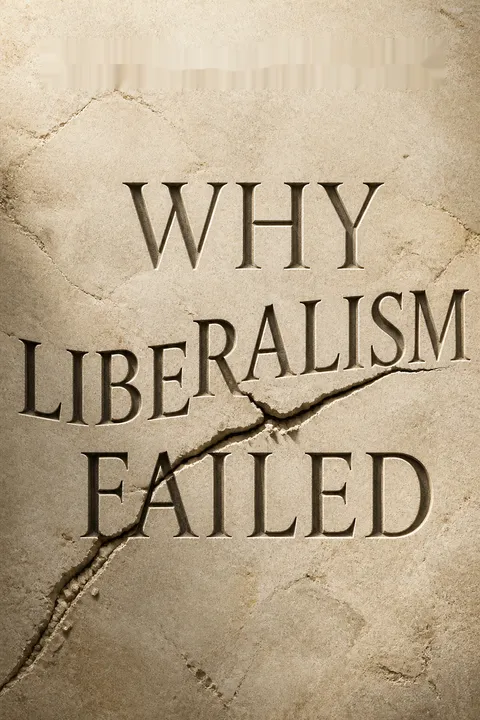
Why Liberalism Failed by Patrick Deneen argues that liberalism's success has led to its downfall by undermining social bonds, traditional values, and community. Reviewers found the book thought-provoking but divisive, with some praising its critique of modern society and others criticizing its analysis as flawed or exaggerated. Many noted Deneen's broad definition of liberalism and his focus on American politics. While some appreciated the book's challenge to liberal orthodoxy, others found its proposed solutions vague or impractical.
People Also Read










Glossary
Liberal voluntarism
Choice-centered political theoryDeneen’s term for the liberal premise that individual choice and consent are the primary basis for legitimate relationships and political authority. It treats people as fundamentally separate choosers and presents freedom chiefly as the ability to act without legal restraint. Deneen argues that this premise can weaken inherited obligations and increase reliance on the state to secure individual choice.
liberal anticulture
Standardized substitute for local cultureDeneen’s name for the replacement of locally rooted customs, practices, and memories by standardized law and market systems. In his account, this is not simply the absence of culture. It is an order that uses the language of diversity and choice while weakening the particular ties to place, nature, and generations through which cultures are sustained.
fractured time
Disconnection across generationsA condition in which people experience the present as detached from both the past and the future. Deneen argues that weakening traditions and intergenerational obligations encourages people to prioritize immediate preferences and discount long-term consequences. He connects this outlook to short-term political decisions, accumulated debt, and the depletion of resources inherited by future generations.
political technology
Institutions that shape technological societyDeneen’s description of political arrangements that establish the conditions in which other technologies develop and are used. The term emphasizes that technology is not an independent force: social and political commitments shape which tools are adopted and what purposes they serve. Those tools can then reinforce the institutions and habits that made them attractive.
liberalocracy
Self-reproducing liberal eliteDeneen’s term for an elite that presents its position as the result of open competition and merit while benefiting from durable advantages. Educational access, wealth, family stability, and social networks help secure its status across generations. The term highlights the tension between liberalism’s promise of equal opportunity and the persistence of concentrated advantage.
household economics
Economy organized around household flourishingDeneen’s term for economic practices that support households and develop useful skills within them. It includes activities such as cooking, repairing, planting, preserving, and making goods, as well as favoring local exchange and relationships over anonymous transactions. The aim is not to eliminate larger markets, but to strengthen practical competence, mutual obligation, and connection to place.
res idiotica
Private, isolated lifeA Latin phrase Deneen uses to contrast a life centered on private concerns with a shared public life, or res publica. In his argument, a society organized around individual preference and material interest can leave people politically detached, even when formal democratic institutions remain. The phrase describes a condition in which citizens are treated primarily as private individuals rather than participants in common affairs.
FAQ
What is "Why Liberalism Failed" by Patrick J. Deneen about?
- Critique of Liberalism: The book argues that liberalism, the dominant political philosophy of the modern West, has failed not because it fell short of its ideals, but because it has succeeded in remaking society according to its flawed premises.
- Systemic Problems: Deneen contends that liberalism’s core commitments—individual autonomy, separation from nature, and the pursuit of unrestrained liberty—have led to social fragmentation, economic inequality, and a loss of meaning and community.
- Historical Perspective: The book traces the philosophical and historical development of liberalism, showing how it diverged from classical and Christian traditions.
- Call for Alternatives: Deneen suggests that the solution is not a return to pre-liberal times or a new ideology, but the cultivation of local, community-based practices and a rethinking of liberty and self-governance.
Why should I read "Why Liberalism Failed" by Patrick J. Deneen?
- Timely Political Critique: The book addresses widespread contemporary discontent with politics, economics, and culture, offering a comprehensive explanation for the current crisis in Western democracies.
- Challenging Assumptions: Deneen challenges the reader to reconsider the foundational assumptions of modern society, making it valuable for anyone interested in political philosophy, history, or current affairs.
- Alternative Vision: The book provides a thought-provoking vision for what might come after liberalism, emphasizing the importance of community, virtue, and local self-governance.
- Influential Work: "Why Liberalism Failed" has sparked significant debate among scholars, policymakers, and the public, making it essential reading for understanding ongoing discussions about the future of democracy.
What are the key takeaways from "Why Liberalism Failed" by Patrick J. Deneen?
- Liberalism’s Success Is Its Failure: Liberalism’s triumph in shaping society has led to the very problems it was meant to solve, such as inequality, alienation, and loss of community.
- False Anthropology: The book argues that liberalism is based on a false understanding of human nature as radically autonomous and separate from community and nature.
- State and Market Collusion: Deneen shows how both the state and the market have grown together, undermining local cultures and mediating institutions.
- Need for Postliberal Practices: The author advocates for building new forms of culture, household economics, and local self-governance as a way forward.
How does Patrick J. Deneen define "liberalism" in "Why Liberalism Failed"?
- Philosophical Foundations: Liberalism is defined as a political philosophy that prioritizes individual autonomy, rights, and the pursuit of self-interest, often at the expense of communal bonds and traditions.
- Anthropological Individualism: Deneen highlights liberalism’s view of humans as nonrelational, autonomous individuals whose relationships are based on voluntary choice.
- Separation from Nature: The book emphasizes liberalism’s project to liberate humans from natural limits, both in terms of the environment and human nature itself.
- Ideological Project: Liberalism is presented as an ideology that seeks to remake all aspects of life—politics, economics, education, and culture—according to its principles.
What are the main arguments Patrick J. Deneen makes about why liberalism has failed?
- Success Breeds Failure: Liberalism’s realization of its own ideals has led to social and economic pathologies, such as inequality, alienation, and loss of meaning.
- Destruction of Culture: The pursuit of autonomy and liberation from tradition has resulted in the erosion of local cultures, communities, and shared norms.
- State and Market Expansion: Rather than limiting government, liberalism has led to the simultaneous growth of both state power and market forces, leaving individuals isolated and powerless.
- Inability to Self-Correct: Liberalism’s faith in progress and self-correction blinds it to its own systemic flaws, making genuine reform within its framework impossible.
How does "Why Liberalism Failed" by Patrick J. Deneen explain the relationship between individualism and statism?
- Mutual Reinforcement: Deneen argues that individualism and statism are not opposites but mutually reinforcing; as individuals become more autonomous, they require a larger state to manage the resulting fragmentation.
- Erosion of Mediating Institutions: The weakening of families, churches, and local communities leaves individuals dependent on the state for support and identity.
- Historical Development: Both classical (right-leaning) and progressive (left-leaning) liberalism contribute to this dynamic, despite their apparent opposition.
- Cycle of Disempowerment: The result is a vicious cycle where increased individualism leads to greater state intervention, which in turn further undermines communal bonds.
What does Patrick J. Deneen mean by "liberalism as anticulture" in "Why Liberalism Failed"?
- Destruction of True Culture: Liberalism replaces genuine, locally rooted cultures with a homogenized, placeless, and timeless "anticulture" that lacks depth and continuity.
- Three Pillars of Anticulture: Deneen identifies the conquest of nature, the experience of time as a perpetual present, and the fungibility of place as central to liberalism’s anticultural project.
- Legal and Market Monoculture: The replacement of informal norms with standardized laws and the dominance of the global market erode the diversity and richness of actual cultures.
- Superficial Diversity: What is celebrated as "multiculturalism" is, in Deneen’s view, a cover for the destruction of real cultural variety and the rise of a uniform liberal order.
How does "Why Liberalism Failed" by Patrick J. Deneen critique the role of technology and science in liberal societies?
- Tool of Liberation and Bondage: While technology and science were meant to liberate humanity from natural limits, they have instead created new forms of dependence and alienation.
- Transformation of Human Nature: Advances in technology, especially in communication and biotechnology, threaten to remake human beings in the image of liberalism’s autonomous individual.
- Loss of Control: Deneen argues that society has lost control over technological development, which now shapes human behavior and relationships in unforeseen ways.
- Erosion of Community: The pervasive use of technology undermines real community, replacing it with shallow networks and contributing to loneliness and social fragmentation.
What is the significance of education and the liberal arts in "Why Liberalism Failed" by Patrick J. Deneen?
- From Liberal to Servile Education: Deneen contends that liberalism has transformed education from the cultivation of free, self-governing citizens (liberal arts) to training for economic productivity and technical mastery (servile education).
- Loss of Purpose: The humanities and liberal arts have been marginalized, replaced by STEM and business disciplines that serve the market and state.
- Undermining of Virtue: The traditional aim of education—to foster virtue and self-restraint—has been abandoned in favor of personal autonomy and career advancement.
- Consequences for Society: This shift contributes to the rise of a new meritocratic elite and the deepening of social and economic divides.
How does "Why Liberalism Failed" by Patrick J. Deneen describe the emergence of a new aristocracy?
- Meritocratic Elite: Liberalism, while claiming to abolish aristocracy, has created a new ruling class based on education, wealth, and mobility.
- Perpetuation of Inequality: The new aristocracy maintains its status through exclusive educational institutions and the transmission of advantages across generations.
- Disconnection from Community: Elites are increasingly detached from local communities, leading to a "secession of the successful" and the abandonment of the less privileged.
- Self-Deception: The new elite often believes in its own merit and benevolence, masking the systemic injustices perpetuated by the liberal order.
What does Patrick J. Deneen propose as alternatives or solutions in "Why Liberalism Failed"?
- No Return to the Past: Deneen rejects both nostalgia for a pre-liberal age and the creation of a new ideology to replace liberalism.
- Local Practices and Communities: He advocates for the cultivation of local cultures, household economies, and forms of self-governance rooted in real relationships and places.
- Reinvigoration of Virtue: Emphasis is placed on practices that foster self-restraint, mutual obligation, and care for the common good.
- Bottom-Up Change: Deneen suggests that meaningful change will arise from the lived experience and practices of communities, not from top-down political programs.
What are the best quotes from "Why Liberalism Failed" by Patrick J. Deneen and what do they mean?
- "Liberalism has failed—not because it fell short, but because it was true to itself. It has failed because it has succeeded."
- This encapsulates Deneen’s thesis that liberalism’s problems are the result of its own logic and achievements, not external failures.
- "The only path to liberation from the inevitabilities and ungovernable forces that liberalism imposes is liberation from liberalism itself."
- Deneen argues that true freedom requires moving beyond the liberal framework, not doubling down on its principles.
- "Culture is the practice of full temporality, an institution that connects the present to the past and the future."
- This highlights the importance of culture as a bridge across generations, something liberalism undermines.
- **"What we need today are practices fostered in local settings, focused on the creation of new and viable cultures, economics grounded in virtuosity within households, and the creation
Download PDF
Download EPUB
.epub digital book format is ideal for reading ebooks on phones, tablets, and e-readers.








