

Key Takeaways
Treat endless moral arguments as evidence of a missing shared standard
Disagreement without a referee. MacIntyre opens with disputes over war, abortion, and the distribution of public services. The sides often reason coherently from their premises, yet appeal to different standards: justice against military effectiveness, rights against obligations to protect life, or equality against liberty. Because modern society has no agreed way to rank these standards, debate repeatedly reaches a point where reasons give way to assertion.
A damaged inheritance. The image is like a society that has kept scientific words and instruments after losing the theories that made them work. Moral terms remain in use, but their shared framework has fractured. People speak as if an impartial standard settles the matter, while acting as though no such standard can be demonstrated.
What's important here is the distinction between disagreement and reasoned disagreement. People can disagree intensely while sharing procedures for testing claims; MacIntyre argues that modern moral disputes often lack even that common ground. This helps explain why more argument does not always produce more agreement. The diagnosis is strongest when rival claims rest on different conceptions of the good, but it risks treating public debate as more irrational than it is. Shared legal procedures, evidence, and negotiated compromises can still guide action, even when they do not settle the underlying moral dispute.
Recover the human purpose that once made moral rules intelligible
Rules once had a destination. In the Aristotelian tradition, ethics connected three things: people as they are, the human good they could achieve, and the virtues and rules that help them get there. That destination, or telos, means an end that gives a life its purpose and direction. Calling someone just or courageous could therefore describe how well that person fulfilled a human purpose, not merely whether they followed a rule.
The Enlightenment severed the link. Hume tried to ground morality in human passions, Kant in reason, and Kierkegaard in fundamental choice. MacIntyre argues that each retained inherited moral rules while abandoning the older account of what those rules were for. Like standards for a good watch detached from any idea of what a watch should do, moral commands were left without an agreed rationale.
The strength of this account is that it treats moral concepts as parts of a lived theory of human development, not as isolated rules. A rule against betrayal makes different sense when loyalty serves a shared human good than when morality is understood mainly as a constraint on private interests. The weakness is equally significant: older accounts of human purpose often carried assumptions about hierarchy and social roles that excluded many people. Recovering purpose therefore cannot mean restoring every inherited rule. It requires asking whose flourishing a proposed purpose serves, and who gets to define it.
Watch moral language turn into persuasion when shared standards disappear
Emotivism as social practice. Emotivism is the view that moral judgments express attitudes and try to influence other people, rather than report standards that everyone can rationally recognize. MacIntyre does not rely only on the theory. He points to recognizable modern roles: the aesthete treats people as sources of experience, the therapist focuses on techniques for changing behavior, and the manager treats organizational goals as given while optimizing the means.
Expertise can conceal a value choice. These roles present themselves as neutral or technically competent, yet decisions about which goals matter are not settled by technique alone. MacIntyre argues that claims of managerial effectiveness can lend authority to preferences that lack a shared moral justification. He does not deny expertise in fields such as medicine or history; his target is the broader claim that managers can reliably control complex social outcomes.
This analysis remains useful because power often travels through claims of neutrality. A decision framed as merely efficient may still distribute risk, opportunity, or status. The manager, therapist, and aesthete are best read as cultural patterns, not descriptions of every person in those occupations. Technical competence is real, and evidence can narrow disagreement, but it cannot by itself determine the ends an organization should pursue. The practical test is to ask which choices are treated as measurable facts and which value judgments have quietly been removed from discussion.
Treat social forecasts as fallible guides, not licenses for control
Human affairs resist prediction. MacIntyre identifies four recurring sources of uncertainty: genuinely new ideas or inventions, choices that agents have not yet made, strategic interaction in which people hide information, and chance events. A computer simulation of the Vietnam War, built from earlier conflict patterns, was badly disrupted by the Tet offensive. The problem was not simply missing data: the real situation was changing and could not be fully specified in advance.
Social knowledge still matters. Social scientists can identify patterns, such as conditions associated with revolution or crime, but these patterns often have exceptions and unclear limits. MacIntyre calls them generalizations that hold characteristically, not universal laws. Their value lies in helping people judge possibilities, not in promising reliable control. This distinction challenges grand claims of managerial expertise without denying the worth of specialized knowledge.
The argument anticipates a familiar problem in complex systems: interventions change the conditions they are meant to manage, while people adapt to being measured or predicted. That makes humility about forecasts a practical virtue, not an excuse to abandon evidence. MacIntyre's contrast with physics can, however, be too stark. Social research can generate useful probabilistic estimates even without exceptionless laws. A sound policy response is therefore neither technocratic certainty nor fatalism, but transparent assumptions, monitored outcomes, and room to revise decisions when people respond in unexpected ways.
Join practices where excellence matters more than winning or status
Practices reward distinctive goods. A practice is a complex, cooperative activity with standards of excellence that participants learn and extend. Chess and architecture qualify; merely placing a brick does not. Its internal goods are achievements available through participation, such as strategic judgment in chess. Money, prestige, and status are external goods: they can be gained in many settings and often invite competition over who gets them.
Virtues protect the activity. MacIntyre argues that justice, courage, and honesty help participants respect standards, accept criticism, and trust one another. A child who plays chess only for candy has an incentive to cheat; someone who values the game’s own excellence has reason to play fairly. Institutions such as schools, hospitals, or universities keep practices alive, but their pursuit of money and power can also distort them.
This framework makes motivation more precise than a simple contrast between selfishness and altruism. Participants can care about achievement for its own sake while also benefiting from recognition or pay. The danger appears when external rewards become the only measure of success. In contemporary organizations, the same tension arises when a metric intended to support good work becomes its substitute. Still, practices are not automatically virtuous: their standards can be exclusionary, and excellence in one activity can serve harmful ends. Their goods need scrutiny within a wider account of human flourishing.
Read your life as an accountable story, not disconnected episodes
Actions need a story. The same act of digging might be gardening, exercise, or preparation for winter. To understand what someone is doing, observers need to know the person’s intentions and the setting in which the act makes sense. MacIntyre extends this point to a whole life: short-term choices become intelligible through longer projects, relationships, and responsibilities.
Identity includes continuity. A person is not simply a sequence of present preferences. People inherit roles and histories, and they remain answerable for actions that belong to their life story, even as they change. MacIntyre describes a good life as a quest: people pursue an imperfectly understood good while learning from its obstacles. This does not mean every life follows a neat plot. It means that responsibility and purpose depend on connections across time.
Narrative thinking clarifies why an isolated action rarely tells the whole moral story. A promise, for example, matters partly because it joins an earlier commitment to a future expectation. The approach also explains how identity can survive substantial personal change without reducing a person to memory alone. Its risk is that a coherent story can be imposed by families, institutions, or authorities on someone who understands their life differently. Narrative interpretation should therefore remain open to revision and attentive to whose account of a life is being treated as definitive.
Test traditions by how well they answer their own deepest problems
Tradition is an argument through time. MacIntyre uses living tradition for a socially embodied debate, extended across generations, about the goods that give a community its purpose. It is not passive reverence for the past. A university, for example, can inherit practices while continuing to dispute what excellent teaching or inquiry requires.
Comparison needs no neutral judge. MacIntyre rejects both the idea that one universal standard can settle every moral dispute and the conclusion that all traditions are equally valid. Adherents can learn to think from a rival tradition’s point of view, then ask whether it can solve problems it recognizes as important. If one tradition explains its rival’s failures and develops answers to its own crises, that can count as rational progress, even without an impartial referee accepted by everyone.
This account offers a middle path between universal foundations and anything-goes relativism. It treats rationality as historically learned while preserving the possibility of criticism across communities. Its strongest safeguard is intellectual hospitality: a tradition must understand a rival’s strongest arguments rather than dismissing them by definition. Its unresolved challenge is practical. Rival traditions may disagree about what counts as a problem or a successful explanation, making comparison slow and inconclusive. That difficulty calls for patient inquiry, not the assumption that every dispute has an immediate winner.
Use Nietzsche to expose moral masks, not to worship isolated will
Nietzsche sees the crisis clearly. He recognizes that appeals to objective morality can disguise the speaker’s preferences or will to power. MacIntyre agrees that modern theories have not successfully justified the authority they claim for moral rules. But Nietzsche’s proposed figure who invents values alone cannot restore shared standards. In MacIntyre’s reading, this self-created moral authority treats other people as instruments and remains cut off from the relationships through which goods are learned.
The past was not a pageant of supermen. Homeric heroes were defined by roles in households and communities, not by freedom from every social bond. Their stories show virtues such as courage and loyalty embedded in a shared way of life. MacIntyre presents the Aristotelian tradition as a more promising alternative: moral authority can grow through participation in common activities rather than through either inherited commands or solitary self-invention.
Nietzsche’s suspicion is valuable wherever moral certainty shields power from criticism. MacIntyre’s reply adds an important question: if values are only invented by individuals, how can they bind anyone else without becoming another exercise of power? Shared practices provide one answer by making standards visible in cooperation and achievement. Yet communities can also enforce conformity, so belonging alone cannot establish moral truth. Nietzsche’s challenge remains a useful test of whether a community’s standards serve common goods or merely protect its most powerful members.
Do not expect rights or utility to settle rival theories of justice
Two accounts, two starting points. MacIntyre contrasts a citizen who sees justice as protecting what was legitimately earned with one who sees it as redistributing resources toward people in greatest need. Robert Nozick gives philosophical form to entitlement; John Rawls asks what principles people would choose without knowing their future position in society. Their arguments can be coherent yet still conflict because neither supplies a shared way to rank entitlement against need.
Desert requires community. Both theories begin largely with separate individuals and their interests, leaving little room for the idea that people deserve recognition through contributions to shared work. MacIntyre argues that modern politics often manages such conflicts through compromise and law, rather than resolving them through common moral principles. He calls concepts such as universal rights and utility modern moral fictions when they claim an objective authority their arguments cannot establish.
The contrast reveals why disagreements about taxation or public provision are rarely settled by adding another abstract principle. Each principle gives moral priority to a different feature of social life. MacIntyre’s emphasis on desert highlights the importance of contribution, but desert itself can reflect unfair starting conditions or inherited privilege. Liberal legal rights, meanwhile, may protect people who lack power even when citizens disagree about the good life. The challenge is to distinguish a concept’s contested philosophical foundation from its concrete role in protecting people and organizing public decisions.
Renew moral life in local institutions, not grand political blueprints
Renewal starts in shared work. MacIntyre rejects the idea that either liberal government or conservative lawmaking can restore a common moral purpose by decree. He instead points to ordinary settings where people can sustain shared goods: families, schools, clinics, households, and local political communities. These are not automatically good communities; their value depends on the practices they support and the virtues they cultivate.
The historical image is Benedict. In MacIntyre’s account, St. Benedict helped create monasteries where prayer, learning, and labor could continue through a period of social disorder. The point is not to copy medieval monastic life or predict a precise political solution. It is that new institutions can preserve worthwhile forms of cooperation, with consequences their founders may not foresee. Moral renewal is therefore local, practical, and open to unexpected forms.
This is a deliberately modest political proposal: build places where people can practice shared responsibility rather than waiting for a national consensus that may never arrive. It resonates with the idea that civic capacity grows through repeated cooperation, not just through formal rules. The caution is that local life can reproduce exclusion, coercion, or inherited status. Any renewed community needs accountability and ways for members to contest its norms. The proposal is most persuasive when local practices remain connected to wider institutions that protect people from abuses within their own communities.
Analysis
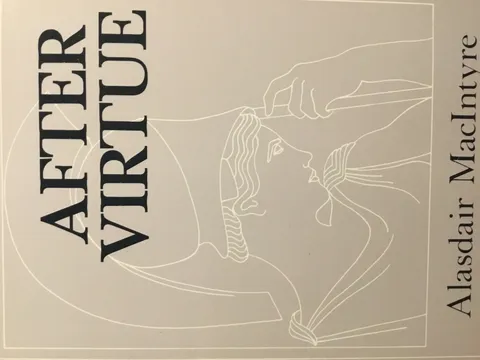
After Virtue is a historical argument about why modern moral debate feels both urgent and strangely inconclusive. MacIntyre’s central move is to refuse the assumption that moral concepts can be understood apart from the social practices and purposes that once gave them meaning. The resulting account is unusually integrative: moral philosophy, social theory, literary narrative, and political history are treated as parts of one inquiry. Its most durable contribution may be the idea that virtues are not merely private traits. They are learned capacities needed to sustain cooperative activities, relationships, and institutions over time.
The argument is strongest as a diagnosis of moral fragmentation and as a defense of practical traditions against atomized theories of choice. It is less decisive when it moves from a genealogy of modern concepts to the conclusion that concepts such as human rights lack rational authority. A history of a concept can show when and why it emerged, but origin alone does not settle its present justification. Rights can also function as protections for dissenters who lack the power to shape a community’s shared account of the good. Likewise, liberal procedural rules may not create moral agreement, but they can make peaceful disagreement possible.
MacIntyre’s alternative also carries a burden. Communities and traditions can educate desire and judgment, but they can also preserve exclusion or silence internal critics. The strongest contemporary use of his framework is therefore neither restoration nor rejection of modern institutions. It is a diagnostic question: which practices develop abilities and goods that participants can recognize together, and which institutions reward status or control at their expense? That question keeps the book’s critique alive while requiring any tradition, including an Aristotelian one, to demonstrate that it can learn, include, and correct itself.
Review Summary
Reviews of After Virtue highlight MacIntyre's compelling critique of modern moral discourse, arguing that Enlightenment philosophy fractured a once-coherent Aristotelian ethical framework, leaving society with incommensurable moral fragments and emotivist debates. Readers praise his historical approach, tracing virtue ethics from Homer through Aristotle to modernity, and his diagnosis of contemporary moral dysfunction. Many find his proposed return to Aristotelian teleology thought-provoking yet incomplete. Critics note dense prose, occasional circular reasoning, and an arguably nostalgic conservatism. The book's enduring influence is widely acknowledged, with readers calling it challenging, stimulating, and essential despite its difficulty.
People Also Read








Glossary
Emotivism
Moral language as attitudeA theory that treats moral judgments as expressions of approval or disapproval that also seek to influence others, rather than as statements grounded in objectively valid standards. MacIntyre distinguishes emotivism as a questionable theory of sentence meaning from its more persuasive use as a diagnosis of social behavior, where moral claims can function as disguised persuasion.
Practice
Cooperative pursuit of excellenceA socially established, complex, cooperative activity with standards of excellence and goods achievable through participation in that activity. Chess, architecture, medicine, and scientific inquiry are examples. A practice is more than technical skill or a tool for external rewards, because its standards and goods can develop as participants extend what the activity makes possible.
Internal goods
Goods achieved through a practiceThe distinctive forms of achievement and understanding available only through participation in a particular practice. Strategic judgment in chess is an example. Internal goods differ from money, prestige, or power, which can be gained through many activities. Participants learn to recognize internal goods by acquiring experience and competence within the practice.
Narrative unity of a human life
A life understood as a storyThe connected form through which a person’s actions, commitments, relationships, and responsibilities become intelligible across time. On MacIntyre’s account, identity is not just a sequence of separate choices or psychological states. People understand themselves through stories that link past events, present obligations, and possible futures, and those stories make them answerable for their actions.
Living tradition
An ongoing inherited argumentA socially embodied, historically extended debate about the goods and purposes that define a community or practice. A living tradition transmits standards and commitments while allowing them to be criticized, revised, and extended. It is not mere obedience to the past; disagreement and argument are part of how a tradition remains active.
Telos
Purposeful human endAn end or purpose that gives direction to human development and helps define what counts as flourishing. In the Aristotelian framework described by MacIntyre, virtues and moral rules guide people from their present condition toward a fulfilled human life. The concept differs from a narrow target because it shapes the meaning of the journey, not only its endpoint.
Bureaucratic individualism
Individuals managed through institutionsMacIntyre’s description of a modern social order in which individual choice and bureaucratic organization appear to be opposing forces but depend on one another. Individuals pursue private goals, while organizations claim technical authority to coordinate behavior and achieve given ends. Both sides typically leave the deeper question of which ends are worth pursuing unresolved.
Fortuna
Uncontrollable contingencyA term MacIntyre takes from Machiavelli for the unpredictable forces that shape human affairs. Social life includes chance, strategic concealment, unmade decisions, and conceptual innovation, so even well-supported generalizations cannot guarantee outcomes. Knowledge can help people act more wisely, but it cannot eliminate vulnerability or make complex human futures fully predictable.
Moral fiction
Claimed standard without secure basisA moral concept that presents itself as an objective, impersonal standard even though, in MacIntyre’s argument, no successful justification establishes the authority it claims. He applies the term to concepts such as utility and universal human rights. The point is not that people never use these concepts meaningfully, but that their public claims to settle disputes exceed their shared rationale.

Download PDF
Download EPUB
.epub digital book format is ideal for reading ebooks on phones, tablets, and e-readers.








