

Key Takeaways
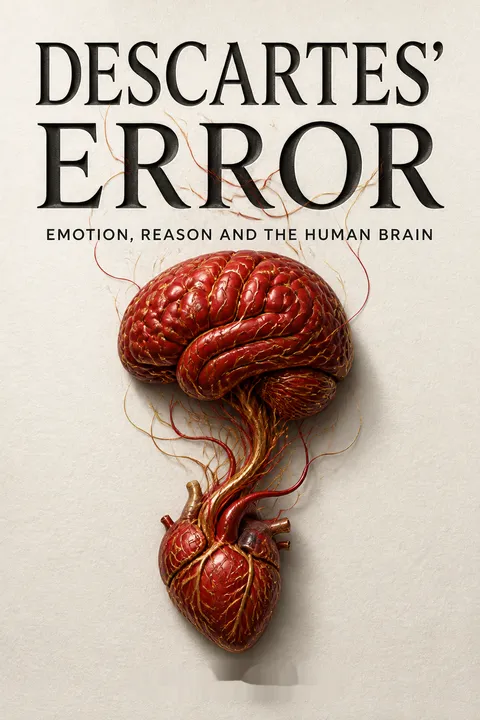
Reason needs emotion to rank choices; feeling belongs inside rationality.
The central reversal. We are often taught to make decisions with a cool head and keep emotion out. Damasio reverses that assumption: emotion helps the mind identify what matters, especially when choices are uncertain, personal, or socially consequential. In patients with damage to particular brain systems, reasoning skills such as language, memory, and calculation can remain intact while practical judgment deteriorates alongside emotional experience. Their cases suggest that emotion is not simply a disturbance added to reasoning. It is part of the machinery that helps reasoning work.
Guidance, not a substitute. Feelings can direct attention toward relevant risks or benefits, leaving logic to compare the options. They do not guarantee a wise decision. Emotion can distort judgment, but losing emotional guidance can make judgment fail too.
What's striking is the shift from asking whether emotion contaminates reason to asking what useful work it performs. Decision theory often assumes that options can be compared against stable goals, but real choices arrive with too many consequences to calculate fully. Emotional responses help supply salience, the sense that one outcome deserves attention now. That is a compelling account of why purely deliberate reasoning can stall. Its limit is equally important: salience is not truth. A feeling can reveal what seems important without establishing what is objectively likely or ethically justified.
High intelligence cannot rescue choices when practical judgment breaks down.
Gage’s altered life. In 1848, railroad foreman Phineas Gage survived an iron rod passing through the front of his brain. His movement, speech, and much of his apparent intelligence remained, but his personality and everyday conduct changed sharply. He struggled to follow plans, respect social expectations, and make choices that served his future. Modern reconstruction of his skull suggested injury to ventromedial prefrontal regions, areas associated with emotion and decision-making.
Elliot’s intact tests. A later patient, Elliot, had frontal tissue damaged by a tumor and surgery. He could reason through abstract problems and score normally on many standard tests, yet repeatedly derailed work, lost money, and made damaging personal choices. The contrast shows that competence on structured tests can coexist with profound difficulty choosing effectively in real life.
These cases expose a measurement problem with consequences beyond neurology. A test can show that someone knows the rules, remembers facts, and can explain sound options, yet miss whether that person can select and sustain a useful course of action under changing conditions. This resembles the gap between laboratory performance and real-world functioning found in many fields. It also cautions against treating poor judgment as proof of laziness or bad character. At the same time, one patient’s history cannot settle how responsibility should be assigned; the case makes that question more informed, not simpler.
Use gut feelings to flag options, then test what they are telling you.
A feeling can filter. Damasio calls his proposal the somatic-marker hypothesis. A somatic marker is a bodily response, or a brain-based simulation of one, linked through experience to a possible choice or outcome. A negative marker can warn that an option may lead to harm; a positive one can make a promising outcome stand out. By directing attention, markers help narrow an overwhelming field of possibilities before deliberate comparison begins.
Reason still decides. The marker is not a verdict and does not replace logic. Imagine weighing a risky investment: an uneasy response may prompt closer scrutiny of the downside, while the prospect of a future benefit may make present sacrifice seem worthwhile. The feeling helps sort the questions that deserve analysis. It does not answer them reliably in every case.
This account connects well with bounded rationality, the idea that human decision-makers operate with limited time, attention, and working memory. A useful intuition can act like a fast relevance filter, keeping every possibility from demanding equal calculation. The crucial question is how that intuition was trained. Repeated experience in a stable environment may make a gut response informative; unfamiliar conditions, prejudice, or misleading feedback can make it unreliable. Treating feelings as prompts to investigate, rather than commands to obey or suppress, preserves their usefulness while making room for correction.
Practice noticing delayed costs before immediate rewards dominate your decisions.
The card game. In Damasio’s Gambling Experiments, participants chose cards from four decks without knowing the reward and penalty schedules. Two decks offered larger immediate gains but could impose severe losses. The other two paid less per turn but were safer overall. Many healthy participants gradually shifted toward the safer decks. Patients with ventromedial frontal damage kept choosing the tempting decks, sometimes until they ran out of money, even when they could explain which decks were disadvantageous.
A warning before choice. Healthy participants developed skin conductance responses before selecting from risky decks, suggesting that their bodies began anticipating bad outcomes. The patients did not show this anticipatory response. Damasio treated skin conductance as an indicator of a bodily process, not as the marker or feeling itself. The experiment links future-sensitive choice with learned emotional signals.
The task makes a useful distinction between knowing a rule and having that rule influence behavior at the moment of choice. It also gives a concrete picture of how immediate rewards can overpower consequences that accumulate over time. In practical settings, slowing down to represent delayed costs may help restore some of that missing perspective. Still, a laboratory game simplifies real life: monetary rewards are easier to count than loyalty, health, or moral obligation. Physiological anticipation is informative evidence, but it does not by itself prove what a participant consciously feels or why a choice occurs.
Treat the body as part of the mind’s machinery, not merely its support.
A living feedback loop. The brain and body continuously exchange information through nerves and chemical signals. The body changes as the brain responds to a threat, a memory, or an image; signals about those changes then return to the brain. For Damasio, this makes the organism, not the brain in isolation, the working unit behind mental life. Bodily conditions help shape attention, feeling, and the significance attached to what is perceived.
A reference for experience. The brain also builds representations of the body’s changing state. These provide a changing reference point for the self and for experiences of the outside world. This does not mean that every thought must be consciously felt in the body. Rather, body-related signals are part of the biological background from which perception, emotion, and decisions arise.
The embodied view offers a useful middle ground between treating the mind as disembodied software and reducing every thought to a bodily sensation. It directs attention to feedback: posture, internal state, and action can influence what becomes salient, while mental events can alter bodily regulation. This is especially valuable in understanding stress and illness, where psychological and physical processes are often treated as separate compartments. The claim should not be stretched into the idea that bodily cues always disclose the truth of a situation. A body state is part of the evidence, not an infallible interpreter.
Remember that the mind reconstructs images across brain systems, not one inner screen.
Memory is not a filing cabinet. Damasio argues that the brain does not preserve complete pictures or recordings of experience. Instead, learned patterns called dispositional representations can help reactivate activity in sensory regions, where an image is reconstructed. Remembering a person, for example, can draw on separate visual, auditory, and other representations rather than retrieving one complete record from a single location.
Many parts, one experience. The book rejects the idea of a single brain theater where every sight, sound, and thought is gathered for an inner observer. Mental integration may depend on coordinated activity across separate regions, with attention and working memory helping keep relevant material available. This distributed account also helps explain why a complex choice can feel like a stream of possibilities while relying on many distinct neural processes.
This picture has an important consequence for how people think about memory: recollection is an active reconstruction, not a perfect replay. That helps explain why remembered details can shift with later experience, and why confidence alone cannot certify accuracy. The account also offers an alternative to imagining a tiny observer inside the brain, since coordinated activity can produce unified experience without a single control room. The challenge is that describing distributed activity does not fully explain how subjective experience arises. A persuasive map of contributing systems is not yet a complete account of consciousness.
Separate the body’s emotional response from your conscious feeling of it.
Emotion and feeling differ. In Damasio’s terminology, an emotion is a coordinated set of changes in the brain and body responding to a situation. A feeling is the perception of those changes. A threat, for example, can trigger bodily and mental responses; becoming aware of the changing body state is part of feeling fear. The two processes are closely linked, but they are not identical.
The body has a background. Damasio also proposes background feelings, the subtle sense of the body’s ongoing condition outside a dramatic emotional episode. His account allows some responses to occur without conscious feeling and describes an “as if” route, in which the brain simulates a body state rather than fully enacting it. He presents these mechanisms as hypotheses, not as a final explanation of how subjective experience works.
Separating response from conscious feeling makes room for a more precise vocabulary: a person can show physiological change without reporting a corresponding emotion, or experience a mood without an obvious trigger. The distinction is also useful when considering facial expressions, bodily reactions, and private experience as related but nonidentical evidence. It resists the simplistic claim that a visible expression reveals exactly what someone feels. The harder question remains how bodily signals become subjective experience. Damasio identifies necessary relationships among body maps, brain systems, and self-representation, while acknowledging that the full mechanism is unresolved.
Social rules must be learned through experience, not merely recited.
Timing shapes social learning. Damasio contrasts adults who suffer frontal damage after learning social conventions with people whose damage occurs early in development. Adults may retain knowledge of rules but fail to use it reliably in daily conduct. In early-onset cases, the person may never properly acquire the social conventions and ethical expectations that ordinarily develop through experience. Emotion, on this account, helps both deploy social knowledge and shape its learning.
Culture joins biology. Innate systems for regulating survival interact with experience, education, and social feedback. This does not make morality a simple biological reflex: societies create and transmit norms, and individuals interpret them. It suggests instead that the ability to learn and apply those norms depends partly on the developing brain’s emotional and regulatory systems.
The distinction between knowing a rule and acquiring the practical feel for when it matters echoes a broader lesson in education: declarative knowledge is not the same as skilled judgment. Social understanding develops through consequences, examples, and feedback, not through memorizing instructions alone. The biological account helps explain why early development can matter without making culture an afterthought. It also requires care: explaining the neural conditions for moral learning does not determine which social rules are just. Biology can help describe how values take hold, but ethical argument is still needed to evaluate them.
Relieve suffering without mistaking symptom control for a complete cure.
Pain has more than one layer. Damasio distinguishes the perception of a local bodily problem from the suffering that accompanies it. He describes a patient with severe facial pain who, after a prefrontal procedure, reported that the pain sensations remained but that he felt fine. The case illustrates how an intervention might reduce emotional suffering without removing the sensory signal itself.
Medicine needs the whole person. The book argues that treatment should consider mental and bodily processes together, rather than treating the mind as an optional add-on to physical care. It also warns against assuming that medication or symptom relief resolves the social and psychological causes of distress. Effective care may require both relief and an account of the conditions producing the suffering.
This distinction is clinically and ethically useful because pain intensity, distress, and impairment do not always move together. A treatment can meaningfully reduce suffering even when it does not erase the original sensation, but that benefit should not be mistaken for a cure of every underlying problem. The same reasoning supports care that takes emotional experience seriously alongside physical diagnosis. There is also a caution in the historical surgical example: reducing distress by blunting emotional systems can carry broader costs. Treatment should be judged not only by what it silences, but by what capacities it preserves.
Analysis
The book’s lasting strength is its choice of evidence. Rather than begin with an abstract argument about whether emotion and reason belong together, Damasio follows a clinical puzzle: people who can remember, speak, calculate, and explain social rules may nevertheless lose the ability to act in their own long-term interests. Phineas Gage supplies the historical opening; Elliot makes the dissociation vivid; physiological and gambling tasks turn the claim into something testable. The narrative gives a difficult neuroscience thesis an unusually clear human stake.
The most powerful idea is not that feelings are wise, but that decision-making requires more than explicit knowledge and logical operations. Choices need priorities. Bodily and emotional signals can help assign them, especially when outcomes are uncertain and working memory cannot hold every consequence in view. This explains why a person may describe a sensible option yet fail to choose it.
The argument also has boundaries. Lesion studies can show that particular systems matter to a capacity, but they do not by themselves establish that one proposed mechanism explains every part of that capacity. A skin conductance response is a measurable physiological sign, not direct access to a feeling or a complete account of a decision. And emotion is not a single, consistently helpful force: fear, attachment, shame, and desire can direct attention toward different goals. Damasio’s own distinction between useful guidance and harmful bias is therefore essential.
The book’s broadest contribution is its insistence that explanation need not equal reduction. Showing that feeling depends on biological processes does not settle the meaning of love, ethical responsibility, or suffering. It does, however, challenge accounts of mind and medicine that treat the body as background equipment. The practical conclusion is measured: cultivate reasoning, but do not expect it to function well when the systems that register value, consequence, and bodily condition are ignored.
Review Summary
Descartes' Error explores the relationship between emotion and reason, challenging traditional views of mind-body separation. Damasio presents compelling evidence from neuroscience and case studies to argue that emotions are integral to decision-making and rational thought. While some readers found the book enlightening and groundbreaking, others struggled with its technical language and occasional verbosity. Many praised Damasio's writing style and the book's impact on understanding human consciousness, though some felt it could be challenging for readers without a background in neuroscience.
People Also Read




Glossary
Somatic-marker hypothesis
Feeling-based guidance for choicesDamasio’s proposal that bodily responses, or brain-based simulations of those responses, become linked through experience to possible actions and outcomes. A marker can signal that an option seems dangerous or promising, directing attention and helping narrow the choices that require deliberate reasoning. It guides judgment but does not replace logic or guarantee a correct decision.
Dispositional representations
Stored patterns that reactivate knowledgeNeural patterns that preserve the potential to reactivate information or guide activity. They do not store complete pictures or recordings. When activated, they can help reconstruct an image in sensory regions, trigger other neural patterns, or contribute to movement. Damasio uses the term for both inborn regulatory knowledge and knowledge modified through experience.
Primary emotions
Innate emotional response patternsPreorganized emotional responses that can be triggered by certain features of a situation or bodily state. In Damasio’s account, they depend especially on limbic structures such as the amygdala and anterior cingulate. They can produce coordinated bodily and brain changes before a person has consciously interpreted the cause.
Secondary emotions
Learned links between situations and emotionEmotional responses built as experience connects categories of people, events, or situations with particular emotional reactions. Damasio argues that these learned patterns involve prefrontal systems as well as the machinery used by primary emotions. They help explain how an adult can respond emotionally to complex situations that do not trigger a simple, inborn reaction.
Background feelings
Subtle sense of ongoing body stateDamasio’s term for feelings arising from ordinary, ongoing body states rather than from a distinct emotional episode. They provide a low-intensity sense of how the organism is doing, such as feeling generally comfortable or unwell. The book proposes that this background bodily sense contributes to the continuity of the self.
Anosognosia
Unawareness of one’s own impairmentA neurological condition in which a person does not recognize a serious impairment, such as paralysis, despite direct evidence of it. Damasio discusses a form associated with particular right-hemisphere damage and disrupted body-state processing. He argues that the lack of updated bodily information can also affect emotion, planning, and decisions about one’s condition.
“As if” loop
Brain simulation of a body stateA proposed route in which the brain produces a pattern resembling the representation of a bodily response without fully creating that response in the body. Damasio suggests that experience can teach the brain to use these simulations in emotion and decision-making. The simulated signal may be faster or less resource-intensive than a full body response.
Gambling Experiments
Card task testing future-sensitive decisionsA decision-making task in which participants choose from four card decks with undisclosed reward and penalty schedules. Some decks offer larger immediate gains but greater eventual losses, while others are safer over repeated choices. Damasio and colleagues used the task to compare how healthy participants and people with ventromedial frontal damage learned to anticipate consequences.
FAQ
What's Descartes' Error about?
- Exploration of Emotion and Reason: Descartes' Error by António Damásio explores the relationship between emotion and reason, arguing that emotions are crucial to rational decision-making.
- Somatic Marker Hypothesis: The book introduces the somatic marker hypothesis, suggesting that emotional responses guide decision-making by marking outcomes as favorable or unfavorable.
- Integration of Body and Mind: Damásio emphasizes the importance of the body in shaping the mind, challenging Cartesian dualism by integrating physiological states into our understanding of consciousness.
Why should I read Descartes' Error?
- Insight into Human Behavior: The book offers profound insights into how emotions influence decisions, enhancing understanding of human behavior in personal and social contexts.
- Challenging Traditional Views: It challenges the dichotomy between emotion and reason, encouraging readers to reconsider their decision-making processes.
- Interdisciplinary Approach: Damásio bridges neuroscience, psychology, and philosophy, making it valuable for those interested in the workings of the human mind and brain.
What are the key takeaways of Descartes' Error?
- Emotions Aid Rationality: Emotions are essential for rational thought and decision-making, providing necessary feedback for evaluating choices.
- Mind-Body Connection: The book emphasizes the interconnectedness of mind and body, asserting that mental processes are deeply rooted in physiological states.
- Somatic Markers Guide Decisions: Bodily responses to emotional stimuli inform decisions, influencing choices based on potential outcomes.
What is the somatic marker hypothesis in Descartes' Error?
- Definition of Somatic Markers: Somatic markers are bodily responses linked to emotions that guide decision-making by signaling potential outcomes.
- Role in Decision-Making: These markers help individuals evaluate risks and rewards, often without conscious awareness, leading to better decision outcomes.
- Clinical Evidence: Supported by observations of patients with brain damage, the hypothesis shows that impaired emotional processing affects decision-making.
How does Damasio use Phineas Gage's case in Descartes' Error?
- Historical Significance: Phineas Gage's accident serves as a pivotal case study illustrating the link between brain function and personality.
- Behavioral Changes: Gage's personality changes post-accident highlight the prefrontal cortex's role in emotional regulation and decision-making.
- Implications for Neuroscience: The case provides foundational evidence for the somatic marker hypothesis, demonstrating the importance of emotional processing.
How does Descartes' Error challenge traditional views of emotion and reason?
- Rejects Dualism: Damásio challenges Cartesian dualism, arguing for a model where emotions and rationality are interconnected.
- Emotions as Rational: The book posits that emotions are essential components of rational thought, positively influencing decision-making.
- Neuroscientific Evidence: Clinical evidence and case studies provide a scientific basis for the argument that emotional processing is crucial for reasoning.
How do emotions influence reasoning in Descartes' Error?
- Emotional Feedback Mechanism: Emotions provide critical feedback, shaping reasoning processes by prioritizing information and guiding attention.
- Cognitive Styles Altered by Emotions: Emotional states can alter cognitive styles, affecting creativity, flexibility, and decision-making quality.
- Impact on Decision Quality: Understanding the interplay between emotions and reasoning can help individuals recognize when emotions may cloud judgment.
What role do emotions play in decision-making according to Descartes' Error?
- Guiding Decisions: Emotions help evaluate options based on past experiences and emotional responses, guiding decision-making.
- Influencing Outcomes: Strong emotional responses can lead to more favorable decision outcomes by prioritizing certain choices.
- Integration with Reason: Effective decision-making requires integrating emotional and rational processes, with emotions providing critical context.
What are the implications of Descartes' Error for understanding mental health?
- Emotional Awareness: Lack of emotional awareness can lead to poor decision-making and social dysfunction, relevant for mental health treatment.
- Therapeutic Approaches: Understanding the emotion-reason connection can inform therapeutic approaches, emphasizing emotional health alongside cognitive processes.
- Neuroscience in Therapy: Damásio’s work encourages integrating neuroscience into psychological practices, considering the biological underpinnings of emotions.
How does Descartes' Error address the mind-body connection?
- Critique of Cartesian Dualism: Damásio critiques the separation of mind and body, arguing for a dynamic interaction between brain and body.
- Neuroscientific Evidence: The book presents evidence showing how bodily states affect emotional experiences and cognitive functions.
- Implications for Consciousness: Emphasizing the mind-body connection, Damásio suggests consciousness arises from the interplay of bodily sensations and cognitive processes.
How does Descartes' Error relate to modern psychology and neuroscience?
- Integration of Disciplines: The book bridges psychology and neuroscience, enhancing comprehension of psychological processes through brain function understanding.
- Implications for Mental Health: Insights into emotions' role in reasoning have significant implications for mental health treatment and therapeutic strategies.
- Influence on Cognitive Science: The somatic marker hypothesis has influenced cognitive science by emphasizing emotions' importance in rational thought.
What are the best quotes from Descartes' Error and what do they mean?
- "Emotion is part and parcel of what we call cognition.": Emphasizes that emotions are integral to cognitive processes, challenging the traditional separation.
- "When emotion is entirely left out of the reasoning picture, reason turns out to be even more flawed.": Highlights the necessity of emotions in making sound decisions.
- "The heart is after all in the head.": Metaphorically emphasizes the intertwining of emotional and rational processes within brain functioning.
About the Author
Other books by António Damásio

Download PDF
Download EPUB
.epub digital book format is ideal for reading ebooks on phones, tablets, and e-readers.








