

Key Takeaways
Turn a five-second lunch ritual into a dependable line of communication.
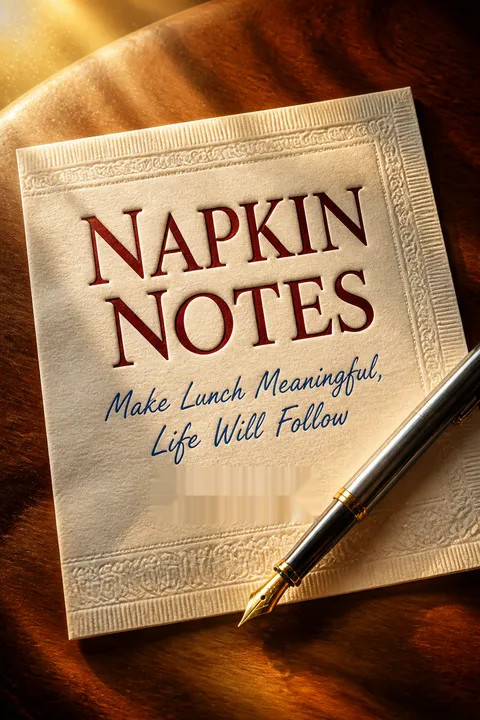
A small daily opening. As his daughter Emma grew, Garth Callaghan realized that school and work had reduced their shared time to a few brief windows each day. He began packing her lunch and slipping in a short handwritten message. The notes started simply, then became encouragement tailored to what Emma was learning and facing. When she once noticed a lunch bag had no note, her request made clear that the ritual mattered to her.
Make it personal. Callaghan calls these messages Napkin Notes, but the napkin is only the delivery method. A parent can write a brief reminder, praise a specific effort, or share a thought that fits the child’s day. The essential ingredients are repetition, attention, and a message meant for one person.
What's striking is how the ritual turns care into something observable. Affection can be sincere yet easy to miss amid school runs and work; a recurring note gives it a reliable place in the day. Its value comes less from literary quality than from the recipient’s knowledge that someone paused to think of them. The practice also travels beyond lunch bags, so families can adapt it to their routines. Still, ritual should invite connection, not become a scorecard: a missed note does not mean a missed relationship.
Use mortality's urgency to protect ordinary moments, not chase grand gestures.
A diagnosis rearranges time. Callaghan first saw blood in his urine and learned that he had a large kidney tumor. He was forty-two, far younger than the average age of diagnosis cited in his research, and feared he might not see Emma finish high school. Further cancers and difficult treatment made the uncertainty a continuing part of family life, not a single crisis that ended with surgery.
Return to the everyday. The book’s answer is not that a positive attitude defeats cancer. Callaghan describes fear, anger, exhaustion, and grief alongside hope. He keeps making lunches, writing notes, and showing up for Emma because those actions express the relationship he wants to live, even when he cannot control the prognosis.
The memoir makes urgency practical: mortality is not treated as a cue to manufacture a dramatic legacy, but as a reason to notice the daily opportunities already available. That distinction matters because outcomes and actions are not equally controllable. A person cannot guarantee more time, but can choose how to use a morning or a conversation. The risk is that this framing could make ordinary tasks sound like a cure for despair. The book is strongest when it lets fear remain real while showing that affection can still be enacted beside it.
Tell children the truth in language they can hold.
Children notice what adults hide. When Callaghan first told Emma about his cancer, he tried to keep the explanation reassuring and limited. He and his wife wanted to spare her fear, but Emma sensed the seriousness and later began saving his notes after his first surgery because she wanted something of him close by. Her notebook revealed that she had understood more than her parents realized.
Be honest and age-aware. Callaghan uses plain explanations, while acknowledging that his comparison of prostate cells to popcorn and a few misplaced sweets may not have clarified matters. The broader lesson is to say what is known, admit what is uncertain, and make room for a child’s questions and emotions. Comfort does not require promising an outcome no one can guarantee.
This account illustrates a family communication problem: adults may confuse withholding frightening facts with protecting a child, while children often register changed routines, private conversations, and emotional tension. A clear, limited explanation can give them a more dependable story than silence or forced cheerfulness. The book also models repair. Callaghan recognizes that his first explanation was imperfect and keeps trying to speak more clearly. Age-appropriate honesty is not a script that eliminates distress; it is a way to ensure distress is not compounded by isolation or confusion.
Choose cancer treatment by weighing survival against the life it changes.
Treatment has trade-offs. After surgery for kidney cancer, Callaghan was diagnosed with a separate, slow-growing prostate cancer. Doctors discussed removing the prostate, a treatment that could bring serious effects, including incontinence and sexual changes. He was forty-three and did not consider those consequences minor simply because surgery might remove the cancer.
Monitoring was still a decision. Callaghan chose active surveillance, meaning regular monitoring of the cancer rather than immediate treatment. The plan involved repeated PSA tests and further biopsies, with treatment reconsidered if results changed. Living with untreated cancer brought its own anxiety, and he describes the choice as difficult rather than triumphant. His account is a prompt for informed discussion with clinicians, not a universal recommendation for any patient.
The useful insight is that medical decisions are not made between risk and no risk. They compare different risks, different time horizons, and different effects on daily life. Callaghan’s willingness to ask about side effects makes room for a more complete conversation than simply asking which option sounds most aggressive. The nuance is essential: his diagnosis, age, and circumstances shaped his choice, and another patient could rationally choose differently. Shared decision-making respects both medical evidence and the person who must live with the consequences.
Make one promise concrete enough to keep through uncertainty.
A number gave the fear a task. After learning that his prognosis was poor, Callaghan encountered a campaign built around keeping promises. He decided to write enough notes for Emma to receive one on every school day until high school graduation. He calculated that he needed 826 and began preparing them in advance, turning an implied commitment into a visible project.
Focus on what remains possible. Writing notes did not alter the medical odds, but it gave Callaghan a specific action he could control when much of his future was uncertain. Sharing the commitment brought attention to Napkin Notes and encouraged other parents to connect with their children. The promise mattered first as a father’s practice, not as a public campaign or a guarantee that he could control what happened.
A concrete promise can convert diffuse fear into a bounded act: there is a clear recipient, a repeated behavior, and a way to see progress. That structure does not solve the underlying crisis, but it can restore a measure of agency without pretending that agency is total. The 826 notes also make the promise tangible to Emma, rather than leaving it as an abstract assurance. One caution follows from the story itself: a promise should serve the relationship, not become a burden that makes illness or interruption feel like moral failure.
Accept practical help before crisis turns love into exhaustion.
Illness spreads its workload. Callaghan says cancer affected his whole family, even though the disease was in his body. His wife Lissa managed family life and watched for treatment side effects; his daughter adjusted to his reduced energy; his mother and sister offered emotional support. Friends and local residents organized a benefit that raised enough to cover about three-quarters of his medical bills.
Care is both intimate and practical. Help included companionship at appointments, food, money, transportation, and small acts of attention. Callaghan’s first diagnosis was delivered while he was alone, and he describes that isolation as changing once family and caregivers became involved. Accepting support did not erase the strain or make him less responsible for his choices. It meant the family did not have to carry every task separately.
The book treats care as infrastructure, not merely sentiment. A person facing illness may need someone to listen, but also someone to drive, cook, coordinate, or reduce a bill. Naming those concrete tasks makes support easier to offer and receive. The benefit in Callaghan’s small hometown shows how collective care can address material pressure as well as loneliness. There is a boundary worth keeping in view: caregivers also need support, and family members may experience the crisis differently. A dependable network shares burdens without assuming that every person can give endlessly.
Give advice with evidence of what you admire in someone.
Make guidance specific. Callaghan’s notes carried lessons he wanted Emma to remember, including how to receive criticism, make safer choices, handle work, and ask for help. The book gathers many of these ideas into Emma’s Life List, a set of 59 pieces of advice rather than a single grand theory of success.
Praise what can be seen. One message recalled Emma’s confident response to a childhood moment when someone offered to rescue her. The note used that memory to encourage independence. Elsewhere, Callaghan argues that saying he is proud means more when he explains what he has noticed. A useful note therefore joins affection to evidence: a particular action, quality, or effort that the recipient can recognize in themselves.
Specific praise helps turn approval into information. Instead of offering a vague verdict about someone’s character, the writer points to an action that the recipient can understand and repeat. Callaghan’s childhood memory gives the advice emotional credibility because it connects a principle to Emma’s own history. The Life List also reveals that guidance is personal rather than infallible. Some entries are firm opinions about relationships or work, so the strongest use of such advice is as an opening for conversation, not a substitute for the recipient’s judgment.
Write ordinary words now; one surviving letter can become a lifeline.
A small record can outlast its moment. After Callaghan’s father died unexpectedly, Garth realized he had almost no written words from him. His mother searched through family papers and found a letter his father had written years earlier. It contained ordinary observations about his children and their schoolwork, but reading it connected Garth to a father he could no longer ask for advice.
Writing is one form of presence. Callaghan’s notes became a record Emma could keep and revisit, while he also sent messages to friends and people he had never met. He suggests alternatives such as notes in books, on mirrors, or by mail. The point is not that paper is always better than a conversation; it is that a brief, personal message can remain available after the moment has passed.
The father’s letter shows why ordinary detail can carry unusual weight: it preserves a voice, a way of noticing, and evidence of attention that a polished tribute might not provide. Written messages also let the recipient return to them at a chosen moment, which differs from the one-time nature of speech. That durability is meaningful, but not magical. A note cannot replace time together or repair every silence. Its value is that it makes care easier to revisit, especially when the writer is no longer available to say it again.
Analysis
Napkin Notes is a memoir organized around a deceptively modest practice. Its narrative begins with an initially hesitant father learning that parenthood is not a feeling alone, but a pattern of attention. Cancer then changes the scale of the story: the lunch note becomes both a daily connection and a concrete answer to a future Garth cannot control. The book’s most persuasive claim is not that small gestures solve large problems. It is that they give love a dependable form while the larger problems remain unresolved.
The memoir’s structure makes this argument emotionally legible. Medical developments arrive alongside domestic scenes, advice to Emma, humor, faith, and the logistical labor of treatment. The result resists the familiar heroic arc in which optimism conquers illness. Callaghan is frightened, angry, sometimes physically depleted, and still committed to the next ordinary act. That combination is more credible than a simple triumph narrative, although the public story of a father preparing notes against a grim prognosis can still make private family life feel like a campaign.
The book also distinguishes influence from control. Callaghan can prepare messages, ask doctors questions, choose among treatment options with clinicians, and accept help. He cannot promise Emma an outcome. His strongest model of fatherhood is therefore not perfect wisdom, but repeated availability, including the willingness to repair clumsy explanations and revisit difficult conversations.
The central practice is adaptable because it does not depend on a napkin, a particular family structure, or a profound message every morning. Its deeper demand is attention made visible. The book is less a manual for parenting than a reminder that intimacy is built through repeated, specific acts. Its limitation is that a ritual cannot compensate for absent time or unequal care. Its insight is that when time is scarce, a small act can still make a relationship unmistakably present.
Review Summary
Napkin Notes is a heartwarming book about a father's love for his daughter, expressed through daily lunch notes. Readers praise Callaghan's optimism and resilience in the face of cancer, finding the book inspirational and touching. Many appreciate the simple yet powerful messages and life lessons shared. The book resonates with parents, encouraging them to connect more deeply with their children. While some note the writing isn't particularly literary, most find the story's sincerity and the author's dedication to his daughter deeply moving.
People Also Read




Glossary
Napkin Notes
Brief personal messagesShort handwritten messages Callaghan places in his daughter’s lunch, usually offering encouragement, affection, or advice. The name refers to the original use of napkins, but the practice can use other materials and settings. Its purpose is to create a small, recurring point of connection between people whose days may otherwise be spent apart.
Active surveillance
Monitored cancer without immediate treatmentA medical approach Callaghan chose for his slow-growing prostate cancer. Instead of removing the prostate immediately, clinicians monitored him through PSA tests and planned follow-up biopsies, with the possibility of treatment if results changed. In the book, the choice is presented as a personal trade-off involving both cancer risk and the potential effects of surgery.
180NN
School days left for notesCallaghan’s shorthand for the number of school days remaining in the year for which he could write Emma a Napkin Note. The number marked each remaining opportunity as a limited, concrete chance to encourage and connect with her. It also gave his online posts a simple way to identify the notes and the school-day countdown.
Pack. Write. Connect.
A note-writing practiceCallaghan’s compact description of the Napkin Notes routine: prepare a lunch, add a personal message, and use that gesture to maintain connection with a loved one. The words emphasize that the message belongs within an act of care, rather than being a standalone inspirational slogan. The practice can be adapted to other daily routines and forms of communication.
Download PDF
Download EPUB
.epub digital book format is ideal for reading ebooks on phones, tablets, and e-readers.








