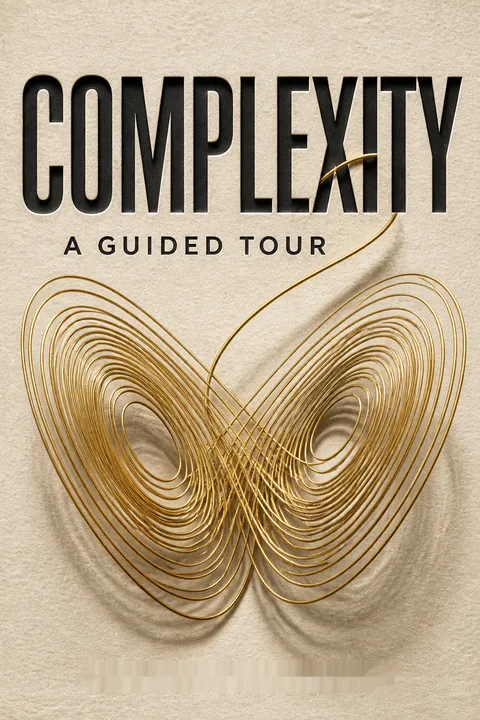


Key Takeaways
Study the interactions, not just the pieces, to explain collective intelligence
Simple parts, surprising wholes. A complex system consists of many components following relatively simple rules, interacting without a central controller. Their collective activity can produce organized behavior, information processing, and adaptation. In the Amazon, individual army ants are nearly blind and limited, yet a colony of hundreds of thousands can forage in coordinated formations and build shelters from linked bodies. Similar puzzles appear in brains, immune systems, economies, and the Web.
Look between levels. Knowing what each component does does not automatically explain what the whole system does. The crucial question is how local signals and interactions create large-scale patterns. The field is interdisciplinary because these patterns appear in systems made of very different things, from cells to people.
The central shift is from asking what components are made of to asking what their relationships enable. That move is useful well beyond biology: an organization’s chart, for instance, says less about its actual behavior than the communication and incentives running through it. Still, a shared pattern is not proof of a shared mechanism. Ants, markets, and immune cells can all self-organize while relying on very different signals and constraints. The comparison generates hypotheses; careful observation of each system tests them.
Deterministic rules can make long-range prediction impossible
Tiny differences, huge consequences. Chaos is behavior in which small uncertainties about a system’s starting state grow until long-term prediction fails. The logistic map, a simple model of population growth with limits, shows how this can happen. At one setting, a population settles to a stable value; at others, it cycles between values, then follows increasingly complicated patterns. At a chaotic setting, trajectories that begin almost identically soon diverge.
Order remains in the pattern. At R = 4, two starting values differing at the tenth decimal place lose meaningful agreement after about 30 steps. Yet across many similar mathematical maps, the route into chaos follows a shared pattern of repeated period doubling. Feigenbaum’s constant, about 4.669, describes the rate at which these transitions crowd together, and was also observed in physical experiments.
Chaos separates predictability from determinism. A system can follow exact rules and still defeat forecasts because observations never capture its initial state with unlimited precision. This distinction matters in weather, ecosystems, and other systems where forecasts should be treated as time-limited rather than simply right or wrong. The shared period-doubling pattern is equally important: uncertainty in detail does not mean that every feature is unknowable. But a simple model’s behavior does not establish that a particular natural system follows the same route.
Measure complexity by asking what you mean by complex
One word, many measures. Researchers do not agree on a single quantitative definition of complexity. Size is easy to measure, but misleading: humans have roughly 25,000 genes, while some organisms have more DNA than humans. Shannon entropy measures uncertainty in a sequence, but a random, nonfunctional sequence can score highly. Neither captures everything people mean when they call a living system complex.
Structure matters. Other proposals count the shortest program that describes an object, the time needed to construct it, the regularities it contains, or its nested levels of organization. Each captures a different feature, and several are difficult to calculate in practice. The book’s useful starting questions are: How hard is the system to describe? How hard is it to create? How organized is it?
Measurement is not a neutral final step. A measure selects which features count, so a claim that one organism is more complex than another can be meaningless until the criterion is named. This resembles debates over intelligence: a test can be precise while measuring only a narrow capacity. Multiple measures are not necessarily a failure of science; they can reveal that a broad everyday word bundles distinct properties. The danger comes when one convenient number is mistaken for the whole phenomenon.
Information and computation can live in systems without a central processor
Computation has limits. Alan Turing described computation using an abstract machine that reads and writes symbols by following rules. His work helped define programmable computers, but also showed that no procedure can determine for every possible program whether it will eventually stop. Computation is powerful, not unlimited.
Nature uses information differently. In a computer, programs and data are stored in memory and processed by a central unit. A self-copying program avoids an infinite regress by using stored information both as instructions and as data. DNA has a related dual role: it carries hereditary sequences, while also encoding much of the cellular machinery that reads and copies them. Yet calling a living process computation raises a harder question: what counts as information, and where does its meaning come from?
The comparison between living systems and computers is most productive when treated as a question about function, not resemblance. A cell is not literally a laptop made of molecules; the analogy asks how signals are stored, transformed, and used to guide action. Turing’s limit also supplies a useful caution against technological triumphalism: more computing power does not make every problem solvable. At the same time, formal computation does not settle whether a system understands what its signals mean. That distinction remains conceptually demanding.
Let evolutionary search discover solutions human intuition overlooks
Selection can design programs. A genetic algorithm searches for solutions by generating candidate programs, testing their performance, favoring better performers, and recombining and mutating them. In Mitchell’s example, a robot named Robby collects cans in a grid. Her hand-designed strategy averaged about 346 points per cleaning session. After 1,000 generations, the best evolved strategy averaged about 483, close to the maximum of 500.
Good answers can look strange. The evolved robot learned to trace the grid’s perimeter when nearby cans were absent, avoiding wasted moves and collisions. It also sometimes left a can in place as a marker, helping it navigate clusters. In a different experiment, a genetic algorithm designed cellular-automaton rules that solved a majority-counting task through moving patterns and collisions. The solutions worked, even when their internal logic was difficult to read.
Evolutionary search is valuable when the design space is too large for people to navigate by intuition. Its less obvious benefit is that an alien-looking solution can expose a hidden assumption in the human approach. But fitness depends on the task definition: an algorithm optimizes what its evaluator rewards, not what a designer vaguely intended. A high score in a simulation is evidence of performance under those conditions, not proof of robustness in an unfamiliar environment.
Build adaptive systems that explore widely, then focus on evidence
Information is often distributed. In an immune system, diverse lymphocytes test many possible pathogen shapes. When a cell binds an invader, its descendants multiply and vary, and better matches become more common. Ant colonies use a related search strategy: ants explore routes, reinforce trails that lead to food, and allow weaker trails to fade. In both cases, local signals guide a group without a single decision-maker.
Search needs both breadth and focus. Mitchell calls this a parallel terraced scan: many possibilities are explored at once, but promising paths receive more resources as evidence accumulates. Her Copycat program uses competing small agents to build interpretations of letter-string analogies. On a puzzle where one string changes from “abc” to “abd,” it can map the pattern onto a different string by noticing that a group’s length, not its letters, provides the useful comparison.
The productive tension is between exploration and exploitation. A system that explores only repeats familiar mistakes; one that explores everything indefinitely never commits to a useful response. Distributed systems can adjust this balance gradually, using feedback rather than a fixed plan. The analogy to human thought is suggestive, especially where a new interpretation depends on reframing what counts as the relevant feature. Yet successful pattern matching is not automatically understanding. Meaning also depends on what consequences a signal has for the system.
A few network hubs connect the world and endanger it
A handful of shortcuts change everything. A network is a set of nodes connected by links. In a small-world network, most connections can remain local while a few long-distance links sharply shorten paths across the system. In a model with 1,000 nodes, rewiring a small fraction of links reduced the average path length from about 250 to about 20. The brain, power grid, and actor networks have all been studied for this kind of structure.
Hubs bring uneven resilience. Scale-free networks have many nodes with few links and a small number of highly connected hubs. Such networks can tolerate random node failures, since most removed nodes are minor ones, but damage to a hub can disrupt the whole network. The Web and social systems show similar patterns, though the evidence for scale-free structure is contested and simple models leave out important differences among links.
Network structure turns resilience into a distributional question: which nodes fail, and how consequential are their connections? This is more informative than saying a system is simply robust or fragile. It also complicates interventions. Targeting hubs may efficiently slow an epidemic or protect a network, but identifying those hubs can be difficult, and their importance may change over time. A power-law fit alone cannot establish why a network formed or how information moves through it. Structure is a map, not the journey.
Treat gene regulation, not gene counts, as a source of biological form
Genes work in networks. The old picture of genes as separate units, each producing one protein and one trait, is inadequate. Genes can overlap, move, contribute to multiple proteins, and be regulated by other genes. DNA also contains switches that help determine when and where genes are active. Humans and other animals can therefore differ greatly in form despite sharing many genes and having similar gene counts.
Evolution has more than one ingredient. The field called Evo-Devo studies how changes in development and gene regulation help generate body forms. Its evidence complicates the idea that all biological complexity comes from slow accumulation of small changes in protein-coding genes. Stuart Kauffman’s simplified Boolean-network models suggest that organized patterns can arise without natural selection, but their assumptions are severe. The book presents self-organization as a possible partner to selection, not a settled replacement.
Regulation offers a powerful explanation for how the same biological parts can be arranged into different developmental outcomes. It shifts attention from an inventory of genes toward the conditions and timing of their activity. That is a broader lesson about systems: components acquire functions through relations and context. The caution is that elegant network models can make order look inevitable when actual organisms face noise, history, and material constraints. A plausible mechanism deserves both conceptual attention and direct empirical testing.
A three-quarter power law hints at networks beneath animal size
Size changes metabolism predictably. Max Kleiber’s measurements suggested that an animal’s resting metabolic rate grows roughly in proportion to its body mass raised to the three-fourths power. This differs from the simpler surface-area argument, which predicts a two-thirds exponent. The pattern is associated with other quarter-power relationships, including the tendency of larger mammals to have slower heart rates and longer lives.
Transport networks may explain the pattern. Geoffrey West, James Brown, and Brian Enquist proposed that branching, space-filling networks distribute fuel through organisms efficiently. Their metabolic scaling theory derives the three-fourths relation from assumptions about network geometry and delivery costs. The proposal is ambitious and influential, but the book describes disputes over the data, the mathematics, and how widely the law applies. Its value is as a testable explanation, not a universal verdict.
Scaling laws are attractive because they compress many observations into a compact relationship. A good mechanism, however, must explain not only the average pattern but also why exceptions occur and where the relationship stops applying. The theory’s network explanation is compelling precisely because it connects organism size to transport architecture rather than treating the exponent as a numerical curiosity. Still, an elegant derivation can outrun evidence. The strongest use of such a law is to generate discriminating predictions that competing explanations would not make.
Use models as probes, not miniature copies of reality
A simple game clarifies cooperation. In the Prisoner’s Dilemma, two players choose whether to cooperate or defect. In a single round, each has an incentive to defect, even though mutual cooperation would benefit both. In repeated computer tournaments, a simple strategy that cooperates first and then mirrors its opponent’s previous move performed well. Models also showed that social punishment or local neighborhoods can help cooperation persist.
Replication tests the lesson. Small changes to a model, such as updating players asynchronously or allowing mistakes, sometimes changed the results. That is why simulations should be independently rebuilt and tested across assumptions. The book’s wider conclusion is not that one master law explains every complex system. It is that tentative common principles can guide research, while detailed evidence must reveal where an analogy holds and where it breaks.
Models are most useful when their simplifications are explicit and their conclusions are proportional to what was tested. The Prisoner’s Dilemma isolates a genuine conflict between individual incentives and shared outcomes, but real cooperation also depends on institutions, history, communication, and power. Those omissions do not make the model worthless; they define its proper job. Complexity science is strongest as a method for discovering questions and mechanisms across fields, and weakest when a shared metaphor is presented as a complete explanation.
Analysis
Mitchell’s tour is not a claim that ants, markets, cells, and brains obey one hidden master equation. Its more defensible argument is methodological: when systems contain many interacting parts, explanations based only on component properties often miss the dynamics that matter at the collective level. The book’s recurring bridge is computation, broadly understood as the transformation of distributed information into action. This lens links physical dynamics, biological adaptation, computer models, and network structure without requiring them to be identical.
The most valuable tension is between abstraction and mechanism. Abstract models such as the logistic map, cellular automata, and the Prisoner’s Dilemma make difficult problems tractable and can reveal surprising behavior. But abstraction also creates a risk of mistaking a useful analogy for a causal account. A network diagram may expose hubs, yet say little about why a link exists or what passes through it. A genetic network may produce stable patterns in a simulation, yet omit noise and developmental history. Mitchell repeatedly emphasizes this boundary, and that caution is central to the book’s credibility.
A second strength is its resistance to simplistic stories of progress. Evolution is not reduced to a steady march toward greater complexity, and complexity itself is not treated as a single scale. Natural selection remains crucial, while regulation, constraint, chance, and self-organization may also shape outcomes. The resulting picture is less tidy than a grand theory, but more faithful to how science develops: measures and explanations compete, and empirical work narrows their scope.
The book’s deepest practical lesson for researchers is to move between levels deliberately. Begin with a concrete system, identify local interactions, propose a higher-level description, then test whether that description predicts anything beyond the original example. Cross-disciplinary concepts earn their keep when they make new observations possible, not merely when they make unlike systems sound alike. Complexity is therefore both a subject and a discipline of intellectual restraint.
Review Summary
Complexity: A Guided Tour receives mostly positive reviews for its accessible introduction to complex systems and interdisciplinary approach. Readers appreciate Mitchell's clear explanations of difficult concepts and the book's broad coverage of topics like information theory, evolution, and network science. Some criticize the lack of depth or coherence between subjects. The book is praised for its engaging writing style and ability to connect seemingly unrelated fields. However, a few readers found it outdated or oversimplified. Overall, it's recommended for those interested in complexity science, especially with a computer science background.
People Also Read





Glossary
Complex system
Many interacting partsA system made of many components that follow relatively simple rules and interact without a central controller. Their collective behavior can produce large-scale patterns, information processing, and adaptation. Examples in the book include ant colonies, immune systems, brains, economies, and the Web. The term describes a family of systems, not a single agreed scientific theory.
Sensitive dependence on initial conditions
Small differences growA property of some dynamical systems in which tiny differences in starting conditions eventually produce large differences in later behavior. In chaotic systems, this makes long-term prediction impossible when initial measurements are not infinitely precise, even though the system follows deterministic rules.
Shannon entropy
Uncertainty in messagesA mathematical measure of the uncertainty or average information associated with messages from a source. It depends on how probable the possible messages are, not on what they mean. A predictable source has low Shannon entropy, while a source whose messages are difficult to anticipate has higher entropy.
Algorithmic information content
Shortest generating programA proposed measure of an object’s information content: the length of the shortest computer program that can generate a complete description of that object. Repetitive patterns are compressible and have low content by this measure. Random strings tend to have high content, which is one reason the measure does not fully match intuitive ideas of complexity.
Genetic algorithm
Search through evolving candidatesA computational search method that maintains a population of candidate solutions, scores them with a fitness function, and produces new candidates by selecting, recombining, and mutating stronger performers. Repeating this process can yield effective solutions without a programmer specifying each step. The method can also produce solutions that are difficult for people to interpret.
Cellular automaton
Local rules on a gridA model made of cells arranged on a grid or lattice. Each cell updates its state according to a shared rule that uses information from its local neighborhood. Despite the simplicity of these rules, cellular automata can generate intricate patterns and, in some cases, perform universal computation.
Parallel terraced scan
Uneven parallel explorationA search strategy in which many possibilities are explored at once, while the amount of effort devoted to each changes according to feedback about its promise. Promising options receive more resources, but less promising ones and new possibilities are not necessarily abandoned. Mitchell uses it to connect adaptive behavior in biological systems with the Copycat analogy program.
Small-world network
Local clusters, short pathsA network with substantial local clustering but relatively short paths between nodes, often because a small number of long-distance links connect otherwise local groups. The Watts and Strogatz model demonstrates how rewiring only a few links in a regular network can sharply reduce average path length.
Scale-free network
Power-law link distributionA network whose node degrees follow an approximate power-law distribution: many nodes have few links, while a small number have very many. Those highly connected nodes are called hubs. Such a network can withstand many random node removals yet remain vulnerable to targeted loss of important hubs. The classification of real-world networks as scale-free can be disputed.
Metabolic scaling theory
Network explanation of metabolic scalingA theory proposed by Geoffrey West, James Brown, and Brian Enquist to explain why metabolic rate across many organisms appears to scale with body mass to the three-fourths power. It models branching transport networks as space filling and shaped by constraints on delivery time and energy. The theory’s assumptions, scope, and fit to biological data remain debated.
Evo-Devo
Evolutionary developmental biologyAn approach that studies how evolutionary change interacts with development. In the book’s account, Evo-Devo highlights how genetic switches and regulatory networks can alter when and where genes are expressed, producing changes in body form without requiring large differences in protein-coding genes. The field challenges overly simple accounts of genes as independent units for traits.
Random Boolean Network
Randomly connected binary modelA simplified network model in which each node has an on or off state, receives inputs from other nodes, and updates according to a Boolean rule. Stuart Kauffman used such networks as idealized models of genetic regulation. They can settle into stable or repeating patterns, though their assumptions and biological relevance require scrutiny.
FAQ
What's Complexity: A Guided Tour about?
- Exploration of Complexity Science: The book provides an overview of complexity science, focusing on how complex behaviors emerge from simple rules and interactions.
- Historical Context: It traces the development of complexity science from reductionism to new fields like chaos theory and network theory.
- Interdisciplinary Approach: Melanie Mitchell integrates concepts from biology, computer science, physics, and economics to explain complex systems.
Why should I read Complexity: A Guided Tour?
- Accessible to All: The book is written for both scientists and nonscientists, requiring no advanced background in math or science.
- Engaging Writing Style: Mitchell's engaging and informative writing makes complex ideas relatable and easier to grasp.
- Insight into Current Research: Readers gain insights into cutting-edge research and challenges in understanding complex systems.
What are the key takeaways of Complexity: A Guided Tour?
- Definition of Complexity: Complexity involves systems with large networks of components that exhibit complex behavior without central control.
- Emergence and Self-Organization: The book highlights how complex patterns arise from simple interactions without a central leader.
- Interconnectedness of Systems: Different complex systems, like ant colonies and economies, share common properties and behaviors.
How does Melanie Mitchell define complexity in Complexity: A Guided Tour?
- Complex System Definition: A complex system is one where large networks of components with no central control give rise to complex behavior.
- Key Characteristics: These systems exhibit complex collective behavior, signaling, information processing, and adaptation.
- Examples of Complex Systems: Examples include ant colonies, immune systems, and economies, all showing complex behaviors from simple rules.
What is reductionism, and how does it relate to complexity in Complexity: A Guided Tour?
- Basic Definition: Reductionism is the belief that understanding a whole system can be achieved by understanding its parts.
- Limitations of Reductionism: The book argues that reductionism often fails to account for interactions between parts in complex phenomena.
- Shift to Complexity Science: Mitchell discusses the shift from reductionist approaches to complexity science, focusing on emergent behaviors.
What is the significance of self-organization in complex systems according to Complexity: A Guided Tour?
- Definition of Self-Organization: Self-organization is the process where simple parts form complex structures without central control.
- Examples in Nature: Examples include animal behavior patterns, cell organization, and social network dynamics.
- Implications for Understanding Complexity: Understanding self-organization helps researchers grasp how order emerges from chaos.
How does Complexity: A Guided Tour address the concept of evolution?
- Darwinian Evolution: The book discusses how complex organisms evolve from simpler ancestors through natural selection.
- Genetic Algorithms: It explores evolutionary principles in computer science, using genetic algorithms to solve complex problems.
- Interplay of Randomness and Selection: The role of randomness in genetic variation and natural selection is highlighted.
What are genetic algorithms, and how are they used in Complexity: A Guided Tour?
- Definition of Genetic Algorithms: These are computational methods using natural selection principles to evolve solutions to problems.
- Application in Robotics: The book describes using genetic algorithms to evolve strategies for a robot named Robby.
- Real-World Applications: Genetic algorithms are used in fields like engineering, finance, and art to solve complex problems.
What is the Copycat program mentioned in Complexity: A Guided Tour?
- Analogy-Making Program: Copycat mimics human-like analogy-making in a letter-string microworld.
- Components of Copycat: It includes the Slipnet, Workspace, and codelets, which work together to solve analogy problems.
- Significance of Copycat: It models human cognition and creativity, showing how complex systems emerge from simple rules.
What is Kleiber's law, and why is it important in Complexity: A Guided Tour?
- Scaling of Metabolic Rate: Kleiber's law states that an organism's metabolic rate scales with its body mass to the three-fourths power.
- Implications for Biology: It challenges traditional views on metabolic rate scaling and suggests larger animals are more efficient.
- Connection to Metabolic Scaling Theory: The law is a key component of metabolic scaling theory, integrating genetics, ecology, and network science.
What are small-world networks, and how are they relevant in Complexity: A Guided Tour?
- Definition of Small-World Networks: These networks have short average path lengths and high clustering, common in social and biological systems.
- Examples in Real Life: Examples include social networks and the Internet, illustrating efficient communication and information flow.
- Significance for Complex Systems: Understanding these networks helps analyze complex system dynamics and information spread.
What are the best quotes from Complexity: A Guided Tour and what do they mean?
- “The whole is more than the sum of its parts.”: Emphasizes that complex systems can't be fully understood by analyzing individual components alone.
- “The great unexplored frontier is complexity.”: Highlights the importance of studying complex systems as largely uncharted scientific territory.
- “Nature proceeds little by little from things lifeless to animal life.”: Reflects the gradual evolution of complexity in nature through evolutionary processes.
About the Author
Other books by Melanie Mitchell

Download PDF
Download EPUB
.epub digital book format is ideal for reading ebooks on phones, tablets, and e-readers.








