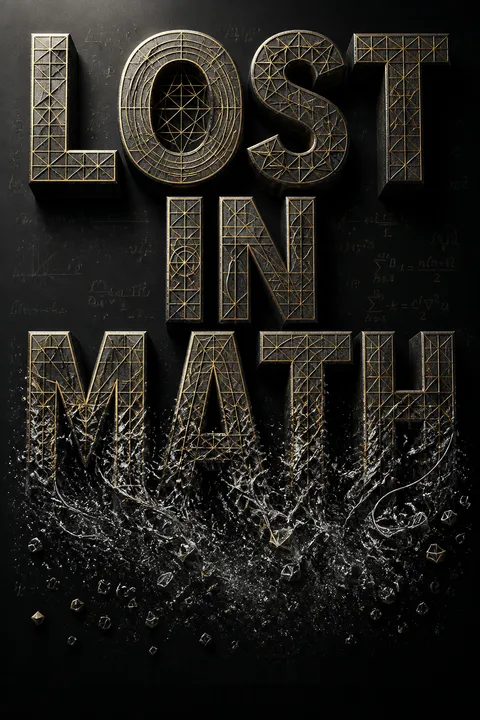


Key Takeaways
Treat beauty as a research hunch, never as evidence of nature.
A useful but risky guide. When experiments are scarce, physicists lean on simplicity, symmetry, and mathematical elegance to decide which ideas deserve attention. These instincts helped build major theories, but Hossenfelder asks whether scientists mistake an appealing pattern in their own mathematics for a clue from nature. Her interviews with leading physicists reveal that beauty can motivate a difficult calculation, reward a moment of insight, or steer a research program. Those roles are not equivalent: motivation can sustain inquiry, while evidence must come from observations that could prove the theory wrong.
A changing intuition. The book follows Hossenfelder’s growing doubt as the Large Hadron Collider finds the Higgs boson but not the extra particles many theorists expected. If beauty were a reliable compass, she argues, decades of confidence should have produced more than elegant, unconfirmed proposals.
What's striking is the distinction between a tool for generating hypotheses and a warrant for believing them. Aesthetic judgment may help researchers search a vast space of possible models, much as intuition helps a mathematician spot a promising proof. But a search strategy earns trust only when its successes and failures are both counted. The book's strongest challenge is not that beauty has no place in science. It is that scientists often leave its influence unmeasured, then describe the resulting preference as if nature itself had endorsed it.
Equations can be flawless and still fail to describe the world.
Two kinds of fit. Mathematics helps physicists make theories precise, internally consistent, and reproducible. Yet a mathematical structure becomes physics only when its terms are connected to things that can be observed. A theory must fit its own logic and the evidence. Hossenfelder illustrates the gap with Einstein: general relativity had the right mathematics, but Einstein still had to work out how Newton’s gravitational potential appeared within it to show that the new theory recovered the older one’s successful predictions.
The data still decide. New theories must account for what established theories already explain, then offer something more. That is a demanding standard, especially when the equations and experiments are far removed from ordinary experience. Mathematical sophistication can make a proposal coherent, but coherence alone cannot tell scientists whether it describes nature.
This is a useful correction to the idea that science is simply mathematics applied to reality. Formal rigor prevents ambiguity and exposes contradictions, but the bridge from symbols to measurements is itself a scientific achievement. The same distinction matters in machine learning: a model can optimize its internal objective while failing on the world it is meant to represent. Still, old experiments can constrain theories strongly even when new tests are unavailable. The book acknowledges this point, so the alternative to aesthetic speculation is not a demand to test every idea immediately.
Symmetry has predicted particles, but history gives beauty no veto.
A real scientific triumph. A symmetry is a pattern of change that leaves the laws of a system unchanged. In the 1960s, Murray Gell-Mann used symmetries to organize the growing list of known particles into families. Gaps in those patterns suggested missing particles, including the omega minus, which was later discovered with the predicted properties. Symmetry also helped physicists develop the Standard Model and unite descriptions of forces.
A record of wrong turns. But beautiful patterns can mislead. Kepler abandoned his attractive model of planetary orbits built from nested solids when observations favored ellipses. The steady-state universe and nineteenth-century vortex theory also attracted support without surviving the evidence. Conversely, Maxwell’s field theory and quantum electrodynamics were criticized as inelegant before becoming central to physics. Past success makes symmetry worth exploring, not automatically true.
Symmetry is powerful because it compresses many observations into a shared rule, and compression can reveal structure that isolated measurements conceal. The caution is a version of survivorship bias: celebrated predictions are easy to remember, while attractive theories that failed often fade from view. A sound appraisal needs both sides of that ledger. Symmetry may be an especially productive language for physics, but usefulness within a domain does not establish that every deeper law must be symmetric.
Naturalness turns an unexplained preference into a false probability.
What physicists dislike. Naturalness is the preference for theories that do not depend on numbers that seem unusually large, small, or delicately balanced. The Higgs boson’s mass became a prominent example: quantum calculations appeared to contribute a value about 10^14 times larger than the observed mass, so the theory seemed to require a remarkably precise cancellation. Supersymmetry was attractive partly because it could reduce this problem and was expected by many to produce new particles within reach of the LHC.
The hidden assumption. Hossenfelder argues that calling a number improbable requires a probability distribution, but physicists have no independent way to know how likely nature’s constants are. The LHC’s failure, as of the book’s publication, to find superpartners forced the proposed theory into greater fine-tuning. That weakens naturalness as a guide, even if it does not prove supersymmetry impossible.
The critique exposes a genuine statistical question: unlikely relative to which distribution, and why that distribution? Without an independently justified prior, claims that nature is improbably tuned can quietly encode the theorist’s expectations. Yet the concern is not useless in every setting. In systems with a well-established distribution, unusual values can signal a missing mechanism. The lesson is to separate a mathematically calculable sensitivity from the additional judgment that the sensitivity makes a theory implausible.
A multiverse can relocate ignorance without removing it.
Many possible universes. Multiverse proposals arise from several routes, including eternal inflation, string theory’s many possible configurations, and interpretations of quantum mechanics. Some physicists use the idea to explain why constants take values compatible with stars, atoms, or other conditions needed for life. This reasoning invokes the anthropic principle: observations are necessarily made from a universe where observers can exist.
The missing measure. To calculate which universe an observer should expect, however, researchers need a probability distribution over possible universes. That distribution is not supplied automatically by the multiverse. Hossenfelder discusses Steven Weinberg’s calculation of the cosmological constant, which assumed a flat distribution of possible values and produced an estimate close to the value later measured. The result is intriguing, but the choice of distribution remains a substantive assumption, not a free consequence of having many universes.
Selection effects are indispensable in many fields: samples only include cases that could enter the sample. The anthropic principle can therefore constrain possibilities without claiming that life is the universe’s purpose. The harder step is converting that constraint into a probability. A multiverse model may become testable through particular consequences, but a probability measure needs its own justification. Otherwise, the explanation risks shifting the question from why this value occurs to why this distribution should be trusted.
Quantum mechanics predicts brilliantly while leaving interpretation unsettled.
Strange, tested behavior. Quantum mechanics gives remarkably accurate predictions, yet its account of measurement troubles physicists. In a long-distance experiment across the Canary Islands, pairs of photons separated by 144 kilometers showed correlations that could not be explained by assuming each photon had a definite polarization before measurement. The correlations do not allow faster-than-light messages, but they do challenge everyday ideas about separate objects carrying fixed properties.
Different stories, same results. Interpretations disagree about what the mathematics means. Some treat the wave function as a real physical state; others treat it as a way to represent knowledge. Decoherence explains why large objects quickly lose observable quantum behavior through interactions with their environments, but does not by itself settle why a measurement yields one outcome. As Hossenfelder’s conversations show, many interpretations remain experimentally indistinguishable.
The important distinction is between a theory’s predictive success and the completeness of its explanation. These are related ambitions, but not identical standards. Competing interpretations can be intellectually valuable because they suggest different questions and experimental designs, even when they currently agree on results. At the same time, discomfort with quantum mechanics is not evidence that it is wrong. A theory need not resemble human intuition, particularly in a domain that ordinary experience never prepared intuition to handle.
Mathematical breakthroughs matter without proving a theory of everything.
A divided record. String theory has not been confirmed as the final description of nature, and its many possible configurations make it hard to identify our universe within the framework. Yet it has produced important mathematical connections. The gauge-gravity duality, for example, shows that certain gravitational theories can be described through different, lower-dimensional gauge theories. String research has also connected ideas in physics and mathematics, including work on black holes and complex geometries.
Promise is not proof. The book sets these achievements alongside the lack of direct experimental evidence and the long chain of assumptions used to connect string theory to our universe. Garrett Lisi’s E8 proposal offers another vivid case: a mathematically ambitious attempt to describe known particles and gravity within one structure, but not an experimentally established theory. Beauty and mathematical fertility can make a program worth studying; neither settles whether it is nature’s choice.
This distinction avoids two easy errors: dismissing a research program because it has not yet made a decisive prediction, or treating its mathematical productivity as confirmation. Mathematics can generate tools that prove useful far beyond the original problem, so theoretical work may have value without delivering a final physical account. The standard should still be explicit about the kind of success being claimed. A mathematical connection, a calculational technique, and an empirically supported theory are different achievements.
When experiments disappear, research communities can mistake repetition for confirmation.
The pressure to continue. Hossenfelder traces how bigger research communities, intense specialization, short-term contracts, grant competition, and publication incentives can favor established programs. Supersymmetry remained popular despite null searches, while models were repeatedly adjusted to accommodate new limits. Dark matter searches produced decades of increasingly sensitive results without a detection. In 2015, a possible excess in two-photon events at the LHC inspired hundreds of papers; by August 2016, the signal had disappeared.
Not just bad judgment. Researchers need peer approval and funding, and familiar work is easier to defend than an unpopular alternative. The book also describes cognitive biases such as confirmation bias, sunk-cost thinking, and the mere-exposure effect, where repeated claims can seem more credible simply because they are familiar. These pressures do not make every result unreliable, but they can make a research community slow to notice that its expectations are unsupported.
The book’s institutional argument is strongest when it explains how individually reasonable incentives can produce collectively poor outcomes. A scientist can sincerely follow a promising tradition while the field as a whole underinvests in alternatives. That resembles a portfolio concentrated in one asset: each investment may look defensible, yet the system becomes fragile. Still, popularity alone cannot diagnose error. A productive program may attract many researchers because it is genuinely useful. The relevant test is whether institutions reward scrutiny as well as expansion.
Fund actual criticism, negative results, and careers that can change direction.
Make correction possible. Hossenfelder’s practical proposals target the conditions that make bias hard to counter. Scientists can describe a theory’s shortcomings as well as its attractions, invite competing researchers into discussions, and publish serious criticism and null results. Institutions can reduce dependence on short-term grants, support researchers changing fields, and create independent reviewers who do not have a personal stake in the research program being assessed.
Protect intellectual freedom. The point is not to replace one rigid checklist with another. It is to make disagreement and course correction viable parts of ordinary science. The book also asks science writers and the public to ask whether researchers’ funding, jobs, or standing depend on producing popular conclusions. When those incentives are invisible, confident claims can sound more settled than the evidence warrants.
These proposals treat objectivity as an institutional design problem rather than a personal virtue. That is a useful shift: people can learn to recognize bias, but incentives determine whether they can act on that recognition without risking their livelihood. Independent review and support for negative findings can improve correction, although neither guarantees it. Any new evaluation system must avoid turning criticism, interdisciplinarity, or publication of null results into yet another box-ticking exercise.
Start with contradictions in evidence, not discomfort with nature’s numbers.
A stronger kind of problem. The book distinguishes aesthetic unease from genuine inconsistency. A theory’s awkward parameter may offend a physicist’s sense of proportion, but it does not necessarily contradict observation. By contrast, the incompatibility between quantum theory and general relativity points to a real gap: existing frameworks cannot consistently describe gravity and quantum matter together in all relevant circumstances. The Higgs boson also answered a concrete consistency problem in the Standard Model, where calculations without it would fail at energies accessible to the LHC.
Keep assumptions visible. Even consistency arguments depend on starting principles that experiments have supported only within tested limits. Hossenfelder’s closing advice is therefore disciplined rather than anti-theoretical: identify the actual problem, state the assumptions, and seek observational consequences. The central question is not whether nature should be beautiful, but whether a proposed description survives contact with what nature does.
Consistency is a powerful filter because it can rule out theories before a new experiment is built. But it cannot select a unique picture of reality without assumptions about what counts as an acceptable theory and which parts of existing physics must be preserved. The book’s three-part discipline is consequently valuable: distinguish a real contradiction from a taste-based complaint, disclose the premises doing the work, and keep empirical checks central. That standard allows mathematical creativity without granting mathematics authority over nature.
Analysis
Lost in Math is both a tour of modern foundational physics and an argument about how scientific communities choose what to believe before decisive experiments are possible. Its central distinction is between aesthetic criteria as search heuristics and aesthetic criteria as evidence. Symmetry, simplicity, and naturalness can help researchers navigate an enormous space of possible theories, but the book shows how easily a useful preference becomes an unexamined claim about what nature must be like.
The case is strongest when it follows specific expectations into contact with null results: supersymmetry and extra dimensions were repeatedly presented as discoverable prospects, while the LHC found no supporting particles. Hossenfelder also makes a careful conceptual point about naturalness. A claim that a parameter is improbable needs a probability distribution, and choosing that distribution is itself a theoretical commitment. The multiverse can broaden the explanatory picture, but it does not make the measure problem vanish.
The argument is less persuasive if read as a demand that theory wait passively for new data. In mature fields, experiments are expensive, and theoretical constraints from existing measurements are real. Mathematical consistency can exclude many proposals and guide experimental design. The practical issue is not whether physicists may use judgment, since research selection always requires judgment. It is whether the community can distinguish judgments that have earned calibration from those sustained chiefly by familiarity, prestige, and professional incentives.
That makes the institutional chapters essential rather than incidental. A field can be full of honest researchers and still reproduce a narrow consensus if funding, hiring, and publication favor continuity. The book’s prescription is not to abandon elegant theories, but to expose their assumptions, support criticism, and make changing course less costly. Its lasting lesson is methodological humility: treat beauty as a source of questions, consistency as a constraint, and experiment as the arbiter of physical claims.
Review Summary
Lost in Math by Sabine Hossenfelder critically examines the current state of theoretical physics, arguing that the pursuit of mathematical beauty has led the field astray. Hossenfelder interviews prominent physicists, questioning their reliance on aesthetic criteria like symmetry and naturalness in developing theories. The book highlights the lack of experimental evidence for popular theories and the challenges facing modern physics. While some readers find the technical content challenging, many praise Hossenfelder's honest and thought-provoking approach. The book sparks important discussions about the scientific method and the future of physics research.
People Also Read







Glossary
naturalness
Preference against unexplained numbersA criterion used in theoretical physics that favors theories without very large or small dimensionless numbers, or delicate cancellations between large terms. Such numbers are called unnatural because physicists suspect they need an explanation. Hossenfelder argues that this judgment is not a probability calculation unless a justified distribution over possible values is supplied.
fine-tuning
Sensitive parameter adjustmentA situation in which a theory’s parameters must be set with unusual precision for its predictions to match observation. In the book’s central example, large contributions to the Higgs mass appear to require a near-cancellation to yield the measured value. The term describes a mathematical sensitivity, while judging that sensitivity implausible requires further assumptions.
symmetry
A change leaving laws unchangedA property of a physical theory in which a specified transformation leaves its laws unchanged. A rotation is a familiar example when the laws do not depend on direction. In particle physics, more abstract symmetries organize particles and restrict possible interactions. Symmetries have guided important discoveries, though their past success does not establish that every fundamental law must be symmetric.
separation of scales
Small-scale details often decoupleThe observed pattern that the details of a system at very short distances often have little effect on its behavior at larger distances. This allows physicists to describe atoms, materials, or galaxies using effective laws without tracking every smaller constituent. The concept helps explain why different levels of nature can have their own useful objects and descriptions.
effective laws
Approximate laws at a resolutionDescriptions that work accurately at a particular scale or resolution, even if they are not fundamental. For example, chemistry can use atoms and their electron structure without modeling every detail of quarks and gluons. Effective laws may need revision as experiments probe finer scales, but their limited scope does not make them inaccurate for the domain where they work.
anthropic principle
Observer-based constraint on possibilitiesThe observation that any universe observed by living beings must permit conditions in which observers can exist. In cosmology, this can rule out some possible values of physical parameters if those values would prevent structures such as stars or stable atoms. It does not by itself establish a probability distribution or show that our universe is the only one compatible with life.
multiverse
A collection of possible universesA proposed collection of universes or universe-like regions, which may differ in history, physical laws, or parameters. The book discusses versions arising from eternal inflation, string theory, and interpretations of quantum mechanics. Some variants may have observable consequences, but many are not directly testable, and statistical predictions require a rule for assigning probabilities across possibilities.
decoherence
Environmental disruption of quantum linksThe process by which interactions with an environment rapidly suppress observable quantum interference between parts of a system. It helps explain why large objects do not ordinarily display obvious superpositions, even without a person measuring them. In the book’s account, decoherence does not by itself explain why measurement yields one particular outcome.
gauge-gravity duality
Equivalent gravity and gauge descriptionsA mathematical correspondence in which certain gravitational theories can be reformulated as gauge theories, often in a space with one fewer dimension. Developed through string theory research, the duality gives physicists ways to study problems that are difficult in one description by using the other. It is an important theoretical result, but does not establish that string theory describes our universe.
non-empirical theory assessment
Judging theories beyond direct testsThe evaluation of a theory using considerations beyond its agreement with observations, such as whether alternatives exist, whether its mathematics has succeeded elsewhere, or whether it connects previously separate ideas. Such judgments are practically important when experiments are difficult or delayed. Hossenfelder argues that they should not replace empirical testing and that aesthetic preferences within them need to be made explicit.
FAQ
What is Lost in Math: How Beauty Leads Physics Astray by Sabine Hossenfelder about?
- Exploration of beauty in physics: The book investigates how aesthetic ideals like beauty, elegance, and symmetry have shaped modern theoretical physics, sometimes leading research astray.
- Crisis in foundational physics: Hossenfelder discusses the current crisis where many popular theories remain untested, and the gap between theory and experiment has widened.
- Critique of scientific practice: The author questions the reliance on non-empirical criteria and highlights the influence of social and cognitive biases in the physics community.
- Call for reform: The book advocates for clearer assumptions, stronger empirical guidance, and cultural changes in how physics is practiced.
Why should I read Lost in Math by Sabine Hossenfelder?
- Insider’s perspective on physics: The book offers a candid look at the culture, sociology, and psychology of physicists, revealing how community beliefs and biases shape research.
- Accessible explanations: Hossenfelder explains complex topics like supersymmetry, string theory, and the multiverse in clear, non-technical language suitable for a broad audience.
- Critical reflection on science: Readers are encouraged to question the role of beauty and aesthetics in scientific progress and to think critically about how science is conducted.
- Practical advice for improvement: The book provides suggestions for scientists, administrators, and the public on how to foster objectivity and progress in physics.
What are the key takeaways and warnings from Lost in Math by Sabine Hossenfelder?
- Beauty can mislead science: While aesthetic criteria have guided successful theories, they are subjective and can bias research, leading to dead ends.
- Empirical test is essential: Reliance on beauty without experimental confirmation risks turning physics into speculation rather than science.
- Need for new methods: As experiments become more difficult, physicists must develop better criteria for theory assessment and remain cautious about overvaluing aesthetics.
- Awareness of biases: Recognizing and addressing social and cognitive biases is crucial for scientific self-correction and progress.
What are the main concepts of beauty and naturalness in Lost in Math by Sabine Hossenfelder?
- Beauty as a scientific guide: Physicists often equate beauty with symmetry, simplicity, and explanatory power, but Hossenfelder warns this is subjective and potentially misleading.
- Naturalness and fine-tuning: Naturalness is the idea that fundamental parameters should not require improbable fine-tuning, but the book argues this is an aesthetic, not a scientific, criterion.
- Problems with these criteria: Many beautiful and “natural” theories, like supersymmetry, have not been experimentally confirmed, suggesting these concepts may not reliably guide discovery.
- Call for explicit assumptions: Hossenfelder stresses the importance of clearly stating when aesthetic judgments are influencing theory choice.
How does Sabine Hossenfelder define and critique "naturalness" in Lost in Math?
- Definition of naturalness: A theory is considered natural if it avoids unexplained fine-tuning of parameters, meaning it does not require very large or small numbers without reason.
- Aesthetic and historical roots: Naturalness originated as an aesthetic preference for proportion and order, later formalized in technical terms.
- Failures in practice: The Higgs boson mass and the lack of supersymmetric particles challenge the reliability of naturalness as a guiding principle.
- Circular reasoning risk: Hossenfelder argues that naturalness is often circular and lacks a rigorous mathematical or empirical foundation.
What is the role and status of supersymmetry (susy) in Lost in Math by Sabine Hossenfelder?
- Supersymmetry’s appeal: Susy is praised for its mathematical elegance, unification of forces, and potential to solve the Higgs mass naturalness problem.
- Lack of experimental evidence: Despite decades of searches, no supersymmetric particles have been found at the LHC or elsewhere, challenging the theory’s naturalness argument.
- Social reinforcement: The book discusses how belief in susy is partly driven by social dynamics and collective momentum within the physics community.
- Future prospects: Continued non-detection may require physicists to accept fine-tuning or reconsider the value of naturalness and beauty in theory development.
How does Lost in Math by Sabine Hossenfelder address string theory and its controversies?
- String theory’s mathematical beauty: The book acknowledges string theory’s rich mathematical structure and its unification of gravity and quantum mechanics.
- Lack of uniqueness and testability: String theory predicts a vast landscape of possible solutions, making it unclear if it uniquely describes our universe and currently lacks testable predictions.
- Community dynamics: Hossenfelder describes string theory as having devoted followers and internal controversies, such as the firewall paradox and failure to predict new particles.
- Philosophical concerns: The reliance on non-empirical theory assessment in string theory raises concerns about loosening the scientific method’s requirement for testability.
What does Lost in Math by Sabine Hossenfelder say about the multiverse and anthropic reasoning?
- Multiverse as a response to fine-tuning: The multiverse hypothesis is proposed to explain why fundamental constants appear fine-tuned for life, suggesting many universes with different laws exist.
- Scientific and philosophical challenges: Multiverse theories are difficult or impossible to test experimentally, raising questions about their scientific legitimacy.
- Emotional and intellectual struggle: Some physicists find the multiverse unsettling, as it challenges hopes for unique, elegant explanations of nature.
- Caution urged: Hossenfelder and others warn against treating the multiverse as established science and emphasize the importance of empirical testability.
How does Lost in Math by Sabine Hossenfelder describe the relationship between mathematics and physics?
- Mathematics as a tool: Physics uses mathematics to enforce logical rigor, internal consistency, and clear communication.
- Math keeps physicists honest: While one can be wrong with math, it prevents self-deception and ensures reproducibility.
- Physics is not just math: Theories must also be consistent with observations; having the right math is only part of having the right theory.
- Limits of mathematical beauty: Mathematical elegance alone is not sufficient for scientific truth without empirical support.
What alternative theories and approaches are discussed in Lost in Math by Sabine Hossenfelder?
- Garrett Lisi’s E8 theory: Lisi proposes a geometric unification using the exceptional Lie group E8, aiming to describe all particles and forces, though it remains incomplete and not widely accepted.
- Xiao-Gang Wen’s qubit model: Wen suggests that space and particles emerge from fundamental quantum bits, challenging conventional assumptions about the nature of reality.
- Other alternatives: The book mentions loop quantum gravity, asymptotically safe gravity, technicolor, and causal fermion systems as other frameworks with different assumptions.
- Importance of openness: Hossenfelder encourages considering diverse ideas and warns against social biases that marginalize unconventional theories.
How does Lost in Math by Sabine Hossenfelder explain the impact of social and cognitive biases in physics?
- Human nature in science: Scientists are influenced by desires for beauty, social acceptance, and career pressures, leading to confirmation bias and groupthink.
- Echo chambers and popularity: Theoretical physics communities often reinforce popular ideas, making it difficult for alternative views to gain traction.
- Impact on progress: These biases slow scientific self-correction and contribute to the persistence of untested or unfalsifiable theories.
- Need for reform: The author calls for education about biases, cultural changes in academia, and institutional measures to promote critical thinking and diversity.
What practical advice and methods does Sabine Hossenfelder offer in Lost in Math to improve scientific progress?
- State assumptions clearly: Researchers should explicitly declare their assumptions, especially when based on aesthetic or philosophical grounds.
- Focus on empirical guidance: Theories must be connected to observations and experiments; non-empirical assessments are insufficient.
- Learn about biases: Scientists and administrators should educate themselves about cognitive and social biases and implement measures to counteract them.
- Encourage criticism and diversity: Scientific communities should foster open debate, support negative results, and allow researchers to change fields without penalty.
What are the best quotes from Lost in Math by Sabine Hossenfelder and what do they mean?
- On beauty and science: “If the laws weren’t beautiful, we wouldn’t have found them.” —Frank Wilczek. This reflects the belief that beauty has historically guided successful theories, but the book questions whether this remains valid.
- On the scientific method: “To my mind that’s a step backwards by a thousand years... it’s undermining the nature of science.” —George Ellis, criticizing attempts to loosen testability requirements in physics.
- On cognitive biases: “The most problematic distortion in science is that we consider a fact to be more likely the more often we have heard of it.” —Sabine Hossenfelder, highlighting attentional bias and echo chambers.
- On the state of physics: “The old rules for theory development have run their course.” —Sabine Hossenfelder, emphasizing the need for new standards in theory assessment and scientific practice.
- On the pursuit of knowledge: “Physics, it might seem, was the success story of the last century... The next breakthrough in physics will occur in this century. It will be beautiful.” —Sabine Hossenfelder, ending on an optimistic note about future discoveries.
About the Author
Other books by Sabine Hossenfelder
Download PDF
Download EPUB
.epub digital book format is ideal for reading ebooks on phones, tablets, and e-readers.








