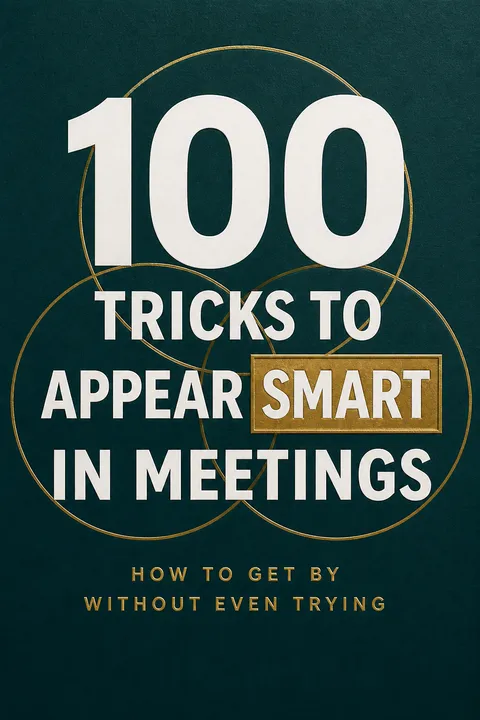


Key Takeaways
Meetings reward visible competence, sometimes more than actual contribution
The book’s central joke. Cooper treats the meeting as a stage where people display leadership, fluency, and attention, whether or not they are following the discussion. Her comic opening claims that workers spend an implausible 75 percent of their waking lives in meetings, then describes meetings that plan more meetings or should have been emails. The inflated numbers signal the book’s method: office habits are pushed just past reality until their absurdity becomes visible.
Visibility compounds. Appear smart in one meeting, the joke goes, and you may be invited to more meetings where you can appear smart again. The cycle is funny because it turns career advancement into a performance loop, not a measure of useful work.
The satire lands because organizations often have trouble observing contribution directly. Attendance, confidence, and quick verbal responses are easier to notice than careful work completed afterward. That gap helps explain why the book’s shallow gestures feel recognizable rather than purely fantastical. Yet visible competence is not always empty: concise updates and attentive listening can make coordination easier. The useful distinction is whether a signal helps others understand the work or merely creates an impression of importance. Cooper’s premise is a sharp warning against mistaking the performance for the outcome.
Ask broad questions to look strategic without offering a solution
Reframe the discussion. When a meeting becomes crowded with opinions, the book’s would-be operator asks everyone to reconsider the underlying problem. Other reliable moves include asking whether a proposal can grow at scale, whether the current process is right, or whether the team is using its resources wisely. The questions sound consequential, but the satire depends on their vagueness: they can redirect almost any conversation without requiring the speaker to know the answer.
Borrow the room’s labor. A similar trick is to draw an inaccurate diagram and let colleagues debate its labels. The person who initiated the detour can then step back while everyone else supplies the substance. These tactics make intervention look like strategy, even when it has not moved the work forward.
A broad question can be genuinely useful when a group has lost sight of its objective. The distinction is whether the question narrows uncertainty or merely transfers the burden of thinking to everyone else. Cooper’s examples expose how easily strategic language can gain authority before it earns it. A practical test is simple: after asking a framing question, can the speaker name what decision it should help the group make? If not, the question may be theater rather than leadership.
Use the whiteboard as a stage, not proof of insight
Visible work looks important. Cooper’s catalogue of whiteboard moves ranges from circling a word such as vision to drawing boxes, arrows, axes, or a rough project timeline. The drawings need not clarify anything. In the book’s comic logic, the act of standing up and marking the board is enough to make colleagues assume that a leader has arrived.
Let others decode it. The diagrams are designed to provoke debate over labels, priorities, and what the shapes are supposed to represent. That debate gives the person at the board a chance to appear as the meeting’s catalyst while the group does the interpretive work. The joke is not that diagrams are useless, but that a visual aid can borrow credibility from the appearance of structure even when its content is hollow.
A shared visual can help a group think by making relationships and assumptions visible. That is precisely why empty diagrams are such effective props: they imitate a real tool for collective reasoning. The test is whether the drawing makes a claim that participants can examine, revise, or use to decide something. If the group spends its energy guessing what a chart means, the image is adding ceremony rather than clarity. Cooper’s parody makes the difference between visual communication and visual authority memorable.
Turn posture, timing, and props into signals of authority
Stage the entrance. The book turns small logistics into a comic leadership kit: arrive with refreshments, sit close to the meeting’s organizer, write on the board, and carry a notebook. During discussion, pacing, looking thoughtful, stepping out, or changing seats can make a person seem busy and consequential. Even facial expressions become signals, from a furrowed brow to a carefully timed smile.
Make attention look tangible. In a one-on-one, the same approach appears as nodding, writing occasional words, or responding as if new information were already familiar. These gestures imitate care and concentration without requiring either. The point is not that body language has no meaning. It is that the book treats every physical cue as a costume piece in a workplace where observers may infer competence from what they can see.
People do read posture and timing as social information, so these behaviors can shape how a colleague experiences a meeting. But the signals are ambiguous: looking away might suggest reflection, boredom, or distraction, depending on the person and context. Cooper’s escalating list reminds readers that no gesture reliably proves intelligence or concern. A better use of the insight is to notice whether meeting conventions reward visible confidence more than attentive listening, especially for people whose communication styles differ from the local norm.
On calls, manufacture presence with interruptions and process checks
Make your presence audible. In the book’s conference-call playbook, a participant checks who has joined, asks people to mute background noise, requests the latest document, or interrupts to make sure everyone is looking at the data. Brief reactions and comments about the caller’s location also announce that the person is present, even if attention has wandered.
Presentations offer another stage. Cooper suggests absurd ways to appear prepared: use dramatic slides with little content, invite questions, postpone answers, or ask the audience to supply the closing lessons. The common thread is control over the format. Instead of showing expertise through an argument, the performer manages pauses, transitions, and procedure so the room notices their command of the event.
Remote and phone-based meetings make attention harder to judge, which gives procedural signals extra weight. Some of the book’s tactics, such as confirming a shared document or reducing background noise, can genuinely prevent confusion. Their value depends on purpose and timing. Repeated interruptions can also fragment the group’s concentration and elevate the interrupter over the person with the relevant information. Cooper’s joke offers a useful filter: does the process check help the meeting proceed, or is it simply proof that someone wants to be heard?
Treat networking as theatrical status work, not instant intimacy
Carry the performance outside. At networking events, business dinners, and team offsites, the book’s tactics shift from meeting jargon to social choreography. A person can make an ordinary job sound secret and high-tech, pretend to recognize a reference, introduce two people with exaggerated ceremony, or use a carefully timed exit to imply a waiting crowd. Even hands need a job: hold a drink, adjust glasses, or reach for food at the right moment.
Manufacture connection. Offsites call for enthusiastic reactions and vague claims that an activity relates to team problems. At dinner, a laptop bag, a worldly toast, or talk about innovation can imply importance. Cooper’s joke is that people may spend more effort acting connected than learning anything about the people around them.
Networking does involve signals of openness and belonging, but the book exposes the weakness of treating every interaction as a transaction. A polished introduction can create a real connection if it helps two people find common ground; pretending to know a subject merely postpones embarrassment. The distinction is between social ease that lowers the cost of conversation and status theater that makes others props. Cooper’s absurd instructions are useful as a diagnostic: they reveal how quickly the goal of building relationships can slide into managing appearances.
Notice when workplace advice asks women to absorb bias
The satire sharpens. In a chapter about women in male-dominated workplaces, Cooper offers deliberately ridiculous instructions: adopt sports comparisons, learn about expensive cars, deliver high fives, and praise men’s socks. She also mocks advice to make every statement sound forceful and to laugh off being invited merely to improve gender representation.
The target is the rulebook. These suggestions parody the expectation that women must decode and imitate masculine-coded behavior to be taken seriously, while also absorbing unfair treatment quietly. The humor becomes more pointed than the book’s general jokes about meeting rituals because the social cost is not evenly shared. The advice is not a sincere checklist for women. It exposes how much extra performance a biased workplace can demand from them.
The chapter’s irony matters because a joke about adaptation can be mistaken for an endorsement of adaptation. Its target is not women’s communication, but a workplace that treats one group’s habits as the neutral standard and asks others to conform. The strongest reading keeps responsibility with the institution: participation should not require someone to suppress a natural speaking style or laugh off tokenism. The satire also raises a practical question for managers: whose behavior is being called confident, and whose is being called difficult?
Meetings can multiply by disguising themselves as the solution
The calendar reproduces itself. Cooper jokes that a meeting can be renamed a huddle, check-in, or fun event without ceasing to be a meeting. Cheerful room names and forced rituals change the packaging, not the underlying experience. An email chain can also be converted into a meeting, and a gathering to discuss fewer meetings can run out of time and require another gathering.
Afterward, keep the cycle alive. The book extends the performance into follow-up: send thank-you notes, complain about the number of meetings, propose a postmortem, or schedule a conversation that keeps getting postponed. These gestures look like organizational care while preserving the machinery that generated the busywork. The recurring joke is that activity can become its own evidence of progress.
The meeting-about-meetings joke captures a familiar organizational trap: process intended to solve friction can become another source of friction. Rituals and recurring check-ins are not inherently wasteful; they can coordinate work when a group needs shared decisions. The sharper question is whether each gathering has a clear purpose, an appropriate set of participants, and a concrete result. Cooper’s comic cycle encourages readers to inspect the calendar as a system, not just blame individual attendees for being unproductive.
Power determines whether bizarre meeting behavior reads as genius
Status changes the story. In its final sections, the book treats famous historical gatherings as corporate case studies, turning events such as the pyramids, the Last Supper, and the Knights of the Round Table into absurd management lessons. The historical framing makes a joke of executives who retrofit familiar events into business language.
Privilege permits spectacle. Cooper’s unverified executive anecdotes include a leader calling in while skydiving, another dining alone while a team reports to him, and an executive receiving a massage during a meeting. The behavior is presented as impressive only because the person has enough status to make others accommodate it. The joke lands on the unequal rules: eccentricity can look visionary from the top and disruptive from below.
These stories expose how the same behavior can receive different interpretations depending on rank. A powerful person’s unusual meeting ritual may be treated as innovation, while a less senior employee’s deviation may be judged as unserious. The examples are intentionally comic and, as the book itself labels them, unverified; they should not be treated as evidence that spectacle produces good decisions. Their value is diagnostic: they show how authority can shape the story people tell about an action before its usefulness is known.
Analysis
Sarah Cooper’s book is best understood as satire disguised as an instruction manual. Its structure moves through the workplace’s stages of performance: entering a conference room, claiming space during the discussion, managing presentations and calls, then carrying the act into networking, dinners, and follow-up. The repetition is deliberate. A tactic that seems silly once becomes recognizable when the book applies the same logic to every setting: display a cue of competence, let other people infer expertise, and avoid being pinned to a substantive claim.
That mechanism connects to Erving Goffman’s account of social life as performance. People manage impressions through roles, settings, and props, especially when others cannot directly observe their intentions or ability. Cooper makes the props literal: a marker, a notebook, a laptop bag, a carefully timed interruption. The satire also resembles signaling theory, in which observers use visible behaviors as imperfect evidence of hidden qualities. A visible signal may be informative, but it can also be copied by someone who lacks the quality it is supposed to indicate.
The book’s deepest subject is therefore not individual laziness. It is an organization’s difficulty distinguishing activity from value. Meetings reward what can be observed in the room, while useful work may be quiet, delayed, or hard to attribute. The gender chapter complicates the joke by showing that the performance burden is uneven: some workers are asked to adopt dominant norms and tolerate treatment others can ignore.
The advice is deliberately unsafe as literal guidance. Interrupting, feigning knowledge, and manufacturing urgency can damage trust, even if they briefly command attention. Read as a diagnostic instead, the book helps identify hollow rituals and status games. A productive meeting needs more than a convincing performance: it needs a purpose, a decision or shared understanding, and clarity about what happens next. The comic value lies in seeing how often organizations substitute the performance for those outcomes.
Review Summary
100 Tricks to Appear Smart in Meetings is a humorous satire of corporate culture, offering tongue-in-cheek advice on appearing intelligent in workplace meetings. Readers found it hilarious and relatable, recognizing many of the behaviors described. Some appreciated its wit and sarcasm, while others felt it hit too close to home. The book's illustrations and quick-read format were praised. While most enjoyed it as comedy, a few found it less amusing or potentially encouraging negative behaviors. Overall, it's seen as an entertaining take on office life, particularly resonating with those experienced in corporate settings.
People Also Read
Glossary
The Kanye
Status through interruptionA comic label for interrupting a colleague’s project update only to emphasize that the update matters, then handing the floor back. The interruption claims symbolic control of the moment without supplying the update’s substance. The book presents this as a way to dominate meeting optics, not as a sound facilitation technique.
meeting sneak attack
An unplanned work conversationThe book’s playful term for an impromptu interaction framed as a quick question, check-in, or chat. Its tactics focus on appearing welcoming while delaying, redirecting, or ending the exchange. The phrase expands the book’s satire beyond scheduled meetings to everyday encounters that can interrupt work.
Emotional Intelligence Plan
A catalogue of meeting facesA satirical section that assigns workplace meanings to facial expressions and gestures, such as a furrowed brow, a blank stare, or an approving smile. It treats nonverbal behavior as a repertoire for appearing engaged or authoritative, exaggerating the idea that colleagues can reliably infer thoughts from a face.
FAQ
What's "100 Tricks to Appear Smart in Meetings" about?
- Satirical Guide: The book is a humorous take on how to appear intelligent in meetings without actually contributing meaningfully. It offers 100 tricks to help you navigate corporate environments.
- Meeting Dynamics: It explores various meeting scenarios, from general meetings to one-on-ones, and provides strategies to seem engaged and smart.
- Author's Experience: Sarah Cooper draws from her experiences at Yahoo! and Google, where she observed and documented these tricks.
- Cultural Commentary: The book also serves as a commentary on corporate culture and the often superficial nature of workplace interactions.
Why should I read "100 Tricks to Appear Smart in Meetings"?
- Humor and Insight: The book provides a comedic yet insightful look at corporate life, making it a fun read for anyone who has ever attended a meeting.
- Relatable Content: If you've ever felt lost or bored in a meeting, this book offers relatable content that can make you laugh at the absurdity of it all.
- Practical Tips: While satirical, some tips can genuinely help you navigate meetings more confidently.
- Cultural Understanding: It offers a deeper understanding of the unspoken rules and dynamics in corporate settings.
What are the key takeaways of "100 Tricks to Appear Smart in Meetings"?
- Appearances Matter: The book emphasizes that in many corporate settings, appearing smart can be as important as actually being smart.
- Simple Tricks: It provides simple tricks like drawing Venn diagrams or asking presenters to go back a slide to appear engaged.
- Meeting Dynamics: Understanding the dynamics of meetings can help you navigate them more effectively, even if you're not fully engaged.
- Humor in the Workplace: The book highlights the importance of humor and not taking oneself too seriously in the workplace.
How does Sarah Cooper suggest you "own the room" in meetings?
- Strategic Positioning: Sit near the meeting leader to appear as if you're co-running the meeting.
- Body Language: Use confident body language, like leaning back and clasping your hands behind your head, to project intelligence.
- Engagement Tactics: Write key words on the whiteboard and make eye contact with colleagues to seem engaged.
- Subtle Dominance: Use pacing and strategic sighs to make others wonder about your thoughts and insights.
What are some "Whiteboard Tactics" mentioned in the book?
- Draw Meaningless Diagrams: The book suggests drawing simple diagrams like circles or arrows to appear smart, even if they don't make sense.
- Use Buzzwords: Incorporate terms like "vision" or "strategy" in your drawings to give the impression of deep thinking.
- Create Complexity: Draw complex-looking flowcharts or models to intimidate others with your supposed intelligence.
- Engage the Room: Use the whiteboard as a tool to engage colleagues in discussions, even if the content is superficial.
How can you "sound smart" on conference calls according to Sarah Cooper?
- Ask About Attendance: Start by asking if everyone is present, showing your concern for inclusivity.
- Discuss the Weather: Mention the weather or time zone differences to appear personable and engaged.
- Mute Background Noise: Request that non-speaking participants mute themselves to demonstrate leadership.
- Use Affirmative Phrases: Interject with phrases like "That's exciting" or "Very cool" to show you're following along.
What are some "Advanced Meeting Power Moves" from the book?
- Skydiving Conference Call: One anecdote involves a tech executive giving a presentation while skydiving, showcasing extreme multitasking.
- Solo Lunch Meeting: Another story describes an executive who eats lunch alone during meetings, emphasizing his importance.
- Bring a Masseuse: Attending meetings while receiving a massage is suggested as a way to appear relaxed and in control.
- Intense Multiday Meetings: Propose long, intensive meetings to tackle big issues, showing commitment to problem-solving.
How does Sarah Cooper address "Networking Events"?
- Avoid Name Tags: Not wearing a name tag can make you seem rebellious and memorable.
- Use Buzzwords: Describe your work using terms like "proprietary" and "technology" to sound impressive.
- Feign Familiarity: Pretend to know about topics you haven't heard of to maintain an air of intelligence.
- Exit Strategies: Use phrases like "I have people waiting on me" to gracefully exit conversations.
What does Sarah Cooper suggest for "Teambuilding Offsites"?
- Wear Activewear: Show up in yoga or running gear to give the impression of being active and health-conscious.
- Relate Activities to Work: Make vague statements about how the activities relate to team challenges to appear insightful.
- Express Enthusiasm: Say you wish you could do these activities every day to seem like a team player.
- Encourage Participation: Ask for group high-fives or cheers to foster camaraderie and enthusiasm.
What are some "Emotional Intelligence" tips from the book?
- Facial Expressions: Use specific facial expressions to convey understanding or skepticism, like furrowing your brow or smiling slyly.
- Body Language: Adjust your posture and gestures to match the tone of the meeting, showing engagement.
- Subtle Cues: Use subtle cues like nodding or tilting your head to appear thoughtful and attentive.
- Expressive Reactions: React to statements with exaggerated expressions to show you're actively listening.
How does Sarah Cooper suggest handling "Impromptu Meetings"?
- Welcome the Meeting: Stop what you're doing and greet your coworker warmly to appear approachable.
- Set Boundaries: Start with a hard stop to manage your time and keep the meeting brief.
- Involve Others: Pull someone else into the conversation to share the focus and responsibility.
- Request Documentation: Suggest documenting the conversation via email to avoid lengthy discussions.
What are the best quotes from "100 Tricks to Appear Smart in Meetings" and what do they mean?
- "Perception is reality." This quote underscores the book's theme that appearing smart can be as impactful as being smart in corporate settings.
- "No one pays attention in meetings." It highlights the often superficial nature of meetings and the need for strategies to appear engaged.
- "The smarter you appear, the more meetings you’ll be invited to." This reflects the cyclical nature of corporate life, where appearances can lead to more opportunities.
- "Ask if we’re asking the right questions." This tactic is about questioning the process itself to seem insightful and thoughtful.
Download PDF
Download EPUB
.epub digital book format is ideal for reading ebooks on phones, tablets, and e-readers.








