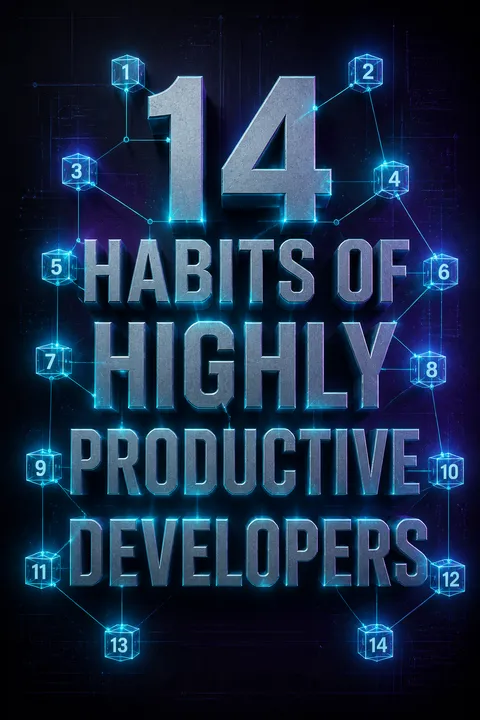


Key Takeaways
Build the habits that make you effective across tools and technologies
Habits outlast tools. The book’s central question is not which programming language, computer, or framework guarantees success. It is what repeated behaviors help developers keep learning, solving problems, and working well with others. The author draws on conversations with experienced engineers across companies including Google, Amazon, Microsoft, Shopify, and The New York Times, looking for practical patterns rather than a universal career formula.
The resulting 14 habits cover learning, daily work, career choices, teams, and life. Their common thread is consistency: focus on useful learning, write understandable code, communicate clearly, and keep improving without mistaking frantic effort for progress. The habits are meant to be adapted to a developer’s circumstances, not followed as a rigid checklist.
The book’s strongest premise is that career effectiveness is less like buying the right instrument and more like maintaining a practice. Tools matter, but their value depends on the judgment and routines around them. This shifts attention from novelty to repeatable behavior, a useful correction in a field where new releases can make yesterday’s expertise feel obsolete. The collection format also makes the advice approachable, though interviews with successful engineers show what worked for them, not a controlled comparison of what causes success.
Treat technology hype as noise until it solves your actual problem
Filter before learning. Developers face a constant stream of advice about the best operating system, language, or framework. The author describes moving from Windows to macOS and later trying Ubuntu, only to conclude that no tool is universally best. He calls the useful information a signal and the distracting churn noise. JOMO, or the joy of missing out, means being content with current skills while remaining open to learning when there is a good reason.
Before investing deeply in a technology, ask what problem it solves, whether it improves your work or the user experience, whether it fits your project’s requirements, and whether real organizations use it in production. A simple priority list, such as this week, next month, and next year, can keep every new trend from becoming an emergency.
This is a practical form of attention management: selection is not the enemy of curiosity, but what protects it from becoming scattered. The same logic applies to any field with a fast-moving information supply. A deliberate trial can reveal whether a tool is useful without requiring full commitment. One caution is that production adoption can lag behind genuinely valuable innovations, so it is a helpful signal rather than a final verdict. The goal is informed experimentation, not reflexive conservatism.
Learn fundamentals deeply enough to explain every important choice
Practice without shortcuts. At university, the author’s professor required students to write HTML and CSS in Notepad, without the conveniences of a modern editor. A forgotten character could break the result, so students had to understand what each line did. The point is not to abandon helpful tools. It is that convenience can hide gaps in understanding.
For software developers, fundamentals include algorithms, logic, networking, accessibility, security, and user experience. These ideas help developers reason beyond the particular framework or task in front of them. To learn a new language, the book’s interviewees recommend applying it to a familiar project, consulting its documentation and existing code, and asking experienced peers to review the work. That keeps the learning challenge focused on the language itself.
Fundamentals act as portable knowledge: when a framework changes, an understanding of networks, security, or user needs can still guide decisions. The Notepad story makes the cost of abstraction visible, but it should not be mistaken for a claim that less capable tools always teach better. Editors and automation reduce needless friction. A sound learning sequence is to use those tools while periodically investigating what they conceal, especially when a bug or design choice depends on a deeper concept.
Teach a concept publicly to discover what you only thought you knew
Explanation exposes gaps. The author had delivered more than 100 conference presentations, yet still felt anxious before going onstage. Preparing talks forced him to read, organize ideas, build examples, and explain the material clearly. Audience questions then revealed where his explanation was confusing or incomplete. The learner often benefits as much as the audience.
Teaching does not require expert status or a large stage. Developers can write an article, record a screen demonstration, share a project with coworkers, or present at a meetup. The key is to explain the idea to another person, rather than merely recognize it while reading. Turning private understanding into a public explanation tests whether the concept can stand on its own and gives other people something useful in return.
Teaching combines retrieval, organization, and feedback. That makes it a powerful learning activity: a person must bring knowledge to mind, decide what matters, and notice where communication breaks down. It also turns expertise into a shared resource rather than a private advantage. The book’s emphasis on public teaching is valuable, but public exposure is not the only route. A careful explanation to one colleague can provide the same intellectual test without requiring a conference stage or a taste for performance.
Choose a steady engineering pace over recurring heroic sprints
Consistency keeps you playing. The book contrasts short-term contests with an infinite game, a situation whose rules can change and whose aim is to continue rather than reach a final victory. Software development fits this model: tools evolve, new people enter the field, and products keep changing. A developer who relies on all-nighters may finish one urgent task, but cannot make that pace a durable strategy.
The interviewees describe strong colleagues as reliable, organized, and willing to do careful work: testing, documenting, communicating, and helping when production problems arise. Extra effort can be necessary for a deadline or emergency. The warning is against making crisis mode the default. Long-term progress depends on work habits that leave a person able to think clearly and contribute again tomorrow.
The infinite-game lens changes the meaning of productivity. Instead of maximizing output in one isolated week, it asks whether a working pattern preserves capacity across many weeks. That is a useful systems perspective because fatigue can degrade judgment, not just reduce available hours. Still, consistency is not an excuse to ignore genuine emergencies, and individual discipline cannot repair chronic understaffing or unrealistic deadlines. Sustainable practice requires both personal boundaries and organizations that do not treat exceptional effort as normal capacity.
Write code so a stranger, including future you, can maintain it
Code loses its context. A project can feel obvious while its author is immersed in it, then become baffling after a year away. The author urges developers to write for that future version of themselves, who may have forgotten why a function exists or what a short variable name means. Readable code makes intention easier to recover.
Use meaningful names, prefer straightforward solutions over clever displays of technique, and add tests that help explain expected behavior. Commit and pull request histories can preserve why decisions were made. When a line requires too much surrounding knowledge to understand, simplifying it, breaking it into smaller parts, or documenting its rationale can reduce the burden on whoever must change it. The future reader may be you, a teammate, or someone maintaining a legacy system.
Readable code is a form of empathy across time. It recognizes that the person maintaining a system may lack the original author’s context, and it reduces the amount of knowledge that must be reconstructed before a change is safe. Tests and version history extend that memory beyond comments. There is a balance: documentation can become stale, and excessive abstraction can make simple work harder to follow. The most useful record is the one that clarifies intent without duplicating what the code already says.
Use free time to grow without letting work consume your life
Invest deliberately. A developer’s day job may limit exposure to particular tools, technologies, or kinds of problems, so learning outside work can broaden skills. The book suggests that even small, regular investments can matter. Yet it explicitly rejects sacrificing sleep, family responsibilities, or every weekend to programming. One interviewee describes stepping back from extra technical study when a heavier workload made it stressful, then making room for exercise, games, and other hobbies.
The useful question is not whether every developer should code after hours. It is whether a chosen skill needs extra practice and whether there is a sustainable way to get it. A short reading session, a small experiment, or a personal project may be enough. Rest and relationships are not evidence of a lack of ambition; they are part of a life that a career must fit within.
This advice contains a real tension: the book argues that career growth can require effort beyond paid work, while also warning against turning every spare hour into labor. That tension matters because access to free time varies with caregiving, health, income, and working conditions. A better interpretation is to invest intentionally when the investment serves a chosen goal, rather than treating unpaid work as a universal measure of commitment. Sustainable learning includes knowing when not to add another obligation.
Understand the business problem before building the requested feature
Solve the need, not the wording. Developers translate requirements into software, but requirements can describe a proposed solution rather than the underlying problem. The book calls this the XY problem: asking how to achieve a particular solution, X, when the real need is Y. In one example, bank users wanted old Excel data moved into a new system. A team planned a month-long importer, until a developer learned that exporting to CSV and using an existing import feature would solve the problem.
Learning the business vocabulary and speaking with users or stakeholders can prevent unnecessary work. It also helps developers recognize which parts of a system deserve extra care, anticipate unusual cases, and prioritize under deadlines. Technical skill remains essential, but domain understanding can make that skill more useful by directing it toward the actual source of the user’s difficulty.
This is a strong argument for treating software work as problem framing, not just implementation. The CSV example shows how a technically plausible feature can be wasteful when the team accepts the proposed solution without checking the need. Cross-functional contact improves the information available for design decisions. The caution is that business context is not automatically a reliable specification: users may disagree, and stakeholders may have competing incentives. Good discovery therefore includes clarifying whose problem is being solved and how success will be recognized.
Use side projects as low-risk laboratories, not unfinished empires
Experiment at manageable scale. A side project can build a portfolio, introduce a new technology, create an open-source tool, or simply provide a playful outlet. The book notes that Twitter, Craigslist, and Slack began as side projects, but commercial success is only one possible outcome. Interviewees describe projects that helped them learn design, programming languages, and engineering practices beyond the limits of their day jobs.
Before choosing an idea, ask whether the subject genuinely interests you, who experiences the problem, what you hope to get from the work, and whether the scope is realistic. A long commitment makes sense for an idea intended to grow, but an experiment does not need to become a five-year obligation. Keeping the project small enough to finish is often more useful than designing an ambitious product that never reaches anyone.
The laboratory metaphor helps separate learning value from market success. A project can be worthwhile even when it attracts no users, provided it produces practice, insight, or a useful contribution. The famous product examples are inspiring but also create survivorship bias: countless side projects do not become companies. That is not a reason to avoid them. It is a reason to choose a success criterion the builder controls, such as completing a feature, testing an idea, or sharing the result.
Choose career depth by fit, and stay while impact still grows
Careers need both depth and range. A specialist develops substantial expertise in a focused area, which can bring technical authority and access to roles that need that depth. A generalist moves across technologies and problem types, offering flexibility, especially in startups or consulting. Each path has risks: a narrow specialty can become less portable, while broad experience can make it harder to demonstrate deep expertise.
The book’s Mario and Sonic comparison adds a question of tenure. Frequent moves can expose a developer to new settings, particularly early in a career, but short stays may limit the chance to understand a system and improve it over time. One interviewee stayed at Yahoo! for nearly ten years, moving through projects and roles. The point is not to stay by rule, but to look for continued learning, autonomy, and meaningful impact.
The specialist-generalist choice is better understood as a shifting allocation of attention than a permanent identity. Deep skill can create leverage, while breadth helps people transfer ideas and recognize when a familiar solution does not fit. The same flexibility applies to job tenure: staying can produce context and ownership, but loyalty alone is not a career strategy. A useful test is whether the role still supports learning and contribution, rather than whether a particular number of years has elapsed.
Make collaboration reliable by listening first and estimating with humility
Coordination is engineering work. Teams include people with different roles, experiences, and assumptions. Active listening means trying to understand a colleague’s point before preparing a reply. The author suggests waiting until others have spoken before contributing, especially in difficult conversations. In remote teams, clear context in messages, issues, and pull requests helps people work across time zones and reduces unnecessary misunderstanding.
Estimates need the same respect for context. Software tasks include testing, reviews, meetings, and surprises, not only coding. Break large work into smaller tasks, communicate assumptions, and use ranges when uncertainty is substantial. The book cites guidance to divide estimates into tasks of no more than two days and to compare actual time with the estimate afterward. Estimation is a way to reason together, not a promise of perfect prediction.
Listening and estimation both improve coordination by making hidden assumptions easier to see. Listening checks whether people share an understanding of the problem; explicit estimates expose uncertainty about effort and scope. Neither skill guarantees agreement, but both make disagreement more informative. There is also a power dimension: a junior developer may have less freedom to challenge an unrealistic deadline. Teams become more accurate when people can revise estimates as evidence changes, rather than being judged for failing to predict unknowns.
Spend energy on controllable choices, then turn wishes into tasks
Replace rumination with action. While writing during the COVID-19 pandemic, the author felt anxious about events he could not control, including public health and the economy. He focused instead on choices available to him, such as how to respond and where to direct his attention. The book also recounts Isaac Newton returning to his family home during the Great Plague of London, where he worked on ideas in mathematics and natural philosophy.
The same approach applies to personal ambitions. A wish to change jobs becomes concrete when a person identifies target employers, skills to build, and interviews to pursue. A plan to move abroad can be broken into language practice, savings, and visa research. Constraints are real, but naming the next possible step makes a goal more actionable than repeating what is wrong.
The distinction between controllable and uncontrollable factors can interrupt helpless rumination, while a task list converts intention into observable behavior. The Newton story illustrates what focused work can look like during disruption, but it should not imply that every crisis offers unusual creative opportunity. People face different constraints, and action does not control outcomes. The more modest value is agency over the next decision: it does not erase uncertainty, but it gives attention somewhere useful to go.
Analysis
The book’s structure is deliberately practical: fourteen short habits, grouped around learning, daily work, career, teams, and personal life, supported by interviews with experienced developers. That makes it easy to browse and gives the advice a useful range of voices. It also means the book is a collection of principles rather than a single tested theory. Its most persuasive insights are those grounded in the mechanics of software work: tools distract, hidden requirements waste effort, context decays, and estimates fail when coding is treated as the whole task.
Beneath the advice is a model of professional competence with three linked parts. First, technical judgment comes from fundamentals and selective learning. Second, reliability comes from repeatable practices such as testing, readable code, and realistic planning. Third, influence comes from understanding users and communicating across roles. This model usefully expands the stereotype of the programmer as someone who only writes code. In practice, software quality depends on choices made before coding and coordination that continues after it.
The book is most vulnerable when individual habits appear to carry too much explanatory weight. Consistency and initiative matter, but they do not neutralize poor management, inaccessible opportunities, discrimination, or lack of free time. Advice to study outside work can help some developers and burden others. Its own emphasis on balance points toward a better reading: habits are tools for agency, not proof that every career outcome is personally deserved.
The strongest application is therefore selective. Readers can identify one friction point, such as learning without direction, coding without context, or estimating without feedback, and choose a practice that addresses it. The book does not promise a guaranteed route to success. It offers a set of ways to make everyday engineering more thoughtful, durable, and useful to other people.
Review Summary
14 Habits of Highly Productive Developers receives mostly positive reviews, with readers appreciating its concise, actionable advice for developers at various career stages. Many find the book's structure, including "TODO" sections and expert interviews, helpful. While some experienced developers feel the content is basic, beginners find it particularly valuable. Readers praise the author's writing style and the book's ability to provoke reflection on career habits. Some criticisms include its brevity and occasional clichéd advice, but overall, it's recommended for developers seeking productivity insights.
People Also Read



Glossary
JOMO
Contentment with missing outJOMO means the joy of missing out. In the book, it is a counterweight to fear of missing out on new tools, frameworks, or technologies. It encourages developers to value what they already know while staying open to learning when a new option is relevant to their goals or work.
finite game
A game with a winnerA finite game has known players, fixed rules, and an agreed objective that can be won or lost. The book uses this idea to describe short-term contests and contrasts it with software development, where tools and participants change and there is no final victory that ends the work.
infinite game
A game played to continueAn infinite game has both known and unknown participants, rules that can change, and the aim of continuing rather than winning once and for all. The book applies this concept to programming: software and technologies keep evolving, so sustainable learning and work matter more than a single burst of performance.
XY problem
Solving a proposed solutionThe XY problem occurs when someone asks how to implement a proposed solution, X, without first clarifying the underlying need, Y. In the book’s example, a team plans a custom tool to move spreadsheet data, though exporting to CSV and using an existing import feature would solve the users’ actual problem.
Download PDF
Download EPUB
.epub digital book format is ideal for reading ebooks on phones, tablets, and e-readers.








