

Key Takeaways
Capitalism turns mass production into a contest to serve ordinary buyers
From status to service. Mises contrasts feudal Europe, where social position was largely inherited, with an economy that lets people try new work and rise or fall through changing fortunes. He traces capitalism's beginnings to producers making affordable goods for ordinary people, not just luxuries for the wealthy. To show the scale of change, he compares England's roughly six to seven million people in 1750 with more than fifty million by his lecture era, living at a much higher standard.
Customers can switch. A business leader may look like a king, but the comparison breaks down when customers can take their spending elsewhere. Railroads once seemed unassailable; buses, cars, trucks, and airplanes challenged them by serving travelers differently. In Mises's account, competition means the freedom to find a better way, not merely copy the incumbent.
What's striking is the shift from judging capitalism by the size of its firms to asking whom their output serves and how easily customers can leave. That makes competition a process of discovery, not simply a large number of sellers. The account also links economic change to social mobility: inherited rank loses some force when new enterprises create new routes upward. A necessary qualification is that purchasing power shapes which needs count as demand. Consumer choice can discipline producers, but it does not by itself ensure fair access, prevent pollution, or protect people with little money.
Use government to secure liberty, not to assign people's economic lives
Freedom has conditions. Mises does not define freedom as escape from every limit. People depend on society, and economic freedom means having room to choose a career, make plans, trade, and cooperate with others. He assigns government the task of protecting people and property against violence and fraud, while leaving ordinary economic decisions to individuals.
Rights are connected. If government controls every printing press, it can decide which arguments appear. If it directs production, it can also assign jobs and locations. Mises uses attempts to police drinking as a warning: once officials claim authority to protect people from their own choices, the same reasoning can reach books, art, and ideas. Freedom includes the ability to make mistakes and to persuade others without using state force.
The argument is strongest as a warning about concentrated power. Economic control can create leverage over speech and livelihood even when a constitution formally protects them. This connects civil liberty to institutional design: rights need independent spaces where people can work, publish, and organize without seeking official approval. Still, political freedom is not reducible to market freedom. Public institutions can protect speech and equal treatment, while markets can contain private concentrations of power. The useful question is not simply whether government acts, but whether its action protects shared rules or gives officials discretion over particular people's choices.
A central planner cannot compare production choices without market prices
Feasible is not worthwhile. An engineer may know how to build several machines or factories, but technical possibility does not reveal which use of labor and materials is most valuable. Mises says businesses compare costs using money prices for inputs, including raw materials, equipment, and labor. Remove markets for those inputs, and planners lose a common measure for weighing competing uses.
Knowledge is scattered. A single authority must also recognize valuable ideas before they can be pursued. Mises points to military experts who dismissed aviation and to proposals for steam-powered ships that Napoleon did not grasp. He argues that the Soviet system could consult prices from world markets, so its existence did not demonstrate that a fully planned economy could calculate without market prices. These examples make his case about both calculation and discovery.
This is a problem of information as much as arithmetic. Prices compress many changing judgments into signals that producers can use without knowing every buyer's reasons. The broader lesson is that decentralized systems can discover options no central office has anticipated. Yet prices do not measure every social consequence. A project can appear profitable while shifting costs onto people who are not part of the transaction. Market calculation is powerful for comparing traded inputs, but it is not a complete measure of public value or justice.
A price ceiling cannot manufacture the goods it makes cheaper
Interventionism defined. Mises uses this term for government interference with market outcomes, such as prices, wages, interest, and profits. His milk example shows how one control can produce further problems. A legal price below the market price encourages more buyers, while producers facing costs above that price may cut production or leave the business. Shortages and queues follow, even though the policy aimed to make milk easier to obtain.
Controls spread. Officials may then cap fodder prices to help dairy farmers, then regulate fodder inputs and wages. Rent controls, Mises argues, similarly discourage new housing and reduce incentives to move. He cites failed price edicts under Roman emperor Diocletian and revolutionary France to show that force cannot make a shortage disappear. In his account, isolated controls can push governments toward managing more of production.
The causal chain is memorable because it asks what producers and consumers do in response to a rule, not just what the rule intends. That is a useful test for policy: identify the incentive created, then follow the adjustment into related markets. The warning is not that every temporary price limit must end in comprehensive planning. A government might pair emergency measures with steps that expand supply or target aid directly. Mises's account is most persuasive as a diagnosis of controls that ignore those responses, not as proof that every intervention has identical consequences.
Inflation rewards early recipients while quietly taxing late ones
New money arrives unevenly. Mises defines inflation as an increase in the money supply that reduces money's purchasing power. The effects do not appear evenly or all at once. In his wartime example, munitions businesses and workers receive new money first and can spend it before many prices have adjusted. Teachers and ministers, whose incomes adjust later, face higher costs without an immediate matching increase in pay.
The shortcut has an end. Governments can print or create money instead of raising taxes, but the new spending competes for goods that have not multiplied. Mises recounts Germany's 1923 collapse, when workers hurried to exchange wages for goods as the mark lost value. He presents a gold standard as a constraint on governments that might otherwise finance new programs by expanding the money supply.
The distributional lens improves on treating inflation as a single change in an average price index. Who receives new money, through which channel, and when prices and wages adjust all affect who gains and loses. That insight remains useful even when inflation has causes beyond direct government spending. The account's main caution is its tendency to place monetary expansion at the center of the explanation. Supply disruptions, changing demand, and expectations can also move prices. The mechanism explains why new money has uneven effects, without making every price increase evidence of the same policy failure.
Give workers more capital per person, not just higher wage decrees
Tools raise output. Mises argues that better equipment lets a worker produce more in the same time, giving employers room to pay more. He calls the value added by a worker's contribution marginal productivity of labor. In his account, countries with more capital goods per person can support higher productivity and living standards than countries relying on older tools.
Savings fund expansion. When savings reach businesses through banks or insurers, entrepreneurs can buy materials, start projects, and hire workers. Workers and suppliers may benefit before the investor knows whether the project will succeed. Mises uses Henry Ford's higher wages to illustrate how a growing business may need to attract workers. He rejects the Marxian prediction that workers must remain near subsistence, while warning that wage rates forced above what employers can sustain may leave some people unemployed.
The useful distinction is between announcing a higher wage and increasing the productive capacity that can sustain it. This links saving, investment, equipment, and wages in a concrete causal sequence. It also puts development policy beyond a simple argument over generosity: the question becomes what enables each hour of work to produce more. But higher productivity does not automatically guarantee that workers receive a fair share of the gains. Bargaining power, labor institutions, and competition shape how output is divided, so capital formation matters without settling the distribution question.
Poorer countries need dependable investment, not protectionist promises
Capital travels. Mises describes British investment in railways, gas companies, and industry abroad as a major force in nineteenth-century development. Countries short of domestic savings could gain equipment and infrastructure without first recreating every stage of Britain's earlier industrial growth. Investment could also raise demand for local labor and, in his argument, put upward pressure on wages.
Trust affects the flow. Foreign investors expect to keep the returns on their investments. Expropriation, currency restrictions, or discriminatory taxes make future investment less attractive. Mises recounts Indian prime minister Jawaharlal Nehru's effort to invite investment while promising not to socialize it for ten years, an assurance Mises considered inadequate. He argues that tariffs cannot substitute for capital: protecting a local industry does not itself provide the tools or funds needed to expand production.
The account makes investment a relationship across borders, not a gift from rich countries to poor ones. Its emphasis on predictable rules identifies a real condition for long-term commitments: investors must have some confidence that agreements will hold. The argument also illuminates why protection can preserve a business without making it more productive. A qualification matters, however. Capital alone does not ensure broad development. Local skills, public infrastructure, accountable institutions, and the distribution of returns influence whether investment improves life beyond the enterprise receiving it.
Track the organized minority behind every supposedly national economic favor
Special favors shape politics. Mises calls an organized group seeking a policy benefit at others' expense a pressure group. He describes legislators negotiating coalitions among producers and other interests, rather than debating only what benefits the country as a whole. In his examples, tariffs and government purchases support sugar and silver interests, while agricultural price programs affect consumers who may prefer lower prices.
Ideas set the agenda. Benefits can be concentrated among a visible group while costs are spread across taxpayers and consumers. That pattern encourages political demands for more spending while making the bill harder to acknowledge. Mises argues that interventionist policies grow from ideas promoted by intellectuals and politicians, so persuasion matters: citizens need to examine who gains, who pays, and what incentives follow. His proposed remedy is public argument for policies that leave people room to cooperate freely.
This section joins economics to political science through a problem of collective action: a small group with a large stake may organize more easily than a vast public each bearing a modest cost. The lens helps reveal why a policy labeled national can serve a narrow constituency. It should not, however, discredit every organized interest. Workers, consumers, and excluded communities may need collective representation to be heard at all. The sharper distinction is between participation that broadens accountability and lobbying that secures a protected advantage while hiding its costs from everyone else.
Analysis
The lectures form a connected argument rather than a catalogue of policy opinions. Mises begins with the transformation of production: entrepreneurs make goods for mass customers, and the possibility of losing those customers disciplines firms. He then treats economic choice as part of social freedom, contrasts market coordination with central direction, and follows government controls through their effects on production. Inflation appears as a politically attractive way to spend without openly taxing, while foreign investment and savings explain how tools and productive capacity can grow. The final lecture connects economic rules to political incentives, especially the ability of organized groups to capture benefits while distributing costs widely.
The book's greatest strength is explanatory sequence. Its examples make abstract mechanisms concrete: milk controls become shortages, new money reaches some incomes before others, and a protected producer may gain while consumers pay more. Readers can carry forward a set of diagnostic questions: What information does this policy suppress? How will people respond to the incentive? Who receives the benefit, and who bears the cost?
Its limits follow from the same clarity. Mises often presents market coordination as a powerful corrective without giving comparable attention to market failures, unequal bargaining power, or costs imposed on people outside transactions. His claim that intervention tends toward comprehensive control is a warning about cumulative rules, not an inevitable law. Nor does productivity alone determine how gains are shared. Institutions, public choices, and distribution remain part of the economic problem, even when prices coordinate production effectively.
The lectures were delivered to a general audience in Argentina in 1959, and their polemical confidence reflects that setting. Their continuing value lies less in treating every historical comparison as conclusive than in learning to inspect causal chains. The book asks readers to resist policies judged only by intention and to examine the institutional consequences that follow.
Review Summary
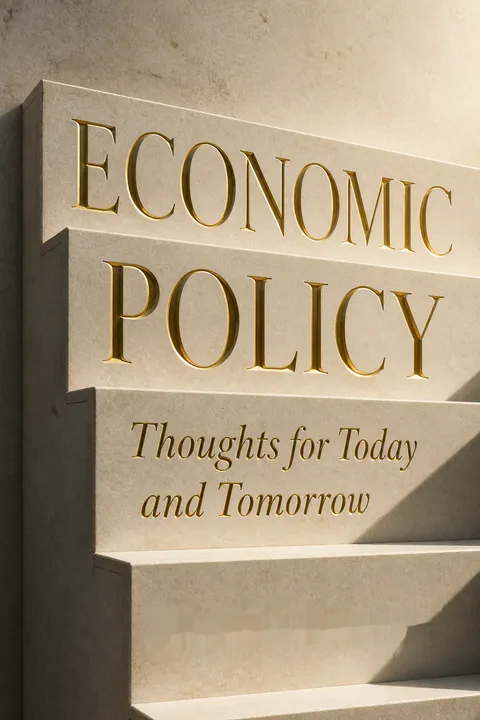
Economic Policy: Lessons for Today and Tomorrow receives mostly positive reviews for its clear explanation of basic economic principles from a free-market perspective. Readers appreciate Mises' simple language and historical examples, finding it accessible for newcomers to economics. Some criticize its lack of data and oversimplification of complex issues. The book covers topics like capitalism, socialism, government intervention, and inflation. While many praise its insights, others view it as overly biased against government involvement in the economy. Overall, it's considered a concise introduction to liberal economic thought.
People Also Read






Glossary
Economic freedom
Choice within social cooperationMises uses economic freedom to mean that individuals can choose how to participate in social production and exchange, including their work and personal plans. It is not freedom from every constraint. It depends on social rules that protect people from force and fraud while allowing voluntary cooperation through markets.
Market economy
Coordination through exchangeA market economy is a system in which people coordinate production and consumption through buying, selling, and the prices that emerge from exchange. Mises stresses that the market is not merely a physical place. It is an ongoing process through which individuals cooperate in a social division of labor.
Economic calculation
Comparing uses of resourcesEconomic calculation is the use of money prices to compare alternative uses of resources, including labor, raw materials, and machinery. Mises argues that planners need prices for production inputs, not just finished goods, to judge which technically possible projects are economically worthwhile. Without market prices for those inputs, such comparisons lose their basis.
Interventionism
Government direction of marketsInterventionism is government interference in market outcomes beyond protecting people against violence and fraud. Mises includes controls on prices, wages, interest, and profits. He argues that a measure aimed at one market can alter incentives and create pressure for controls on related markets, potentially expanding government direction over production.
Marginal productivity of labor
Value added by a workerMarginal productivity of labor refers to the additional value a worker's contribution adds to production. Mises uses the concept to explain why workers with better tools may produce more and why employers' ability to pay depends on the value customers place on the resulting output. It is a theory of wage determination, not a guarantee of fair distribution.
Pressure group
Organized pursuit of special favorsA pressure group is an organized interest seeking policy benefits, such as tariffs, subsidies, or restrictions on competitors. Mises uses the term to describe political coalitions that can secure advantages for particular groups while spreading the costs among taxpayers and consumers. His concern is that such bargaining can displace consideration of the public as a whole.
About the Author



Download PDF
Download EPUB
.epub digital book format is ideal for reading ebooks on phones, tablets, and e-readers.








