

Key Takeaways
Build wealth by owning good businesses patiently, not chasing quick wins
A costly first lesson. Sean Seah began investing after a short trading course, made an early profit, then persuaded friends to give him money to manage. Within three months, he had lost more than half of the $100,000 he raised. His turning point came when he stopped treating investing as a shortcut and studied Warren Buffett's approach. The book's central idea is value investing: buy shares in solid businesses at sensible prices, then give those businesses time to grow.
Process beats a windfall. The authors argue that lasting wealth comes from repeated choices, including saving, studying companies, and resisting impulsive trades. Their story makes the shift vivid: investment skill is learned, but learning only helps when it changes behavior.
What's compelling is the move from a painful loss to deliberate learning, rather than the promise of a secret formula. That arc resembles skill acquisition in other fields: feedback matters only when people examine what went wrong and change their method. Still, Sean's later success is a survivor story, not proof that the same strategy will make every reader wealthy. The more reliable lesson is procedural: avoid decisions you cannot explain, and treat losses as evidence to investigate rather than as a cue to gamble harder.
Save before spending, so compounding has capital to work
Reverse the payday routine. The authors recommend setting aside at least 10% of income before paying for discretionary spending. Mary illustrates the cost of small repeated purchases through her son, who bought about two coffees a day at more than $5 each. She helped him switch to making coffee at home. The point is not that every treat is wasteful. It is that recurring spending can quietly crowd out saving.
Make saving build gradually. One workshop participant began by saving $1 in the first week, $2 in the next, and continued increasing the weekly amount until saving $52 in week 52. The exercise turns saving into a rising, repeatable challenge rather than an all-or-nothing resolution.
The strongest insight is behavioral, not mathematical: saving first removes the need to negotiate with oneself at the end of the month. Behavioral economics calls this commitment, arranging a choice in advance so a future impulse has less power. The coffee example makes recurring costs visible, though it should not become a moral test of every small pleasure. Nor should eye-catching compounding projections be mistaken for promised returns. The controllable action is the saving rate; investment performance remains uncertain.
Treat work, health, and character as assets requiring upkeep
Protect the person behind the portfolio. The authors describe Nebraska Furniture Mart's Rose Blumkin, who sold the business to Buffett at 89 and continued working until 104. Her attachment to the work illustrates how meaningful work can sustain effort. The book also treats the body and mind as long-term assets, urging readers to build habits around exercise and eating well.
Choose an inner standard. Buffett's inner scorecard asks whether a person values how they actually behave or mainly how others judge them. The authors connect this to integrity, intelligence, and energy, arguing that ability without honesty can become dangerous. Their exercise is simple: name qualities admired in others, then practice them until they become habitual.
This section broadens financial success beyond account balances. Work design, physical capacity, and reputation all shape a person's ability to earn and make sound decisions. The inner scorecard also resembles the distinction between intrinsic motivation and status seeking: one is guided by standards that persist when applause disappears. Yet passion is not a universal career solution. Work can be meaningful without being a calling, and health advice must fit individual circumstances. The useful principle is stewardship, not perfection.
Insure against ruin before risking money for growth
Keep a liquid reserve. The authors suggest holding at least three months of living expenses in accessible savings, separate from investment money. Sean learned the value of liquidity when his child arrived prematurely and hospital costs exceeded the cash he had available because most of his money was invested. He later kept six months of expenses in reserve.
Stop debt from multiplying. Alan's credit-card balances grew to several times his monthly salary. He then used new cards and mobile-phone deals to raise cash, worsening the problem before he and Sean listed each debt and interest rate and repaid them one by one. The authors also recommend insurance for medical costs and lost income, while warning against borrowing to invest when losses would be unaffordable.
A reserve is more than a pile of cash. It prevents a temporary shock from forcing the sale of investments at a bad time or pushing a household toward expensive borrowing. Insurance serves the same broad purpose by transferring risks too large for one family to absorb. The precise reserve and coverage needs vary with income stability, dependents, and local health systems, so the book's figures are starting points rather than universal prescriptions. Its core risk principle is sound: protect against financial ruin before optimizing returns.
Stay inside your competence, and mine daily life for ideas
Know what you can judge. Buffett's circle of competence is the set of businesses an investor can understand well enough to assess. The boundary matters more than its size. The authors suggest starting with companies that earn your money, receive your spending, match your expertise, or connect with genuine interests. A familiar shop, regularly purchased product, or service used at work can be a starting point for research.
Generate leads, not conclusions. The book also points readers toward financial news, company lists, and the portfolios of experienced value investors. These sources can reveal candidates, but a familiar brand or famous investor's purchase is not a reason by itself to buy. Each business still needs independent examination.
Familiarity can help an investor ask better questions, much as domain knowledge helps a researcher notice meaningful anomalies. But being a customer is not the same as understanding a company's economics. A popular product may come from a weak business, and a celebrated investor may have a different time horizon or risk tolerance. The useful sequence is to use everyday observation to generate hypotheses, then test them against business evidence. Knowing the edge of one's knowledge is a form of intellectual risk control.
Prefer businesses with advantages competitors cannot quickly copy
Look for durable protection. An Economic Moat is a lasting business advantage that helps a company attract customers, defend profits, or withstand competition. The authors describe four sources: a strong brand, scale that lowers costs, legal protection such as patents, and high switching costs that make changing providers difficult. A familiar example is business software that organizations are reluctant to replace because retraining and compatibility changes are expensive.
Ask whether the edge lasts. A brand matters financially only if customers keep choosing it, including when the company charges more. Patents expire, and technology leaders can be displaced. The authors recommend asking what the business provides, whether alternatives exist, why customers choose it, and whether that reason is likely to endure. Companies can have several advantages, but none should be assumed permanent.
The moat metaphor directs attention away from a product's current popularity and toward the mechanisms that protect its profits. Switching costs and scale can create powerful feedback loops: more customers make a service more useful or less costly, which can attract still more customers. But an advantage must be measured in business outcomes, not admired as a brand story. The framework is most useful as a set of questions, not a label. Competitive protection can erode as technology, regulation, or customer preferences change.
Use statements to separate durable performance from attractive stories
Read the business in three views. The balance sheet shows what a company owns and owes; the income statement records revenue, costs, and profit; the cash-flow statement tracks cash actually received and spent. The authors' checklist asks whether equity grows, debt stays manageable, profits remain positive across ten years, return on equity is consistently high, and free cash flow is positive.
Check the pattern, not one year. Their fictional examples contrast Wong's steady, modest restaurant profits, Ahmed's growing consultancy, and Jane's construction company, whose results swing sharply with the cycle. Return on equity compares profit with shareholders' equity. The book treats a debt-to-equity ratio below 50% and return on equity above 15% as useful guideposts, not substitutes for understanding the company.
The three statements correct different blind spots. Reported profit can rise while customers have not paid, and cash can improve temporarily because suppliers have not yet been paid. Reading them together is a basic form of triangulation: each view constrains the others. Still, accounting ratios are not neutral facts. Asset values, depreciation, and one-time events require interpretation, while appropriate debt levels differ across industries. The checklist is strongest as a prompt to investigate patterns, not as an automatic scoring system.
Pay less than a conservative estimate of business value
Use a method that fits the business. The authors explain several valuation approaches. Net-Net compares a company's current assets, less all liabilities, with its share price; Graham's approach seeks a price no higher than two-thirds of that value. Price-to-book compares share price with book value, and the book suggests looking for a ratio of 0.8 or less. For earnings-based valuation, it proposes comparing a company's price-to-earnings ratio with its historical average and seeking a 30% discount.
Build in room for error. Dividend investors are told to check a decade of payment consistency and seek a yield at least two percentage points above the risk-free rate. A growth formula also estimates value using earnings per share and expected growth. These are different tools for different business types. A discount matters because estimates can be wrong, assets can sell for less than book value, and growth can disappoint.
The unifying idea is not any single ratio but the refusal to pay as though forecasts were certain. A margin of safety is especially valuable when evidence is incomplete, because valuation is an estimate rather than an observable fact. The methods also have clear limits: asset-based measures fit some firms better than service businesses, while growth formulas depend heavily on assumptions about the future. Historical averages can mislead when a company's economics have changed. Conservative inputs matter more than impressive precision.
Diversify to survive mistakes, and size holdings by conviction
Plan the portfolio before buying. The authors suggest deciding how much money to invest and how much to keep in cash, limiting any one stock to 10% of the portfolio, and assigning larger positions to businesses judged stronger. They recommend reviewing holdings at least annually, using company reports and unusual developments to reassess the business.
Allow for being wrong. Buffett's portfolio contains many holdings, and the authors argue that diversification can keep one bad choice from destroying an investor's capital. Mary describes having once put all her investment money into a single stock and learning that even a promising business can fail. The book also notes that Buffett sometimes held more cash when he considered the market expensive, rather than forcing money into unattractive opportunities.
Diversification is a practical answer to uncertainty about individual companies, not an admission that research is pointless. Position limits reduce the damage of an analytical error, while differentiated sizing can reflect varying confidence. The tension is real: excessive diversification can make it difficult to understand what one owns, while too little makes a portfolio fragile. The book's allocation rules are heuristics, not a complete plan; a suitable portfolio also depends on liquidity needs, time horizon, and capacity to tolerate losses.
Sell when the business deteriorates, not merely when prices move
Separate price from performance. The authors advise against selling solely because a share price rises or falls. If a stock drops, review whether the company's long-term prospects have weakened. If they remain sound and the price is attractive, the authors say an investor might hold or buy more. If the price rises, reassess value rather than automatically taking a profit.
American Express illustrates the distinction. In 1963, a salad-oil fraud left American Express facing substantial losses, and its share price fell by about 43% in less than three months. Buffett judged the underlying business more durable than the crisis suggested and invested heavily. The lesson is not that every plunge is a bargain. A price decline is a reason to investigate, not proof that the market is wrong.
This approach counters the tendency to treat market prices as direct verdicts on business quality. The American Express episode shows how separating a company's core operations from a damaging event can reveal mispricing. But the same discipline must permit selling: investors can become attached to a thesis and reinterpret every warning as temporary. Periodic review, explicit reasons for owning a stock, and attention to changed fundamentals help distinguish patience from denial.
Make patience and independent judgment your edge over market noise
Skill is not the same as IQ. The book recounts how Isaac Newton sold South Sea Company shares for a profit, bought back at a higher price amid market excitement, and suffered a major loss. It contrasts this with Buffett's decision to avoid the dot-com boom, even while critics mocked his stance. The authors argue that investors need patience, focus, and the ability to make decisions without simply following popular opinion.
Keep the method plain. Their final roadmap is to save regularly, build an emergency fund, obtain suitable insurance, clear consumer debt, and invest for the long term. They emphasize steady learning and independent analysis over constant trading. The desired investor is not someone who predicts every turn, but someone who knows what they own and can wait for a sensible opportunity.
Newton's experience is a compact lesson in the gap between analytical brilliance and emotional self-control. Markets reward neither intelligence nor contrarianism in isolation; a lonely position is not automatically a wise one. The useful standard is evidence: understand the business, state what would change the thesis, and avoid letting crowd excitement dictate a decision. Patience works when paired with review. Without review, it can become stubbornness; without patience, even sound analysis can be abandoned too early.
Analysis
The book is structured as a practical ladder: build financial habits, find businesses, judge their durability, read their accounts, estimate value, and manage a portfolio. Its strongest contribution is that it treats investing as a sequence of decisions rather than a hunt for a hot stock. The reader is repeatedly asked to move from observation to evidence: notice a business in daily life, understand its competitive advantage, inspect long-term financial records, and then compare price with an estimate of value. That sequence is memorable and more useful than any isolated ratio.
The opening story of Sean's losses gives the method human stakes, while the fictional companies make accounting less intimidating. The book's distinction between profit and cash is particularly valuable for beginners. Its emphasis on liquidity, debt control, and diversification also recognizes that survival is a precondition for compounding. These ideas complement modern behavioral insights: automatic saving reduces reliance on willpower, while a written investment rationale can limit decisions driven by panic or excitement.
The main caution is that the book sometimes presents rough rules as if they travel easily across businesses. A 50% debt-to-equity ceiling, a 15% return on equity target, or fixed discounts to book value and historical earnings cannot account for every industry, accounting convention, or stage of company development. The growth formula depends on forecasts, and the book's examples of very high long-term returns are arithmetic scenarios, not dependable expectations. A calculation can be exact while its assumptions are wrong.
The most responsible reading is therefore to treat the checklists as questions, not commands. Buffett's approach requires judgment about business quality, management, competitive change, and price. Beginners may also need to compare this active research burden with simpler diversified investment approaches. The book teaches a coherent value-investing vocabulary, but its lasting lesson is epistemic humility: invest only where evidence is legible, leave room for error, and never confuse confidence with certainty.
Review Summary
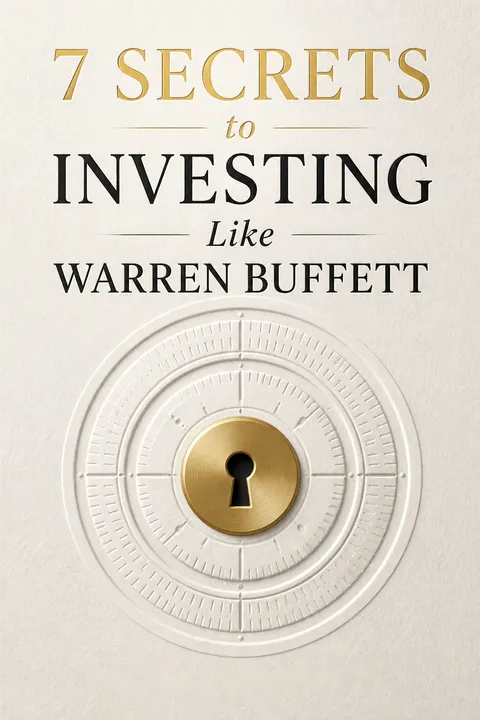
7 Secrets to Investing Like Warren Buffett is generally well-received as an accessible introduction to value investing. Readers appreciate its simple language and clear explanations of financial concepts, making it ideal for beginners. The book covers basics like reading financial statements, valuation methods, and portfolio management. Some find it too basic for experienced investors, while others value its practical advice and insights into Buffett's strategies. Criticisms include overuse of Buffett's name for marketing and oversimplification of complex topics. Overall, it's seen as a solid starting point for novice investors.
People Also Read






Glossary
Value investing
Buying businesses below estimated valueAn investment approach that treats shares as ownership in businesses. The investor studies a company's economics and estimates what the business is worth, then seeks to buy its shares for less than that estimate. The difference provides a margin for error. In this book, the approach emphasizes understandable businesses, durable advantages, financial strength, and patient ownership.
Circle of competence
Businesses an investor understandsThe range of businesses an investor can evaluate with reasonable understanding. It may be narrow or broad; what matters is knowing its boundaries. The book recommends beginning with familiar industries, products, or services, while resisting the urge to invest in an unfamiliar company simply because familiar choices seem expensive.
Economic Moat
Durable competitive advantageA persistent business advantage that helps a company attract or retain customers and defend profits against competitors. The book discusses brands, economies of scale, legal protections such as patents, and high customer switching costs as possible sources. A moat can weaken, so its source and durability need periodic reassessment.
Margin of safety
Discount allowing for valuation errorThe gap between an investor's estimate of a business's value and the price paid for its shares. The discount is intended to cushion mistakes in assumptions, unforeseen problems, or changes in the business. The book applies different suggested discounts to asset-based and earnings-based valuation methods.
Net-Net
Buying below adjusted current assetsA conservative valuation method associated in the book with Benjamin Graham. It estimates net current asset value by subtracting total liabilities from current assets, then compares that figure with shares outstanding. The book describes seeking a purchase price no greater than two-thirds of net current asset value per share.
Return on equity (ROE)
Profit relative to shareholders' equityA measure comparing a company's profit with the equity shareholders have invested or left in the business. It helps assess how efficiently management uses that capital. The authors examine ROE across multiple years, favoring consistently strong results over a single impressive year, while treating 15% as a general guidepost.
Free cash flow
Cash remaining after capital spendingAn estimate of cash a business generates after operating activities and necessary capital expenditures. The book presents it as a way to assess whether a company produces cash after maintaining its assets, rather than relying only on reported earnings. Definitions and calculation conventions can vary, so the underlying cash-flow statement matters.
Price-to-book value
Share price relative to book valueA valuation ratio comparing a company's share price with its book value, or equity, per share. A ratio below 1 means the market price is below the recorded net asset value. The book suggests 0.8 or less as a possible entry point, particularly for businesses whose operations depend on substantial assets.
PE ratio
Share price relative to earningsThe price-to-earnings ratio compares a company's share price with its earnings per share. It indicates how much investors are paying for each unit of current earnings, but it does not by itself establish whether a stock is cheap. The book compares current PE with historical or industry averages and recommends a discount as a margin of safety.
Envelope System
Category-based cash spending limitsA budgeting technique in which money is divided among spending categories, traditionally using separate envelopes. Each category receives a planned amount, and spending stops when that amount is used. The book presents the method as a practical alternative for people who find credit-card spending difficult to control.
FAQ
What's "7 Secrets to Investing Like Warren Buffett" about?
- Investment Strategies: The book, authored by Mary Buffett and Sean Seah, explores the investment strategies of Warren Buffett, focusing on how to emulate his success.
- Seven Secrets: It outlines seven key secrets or principles that guide Buffett's investment philosophy, aiming to help readers create wealth.
- Practical Guidance: The book provides practical guidance on developing habits, understanding financial statements, and managing a stock portfolio.
- Real-Life Examples: It includes real-life examples and stories to illustrate the application of these investment principles.
Why should I read "7 Secrets to Investing Like Warren Buffett"?
- Learn from the Best: Warren Buffett is one of the most successful investors in history, and this book offers insights into his methods.
- Comprehensive Approach: It covers a wide range of topics from habits to financial analysis, making it a comprehensive guide for investors.
- Actionable Advice: The book provides actionable advice that can be applied by both novice and experienced investors.
- Inspiration and Motivation: Through stories and examples, it inspires readers to adopt a disciplined and thoughtful approach to investing.
What are the key takeaways of "7 Secrets to Investing Like Warren Buffett"?
- Power of Habits: Developing consistent and disciplined habits is crucial for financial success.
- Value Investing: Understanding and applying value investing principles is key to building wealth.
- Economic Moats: Identifying companies with durable competitive advantages can lead to long-term investment success.
- Portfolio Management: Diversification and regular review of your investment portfolio are essential for managing risk.
What are the best quotes from "7 Secrets to Investing Like Warren Buffett" and what do they mean?
- "Take your time. Have patience. Be disciplined." This quote emphasizes the importance of patience and discipline in investing, as quick results are often unsustainable.
- "The chains of habit are too light to be felt until they are too heavy to be broken." This highlights the significance of developing good habits early on, as they become harder to change over time.
- "If you are going to buy a company, do so as if you were going to marry it. Forever." This suggests that investors should thoroughly understand and commit to their investments for the long term.
- "You can’t produce a baby in one month by getting nine women pregnant." This metaphor illustrates that some things, like successful investing, require time and cannot be rushed.
How does "7 Secrets to Investing Like Warren Buffett" define value investing?
- Buying Good Businesses: Value investing involves buying shares of good businesses at sensible prices.
- Focus on Fundamentals: It emphasizes understanding a company's fundamentals rather than speculating on market trends.
- Long-Term Perspective: Value investors look for companies that can provide consistent returns over the long term.
- Margin of Safety: The concept of buying stocks at a discount to their intrinsic value to minimize risk.
What is the "Economic Moat" concept in "7 Secrets to Investing Like Warren Buffett"?
- Competitive Advantage: An economic moat refers to a company's durable competitive advantage that protects it from competitors.
- Types of Moats: The book discusses various types of moats, including branding, economies of scale, legal barriers, and high switching costs.
- Investment Strategy: Identifying companies with strong moats is a key strategy for long-term investment success.
- Sustainability: The moat should be sustainable over the long term to ensure continued profitability.
How does "7 Secrets to Investing Like Warren Buffett" suggest managing a stock portfolio?
- Diversification: The book advises against putting all your eggs in one basket and suggests diversifying investments.
- Regular Review: It recommends reviewing your portfolio at least once a year to ensure it aligns with your investment goals.
- Allocation Strategy: Allocate funds based on market conditions and the strength of individual stocks.
- Sell Decisions: Decisions to sell should be based on business fundamentals, not just stock price movements.
What is the "Net-Net" valuation method in "7 Secrets to Investing Like Warren Buffett"?
- Liquidation Value: The Net-Net method calculates a company's liquidation value to determine if it's undervalued.
- Current Assets Focus: It focuses on a company's current assets minus total liabilities to find its net current asset value (NCAV).
- Margin of Safety: Investors should buy stocks at a significant discount to the NCAV to ensure a margin of safety.
- Conservative Approach: This method is conservative and suitable for identifying deeply undervalued stocks.
How does "7 Secrets to Investing Like Warren Buffett" explain the Price-to-Book Value method?
- Net Asset Value: Price-to-book value compares a company's market price to its net asset value (book value).
- Asset-Heavy Companies: It's particularly useful for valuing companies with significant physical assets.
- Discounted Purchase: Investors should aim to buy stocks at a price-to-book value of 0.8 or lower for a margin of safety.
- Limitations: Not all companies can be valued this way, especially those with few physical assets.
What is the role of financial statements in "7 Secrets to Investing Like Warren Buffett"?
- Understanding Business Health: Financial statements provide insights into a company's financial health and performance.
- Three Key Statements: The book focuses on balance sheets, income statements, and cash-flow statements.
- Investment Decisions: Analyzing these statements helps investors make informed decisions about buying or selling stocks.
- Checklist Approach: The book offers a checklist to evaluate companies based on their financial statements.
How does "7 Secrets to Investing Like Warren Buffett" address risk management?
- Emergency Fund: It emphasizes the importance of having an emergency fund to cover unforeseen expenses.
- Insurance Coverage: Adequate insurance is crucial to protect against loss of income and medical expenses.
- Debt Management: Avoiding high levels of debt is essential to reduce financial risk.
- Investment Rules: Warren Buffett's rules of never losing money and managing risk are highlighted.
What mindset does "7 Secrets to Investing Like Warren Buffett" recommend for successful investing?
- Patience and Discipline: Successful investors are patient and disciplined, avoiding the temptation of quick gains.
- Independent Thinking: They think independently and resist following the crowd, focusing on long-term value.
- Focus and Consistency: Maintaining focus on their investment strategy and being consistent in their approach is key.
- Continuous Learning: They continuously seek to improve their knowledge and skills in investing.
About the Author
Other books by Mary Buffett



Download PDF
Download EPUB
.epub digital book format is ideal for reading ebooks on phones, tablets, and e-readers.








