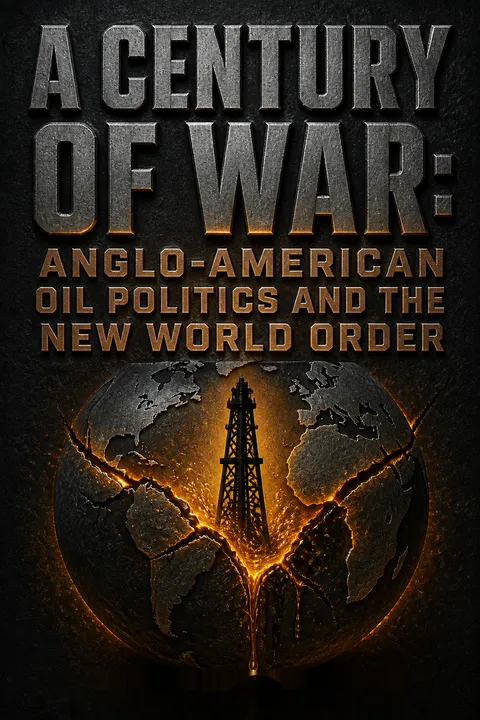


Key Takeaways
Read oil as a lever of power, not merely a fuel supply.
The central argument. Engdahl’s thesis is that modern power depends not only on possessing oil, but on shaping who can extract it, transport it, finance it, and buy it. He traces this contest from Britain’s efforts to protect its naval supremacy to later American military and financial influence. Oil matters because it powers industry and armed forces, while control of its routes and prices can pressure countries far from the oilfields.
Follow the connections. The book links energy to banking, trade, military strategy, and currency. Its recurring question is who gains room to act, and who becomes dependent, when access to petroleum changes hands.
What’s valuable in this lens is its refusal to treat energy as a background commodity. Infrastructure and supply chains create political leverage, often without a formal declaration of control. The same framework can illuminate other strategic resources: access, transport, finance, and pricing matter as much as ownership. The risk is monocausality. Oil can explain why a region matters without proving it caused a particular war. Treating it as a powerful incentive, rather than a universal master key, preserves the insight while leaving room for other motives.
Build infrastructure, and you build dependence as effectively as occupation.
Britain’s quiet empire. Engdahl describes an “informal empire” as influence exercised through finance, trade, shipping, and infrastructure instead of direct colonial rule. British firms financed railways and ports in countries such as Argentina, while London banks, shipping insurers, and trade networks shaped the terms on which those economies reached world markets. The author argues that this could limit a country’s economic choices without placing it under formal occupation.
A competing model. Germany’s industrial growth before 1914 rested on a different emphasis: railways, technical education, protective measures, and close links between banks and industry. The Berlin-Baghdad Railway became a flashpoint because it promised to connect German industry with Ottoman territory and the Persian Gulf, potentially changing trade and strategic access.
This contrast makes infrastructure legible as a form of power: a railway can connect a country to markets while also directing its trade toward particular lenders, ports, and buyers. The distinction between influence and coercion is not always clean. Host governments negotiated concessions and pursued their own ambitions, too. Engdahl’s account is strongest when it shows how dependence can accumulate through ordinary commercial arrangements. It is less conclusive when it treats those arrangements as proof of a single, coordinated British plan.
Wars redraw oil maps, while public promises conceal competing bargains.
The eastern front mattered. Engdahl argues that the First World War was fought over more than Europe’s battlefields. Oil powered ships, aircraft, and motor transport, and the Allies’ access to supplies helped determine military mobility. Britain’s 1916 Sykes-Picot agreement with France secretly sketched how Ottoman territories would be divided after victory, including lands thought to hold oil. The agreement contradicted British assurances of Arab independence made to secure Arab support against Ottoman rule.
Promises became policy. The 1917 Balfour Declaration supported a Jewish national home in Palestine, while the population was overwhelmingly Arab. Engdahl interprets these commitments as pieces of British strategy for controlling territory along imperial routes. The postwar mandates and borders, in his telling, carried wartime bargains into the political map of the Middle East.
The chapter’s lasting insight is that wartime diplomacy often has two audiences: the public, which hears ideals, and negotiating partners, who see the terms of the bargain. Comparing promises with secret agreements is a useful historical method. But showing that oil and imperial routes influenced policy does not, by itself, establish that they explain every decision or consequence. The strongest reading keeps both dimensions in view: the material stakes were real, and the conflicts also involved local political movements whose aims cannot be reduced to outside powers’ designs.
Follow the money: wartime credit helped transfer empire from London to Washington.
A costly victory. Britain relied heavily on U.S. credit during the First World War, with J.P. Morgan acting as a major purchasing and financial agent for the Allies. Engdahl sees this as an early sign that American banks and industry were gaining influence even as Britain expanded its territorial reach. After the war, financial competition between London and New York continued over debt, trade, and access to oil.
A cartel takes shape. In 1928, leading British and American oil interests reached the Achnacarry, or “As Is,” agreement. Engdahl presents it as a step toward coordinated control of markets by the companies later known as the Seven Sisters. After the Second World War, the dollar-centered Bretton Woods system and the Marshall Plan helped U.S. oil companies dominate European supply and bind petroleum trade more closely to American finance.
This history usefully separates territorial empire from financial reach. A state can lose formal possessions while its banks, currency, and companies gain influence elsewhere. The oil cartel story also shows why competition policy matters: when a few firms can shape access and price, private decisions acquire public consequences. Yet the book’s language of a unified Anglo-American bloc can obscure real rivalries among states and companies. Cooperation in some markets should not be mistaken for a seamless alliance across every political question.
National control of oil invited punishment, from Mossadegh to Mattei.
Iran’s challenge. In 1951, Iranian Prime Minister Mohammed Mossadegh nationalized the Anglo-Iranian Oil Company, seeking a fairer share of oil revenues and greater national control. Britain imposed an oil embargo and financial pressure. Engdahl describes the 1953 coup, known as Operation AJAX, as a joint British-American operation that removed Mossadegh and restored the Shah’s authority. The episode illustrates how energy disputes could become questions of sovereignty and regime survival.
A different route. Italian energy executive Enrico Mattei built state-owned ENI into a competitor to the major oil companies. He pursued partnerships with Iran, Egypt, and the Soviet Union, often offering producing countries a larger share and local industrial investment. Mattei died in a plane crash in 1962. The book treats the crash as suspicious, but does not establish who caused it.
These cases give the book a human-scale version of its argument: control over oil revenue affects a country’s ability to choose its development path. Mattei’s model also demonstrates that energy policy can include refining, pipelines, and technical capacity, rather than simply securing crude. Still, each episode needs evidence-specific treatment. The pressure on Mossadegh is documented in the narrative, while claims about hidden coordination and Mattei’s death require a higher standard of proof. Distinguishing those levels makes the sovereignty argument more persuasive, not less.
Treat oil shocks as political events, not automatic market weather.
A dramatic reversal. In 1971, President Nixon suspended the dollar’s convertibility into gold, ending a central feature of the Bretton Woods system. Two years later, oil prices surged after the Arab oil embargo and OPEC price decisions. Engdahl argues that this was not simply a market response: he points to a May 1973 Bilderberg meeting that discussed a major rise in oil revenues, and to Henry Kissinger’s diplomacy before the 1973 Arab-Israeli war. The price of oil rose roughly fourfold by early 1974.
The author’s claim. Engdahl interprets the crisis as deliberately shaped to restore financial leverage, increase demand for dollars, and make new oil projects profitable. He also connects the 1979 Iranian revolution and later price spike to a second engineered shock. These are the book’s central allegations, not conclusions established by the chronology alone.
The key analytical move is to ask who anticipated a shock, who profited from it, and which policies turned it into a global crisis. Those questions help reveal incentives that a purely technical account might miss. But a meeting that forecasts a price increase is not proof that its participants caused one. Strong causal claims need evidence of decisions, channels, and implementation, not just timing and benefit. Engdahl raises a valuable question about market power, while the reader should keep prediction, opportunism, and orchestration distinct.
Petrodollars turned an oil-price shock into a debt trap.
Dollars went full circle. Because oil was priced in dollars, the 1970s price increases generated large dollar surpluses for oil-exporting countries. Engdahl argues that much of this money flowed into London and New York banks, which then lent it to countries struggling to pay their higher import bills. The author calls the resulting arrangement a “petrodollar” order: oil demand helped sustain demand for dollars, while financial institutions gained a growing role in international lending.
The squeeze tightened. Many loans carried floating interest rates. When the U.S. Federal Reserve sharply raised rates under Paul Volcker, debt payments rose as export markets weakened. Engdahl describes the resulting crisis as a product of these policy choices, not merely irresponsible borrowing. IMF conditions then required austerity, currency devaluation, and cuts to public spending, often at the expense of development.
This chain is a powerful example of how a price shock can migrate from energy markets into public budgets and household welfare. Floating-rate debt shifts risk toward borrowers, especially when they earn in one currency and owe in another. That mechanism helps explain why a short-term loan can become a long-term constraint. Engdahl’s emphasis on creditor power is important, though it can understate variation among borrowers and lenders. A complete account should examine both the international rules and the domestic decisions that shaped each country’s exposure.
When the Cold War ended, markets and military alliances carried power forward.
Reform reshaped states. Engdahl argues that after 1990 the IMF’s market reforms weakened Russia’s industry and helped concentrate wealth in the hands of oligarchs. He also links IMF austerity and outside political involvement to Yugoslavia’s economic breakdown and fragmentation. These accounts frame privatization and financial liberalization as instruments of geopolitical influence, not politically neutral technical fixes.
Oil routes returned. The Balkan conflicts also mattered, in his telling, because the region connected Europe with potential Caspian energy supplies. The book describes NATO expansion and the Kosovo war as strengthening U.S. influence over possible pipeline routes. It further argues that pressure on Japan and the Asian economies helped limit alternative economic models. In this post-Cold War account, financial rules and military presence work together to shape which states can pursue independent strategies.
This section connects domestic reform to international power, a useful corrective to accounts that treat economic policy as politically neutral. Privatization can transfer control as well as improve efficiency, and outside security commitments can alter a region’s bargaining position. But the book often moves quickly from U.S. interest to U.S. causation. The breakup of states and financial crises can have local, institutional, and political causes alongside external pressure. The argument is most useful when read as a map of strategic incentives, not as a complete explanation of each conflict.
Judge energy strategy by who controls routes, reserves, and choices.
Military presence matters. Engdahl reads the wars in Afghanistan and Iraq through the pursuit of influence over oil and pipeline routes. He notes that plans for Iraq regime change appeared in the Project for the New American Century before the September 11 attacks, and argues that the invasion placed a major oil region under U.S. military occupation. After the invasion, the stated claims about Iraqi weapons of mass destruction and links to al-Qaeda were not substantiated by the searches described in the book.
A broader doctrine. The author uses “full spectrum dominance” for the ambition to shape military, economic, and political outcomes across regions. In this interpretation, bases near energy-producing areas increase the power to influence supply and access. The question is not only who owns an oilfield, but who can protect, redirect, or interrupt its connections to markets.
The book’s strongest practical test is to look beyond stated intentions and ask who gains control over the infrastructure that makes energy usable. Ownership, pipelines, ports, and military access are different forms of leverage, and they need not belong to the same actor. That framework helps readers scrutinize energy policy without assuming every intervention has one motive. The caution is that strategic advantage does not alone prove a war’s cause. The analysis should weigh declared rationales, security concerns, domestic politics, and material interests together.
Question scarcity claims without treating disputed geology as settled fact.
A late challenge. In the 2011 introduction and final chapter, Engdahl rejects the idea that the world is simply running out of oil. He argues that scarcity narratives can benefit producers and financiers who gain from higher prices. He also presents the “abiotic” theory, which holds that petroleum forms deep within the Earth rather than primarily from ancient biological material. The book points to Soviet and Ukrainian exploration in the Dnieper-Donets Basin, where 37 of 61 wells reportedly found commercially productive oil or gas.
Keep the claims separate. Engdahl treats this drilling record as evidence that Western geological assumptions may have missed resources. He extends that argument toward a much broader challenge to finite-resource thinking. The exploration results support the possibility of finding reserves in unexpected places; they do not, on their own, establish that petroleum is inexhaustible.
The useful lesson is methodological: forecasts about scarcity should disclose their assumptions, incentives, and uncertainty. Exploration success in a region previously thought unpromising can challenge a model without proving an entirely different account of petroleum’s origins. Those are separate questions, requiring separate evidence. Engdahl’s political question about who benefits from scarcity rhetoric remains relevant even if readers reject his geological conclusion. Keeping the two claims distinct protects the strongest insight from resting on the most controversial part of the argument.
Analysis
A Century of War is a polemical geopolitical history, not a neutral survey of oil policy. Its narrative runs from Britain’s nineteenth-century maritime and financial dominance through the rise of American power, the oil shocks, debt crises, post-Cold War interventions, and the wars in Afghanistan and Iraq. Engdahl’s organizing idea is consistent: oil is both an energy source and a means of shaping other states’ choices, particularly when control of supply is joined to finance and military reach.
The book’s most durable contribution is its insistence on tracing connections that conventional accounts can separate: who finances infrastructure, who owns extraction rights, what currency oil is sold in, who lends the resulting surpluses, and who can secure transport routes. This systems view helps readers see why an oil concession or a monetary rule can matter politically even without overt annexation. The histories of Mossadegh and Mattei make the stakes tangible, while the debt discussion shows how energy costs can be transmitted into public austerity.
Its central weakness is also its central method. Engdahl often presents a pattern of interests as evidence of deliberate coordination. A beneficiary, a forecaster, or a participant in elite meetings may reveal motive or access, but does not by itself demonstrate operational control. The narrative sometimes moves from documented events to inferred conspiracy without clearly marking the change in evidentiary strength. It also tends to subordinate local agency and competing explanations to Anglo-American strategy.
A careful reader can retain the book’s strongest questions without accepting every answer. For each episode, separate the observable event, the documented decision, the actor’s stated rationale, the material beneficiary, and the author’s inference about hidden intent. This makes the book useful as a provocation and a guide to neglected relationships, while limiting the risk that a compelling grand narrative will be mistaken for settled proof. Its most persuasive thesis is not that oil explains every war, but that energy control repeatedly gives financial and military power a concrete geographic form.
Review Summary
A Century of War receives mixed reviews, with ratings ranging from 1 to 5 stars. Critics praise its comprehensive analysis of oil's role in geopolitics and conflicts, while skeptics question its conspiracy theories and lack of evidence. Supporters find it enlightening and well-researched, appreciating its alternative perspective on 20th-century history. Detractors criticize the author's writing style, bias, and reliance on questionable sources. Many readers acknowledge the book's thought-provoking nature but advise approaching it with caution and cross-referencing with other sources.
People Also Read






Glossary
informal empire
Influence without direct ruleEngdahl uses this term for imperial power exercised through finance, trade, shipping, and infrastructure rather than formal colonial administration. British investment in railways and ports, combined with London’s influence over credit and trade, is presented as a way to shape other countries’ economies while leaving them nominally sovereign.
Berlin-Baghdad Railway
German rail link eastwardA German-backed railway project intended to connect Berlin through Ottoman territory to Baghdad and, in its larger conception, the Persian Gulf. Engdahl presents it as both an economic development project and a strategic challenge to British influence over sea routes and access to the Middle East.
Seven Sisters
Major Anglo-American oil firmsThe label, popularized by Italian oil executive Enrico Mattei, refers in the book to seven large oil companies that dominated much of the international petroleum industry. Engdahl presents their market coordination, concessions, and influence over production and refining as a powerful private system closely connected to British and American state interests.
Eurodollar market
Offshore dollar bankingThe market in which U.S. dollars are deposited and lent through banks outside the United States, especially London in Engdahl’s account. Because these funds operated beyond ordinary U.S. domestic controls, the market became a major source of international lending and a key channel for recycling oil-export revenues into loans to importing countries.
petrodollar monetary system
Oil trade sustaining dollar demandEngdahl’s term for an international arrangement in which oil is priced and traded in U.S. dollars, creating continuing demand for dollars among oil-importing countries. He links this system to the investment of oil-export surpluses in U.S. and British financial institutions, which then lent those funds internationally.
IMF Structural Adjustment Program
Loan-linked economic conditionsA set of policy conditions the book associates with IMF assistance to indebted countries. Engdahl describes measures such as cutting public spending, reducing subsidies, devaluing currencies, and opening markets to foreign capital. He argues these policies often prioritized debt repayment and export earnings over domestic development and living standards.
National Security Study Memorandum 200 (NSSM 200)
U.S. population policy reviewA 1974 U.S. National Security Council study, as described by Engdahl, examining the implications of population growth for U.S. security and overseas interests. The book emphasizes its focus on selected developing countries with important resources and presents it as evidence that population policy became part of American national security planning.
full spectrum dominance
Comprehensive global powerA term used in the book for the ambition to shape military, economic, and political developments across regions and domains. Engdahl connects it to U.S. military bases, control of strategic routes, and the capacity to influence access to energy resources. The concept captures the book’s view that military power and economic leverage reinforce each other.
abiotic theory
Deep-origin petroleum theoryThe theory presented by Engdahl that petroleum forms deep within the Earth and is not primarily derived from ancient biological material. He cites Soviet and Ukrainian scientists and drilling in the Dnieper-Donets Basin. The book uses the theory to challenge claims of imminent oil scarcity, while its evidence does not establish that petroleum is inexhaustible.
FAQ
1. What is A Century of War: Anglo-American Oil Politics and the New World Order by F. William Engdahl about?
- Central theme of oil and power: The book investigates how oil and political power have shaped global events, wars, and economic systems since 1914, arguing that oil scarcity narratives are manipulated for elite interests.
- Anglo-American dominance: Engdahl details the rise and influence of Anglo-American oil cartels and their integration with military and financial power.
- Historical and geopolitical analysis: The narrative traces the control of petroleum from the British Empire to modern U.S. foreign policy, linking oil to wars, finance, and global economic manipulation.
- Exposure of hidden agendas: The book uncovers the covert strategies used by elites to maintain dominance over oil, finance, and world politics.
2. Why should I read A Century of War by F. William Engdahl?
- Reveals hidden power dynamics: The book exposes the often unseen forces behind global conflicts, especially the central role of oil in shaping history.
- Challenges mainstream narratives: Engdahl questions official explanations for major events, encouraging readers to think critically about accepted history.
- Comprehensive historical scope: It covers over a century of geopolitical maneuvers, connecting disparate events into a coherent strategy of control.
- Insight into energy and finance: Readers gain a deeper understanding of how oil, finance, and military power intersect to shape the modern world.
3. What are the key takeaways from A Century of War by F. William Engdahl?
- Oil as a tool of power: Control over oil resources has been central to the strategies of the British Empire and the United States for global dominance.
- Elite manipulation: A small group of Anglo-American elites have orchestrated wars, economic crises, and political changes to maintain their control.
- Economic and political consequences: Oil politics have led to wars, economic manipulation, and the suppression of national sovereignty in developing countries.
- Suppression of alternatives: The rise of nuclear energy and other competitors to oil have been deliberately undermined to protect oil interests.
4. What are the best quotes from A Century of War by F. William Engdahl and what do they mean?
- Eisenhower’s warning: “In the councils of government, we must guard against the acquisition of unwarranted influence... by the military-industrial complex.” This highlights the dangerous fusion of military and oil interests.
- Henry Kissinger on oil: “Control energy and you control the nations.” This underscores oil’s central role in geopolitical power.
- Engdahl on Big Oil’s influence: “Their influence over the decisions of their respective governments to wage wars... is greater than the power of any American President.” This stresses the outsized power of oil companies in shaping global conflicts.
- Implication of quotes: These statements encapsulate the book’s central thesis about the intersection of oil, power, and global conflict.
5. How does F. William Engdahl describe the role of the British Empire in shaping global oil politics in A Century of War?
- Three pillars of power: Britain’s dominance relied on naval control, financial supremacy in London, and control of raw materials, especially oil.
- Free trade as a weapon: The British used “absolute free trade” to undermine competitors and create economic dependence on their system.
- Informal empire and intelligence: Britain maintained influence through financial investments, spheres of influence, and covert alliances between private companies and government intelligence.
- Strategic moves in the Middle East: The British occupation of Egypt and Persia and the creation of the Anglo-Persian Oil Company were pivotal in securing oil supplies.
6. What is the significance of the Berlin-Baghdad Railway in A Century of War by F. William Engdahl?
- Geopolitical threat to Britain: The railway represented Germany’s ambition to access Middle Eastern oil, challenging British control of trade routes and resources.
- British obstruction tactics: Britain used diplomatic, military, and intelligence means, including control over Kuwait, to delay and sabotage the railway.
- Prelude to World War I: The railway project heightened tensions and was a key factor leading to the outbreak of the Great War.
- Symbol of imperial rivalry: The railway exemplified the broader struggle for control over oil and strategic regions.
7. How does A Century of War by F. William Engdahl explain the creation and impact of the Anglo-American oil cartel?
- Post-WWI consolidation: British and American oil interests formed a powerful cartel, controlling major oil reserves worldwide.
- San Remo and Red Line Agreements: These agreements formalized the division of Middle Eastern oil and established the “Seven Sisters” cartel.
- Market and price control: The cartel maintained a near-monopoly on oil resources, setting prices and dividing global markets.
- Exclusion and dominance: American companies were initially excluded but later integrated, cementing Anglo-American dominance over oil.
8. What were the causes and effects of the 1973-74 oil shock according to A Century of War by F. William Engdahl?
- Deliberate price manipulation: Anglo-American elites, including Henry Kissinger and the Bilderberg group, orchestrated a 400% oil price increase to enforce control over oil revenues and the dollar system.
- Global economic crisis: The shock triggered recessions, inflation, and debt crises, especially in developing countries.
- Benefit to oil majors and banks: Major U.S. and British oil companies and banks profited immensely, consolidating their economic power.
- Suppression of nuclear energy: The oil shock was used to undermine the rise of nuclear energy as a competitor.
9. What is the "Petrodollar Monetary Order" and its impact on developing countries in A Century of War by F. William Engdahl?
- System creation: After the 1971 dollar-gold decoupling and the 1973 oil shock, oil was priced exclusively in U.S. dollars, with revenues recycled through Western banks.
- Economic consequences: Developing countries faced soaring oil import costs and were forced to borrow petrodollars at high interest rates, leading to debt crises.
- Control through debt: The system kept developing nations dependent on Western financial institutions, with loans servicing debt rather than development.
- Political manipulation: The U.S. and Britain used divide-and-conquer tactics to prevent alliances that could challenge their economic order.
10. How did the Anglo-American establishment suppress nuclear energy development according to A Century of War by F. William Engdahl?
- Anti-nuclear campaigns: Foundations and oil interests funded projects and activism to highlight nuclear risks and promote inefficient alternatives.
- Creation of control groups: Secretive organizations like the Nuclear Suppliers Group limited the spread of nuclear technology and fuel.
- Media and political influence: Public opinion was manipulated through media and political appointments to keep nuclear energy contentious.
- Protection of oil interests: These efforts ensured oil remained the dominant global energy source.
11. How does A Century of War by F. William Engdahl describe the role of oil in U.S. foreign policy during the George W. Bush administration?
- Oil-centric leadership: Key cabinet members, including Dick Cheney and Condoleezza Rice, had deep ties to the oil industry, shaping national energy strategy.
- Preemptive war doctrine: The administration pursued military dominance to secure oil-rich regions, especially in the Middle East.
- War on Terror as cover: Military interventions in Afghanistan and Iraq were justified by security concerns but were fundamentally about controlling energy resources.
- Full spectrum dominance: The U.S. aimed for comprehensive control over military, economic, and political spheres, with oil as a strategic lever.
12. What is the "abiotic oil theory" and its geopolitical implications in A Century of War by F. William Engdahl?
- Russian scientific discovery: Soviet geologists proposed that oil is of deep, primordial origin, not just from fossilized organic matter, allowing exploration in new regions.
- Strategic advantage for Russia: This theory enabled Russia and Ukraine to discover vast reserves, challenging Western assumptions about oil scarcity.
- Geopolitical leverage: Russia’s unique technology and reserves became a critical factor in U.S.-Russia relations, with the U.S. seeking to limit Russian energy independence.
- Military encirclement: The U.S. expanded NATO and established bases around Russia to control pipeline routes and restrict Russian influence.
Download PDF
Download EPUB
.epub digital book format is ideal for reading ebooks on phones, tablets, and e-readers.








