

Plot Summary
Louis Leaves His Birthday
At two hundred, Louis Wu can travel anywhere on Earth in an instant, but the cities have begun to feel like copies of one another. He slips away from his birthday party and meets Nessus, a Pierson’s puppeteer thought to have vanished from known space. Nessus warns that radiation from the galactic core will eventually endanger inhabited worlds, then recruits Louis for a secret expedition two hundred light-years away.
The destination remains hidden, but Nessus offers a spacecraft far faster than any human ship as payment. Louis accepts less from duty than from curiosity: another alien, another unknown, and a reason to risk himself instead of watching his long life turn stale.
Louis’s restlessness is not simple thrill-seeking. His long life has made novelty scarce, while instantaneous travel has flattened distance into convenience. The expedition restores consequence by offering a journey whose risks cannot be sidestepped with a transfer booth. Nessus recognizes that Louis’s appetite for aliens and solitude makes him recruitable, but also mistakes his willingness to take risks for a stable character trait. The opening therefore frames exploration as both escape from ennui and a test of what a person does when comfort has become its own trap.
The Kzin Takes the Bait
Nessus takes Louis to a New York restaurant, where he provokes a Kzin embassy by calling one of its members a pet. The enormous carnivore, Speaker-To-Animals, has reason to attack, but another Kzin, Hroth, apologizes before the insult becomes a duel. The restraint reflects centuries of defeats in the Man-Kzin wars, which have taught the Kzinti that human retaliation is costly.
Nessus recruits Speaker with the promise of an experimental ship and its plans, valuable enough to earn him a name among his people. The choice is also a test: the puppeteers want to know whether a Kzin can travel beside other species without reverting to conquest. Speaker accepts, though Louis senses that pride, not trust, drives him.
The recruitment scene makes interspecies politics bodily and immediate. A single insult could revive a war, yet Hroth’s apology shows how repeated defeat has altered Kzin behavior without making the Kzinti comfortable with peace. Speaker’s acceptance is similarly double-edged: he seeks honor and status, but must cooperate with the species his people once tried to enslave. Nessus treats the expedition as an experiment in social behavior, while the Kzin sees a chance to prove himself. Their competing motives make the crew’s alliance useful and unstable from its first moment.
Teela Joins the Crew
At Louis’s party, Nessus identifies Teela Brown, a twenty-year-old whose ancestors repeatedly won Earth’s birthright lotteries. He believes luck may have been bred into her family, though Teela initially refuses the voyage and Louis doubts she can handle danger.
She stays with him, admits that she loves him, and later studies the core explosion that threatens the galaxy. Louis explains why the puppeteers need faster ships long before the radiation arrives; Teela then insists on joining, partly from concern for humanity and partly because she cannot bear to leave Louis.
She also guesses that their destination is an enormous ring-shaped habitat. Her confidence unsettles Louis, who has never seen her suffer and mistakes that sheltered ease for foolishness.
Teela’s decision exposes a gap between the crew’s idea of courage and her own. Louis interprets a life without visible hardship as evidence that she cannot endure it, while Teela claims the right to choose without first proving herself to him. Her attachment to Louis gives her a personal route into a cosmic mission, but her curiosity about the ring-shaped image also shows independent intelligence. Nessus’s theory of inherited luck hangs over the choice without explaining it. The result is a crew assembled not by shared expertise, but by incompatible beliefs about risk, agency, and what makes someone fit to explore.
The Long Shot Mutiny
At Nereid, the crew finds the Long Shot, a gigantic vessel whose experimental quantum drive can cross a light-year in just over a minute. Its cramped cabins and untested machinery make the promised reward look less comfortable than it sounded. Before departure, Speaker-To-Animals reveals a variable-sword and tries to take the ship for the Kzinti, hoping to secure a military advantage in a future war.
Nessus stops him with a tasp, a device that stimulates the brain’s pleasure center so powerfully that repeated use can create dependence. Louis then seals Speaker in a stasis couch, preventing him from restarting the mutiny. With the Kzin contained and the drive ready, Louis pilots the Long Shot beyond the solar system.
The mutiny turns the expedition’s promised reward into a live political threat. Speaker’s reasoning is not irrational: a drive this powerful could reshape the balance between human and Kzin civilizations. But his unilateral attempt to claim it confirms the very fear that made Nessus recruit him as a test case. The tasp complicates the crew’s victory because it defeats violence through engineered pleasure, a form of control that can be more intimate than force. Louis secures the ship, but the crew’s survival now depends on restraint from a warrior who has been physically subdued, not persuaded.
Five Worlds in Flight
Following coordinates Nessus withheld, Louis finds five worlds arranged in a rare, stable orbital pattern. They are not the moving fleet he expected, but the migrating home system of the puppeteers.
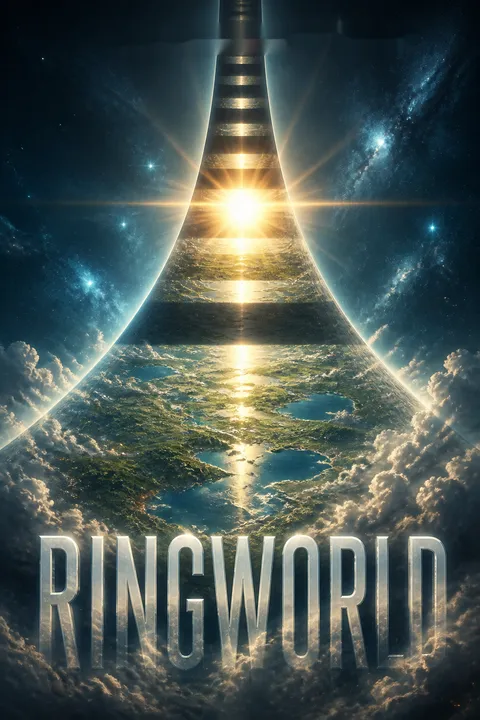
Nessus explains that his species once grew so numerous that civilization’s waste heat threatened their planet; they learned to move worlds and eventually carried their homes away from an expanding star. On the puppeteer world, Chiron shows the crew their actual objective: the Ringworld, a solid band circling a sun, wide enough to hold an almost unimaginable living surface.
Twenty moving shadow panels provide night, while the ring’s rotation supplies gravity. Its builders achieved engineering on a scale even the puppeteers fear to approach, so they send the mixed crew to investigate.
The revelation shifts the scale of the story twice: the puppeteers are not merely survivors of an old empire, and their technical power extends to moving entire planets; the Ringworld surpasses even that achievement. Nessus’s account of waste heat links technological success to an ecological limit, making engineering both a means of survival and a source of danger. The crew is sent not to conquer the artifact but to judge whether such a construction can endure. Their different reactions matter: Speaker sees a challenge, Teela sees a wonder, and Louis sees a mystery large enough to renew his interest in living.
The Ringworld Fires Back
Nessus gives the crew a second vessel, the Lying Bastard, designed with most machinery outside its protective hull so a stasis field can shield the cabin. As they approach the Ringworld, their attempts to communicate receive no answer. Speaker guides the ship toward the enormous habitat, but an automatic defense system mistakes their projected path for a collision.
X-ray lasers vaporize the wing, engines, and sensors, leaving only the hull and life-support system. The surviving crew cannot steer or brake. They strike the Ringworld at tremendous speed, and the stasis system keeps them alive as the ship plows a long furrow through the surface. The craft comes to rest tilted in a desert, far from help and with its flight systems destroyed.
The attack is not evidence of a hostile civilization so much as a failure of interpretation: the crew’s trajectory looks like a meteor, and the Ringworld’s defenses respond without negotiation. Yet the distinction offers little comfort to people whose ship has been dismantled by a machine. The landing converts exploration from a controlled visit into a survival problem, while the immense scale of the ring makes rescue uncertain. The Lying Bastard’s unusual protective design pays off, but only by preserving the crew inside a wreck. Their first lesson in the Ringworld’s power is that safety systems can save lives and still leave their users stranded.
The Arch and the Priests
The crew unloads flycycles and heads toward the distant rim, learning that the blue arc overhead is the Ringworld’s own surface. Teela becomes transfixed by the vast horizon, while Louis tries to keep her attentive to hazards.
They encounter human-looking fishermen, then reach a ruined city where villagers still live among the wreckage. Its leaders mistake the visitors for divine engineers. Louis demonstrates a flashlight-laser, not knowing that the locals treat such light as forbidden.
The villagers attack; Speaker fights them, Nessus kills an assailant with a defensive kick, and Louis escapes with his crew rather than let the Kzin massacre the crowd. The encounter teaches them that Ringworld humanity survives in scattered cultures whose histories have become religion.
The first contact fails because technology has outlived its explanation. To Louis, the laser is a modest tool; to the villagers, it violates a sacred boundary. Their fear is not irrational within a society that has inherited fragments of a lost engineering age. Louis’s laughter worsens the encounter because he reads their worship as an absurd mistake rather than a social system shaped by catastrophe. The scene also complicates the crew’s assumed superiority: they can fly and fight, but they cannot yet interpret local meanings. Surviving first contact requires restraint as much as technological advantage.
The Puppeteers’ Hidden Breeding
As the crew flies onward, Louis connects Nessus’s account of starseed navigation with the Outsider ship that once gave humanity faster-than-light travel. He suspects the puppeteers guided that ship into human space to help defeat the Kzinti, deliberately shaping Kzin evolution through war.
Nessus confirms the manipulation and admits that his species also changed Earth’s fertility laws, hoping to breed unusually lucky humans. Teela learns that her family was part of the experiment and feels used.
The crew fractures: she cuts off contact, while Speaker turns on Nessus. Soon afterward, mirror-blossomed sunflowers focus sunlight to burn anything that approaches, severely injuring Speaker. Louis leads the survivors beneath cloud cover, where they can move without being roasted.
The revelation recasts the expedition’s recruitment as an ethical trespass. The puppeteers did not simply observe human and Kzin history; they altered the conditions under which both species evolved, then called the result useful. Teela’s anger is especially personal because the abstract policy reaches into her own identity. Louis’s discovery also implicates him: he is not a neutral observer but a participant in a plan whose consequences he cannot predict. The sunflowers immediately replace political betrayal with physical danger, forcing the crew to cooperate before they have repaired their trust.
The Eye in the Clouds
A vast storm shaped like a human eye unsettles the crew, but Nessus reasons that a puncture in the Ringworld may be drawing air into space. They fly through its clear center to inspect the suspected breach.
Teela drops toward the funnel and is pulled away at extreme speed; she survives because her flycycle’s emergency system activates, though the others cannot follow immediately. The storm confirms that the Ringworld floor can be punctured and that its atmosphere is leaking.
During the continued search for Teela, interference later disables her communications and separates her from the group. Louis, Speaker, and Nessus reach a lit city seeking her trail, but an automated police system overrides their flycycles and traps them inside a floating prison.
The Eye turns the Ringworld’s engineering into a landscape of visible failure. Its beauty and apparent design provoke fear, but Nessus’s explanation replaces supernatural dread with an environmental mechanism: air escapes through a wound in the structure. Teela’s disappearance intensifies the crew’s uncertainty because her unusual fortune can preserve her without making her choices predictable to others. The later prison trap shows that danger on the Ringworld is often not a living enemy but an unattended system still enforcing rules no one remembers. The crew’s instruments, meant to make them capable, become handles by which the old machinery controls them.
The Prisoner in Heaven
Suspended upside down over the prison’s central pit, Louis and Speaker depend on Nessus to devise a way out. A nearly bald woman watches from an observation platform and tests them with fruit, while Nessus uses his tasp to make her receptive. She is Halrloprillalar, called Prill, a crew member from a ramship that has followed a regular circuit between the Ringworld and abandoned planets.
Prill explains that her ship’s crew reached the Ringworld after its spaceport failed, then split up among the ruined lands. She survived by using the city’s police machinery and her knowledge of the floating tower. Once the prison’s force field drops, Nessus turns the tower into a crude flying base, giving the stranded crew shelter and a way to travel.
Prill is neither a simple rescuer nor a reliable guide. Her control of the prison reflects long adaptation to isolation, while Nessus’s use of the tasp repeats the expedition’s pattern of treating another person’s autonomy as a tool. Her history expands the Ringworld’s collapse from a distant mystery into a lived sequence of failed institutions and improvised survival. The floating tower offers the crew mobility, but its usefulness depends on Prill’s knowledge and willingness to cooperate. For the first time, they have a local witness who can connect ancient infrastructure to the people still living among its ruins.
Teela Finds Seeker
Teela reappears with Seeker, a long-lived traveler who has spent centuries walking toward what he believes is the base of the Ringworld’s arch. She has been separated from Louis, frightened by repeated danger, and helped by Seeker after her flycycle failed.
Louis recognizes how much she has changed: she now knows fear, pain, and the need to rely on someone else. Teela chooses to continue traveling with Seeker, whose simple skills let him help villages along his route. Louis does not try to keep her, though the separation hurts.
Meanwhile, Prill helps Louis and the aliens understand the Ringworld’s collapse: a mold destroyed crucial superconductors, power systems failed, and the metal-poor structure offered no easy materials from which civilization could rebuild.
Teela’s change is not a sudden conversion into a different person. Experience has supplied what her protected life could not: awareness that bodies can fail and that other people’s needs are real. Her attachment shifts from Louis to Seeker because she now wants a life organized around teaching and service, not simply following desire. Louis’s decision to let her go marks a limit to his habitual protectiveness. Prill’s account gives this emotional turn a material counterpart: both people and civilizations become vulnerable when they assume their systems will always protect them.
The Shadow Wire Battle
Louis realizes that the nearly invisible wire linking the shadow panels might help move the crew’s ruined ship. He returns with the others to a city where the wire has tangled across the streets. Local zealots attack when Speaker tests the material with a tool. In the fighting, the wire severs one of Nessus’s necks.
Louis stops the bleeding with Teela’s scarf, and the crew retreats to the floating tower with Nessus alive but critically injured. Speaker retrieves the wire’s detached anchor, and Louis fastens it to the tower so the strand can trail behind them. Teela and Seeker then leave to continue their own journey. Louis lets them go, while the remaining crew turns toward the Lying Bastard and a desperate plan to escape.
The battle brings the expedition’s ethical and mechanical problems together. The wire is both a lethal hazard and the material that may make escape possible; to obtain it, the crew must risk violence against people who understand it through their own sacred history. Teela’s scarf becomes a practical act of care, evidence that she can respond to another person’s emergency rather than merely survive her own. Nessus’s injury exposes the cost of the crew’s manipulations, while Teela’s departure makes Louis accept that loving someone does not grant him authority over her choices.
The Gods Keep Traveling
While Nessus lies in the Lying Bastard’s medical system, Louis, Speaker, and Prill travel in the floating tower, using the shadow wire to keep a connection to the wreck. They visit villages as supposed gods, with Speaker playing a war deity and Louis interpreting.
The performance brings food and information, but it also forces Speaker to answer questions about human affairs he barely understands. Prill gradually recovers from her dependence on the tasp and begins contributing her technical and social knowledge.
Louis warns Speaker that taking the Long Shot for Kzin could provoke another war and expose his people to stronger civilizations. Speaker chooses restraint. Prill decides to leave the Ringworld with them, trading an isolated life among ruins for the possibility of a wider society.
The God Gambit is ethically compromised, yet it becomes a form of contact that gives the crew access to communities otherwise beyond their reach. Speaker discovers that power does not make him competent to govern, while Louis learns to influence events through explanation rather than force. Prill’s recovery matters because it is not achieved by simply removing the tasp; she needs new relationships and purposes that can replace its artificial reward. Speaker’s decision about the Long Shot is also a genuine political choice. He does not become harmless, but he recognizes that victory without restraint may destroy the people it is meant to elevate.
Fist-of-God’s Secret
Near the end of their journey, Louis and Speaker realize that Fist-of-God, a mountain visible from far away, is not a natural peak. Its exposed Ringworld foundation and absence from the old map suggest that a massive meteor struck from below, deforming the ring and punching through its surface. At the mountain’s summit, they find a crater open to space.
Louis’s plan is to tow the Lying Bastard toward the breach using the shadow wire, letting the Ringworld’s rotation fling the ship outward. The Improbable rises into the crater, where gravity disappears and stars fill the opening. The wire holds, but the crew has not yet returned to space; they still need the ship and its faster drive to carry their discoveries home.
The ending rewards observation rather than brute force. Details that once seemed like unrelated damage, exposed foundation, altered weather, and the immense peak, become evidence of a single impact. Louis turns the Ringworld’s own failed machinery into a possible route out, but the solution remains unproven. That uncertainty matters: the crew has learned enough to act, not enough to declare victory. Their predicament also preserves the novel’s central tension between wonder and responsibility. The Ringworld can carry worlds of life, yet its inhabitants and visitors remain exposed to the consequences of its design.
A Future Still Uncertain
As the Improbable hangs beneath the breached Ringworld, Speaker admits that the Kzinti could use the Long Shot to dominate nearby space, but that conquest would eventually expose them to stronger powers. Louis reminds him that the drive is essential if humans and Kzinti are to escape the approaching radiation from the galactic core.
Neither can simply seize the ship without risking disaster. The crew’s immediate plan remains to pull the Lying Bastard through the opening and reach clear space; only then can they decide what to do with the technology and the secrets they have learned. Their journey ends not with a confirmed rescue, but with a shared obligation to return alive and choose carefully.
The final uncertainty is not a failure to resolve the plot so much as a refusal to confuse discovery with mastery. The crew has learned what happened to the Ringworld, but possession of that knowledge does not settle who should control the Long Shot or how its power should be used. Speaker’s restraint echoes the novel’s question about whether a species can outgrow the logic of domination. Louis, meanwhile, has moved from risking his life to escape boredom toward accepting responsibility for what survival makes possible. The unresolved escape keeps those ethical decisions attached to physical danger.
Analysis
Ringworld treats engineering as a bargain with consequences. The puppeteers move planets to escape the waste heat of their own civilization, while the Ringworld’s builders construct almost limitless living space; neither feat abolishes vulnerability. On the ring, a microscopic mold can disable superconductors, a failed power network can bring floating cities down, and an ancient defense system can mistake visitors for meteors. The scale of the artifact is immense, but its collapse begins with failures that are small enough to overlook.
The crew’s social arrangements mirror those technological risks. Nessus treats other species as material for experiments in survival; Speaker must decide whether power justifies conquest; and Louis discovers that observation does not make him ethically neutral. Teela’s apparent immunity to harm initially separates her from the others, but experience gives her a more human understanding of fear and dependence. Her development is not simply a lesson that suffering is good. Rather, the story asks what a person cannot learn when consequences never reach them, and what it costs others when one person’s protection is mistaken for universal safety.
The Ringworld’s inhabitants have inherited broken machines as religion, while the explorers repeatedly misread customs they do not understand. Their technological advantage does not grant moral authority. The novel’s durable warning is that systems built for safety, abundance, or survival can become dangerous when their makers assume they will remain understandable and controllable. Knowledge helps the crew act, but the final escape plan remains uncertain, leaving responsibility as unfinished as the journey.
Review Summary
Ringworld receives mixed reviews. Many praise its innovative sci-fi concepts, particularly the massive artificial ring structure. Readers appreciate the alien characters and exploration themes. However, criticisms include dated gender portrayals, flat characters, and slow pacing. Some find the physics explanations excessive, while others enjoy the hard sci-fi elements. The book's influence on later works is acknowledged, but its 1970s context is noted as potentially off-putting to modern readers. Overall, opinions vary widely on its merits as a classic of the genre.
People Also Read





Characters
Louis Wu
The restless veteranA two-hundred-year-old human explorer, Louis has lived long enough to find Earth’s instant travel and familiar social rituals numbing. He seeks novelty in solitude and alien company, but his apparent casualness hides careful observation and hard-earned survival skills. He often treats danger as an antidote to boredom, a habit that makes him both useful and difficult to trust with other people’s safety. Louis is socially perceptive, especially when cultural assumptions collide, yet he can be impatient with people whose experiences differ from his own. His relationships with Teela and the alien members of the crew challenge his belief that age and experience give him the right to decide what risks others should take.
Nessus
The cautious recruiterNessus is a Pierson’s puppeteer, an intelligent herbivore from a species famous for extreme caution. He recruits the expedition on behalf of his people and approaches other beings as both partners and subjects of observation. His two heads, musical voice, and ability to use his mouths as hands make him physically unlike his human and Kzin companions. Nessus experiences pronounced psychological cycles: a manic phase can carry him into startling risks, while depression can make ordinary danger overwhelming. Beneath his apparent timidity lies a strategist willing to manipulate information and behavior for what he considers the survival of his species. His uneasy alliances reveal the costs of trying to control others while remaining afraid of them.
Teela Brown
The sheltered young travelerTeela is a twenty-year-old woman from Earth who joins the expedition despite having little experience beyond familiar human society. She is beautiful, frank, and curious, but her ease in the world can make her seem careless to people who have learned caution through injury or loss. Her attachment to Louis gives her an initial reason to leave home, while her interest in the Ringworld grows through encounters that challenge her assumptions. Teela does not respond to risk in the way her companions expect, and this difference affects how they judge her intelligence and independence. Her presence raises questions about protection, chance, and whether an untested life can develop the forms of empathy that hardship often teaches.
Speaker-To-Animals
The Kzin diplomatSpeaker-To-Animals is a Kzin ambassador whose title reflects his work among species his people once regarded as prey or enemies. He is physically formidable, proud, and trained in warfare, yet he has also learned the political restraint demanded by his people’s repeated defeats at human hands. Speaker seeks recognition and honor, but his ideas of honor often pull against cooperation. His sharp senses and military experience make him an asset in unfamiliar territory, while his instinct to measure relationships through strength can create danger for the crew. He is neither a tame warrior nor a simple aggressor: his struggle is to decide what courage and leadership require when victory is not the only measure of worth.
Halrloprillalar, called Prill
The stranded spacerPrill is a human woman connected to the Ringworld’s spacefaring past and its scattered, diminished present. She has survived through practical knowledge, social adaptability, and a strong instinct for maintaining control in a world where dependable institutions have vanished. Her appearance gives little away, so Louis learns to read her through movement and behavior rather than facial expression. Prill’s experience with machinery and local communities makes her an important source of knowledge for the crew, but she is not merely an informant. Her relationships expose how isolation can turn companionship into leverage, and how a person may rebuild a sense of self after living under someone else’s influence.
Seeker
The wandering travelerSeeker is a long-lived Ringworld traveler pursuing a personal quest toward what he believes is the base of the world’s arch. He carries a sword, knows practical skills, and has spent generations sharing what he knows with people along his route. His intelligence is limited, but his steadiness and sense of honor make him more than a comic figure or a weapon. Seeker’s life is organized around a belief that may not be literally true, yet the work he does for others is real. Through him, the novel distinguishes between factual accuracy and the human value a purpose can provide.
Chiron
The puppeteer spokesmanChiron represents the leadership of the migrating puppeteers when the crew reaches their moving home worlds. More composed than Nessus, Chiron explains why the expedition matters and presents the Ringworld as both an engineering marvel and a possible danger. His caution reflects the priorities of a civilization built around survival, but his distance from the crew also shows how little the leaders understand the experience they have ordered others to face.
The Hindmost
The distant puppeteer leaderThe Hindmost leads the puppeteer migration and authorizes Nessus’s expedition. Though physically absent from the journey, this leader’s policies shape the crew’s composition and purpose. The Hindmost embodies a society that makes decisions collectively through carefully managed authority, yet is willing to use outsiders as instruments of research.
Hroth
The apologizing KzinHroth is a member of the Kzin embassy whose assigned role is to apologize when conflict threatens. His intervention prevents Louis’s challenge from turning Nessus’s recruitment into a lethal public duel.
Plot Devices
The Long Shot
The escape-speed bargainThis experimental spacecraft uses a quantum hyperdrive far faster than the drives available to humans. Nessus offers it, along with its plans, as payment for the expedition, giving each crew member a reason to accept the mission. The ship’s speed makes it potentially vital to escaping the radiation wave from the galactic core, but its military value also tempts Speaker to claim it for the Kzinti. The Long Shot therefore joins the story’s survival problem to its political one: the same technology that could save many species could also enable one species to dominate others.
The Ringworld
An engineered world without limitsThe Ringworld is a vast solid band circling a star, with an inhabited inner surface, immense rim walls, and moving shadow panels that create alternating periods of light and darkness. Its rotation supplies gravity, while its structure offers more living area than an ordinary planet could provide. The artifact’s size repeatedly defeats the crew’s intuition about distance, weather, and scale. Its defenses, transportation systems, power sources, and eventual failures shape the expedition’s route and dangers. It is at once a home for scattered human societies, a technological puzzle, and a reminder that enormous constructions remain vulnerable to small failures.
Teela’s apparent luck
Chance as hidden guidanceNessus selects Teela because her family history appears linked to repeated birthright lottery wins, and he suspects that human luck can be inherited. Her companions gradually interpret her survival, choices, and unlikely encounters through that possibility, though they cannot reduce every event to a reliable rule. This idea complicates ordinary notions of competence: Teela can appear clumsy or unprepared because she has rarely needed to learn from failure. It also raises an ethical question about the puppeteers’ attempt to shape a population by altering reproductive policy. Teela’s experiences on the Ringworld make the theory emotionally consequential rather than merely statistical.
The tasp
Pleasure used as controlThe tasp stimulates a target’s pleasure center from a distance. Nessus uses it to prevent Speaker from taking the Long Shot, then later uses it to influence people he wants to approach or calm. Its immediate effect can be overwhelming, and repeated use risks dependence. Because it controls through pleasure rather than pain, characters may mistake its effects for trust or consent. The device makes the crew’s own methods of survival morally difficult: a tool designed to avoid physical injury can still undermine another person’s freedom and reshape relationships.
Shadow-square wire
The thread that can towAn extraordinarily thin, strong strand links the Ringworld’s moving shadow panels. The crew first encounters it as an invisible cutting hazard, then discovers that a detached anchor can be fixed to the floating police tower. Louis uses the wire as a line connecting the tower to the wrecked Lying Bastard, hoping the Ringworld’s rotation will help pull the ship toward a breach in the structure. Its changing purpose reflects the crew’s method of survival: an element of the Ringworld that first appears as a threat may become useful once they understand how it works.
Series


Download PDF
Download EPUB
.epub digital book format is ideal for reading ebooks on phones, tablets, and e-readers.








