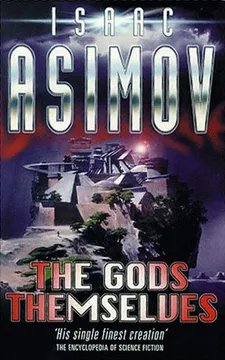


Plot Summary
The Bottle That Changed History
On October 3, 2070, radiochemist Frederick Hallam2 noticed that a dusty bottle labeled tungsten contained something else. His colleague Benjamin Denison7 challenged him to prove he could recognize the metal, and Hallam's2 wounded pride turned the puzzle into an obsession. Tests identified plutonium-186, an isotope that should not be stable, yet the sample's radioactivity kept increasing.
Hallam2 enlisted the physicist Kantrowitsch,18 who detected powerful positrons and warned that the material could become dangerously energetic. The discovery was not an act of serene scientific insight. A small insult pushed an insecure researcher toward a mystery that might otherwise have been ignored, with consequences neither man could foresee.
Hallam Names the Pump
Scientists scattered the dangerous material and convened a seminar, but no one could explain how it changed. During a break, nuclear physicist John McFarland11 proposed treating a parallel universe as a possibility.
Hallam2 presented the formal theory: plutonium-186 had crossed from a universe with different physical laws, while ordinary tungsten had gone the other way. As the alien isotope changed toward stable tungsten, it released energy; its counterpart did the reverse in the other universe.
Repeated exchanges could therefore provide power to both sides. The idea became the Electron Pump, and Hallam's2 name attached itself to the discovery. McFarland's11 earlier suggestion and the contributions of the research team faded from public memory as Hallam's2 authority grew.
Lamont Reopens the Record
Decades later, physicist Peter Lamont1 joined the Pump's research station while writing a clear, complete history of its creation. His admiration for Hallam2 collapsed when interviews and missing seminar records suggested that McFarland11 may have voiced the central idea first.
McFarland11 would not pursue a claim he believed no one would credit, and Lamont1 could not prove Hallam2 had heard him. When Lamont1 suggested that the people in the parallel universe had supplied essential guidance, Hallam2 erupted and threatened to block the book.
Colleagues stopped cooperating, and Lamont's1 scientific career suffered. His search for historical fairness became personal, but it also put him close to a larger question: what the celebrated Pump was doing to both universes.
The Sun Becomes Evidence
Lamont1 studied the Pump's basic premise and concluded that the two universes were not simply exchanging useful matter. Their physical laws were mixing. He believed the strengthened nuclear force could accelerate fusion inside Earth's Sun until its delicate balance failed, destroying the planet.
Hallam2 dismissed Lamont's1 warning, while Senator Burt14 refused to intervene without proof and activist Joshua Chen15 would not risk opposing the popular, nearly limitless energy source on theory alone.
Chen's15 hope for human immortality made the Pump especially precious to him. Lamont1 was left with a danger that powerful people found convenient to doubt. A fragment from the other universe, marked with a misspelled version of the word fear, offered a possible clue but no certain interpretation.
A Warning Across Universes
Lamont's1 colleague Myron Bronowski3 had been sending experimental messages through metal foils, trying to establish a shared vocabulary with the other universe. A reply confirmed that its inhabitants also feared the Pump and wanted it stopped, but their message showed that their authorities would not act either.
Both sides were trapped by the same dependence on energy and the same disbelief in catastrophe. Lamont's1 warnings brought him a disciplinary hearing, while his paper was rejected without a scientific rebuttal.
Bronowski,3 exhausted by the failure to move either society, abandoned the effort. Lamont1 had discovered that he was right, yet the confirmation could not overcome institutional self-protection. He faced the prospect of watching two worlds choose danger because the alternative felt intolerable.
Dua Refuses the Third Child
In the parallel universe, the Soft Ones live in triads: Rational5 Odeen5 learns, Parental6 Tritt6 tends the children, and Emotional4 Dua4 provides the energy needed for their intimate union. Dua4 is unlike other Emotionals. She wanders alone, asks questions, and prefers Odeen's5 explanations to the usual social life of her kind.
The triad already has a Rational child5 and a Parental child,6 but Tritt6 wants a third, an Emotional.4 Dua4 resists eating enough to make one. She remembers her own Parental leaving and suspects that completing the family will bring her own end. Odeen5 sees her reluctance but has not understood its source. Her independence is not mere caprice; it is a frightened attempt to keep hold of herself.
Tritt Steals the Food
Unable to persuade Odeen5 to act, Tritt6 enters the Hard Ones' caverns and steals a concentrated energy battery. He connects it to Dua's4 private feeding place, hoping to make her eat enough to begin the third child. Odeen,5 meanwhile, follows the advice of his teacher Losten12 and begins explaining the universe to Dua,4 unaware of Tritt's6 scheme.
The lesson gives Dua4 real pleasure, and the concentrated food supplies the energy she has long withheld. The three melt together, and a new Emotional4 begins growing inside Tritt.6 When the Hard Ones discover the missing battery, Tritt6 admits what he did. Dua4 realizes that the lesson and the stolen food have joined to make her choice for her. She flees, feeling betrayed by both partners.5
Dua Disappears Into Stone
Dua4 hides by flowing completely into rock, a capacity she had privately explored since childhood. Inside the stone, her perception sharpens: she can sense the Hard Ones, understand fragments of their activity, and study their records of communication with the other universe. She concludes that the Pump will destroy the people there as well as endanger her own world.
Using symbols and fragments of human language, she sends warnings and pleas for the Pump to stop. The replies show that the other side is frightened but unable to make its authorities listen. Dua4 keeps sending messages while hunger and exhaustion weaken her. Losten12 tells Odeen5 that she is hiding in the rock and that only Odeen5 can reach her through understanding.
The Triad Becomes Estwald
Odeen5 and Tritt6 locate Dua4 collapsed from hunger after she has spent her strength sending one last desperate message. Odeen5 feeds her from a battery and explains the insight he has reached: Soft Ones are not machines, as Dua4 feared, but immature forms of the Hard Ones.
During each melting, a triad briefly becomes one Hard One; a final, conscious union can make that transformation permanent. Their children and their learning have prepared them for it. Dua,4 Odeen,5 and Tritt6 melt again, this time without returning to separate lives.
Their joined identity emerges as Estwald,13 the Hard One whose work has shaped the Pump project. The warning is not followed by an immediate shutdown. Instead, the new being inherits both the Pump and the responsibility to decide what comes next.
Denison Reaches the Moon
On the Moon, former radiochemist Benjamin Denison7 arrives hoping to return to science after Hallam's2 rise helped drive him from research into cosmetics. Tour guide Selene Lindstrom8 notices his interest in the restricted proton synchrotron and brings him to lunar physicist Barron Neville.9
New Commissioner Konrad Gottstein10 also recognizes Denison7 from an old inquiry into Pump safety. Denison7 explains that he came to investigate Lamont's1 theory, and Neville9 offers him modest laboratory space despite doubting his physics.
The Moon's native population has its own grievances: Earth controls its largest instruments and has not allowed it to establish an Electron Pump station. Selene,8 whose unusual intuition has helped lunar researchers, becomes Denison's7 collaborator and guide to a society that resents being treated as Earth's dependent.
A Second Universe Opens
Denison7 uses a compact lunar instrument called the Pionizer to test whether the Pump is changing the strong nuclear force as Lamont1 predicted. Selene8 supplies the crucial intuitive ideas, including a way to make the instrument work under the Moon's natural vacuum.
Their experiment produces a brief point of energy as matter leaks from another universe. Denison7 then sees a way to replace dangerous dependence on the Electron Pump: draw energy from a different kind of universe, one concentrated into a single enormous mass.
This cosmeg pump would also alter physical laws, so its output must balance the Electron Pump's effect. When Selene8 increases the magnetic field, the leak stabilizes. Denison7 now has a solution he can present alongside the danger, not simply a demand that humanity surrender its power source.
Neville Wants the Moon Gone
With the cosmeg pump stabilized, Denison7 plans a paper with Lamont1 and the lunar physicists, and Gottstein10 returns from Earth with backing for lunar installations. Neville9 rejects the arrangement because Earth would still control policy while Moon residents did the labor.
He reveals a larger ambition: use the cosmeg universe to transfer momentum and propel the Moon away from Earth. Denison7 argues that the Moon's people could instead build starships, preserving the choice to explore without forcing every resident to leave.
Selene,8 who has grown close to Denison7 and values Earth remaining visible in the sky, has already asked other Lunarites what they want. Neville's9 plan turns a technical breakthrough into a political test of whether independence means freedom for a community or obedience to its most forceful leader.
The Moon Chooses Its Course
Selene8 reveals that most Lunarites prefer building starships and letting individuals choose whether to travel, rather than towing the Moon away from Earth. The vote goes heavily against Neville,9 who loses the power to impose his private need for separation on the whole colony.
Denison7 chooses to remain on the Moon, where the new pumps and lunar science will develop, rather than return to the Earth that once rejected him. Selene8 asks him to contribute to the conception of her second child, and he accepts, while their affection deepens beyond their scientific partnership.
The colony's future remains open, but its residents have preserved the right to shape it together. Denison's7 recovery is not a return to his old status; it is the beginning of a life he has chosen.
Analysis
The novel's three parts test the same danger at different scales: a scientist's career, a triad's intimacy, and a civilization's future. In the first, Hallam's2 insecurity becomes an institution. His discovery is real, and his stubbornness helps make it useful, but his need for public ownership narrows what the institution is willing to hear. Lamont's1 anger weakens his credibility even as his analysis proves essential. The conflict is not simply between truth and lies; it is between evidence and the social machinery that decides whose evidence can count.
Dua's4 story gives that problem a bodily form. Her society assigns thought, care, and feeling to separate roles, yet her curiosity refuses those borders. Tritt's6 battery and Odeen's5 teaching both proceed from affection, but affection without consent becomes coercion. Dua's4 rock-borne perception turns the supposedly lesser Emotional4 into the best observer of a danger the official minds cannot interpret. The revelation that Soft Ones develop into Hard Ones makes individual identity less fixed than their society assumes, while the final union asks whether knowledge can survive the loss of the self that acquired it.
The lunar story shifts the question from scientific authority to political autonomy. Denison7 needs Selene's8 intuition, but she must choose to offer it; the Moon's people need Earth's cooperation without surrendering their right to decide what cooperation means. Neville9 mistakes separation for freedom, while Denison7 argues for options that do not compel an entire population. Across all three movements, the book distrusts certainty when it is protected by status, convenience, or fear. Its most practical lesson is that warnings need more than correctness: they require translators, institutions willing to listen, and alternatives people can bear to choose.
Review Summary
Reviews of The Gods Themselves are largely positive, averaging 4.08/5. Readers praise Asimov's imaginative hard science, particularly the concept of parallel universes and inter-universe energy transfer. The novel's three-part structure receives mixed reactions: the alien middle section is widely considered the most creative and compelling, featuring a unique tri-gendered species. Some critics find the pacing slow and characters underdeveloped, while others admire its prescient parallels to climate change debates. Most agree it is a bold, original work, deserving of its Hugo and Nebula Award wins.
People Also Read





Characters
Peter Lamont
The stubborn physicistLamont is a para-physicist and science historian whose admiration for Frederick Hallam2 curdles into suspicion when the official story of the Electron Pump fails to withstand scrutiny. He wants accurate credit, but his need to expose Hallam2 is sharpened by professional humiliations and a career blocked by the powerful institution he challenges. His warning about the Pump grows from mathematical reasoning, not simply resentment, though he knows his anger can make others dismiss him. Lamont is brave enough to act without approval and insufficiently patient with people who need evidence before they will risk comfort. His central conflict is whether telling the truth matters when he cannot make anyone act on it.
Frederick Hallam
The celebrated gatekeeperHallam is the public face of the Electron Pump and a radiochemist whose early encounter with an impossible isotope launches his rise. He is not a great theorist, but his stubbornness and confidence carry the discovery into practical use. That persistence has genuine value, which makes his later possessiveness more complicated than simple fraud. Hallam's self-image depends on being recognized as humanity's benefactor, so evidence that others supplied the crucial insight feels like an attack on both his status and human capability. He protects his authority by silencing challenges and controlling access to the historical record. His fear of losing credit makes him dangerous precisely because the world has entrusted him with so much.
Myron Bronowski
The patient decoderBronowski is a philologist and archaeologist famous for deciphering Etruscan inscriptions. His methodical patience makes him the natural partner for Lamont's1 attempt to communicate with the para-people. He is dry, self-possessed, and wary of claims that cannot be tested, but his pride can be reached through intellectual challenge. Bronowski's expertise does not magically solve the alien language; instead, it lets him build a cautious exchange from fragments and repeated attempts.
Dua
The questioning EmotionalDua is the Emotional member of a Soft-One triad with Rational5 Odeen5 and Parental6 Tritt6. She is curious, solitary, and unusually receptive to ideas that her society expects Emotionals to leave to Rationals. Her difference makes her feel isolated even within the intimate structure of her triad. She values learning and private freedom, but she also fears the demands of family life and what completing her role may cost her. Dua is sensitive to other minds and capable of perceiving patterns others overlook. Her questions expose the limits of a society that treats temperament as destiny, while her stubbornness can turn insight into risky action.
Odeen
The learning RationalOdeen is the Rational in Dua4 and Tritt's6 triad, devoted to study and to his relationship with his Hard-One teacher, Losten12. He takes pride in his ability to understand complex ideas, yet that confidence can blind him to what Dua4 is feeling. Odeen loves both partners, though he leans on Tritt's6 steadiness and delights in sharing knowledge with Dua4. His education is not merely a store of facts; it shapes how he understands intimacy, life, and his own place in the world. Odeen's deepest challenge is to recognize that reason cannot substitute for attention. He must learn that explaining a choice is not the same as allowing someone else to make it.
Tritt
The devoted ParentalTritt is the Parental member of the triad and the chief caretaker of its children. He understands need through instinct and action rather than analysis, and he often feels that Odeen's5 learning distracts from the practical work of keeping the family whole. Tritt's love is expressed through care, persistence, and a fierce desire for the third child he believes the triad requires. He can be stubborn and short-sighted, especially when Dua's4 wishes conflict with his sense of duty. Yet his apparent simplicity conceals courage and initiative. Tritt's concern for family can produce both genuine devotion and decisions that disregard the person he means to protect.
Benjamin Allan Denison
The displaced scientistDenison is a gifted radiochemist whose early clash with Hallam2 helped push him out of science. Older and wary, he comes to the Moon seeking work that can restore meaning rather than merely status. He has a scientist's appetite for evidence and a survivor's awareness that institutions often decide what counts as evidence. Denison can admit that his motives include pride and resentment, but he refuses to let those motives erase the stakes for other people. His relationship with Selene8 grows through shared work and mutual respect. He is willing to start over in an unfamiliar society, where his experience matters more than the reputation Earth took from him.
Selene Lindstrom
The intuitive lunar guideSelene is a Moon-born tour guide whose intuitive talent has quietly aided the colony's scientific work. She is perceptive about people, frank about the cultural distance between Lunarites and Earth visitors, and protective of the Moon as a home rather than a deficient copy of Earth. Barron Neville9 tries to keep her abilities within the bounds of his plans, but Selene increasingly trusts her own judgment. She responds to Denison7 because he treats her as a collaborator rather than a resource to control. Her scientific insight is powerful but not infallible, and she knows intuition must meet experiment. Selene's independence is tested both in research and in deciding what kind of future she wants.
Barron Neville
The wary lunar physicistNeville is a Lunar physicist who resents Earth's control of major scientific equipment and wants the colony to become independent. Suspicion shapes his politics and his personal life; he often reads cooperation as a route to manipulation. He recognizes Selene's8 exceptional intuition but keeps her abilities hidden, partly from fear that Earth will claim or exploit her work. His desire for autonomy is real, yet he struggles to distinguish freedom for Lunarites from the security he personally wants.
Konrad Gottstein
The pragmatic commissionerGottstein arrives on the Moon as its new Terrestrial commissioner, inheriting both Luiz Montez's16 concerns and a strained relationship between Earth and Luna. He is curious enough to revisit Denison's7 old warning, but he approaches politics through negotiation and practical proof. Gottstein wants scientific cooperation without pretending that distrust will vanish on its own. His attention gives Denison7 a route to broader support, while his authority raises the question of who gets to set policy for the Moon.
John McFarland
The overlooked theoristMcFarland is a nuclear physicist whose informal speculation helps open the path toward the Electron Pump theory. He is unwilling to make a public claim that would leave him looking vain or foolish, especially when Hallam2 has already secured the world's confidence. His silence complicates the question of scientific credit: insight matters, but so does the willingness to risk saying it in a form others can act upon.
Losten
Odeen's Hard-One teacherLosten is a Hard One who teaches Odeen5 and takes an unusually personal interest in his development. He is patient with the Soft Ones' different temperaments and understands that Dua's4 reluctance cannot be solved by simply demanding obedience. Losten's guidance encourages Odeen5 to teach Dua4 rather than dismiss her questions. He knows more about the Hard Ones' society than he reveals, and his restraint gives his advice both care and weight.
Estwald
The remote innovatorEstwald is a Hard-One scientist whose work on a new energy source has become central to the hopes of his world. He is remote from the Soft Ones and known to them mainly through reports of his ability and influence. His absence makes him a focus for their admiration, unease, and speculation about what the Hard Ones are building.
Senator Burt
The cautious power brokerBurt leads the committee responsible for technology and the environment. He takes Lamont's1 warning seriously enough to hear him out, but understands that a society dependent on the Pump will not abandon it on one scientist's unsupported claim. Burt's political realism makes him neither a simple villain nor a reliable ally: he needs proof that can survive public resistance.
Joshua Chen
The evidence-first activistChen is an influential political organizer whose campaigns helped make the Electron Pump central to Earth's energy supply. He is disciplined about evidence and reluctant to spend his authority on a warning he cannot verify. His personal investment in future medical progress, including the prospect of immortality, reveals how public causes can be braided with private fear.
Luiz Montez
The departing commissionerMontez is Gottstein's10 predecessor on the Moon. Before leaving, he warns that Lunar science and confidence are growing while Earth retreats from technological risk. His concern helps Gottstein10 see the colony as more than a remote administrative post.
Benjamin Denison's colleague Tracy
The overlooked technicianTracy performs the early mass-spectrograph measurements that identify the impossible isotope. His repeated results help establish that the readings are real, even though Hallam's2 rise leaves Tracy's contribution out of the celebrated account.
Kantrowitsch
The radiochemical investigatorKantrowitsch is the senior scientist who helps Hallam2 investigate the isotope's growing radioactivity. His measurements reveal the intense positron emissions and the danger of leaving the substance in large pieces.
Plot Devices
The Electron Pump
Power across universesThe Electron Pump begins with an exchange of tungsten and plutonium between universes whose physical laws differ. As each material changes toward the stable form required by its own universe, the process releases energy on both sides. Its appeal is practical and immense, which makes it difficult for either society to question. But the repeated exchange also mixes the universes' fundamental laws. The Pump drives the story's conflict between immediate abundance and distant catastrophe, while exposing how dependence on a technology can distort scientific judgment and public choice.
The Metal Foils
A fragile shared languageThin metal foils pass through the boundary between universes and carry marks made by the beings on either side. Their symbols are difficult to interpret because neither society shares language, culture, or a common reference point. Bronowski3 and Lamont1 build messages from repeated signs and tentative word associations; Dua4 later senses emotional meanings in the same material. The foils turn communication into a risky chain of inference. A reply can confirm that someone received a message without proving that they understood it as intended.
Rock-Rubbing
A hidden sensory advantageEmotionals can flow into rock, a capacity treated as a childish or improper habit. Dua4 continues the practice after adulthood and discovers that being immersed in matter changes what she can perceive. Hidden inside stone, she can sense activity the Hard Ones cannot easily detect and observe information they believe secure. The ability links her personal difference to her role in the larger crisis: what her society regards as a defect becomes a source of knowledge. It also isolates her, since her new perception demands strength and secrecy she does not yet know how to manage.
The Pionizer
A gateway to new energyThe Pionizer manipulates pions, the particles that mediate the strong nuclear interaction. Denison7 uses it to investigate whether the Electron Pump is changing that interaction, and Selene's8 intuition helps him adapt the instrument to the Moon's vacuum and find a stable configuration. The experiments reveal that matter can leak in from another universe. Denison7 develops this into the cosmeg pump, which could provide energy while balancing the changes caused by the Electron Pump. Its use also permits momentum transfer across universes, making it both a scientific answer and the center of a political dispute over the Moon's future.
Robot Series Series

About the Author
Other books by Isaac Asimov





Download PDF
Download EPUB
.epub digital book format is ideal for reading ebooks on phones, tablets, and e-readers.








