Key Takeaways
1. The Birth of History: Inquiry, Narrative, and the Greek Legacy
History—the elaborated, secular, prose narrative (all these qualifications are necessary) of public events, based on inquiry—was born, we can claim with confidence, in Greece between roughly 450 and 430 BC.
Proto-history's limitations. Before Herodotus and Thucydides, ancient civilizations like Egypt and Babylon kept meticulous records, but these were primarily bureaucratic or commemorative, lacking systematic inquiry or secular narrative. Herodotus himself acknowledged Egypt as the "premier record-keepers" but distinguished their practice from his own "historia," meaning inquiry. This distinction highlights the shift from mere documentation to a critical investigation of the past.
Herodotus's expansive inquiry. Herodotus, often called "the father of history," broadened the scope of historical writing beyond mere events to include geography, ethnography, and cultural comparisons. His work, "Histories," aimed to preserve "great and marvellous deeds—some displayed by Greeks, some by barbarians—may not be without their glory; and especially to show why the two peoples fought with each other." He relied on extensive travel and interrogation of informants, often expressing skepticism but recording diverse accounts, even those he found incredible.
Thucydides's rigorous realism. Thucydides, writing a generation later, refined history into a rigorous, contemporary, political, and military narrative focused on causality and utility. He famously declared his work "was done to last for ever," aiming for certainty by relying on eyewitness testimony and critical analysis, implicitly criticizing Herodotus for entertaining rather than truth-telling. His use of speeches, though often his own composition, served to reveal the motives and calculations of political actors, making his history a "possession for all time" for understanding human nature and power dynamics.
2. Rome's Historical Vision: Virtue, Decline, and the State's Enduring Power
The study of history is the best medicine for a sick mind.
Rome's unique historical consciousness. Roman historiography, exemplified by Polybius, Sallust, and Livy, developed a profound sense of national destiny intertwined with moral character. Unlike Greek city-states, Rome's history was seen as a continuous narrative from humble origins to world dominion, fostering both immense pride and a pervasive anxiety about moral decline. This led to a deep engagement with the city's earliest, often legendary, years, seeking the roots of its virtues.
Moralism and political insight. Roman historians frequently used history for moral instruction, presenting examples of virtue to emulate and vice to avoid. Sallust, in his monographs on the Jugurthine War and Catiline's Conspiracy, vividly depicted the corrupting effects of avarice and ambition on public life, contrasting them with idealized ancestral virtues. Livy's monumental "Ab urbe condita" celebrated Roman "firmness" and patriotism, lamenting the erosion of traditional customs by luxury and foreign influences, particularly after conquests.
The empire's paradox and its chroniclers. The transition from republic to empire, and the subsequent challenges of imperial rule, became central themes. Tacitus, writing under the empire, chronicled the "servility" and "hypocrisy" of the Senate under emperors like Tiberius and Nero, lamenting the loss of republican liberty while acknowledging the necessity of imperial order. Josephus, a Jewish historian, provided a provincial perspective on Roman rule, detailing the Jewish Revolt and the fall of Jerusalem, while Ammianus Marcellinus, the "last pagan historian," chronicled the empire's struggles in the late 4th century, often with a Tacitean sense of decline and the arbitrary hand of Fortune.
3. Christianity's Providential History: Divine Plan and the Church's Triumph
The Lord in his anger [at the arrogance and quarrels of certain church leaders] covered the daughters of Zion with a cloud, and cast down from Heaven the glory of Israel…Everything indeed has been fulfilled in my time; I saw with my own eyes the places of worship thrown down from top to bottom, the inspired holy Scriptures committed to the flames in the middle of the public squares, and the pastors of the churches hiding disgracefully.
Biblical framework for history. The Hebrew scriptures, adopted as the Old Testament, provided a linear, providential framework for history, from Creation to Apocalypse, with God as the ultimate mover. This contrasted sharply with classical cyclical views. Christian history, as seen in Eusebius, Gregory of Tours, and Bede, interpreted events through a lens of divine intervention, sin, punishment, and redemption, with Christendom often assuming the role of God's Chosen People.
Eusebius and the Church Triumphant. Eusebius, the first church historian, chronicled the Church's journey from persecution to triumph under Emperor Constantine, whom he saw as a divinely appointed deliverer. His "History of the Church" established the apostolic succession of bishops and the canon of scriptures, emphasizing orthodoxy against heresy. Eusebius's work, though often polemical and focused on theological disputes and martyrdoms, provided a foundational narrative for Christian history, later influencing medieval chronicles through his "Chronicle" which synchronized pagan and biblical timelines.
Medieval chronicles: Local, pious, and personal. Medieval historical writing, exemplified by Gregory of Tours and Bede, blended universal Christian history with local, often monastic, concerns. Gregory's "Histories" offered a vivid, anecdotal account of 6th-century Gaul, focusing on kings, bishops, and the pervasive influence of saints and miracles, often with a personal, unpolished style. Bede's "Ecclesiastical History of the English People" presented a more structured narrative of England's conversion and the establishment of a unified English Church, celebrating the English as a chosen people and meticulously documenting his sources, setting a high standard for medieval scholarship.
4. Humanism's Renaissance: Civic Virtue, Critical Scholarship, and the Past's Rebirth
But considering that our city of Florence, the daughter and creature of Rome, was rising, and had great things before her, whilst Rome was declining, it seemed to me fitting to collect in this volume and new chronicle [the title his work was given] all the deeds and beginnings of the city of Florence…and in this year 1300, having returned from Rome, I began to compile this book, in reverence to God and the blessed John and in commendation of our city of Florence.
From chronicle to civic history. The flourishing city-states of Italy, particularly Florence, fostered a new civic consciousness that transformed chronicle writing. Giovanni Villani's 14th-century "Chronicle" exemplified this, blending providential history with detailed accounts of Florentine politics, trade, and social life, driven by a deep civic pride. His work, though still anecdotal, laid groundwork for a more focused urban history.
Humanist re-imagining of Rome. The Renaissance saw a profound shift with humanism, which applied critical philological methods to classical texts, including Roman law and history. Scholars like Leonardo Bruni and Lorenzo Valla, by detecting anachronisms, exposed forgeries like the "Donation of Constantine" and historicized Roman law, revealing it as a product of its time rather than a timeless ideal. This critical approach challenged medieval interpretations and fostered a new understanding of the past.
Machiavelli and Guicciardini: Political realism and the lessons of history. Niccolò Machiavelli and Francesco Guicciardini, drawing on Roman republican models (Sallust, Livy) and their own diplomatic experience, pioneered a new form of political history. Machiavelli's "Florentine History" analyzed factionalism and the dynamics of power, seeking universal maxims from historical examples, often with a cynical realism. Guicciardini's "History of Italy" offered a detailed, nuanced account of Italian statecraft and the tragic consequences of foreign intervention, emphasizing the unique complexity of each historical situation and the interplay of multiple motives.
5. Enlightenment's "Philosophic History": Progress, Manners, and Societal Evolution
The decline of Rome was the natural and inevitable effect of immoderate greatness. Prosperity ripened the principle of decay; the causes of destruction multiplied with the extent of conquest…
Progress and the "state of society." The Enlightenment introduced "philosophic history," focusing on the "progress of society" through stages of manners, commerce, and civilization. Historians like David Hume and William Robertson moved beyond mere political narrative to analyze underlying social and economic forces. Hume's "History of England" challenged Whig triumphalism, attributing the English Civil War to deep-seated changes in national manners and the balance of power, while Robertson's "History of Charles V" explored the emergence of modern Europe through the decline of feudalism and the rise of the balance of power.
Gibbon's monumental synthesis. Edward Gibbon's "The Decline and Fall of the Roman Empire" synthesized classical and Enlightenment historical thought. Inspired by the ruins of Rome, Gibbon chronicled the empire's long decline, attributing it to a combination of factors:
- The "immoderate greatness" leading to internal decay and corruption (a classical, Machiavellian theme).
- The enervating effects of luxury and uniform government.
- The rise of Christianity, which he viewed with ironic detachment, as contributing to civil strife and undermining martial virtues.
Gibbon's work, characterized by its elegant prose, vast erudition, and pervasive irony, became a benchmark for historical scholarship and narrative.
Unintended consequences and cultural distancing. Enlightenment historians often highlighted "unintended consequences," where actions led to unforeseen, sometimes beneficial, outcomes (e.g., the Crusades fostering European refinement). They also practiced "cultural distancing," analyzing past societies like the Reformation era as "rude" or "fanatical," distinct from their own "polite" and "enlightened" age. This approach, while sometimes condescending, allowed for a more nuanced understanding of historical change and the complex interplay of human agency and broader societal forces.
6. Revolutions as History's Crucible: Ideology, the People, and the State's Fate
The great cause of revolutions is this, that while nations move onwards, constitutions stand still.
England's "Glorious Revolution" and Whig history. England's 17th-century revolutions remained central to historical inquiry. Thomas Babington Macaulay's "History of England" celebrated the "Glorious Revolution" of 1688 as a "preservative" event, ensuring constitutional liberty and preventing the anarchy seen in France. Macaulay, a Whig politician, infused his narrative with dramatic vividness and a strong sense of national progress, seeing history as a story of freedom's continuous expansion, often contrasting English pragmatism with continental radicalism.
Carlyle's apocalyptic French Revolution. Thomas Carlyle's "The French Revolution" offered a starkly different, epic, and often apocalyptic interpretation. Rejecting conventional narrative, Carlyle depicted the Revolution as a sublime, terrifying, and divinely ordained outburst of "Democracy" and "Sansculottism," driven by hunger, hatred, and a profound sense of divine justice against a corrupt aristocracy. His multi-voiced, frenzied prose aimed to re-enact the chaos and emotional intensity of the period, seeing the "People" as a raw, elemental force, both heroic and atrocious.
Michelet and Taine: The People vs. the Mob. French historians continued to grapple with the Revolution's legacy. Jules Michelet, deeply influenced by Vico, saw the Revolution as the "resurrection" of the French "People," a benevolent and fraternal force, and the high point of national consciousness. In contrast, Hippolyte Taine, writing after the Paris Commune, viewed the Revolution as a pathological descent into collective insanity, driven by abstract ideas and the unchecked power of the "mob." Taine's heavily documented, psychological approach emphasized the disintegration of social order and the rise of a despotic state, offering a powerful, if deterministic, indictment of revolutionary excess.
7. The Professionalization of History: Objectivity, Archives, and Global Perspectives
The accession of the critic in place of the indefatigable compiler, of the artist in coloured narrative, the skilled limner of character, the persuasive advocate of good, or other, causes, amounts to a change of dynasty, in the historic realm. For the critic is one who, when he lights on an interesting statement, begins by suspecting it.
The rise of "scientific" history. The late 19th and early 20th centuries saw the professionalization of history, particularly in Germany, with Leopold von Ranke as its doyen. This movement emphasized:
- Objectivity: The ideal of presenting "how it really happened" (wie es eigentlich gewesen).
- Critical source analysis: Rigorous examination of primary documents, distinguishing them from secondary accounts.
- Systematic research: The establishment of university seminars and archival work as core practices.
This led to a focus on political and diplomatic history, often with a nationalistic bent, and the creation of academic journals to enforce scholarly standards.
Critiques of "Whig History" and narrative. The professional consensus challenged earlier liberal narratives, particularly the "Whig Interpretation of History" (Butterfield), which was criticized for imposing a teleological view of progress and anachronistically judging the past by present standards. This critique, alongside Namier's prosopographical studies of 18th-century British politics, questioned the role of ideology and emphasized individual motives and structural factors, often leading to a de-emphasis on grand narratives and a focus on "technical history."
Diversification and new approaches in the 20th century. The 20th century witnessed a vast diversification of historical inquiry:
- Annales School (France): Pioneered social, economic, and cultural history, emphasizing "longue durée" (long-term structural change) and "mentalités" (collective mindsets), drawing on sociology and anthropology.
- Marxist History: Interpreted revolutions and social change through class struggle and economic determinism, though later challenged for its "whiggish" tendencies.
- Cultural History: Explored the symbolic worlds, emotions, and everyday life of past societies, often influenced by anthropology and psychology (e.g., Huizinga, Febvre).
- Micro-history and Identity: Focused on small-scale communities or marginalized groups, reconstructing their experiences and "making" of their own identities, often using oral history and challenging traditional narratives centered on states and great men.
Last updated:
Review Summary
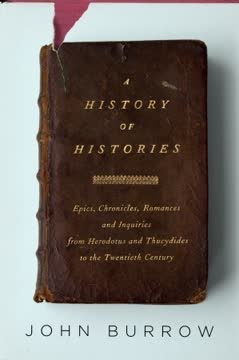
A History of Histories receives praise for its comprehensive survey of Western historiography from Herodotus to modern times, with readers appreciating Burrow's encyclopedic knowledge and wit. However, many find the writing style dense, academic, and difficult, with overly long sentences that require slow, careful reading. Reviewers particularly enjoyed chapters on ancient historians but found later sections less engaging. Some criticize the book for excessive summarizing over analysis, disproportionate coverage favoring earlier periods, and Eurocentric perspective. Most agree it's better suited for academics and serious history students than general readers.
Similar Books