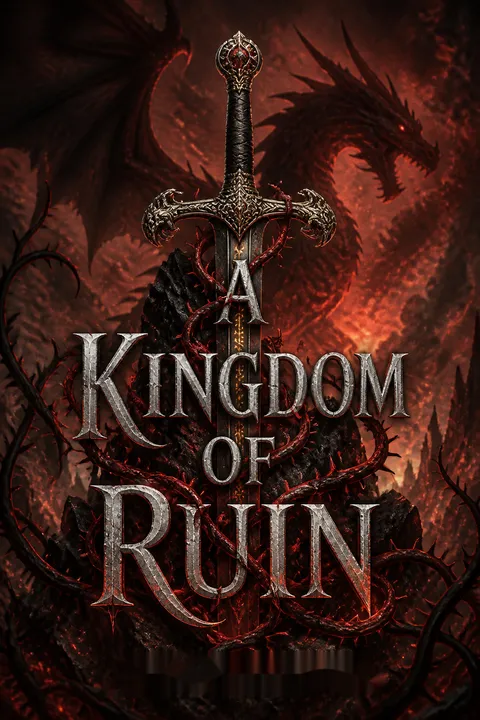


Plot Summary
A Bargain in Chains
Finley arrives on Dolion's island after agreeing to marry her former betrothed, Jedrek. The demon king has lifted the magic suppressing Wyvern's shifters in exchange for the marriage, and Finley means to escape back to Nyfain, her dragon mate, once her people can fight. Dolion instead parades her through the rain, threatens to use her as a court pet, and sends her toward the dungeons.
Nyfain's scent clings to her, a protection Dolion cannot easily erase. Finley hides her knowledge of the curse and keeps her resolve behind jokes, though each mile from Nyfain costs her. When a guard risks the dungeon's dark entrance, she realizes the journey has taken her into a place designed to swallow prisoners.
Finley's bargain makes political agency inseparable from bodily risk. She chooses the demon wedding as a means of freeing her people, but Dolion recasts that choice as permission to possess and humiliate her. Her jokes are not invulnerability; they let her control the terms of a scene in which physical control belongs to others. The mate bond complicates the sacrifice: she is acting for Nyfain and Wyvern while deliberately leaving both behind. That tension establishes the novel's central test of love, whether devotion can survive separation without becoming a claim to decide another person's future.
The Dungeon's First Lesson
A guard shoves Finley down the dungeon stairs to test the magical darkness, and she breaks an ankle before crashing beside the dying demon Luru. Captain Govam keeps her upright, while another guard confirms what Finley feared: Wyvern dragons are imprisoned below, and only their alpha can fully draw their animals out.
Jedrek joins her in a cell, where he still believes Dolion's promise of marriage makes him a favored guest. The first officer then takes Finley for punishment, hoping her pain will feed the demons' creature-making magic.
When a prisoner offers to take the beating in her place, Finley refuses to surrender the whip. Nyfain's power reaches her through their bond, helping her endure the attack and revealing that distance has not severed their connection.
The dungeon turns the abstract cost of Finley's bargain into a system: prisoners are sorted, injured, and harvested for power. Her fall demonstrates how little protection a royal title offers, while Govam's practical intervention introduces moral ambiguity among the guards. The imprisoned dragons, meanwhile, make the stakes collective rather than romantic. Finley's refusal to let another prisoner suffer for her preserves her sense of responsibility, but it also exposes how quickly compassion can be exploited. Nyfain's distant support offers genuine care, yet the demons convert even suffering into a resource, making intimacy itself part of the struggle.
Pain Shared Across Distance
Back in Wyvern, Nyfain retreats into grief after Finley's capture, leaving his people and the curse's unfinished work unattended. His butler, Hadriel, enters Finley's abandoned tower with Leala and presses him to act on the promise Finley left behind.
Leala suggests that Nyfain send pleasure and reassurance through the bond rather than adding his despair to Finley's pain. He does, giving her a way to withstand the dungeon's punishments. Hadriel also reminds him that Finley expected him to free the shifters and prepare Wyvern for war.
Nyfain resumes the work, helping restore the villagers' animals, organizing treatment for the demon sickness, and hunting the creatures released into the Royal Wood. Hadriel stays close, tracking the threat and keeping Nyfain's attention on the kingdom.
This parallel thread counters the dungeon's logic of helplessness with a form of care that requires action. Nyfain initially treats suffering as proof that he has failed Finley, which risks making his grief another burden she must carry. Leala's intervention gives him a specific alternative: direct his emotional power toward her endurance, then serve the people she left in his care. Hadriel's courage is deliberately unheroic. He is frightened and uncertain, but he converts loyalty into a practical demand. The scene defines support not as rescuing someone from every danger, but as doing the work that makes their chosen risk meaningful.
The Queen's Sword
Finley's battered sword becomes a flashpoint when Tamara, a former officer of Wyvern's queen, believes Finley stole it from the royal household. Finley will not surrender it, and the prisoners attack.
When the larger dragon Micah tries to dominate her, Nyfain's power floods through the bond and Finley forces him back. Her command accidentally drives every prisoner to their knees, proving that the demon suppression has weakened and that she can reach Wyvern's dragons.
Tamara recognizes the sword as the queen's and understands that Dolion meant it to wound the prisoners' memories, not merely mock Finley. Finley turns that pain toward a future they can reclaim, and the dragons begin treating her as a possible ally rather than an inexplicable newcomer.
The sword is both a contested object and an argument about who gets to inherit history. Tamara sees it as evidence of theft because the prison has stripped her of context; Finley knows it as a gift but cannot initially explain its weight. Their clash shows how trauma makes recognition dangerous: the object promises a lost world and therefore invites violence. Finley's accidental command is equally revealing. Power arrives before discipline, so leadership here is not simply the ability to compel. Her apology matters because she distinguishes winning obedience from earning trust, a distinction she will need as separate peoples prepare to act together.
The Butler's Reckless Return
As Nyfain restores Wyvern, Hadriel grows alarmed that Finley may be trapped too long to escape before Nyfain makes a desperate bargain with Dolion. Finley's brother Hannon, unable to shift despite sensing an animal within him, joins Hadriel and Leala on a rescue mission.
They use one of the portals through the Royal Wood and deliberately let demons capture them, hoping to be taken to Finley's dungeon. Hannon's calm size makes the guards wary, while Hadriel's maid disguise and nonstop chatter draw their attention.
When they reach Finley, she is overcome with relief and fear for them. Hadriel brings Nyfain's letter, and Hannon confirms that the kingdom is being repaired, but also warns that Nyfain has set a deadline before he trades himself for her.
The rescue party reverses the usual fantasy rescue pattern: its members seek capture because the prison is the only route to Finley. Hadriel's comic performance is tactical camouflage, while Hannon's quiet presence gives the mission a steadier center. Finley's reaction exposes the cost of being treated as the one who must always endure: she is grateful to see her family, but horrified that they have entered the same machinery of harm. Nyfain's letter confirms that care can travel through absence, yet its deadline sharpens the danger. His self-sacrifice is loving, but it could also erase the agency Finley has fought to preserve.
A Party Turned Inside Out
Finley has been barred from the demon court's parties because her scent repels potential buyers, leaving her cut off from wolves and faeries who move more freely through the castle.
Hadriel and Leala attack that isolation by changing the gatherings' sexual conventions, drawing demons into unfamiliar arrangements and making the events a source of information rather than simple spectacle. Hadriel quietly approaches the faerie Calia and Weston, the imprisoned wolf alpha, while Leala helps Finley reach Calia at a private after-party.
Calia explains that her rare magic can unravel spells, but the demon suppression keeps it locked away. Finley uses her power to break that suppression long enough for Calia to free the dungeon floor's magical lock. The captives now have a path out, but only if they move before Dolion notices.
The party scenes turn coerced access into a contested social space. Hadriel and Leala do not pretend the prisoners are free to choose their circumstances; instead, they manipulate the demons' appetite for novelty to create brief openings for contact. That strategy is ethically uneasy because performance and sexual labor remain forms of survival, but the characters use them toward collective escape. Calia's magic adds a precise technical possibility to the plan, while Finley's power supplies what Calia lacks. The turning point depends on cooperation across different vulnerabilities: no single character has enough strength, knowledge, or access to break the system alone.
Everlass in the Officers' Drink
After learning that the dungeon officers drink a fizzy brew before their periods of magical exhaustion, Finley prepares crowded everlass, a potent plant she has used as medicine and poison. During a transfer, she breaks her cuffs and drops the leaves into their copper brewing vessel under cover of a staged stumble.
The officers punish her, unaware that the drink will kill them when they consume it. Meanwhile, Calia and her sister Felicia move among the cells, freeing prisoners from suppression and unlocking the next magical barrier.
Hadriel and Leala keep gathering intelligence, while Weston shares maps and patrol details. Finley cannot yet risk a breakout, so she submits to the familiar routine and waits for the officers to drink. The plan is dangerous, but it gives the prisoners a narrow window without their jailers.
Everlass embodies Finley's distinctive form of knowledge: practical, local, and earned through care for people who lacked access to reliable medicine. Its use as poison does not negate that history; it shows how survival tools change moral meaning under coercion. Finley accepts the danger of acting indirectly because an open attack would bring reinforcements before the prisoners could escape. The waiting is as important as the strike. Her apparent submission builds a pattern the guards trust, and that pattern becomes cover. The scene links botanical expertise to political strategy, showing that resistance can begin in the unnoticed details of an institution's daily routine.
Across the Bridge of Doom
When the officers die, Finley and the prisoners find the dungeon's magical lock disengaged and rush to release captives on the upper floors. The route out demands a crossing of the bridge whose magic drives victims toward the lava below.
Wolves cross in animal form, dragons fly-hop, and Hannon carries those who cannot shift. Jedrek, who had chosen Dolion's favor over escape, shifts on the bridge and attacks Hannon; Hannon kills him to keep them both from falling.
At the final locked door, Vemar's lock picks are gone, lost with his clothes in the lava. Govam and his guards arrive, kill their own disloyal comrades, and reveal they have been working toward Dolion's overthrow. Govam has the key and the demon magic needed to operate the escape boat.
Escape does not purify the group or make every prisoner willing to be saved. Jedrek's death is the hardest test of Finley's leadership because she must acknowledge both her responsibility for others and the limits of what she can force them to want. Hannon acts decisively when Jedrek becomes an immediate threat, and Finley's grief is complicated by relief. Govam's turn exposes the castle's second captive population: guards who serve a ruler they fear. Their alliance is transactional at first, but it widens the revolt beyond the people in cells. Freedom begins as a coalition, not a clean break from compromised allies.
The Mountain Holds Its Breath
The escapees sail to the Flamma Kingdom, then travel inland to Micah's dragon village, where the people welcome him home after years of presumed absence. Finley wants to turn straight back toward Nyfain, but Hadriel, Hannon, and the leaders persuade her that a small, exhausted force cannot survive Dolion's retaliation.
She remains long enough to learn her first shift and attempt flight with experienced herbalists Ami and Claudile. Her dragon is powerful and headstrong, repeatedly crashing into the mountains as she tries to master an updraft.
Finley also feels an unsettling attraction to Micah, whose alpha power challenges her dragon, but her commitment to Nyfain remains firm. Meanwhile, Micah and Vemar rally dragon villages, and Weston promises wolf support. The pause gives Finley training and allies, though the growing danger keeps the reunion out of reach.
The village interlude makes delay emotionally costly rather than merely strategic. Finley knows that preparation is sensible, but every day away from Nyfain feels like a possible abandonment, especially as he seems to withdraw through the bond. Her first flight externalizes the same conflict: she has power, but mastery requires accepting instruction and surviving mistakes. Micah's attraction complicates her body without displacing her chosen attachment, separating instinctive response from ethical commitment. The alliances also challenge the dragon-centered hierarchy she once accepted. Finley's experience in prison has taught her that collective competence matters more than species pride, and the village's coalition begins to embody that lesson.
A Barrier Opens at Last
Finley senses that Nyfain is nearing a desperate decision and refuses to wait for the village elders to finish their deliberations. She sets a departure deadline, prompting Micah's dragons, Weston's wolves, and Calia's faeries to mobilize.
At Wyvern's boundary, Calia cannot unravel the kingdom-wide barrier by herself, so she draws on the demons' magic and holds open a temporary passage. Finley leads the first wave through, ordering the others to organize rather than scatter. She shifts and roars for the kingdom's villagers to rise, and dragons, wolves, and other shifters answer from settlements along the route.
Nyfain is under siege at the castle and has Finley's father and youngest brother held hostage. Hearing the approaching battle, he offers himself to Dolion in exchange for their safety, just as Finley's force reaches Wyvern.
The barrier is more than a border; it is the physical expression of a history others have been made to forget. Calia can open it only by borrowing the power of the regime that created it, so the passage carries a political cost as well as a magical one. Finley's decision to leave before consensus is complete risks alienating potential allies, but delay would hand Dolion the initiative. The parallel between Nyfain's bargain and Finley's earlier sacrifice is deliberate: both are willing to trade themselves for loved ones. Their difference is that Finley now leads a force capable of interrupting that cycle.
The Demon King Flees
As Nyfain prepares to seal his bargain with Dolion, Finley crashes into the gathered demons in dragon form, then shifts and fights her way to him. Nyfain breaks off the deal, protects Finley's father and young brother, and joins the arriving dragons and wolves in battle.
The force he and Finley assembled burns through Dolion's guards and pursues demons from the castle grounds into the villages. Finley's call awakens local shifters, including young dragons, who rise to fight beside the returning prisoners.
Nyfain orders his people to secure the kingdom and help the wounded rather than pursue revenge blindly. Dolion escapes by teleporting away, and the portals have been removed, trapping the remaining demons inside Wyvern. The invasion is broken, but the demon king remains free and the curse still stands.
Finley's arrival interrupts the story's most intimate repetition: Nyfain is about to sacrifice himself in the same way she sacrificed her freedom. Their reunion therefore begins not with private relief but with collective action, as she prevents his bargain and he protects her family. The battle's structure rejects a single-hero victory. Prisoners, village shifters, and allies from other kingdoms each make the uprising possible. Nyfain's orders after the fight also matter: he directs people toward care and containment, not indiscriminate retaliation. Dolion's escape keeps victory provisional, reminding the reader that defeating an invasion is not equivalent to dismantling the machinery that enabled it.
An Alpha's Public Challenge
After the battle, Micah presses his attraction to Finley and presents himself as a dragon who could offer her a future with a mate able to fly. Nyfain hears the challenge and attacks Micah, but his fear of his damaged wings and altered scales initially keeps him from fighting back.
Finley refuses to let the watching dragons define Nyfain by what the curse took from him. She and the former prisoners publicly lower themselves in support, while Micah's own conduct becomes impossible to dismiss as harmless courtship.
Finley directs her dragon to rouse Nyfain's, lending him power without fighting in his place. Nyfain finally erupts, defeats Micah, and spares him. The other dragons land rather than side with Micah, recognizing Nyfain's strength and his restraint.
The challenge stages Nyfain's deepest fear in public: that his altered body has made him unfit to lead or to be chosen. Micah weaponizes comparison, turning the absence of wings into a spectacle. Finley's response does not deny the injury or fight Nyfain's battle for him. Instead, she changes the social conditions around the duel, making visible who stands with him and allowing his own strength to return. The dragons' decision to land is a form of political recognition, not merely applause for violence. Nyfain's choice to spare Micah matters too; he can defend his bond without confusing dominance with the right to kill.
The Curse Breaks Open
Finley and Nyfain withdraw to the tower, where they wash away the battle's blood and finally speak openly about their love. Nyfain admits that he has been pushing her away because he sees his altered body as a burden she should not have to accept.
Finley answers by choosing him as he is, scars and all, and makes clear that neither royal custom nor his self-doubt will choose her life for her. They mate and imprint, joining their power in a bond neither had been able to complete before.
The curse then breaks, cleansing the air and ending the magical force that held Wyvern in ruin. Their reunion gives them both belonging, but it also restores the kingdom's history and political order, bringing an unexpected figure from Nyfain's past to the castle.
The intimacy resolves a conflict that force alone could not: Nyfain must accept that being loved is not a reward reserved for an undamaged body. Finley refuses to frame his scars as an obstacle she nobly tolerates; she names them as part of the person she chooses. Their imprint is both erotic and political, because its magic breaks the curse that has shaped the kingdom's suffering. Yet personal union does not automatically settle public life. The restored past arrives with claims and obligations, so the ending deliberately separates emotional resolution from political certainty.
The Queen at the Door
Hadriel interrupts the couple to report that people from the villages and former members of the court have recognized Ami as the queen, Nyfain's mother, who was believed dead. Finley recognizes her too: Ami was the herbalist who trained her and watched her closely while she recovered in the dragon village.
The queen arrives holding the sword Finley carried through the dungeon, and her guarded reaction to Finley now has a new meaning. Nyfain is stunned, since his father claimed she had died and he attended what he believed was her funeral.
Ami's guilt suggests that the story of her disappearance is not simple, but she offers no explanation yet. The curse is broken, Dolion has fled, and Wyvern is free, but who will rule and why the queen vanished are unresolved.
The final revelation destabilizes the apparent reward of the curse's defeat. Ami had seemed to be a practical mentor whose reserve reflected temperament; her identity recasts that distance as a guarded relationship to a royal past Finley did not know she was entering. The sword now connects three generations and turns a personal keepsake into a contested emblem of succession. Nyfain's shock is not only filial grief; his father's account, his memories, and the public record no longer agree. Ending at the threshold of explanation preserves the novel's central tension between intimate trust and political inheritance.
Analysis
The novel makes captivity a political technology rather than a single villain's cruelty. Dolion's castle separates dragons, wolves, faeries, and demons, then turns their bodies, magic, and fear into resources. The prisoners' escape succeeds only when they counter that division with overlapping forms of knowledge: Finley's botany, Calia's spellwork, Hannon's observation, Hadriel's social improvisation, Weston's leadership, and the dragons' force. The coalition is not frictionless. Jedrek refuses its premise, Micah tests its limits, and Govam's usefulness does not erase his role as jailer. Trust emerges through costly action, not declarations.
Finley's relationship with Nyfain supplies the emotional center without replacing the political plot. Their bond can transmit care, but it can also transmit panic and pain; neither partner can simply make the other's suffering disappear. Nyfain's impulse to sacrifice himself and Finley's decision to enter the dungeon arise from the same protective instinct, yet both risk turning love into self-erasure. Their reunion matters because Finley chooses him as a scarred, uncertain person, while Nyfain must accept that choice rather than decide on her behalf. The imprint breaks the curse, but the story does not equate magical restoration with psychological repair. Nyfain still has to confront what he believes his damaged body means.
Finley's expertise also challenges inherited hierarchies. She is village-born, not trained for court, and becomes indispensable through close attention to plants, people, and patterns. Her authority develops from competence and accountability, including her willingness to apologize when her power harms allies. The closing revelation complicates that achievement: the return of Nyfain's mother and the queen's sword reopen questions of legitimacy and history just as Wyvern becomes free. The kingdom's future is not settled by the curse's end. It will depend on whether its restored institutions can make room for a leader shaped outside the court, and for a prince who no longer fits the ideal his people once revered.
Review Summary
A Kingdom of Ruin received mixed reviews. Many readers found it dark and intense, with some praising the character development and plot twists. However, others felt it was slow-paced and focused too much on torture scenes. The separation of main characters Finley and Nyfain frustrated some fans. Hadriel's character provided comic relief. The book ends on a cliffhanger, leaving readers eager for the next installment. Overall, opinions were divided, with some calling it the best in the series and others disappointed compared to previous books.
People Also Read






Characters
Finley
The stubborn village-born dragonRaised in a poor village during Wyvern's decline, Finley relies on practical intelligence, blunt humor, and an intimate knowledge of healing plants. She has spent much of her life protecting family and neighbors from a sickness no one else could cure, so danger rarely persuades her to abandon people who depend on her. Her connection with Nyfain draws her into a world of dragons and courtly expectations she never learned to navigate, but she does not mistake status for worth. Finley is compassionate without being meek, and her instinct to resist control can make her reckless. She learns to turn that resistance into leadership, bringing together people who have little reason to trust one another.
Nyfain
The scarred dragon princeNyfain is Wyvern's powerful prince, a dragon whose fierce temper and sense of duty conceal a deeply protective nature. He has spent years carrying responsibility for a kingdom damaged by his father's rule and by a curse that he could not prevent. His love for Finley is intense, but he often expresses it through protection and sacrifice rather than faith in his own worth. He wants her freedom more than he wants to keep her near, even when that means denying what he needs. Nyfain's central struggle is not whether he can fight, but whether he can accept love without treating his scars and losses as reasons to push it away.
Hadriel
The irreverent royal butlerHadriel serves Nyfain as butler and confidant, using irreverence to puncture the grim silences that gather around the prince. He is anxious, self-deprecating, and frequently convinced that he is too ordinary to help, yet he notices patterns and reads people better than he gives himself credit for. His loyalty to Finley turns him into a reluctant strategist: he gathers information, improvises disguises, and recruits help despite lacking the confidence of a conventional hero. Hadriel's humor is both social skill and defense, but it never makes him indifferent to danger. He is most courageous when he admits he is frightened and acts anyway.
Hannon
Finley's steady older brotherHannon is Finley's older brother, a calm and observant man whose strength is matched by patience. He rarely seeks attention and tends to let others underestimate him, which allows him to watch, learn, and act at the right moment. His concern for Finley is practical rather than possessive: he supports her choices while making sure she does not face every danger alone. Hannon is also a caretaker, comfortable tending the injured and helping his family recover. His restraint should not be confused with passivity. When someone he loves is threatened, he can move with startling decisiveness, but he does not reach for violence when quieter means will do.
Dolion
The demon kingDolion rules the demon kingdom through intimidation, calculated bargains, and the deliberate exploitation of prisoners. He regards people as leverage and treats fear as a reliable tool of government. His interest in Finley is bound up with Nyfain and Wyvern, whose survival frustrates his control. Dolion is not simply impulsive: he studies opponents, builds defenses, and knows how to make cruelty serve a political purpose. His confidence rests on keeping others divided and dependent. That makes a coalition of prisoners and former enemies especially threatening to him, because it undermines the isolation on which his rule depends.
Jedrek
Finley's former betrothedJedrek is Finley's former betrothed, a wolf shifter who accepts Dolion's apparent favor more readily than he understands its cost. He wants comfort, status, and the promise of a life arranged around his own desires. When danger strips away the privileges he thought he had secured, he struggles to distinguish a bargain from genuine safety. His self-interest repeatedly clashes with Finley's sense of responsibility, and his confidence in Dolion's promises leaves him vulnerable to manipulation.
Govam
The demon guard captainGovam is the captain assigned to the dragon prisoners, a disciplined observer who understands how dragons think and fight. He speaks sparingly and rarely reveals what he is planning, which makes his moments of apparent kindness difficult to read. Survival has shaped his methods, but he is not blind to the cruelty of the system he serves. Govam's knowledge of the castle, its guards, and its hidden rules makes him valuable, while his past actions leave the prisoners with good reason to doubt him.
Micah
The imprisoned dragon alphaMicah is a formidable dragon alpha who has spent years imprisoned and has become a central figure among the captives. His size and authority make him a natural leader, but his long confinement has tested his hope and his belief that escape is possible. He is protective of the other prisoners and wary of easy promises. Micah is drawn to Finley's strength and power, and his own alpha instincts can turn attraction into a challenge. Beneath his confidence is a leader who has had to keep a community alive with very few resources.
Tamara
The queen's former guardTamara once served as captain of the queen's guard and carries the discipline and pride of that position into captivity. She is direct, formidable, and fiercely protective of the people and history she has lost. Her suspicion of Finley grows from grief rather than simple hostility, especially when the royal sword appears in a stranger's hands. Tamara respects courage, but she also values competence and loyalty. Her military experience helps turn a scattered group of prisoners into a force capable of acting together.
Weston
The displaced wolf alphaWeston is an experienced wolf alpha whose authority rests on a disciplined pack and a strong instinct to protect its members. He was captured while trying to rescue a younger wolf, a decision that reveals the personal cost he is willing to accept for his people. Weston is controlled and commanding, but not indifferent to fear or weakness in those around him. He understands that loyalty must be organized, not merely demanded, and his leadership becomes crucial when different species must coordinate under pressure.
Calia
The spell-unbinding faerieCalia is a faerie prisoner with a rare talent for unpicking magical spells. She is intelligent and deliberate, but years of captivity and magical suppression have made her cautious about promising more than she can deliver. Her power works best when supported by others, so she understands the practical value of cooperation. Calia is devoted to her sister and determined to use her knowledge to free the captives. She brings a crucial form of expertise that neither brute force nor dragon power can replace.
Leala
The fearless lady's maidLeala is a lady's maid at Nyfain's castle and Hadriel's closest partner in difficult plans. She is unusually composed under pressure and speaks plainly, even when a room full of powerful people makes others falter. Her understanding of desire and pain helps her read situations others find uncomfortable, and she turns that insight into a tool for distracting enemies and helping prisoners connect. Leala's confidence is not fearlessness so much as a willingness to act while afraid. She balances Hadriel's anxious improvisation with steadiness and resolve.
Vemar
The dungeon's irrepressible dragonVemar is a long-imprisoned dragon whose irreverent manner keeps conversation alive in the dungeon. He is curious, brazen, and skilled at listening for information, though his jokes can conceal how much danger he understands. Vemar helps organize the prisoners and knows how to pick locks, making his humor useful as well as entertaining. He values loyalty among dragons but is willing to work alongside people from other species when survival demands it.
Sonassa
The succubus with a planSonassa is a succubus whose glamour and sexual magic give her access to people and rooms other prisoners cannot reach. She is provocative, observant, and accustomed to using others' assumptions about her kind. Her interest in Finley mixes attraction with political calculation, but she is unusually candid about the risks and benefits of cooperation. Sonassa understands that the demon king's system restricts her people too, and she looks for opportunities to turn access into influence.
Ami
The reserved herbalist mentorAmi is an experienced herbalist in Micah's mountain village who teaches Finley about healing plants and guides her first shift. She is reserved, exacting, and more comfortable judging someone through their work than through conversation. Ami expects discipline from those she trains and does not flatter Finley for being unusual. Her knowledge of plants gives Finley a rare opportunity to learn alongside someone with comparable expertise. She carries herself with quiet authority, suggesting a history and standing beyond the small tasks she performs.
Claudile
The exacting plant-workerClaudile works with Ami and shares her knowledge of herbal remedies, elixirs, and dragon training. She is skeptical, sharp-tongued, and unwilling to accept confidence as proof of competence. Her challenges push Finley to explain why her methods work, especially when medicine carries serious risks. Claudile's caution is not mere obstruction: she has seen the harm that careless use of powerful plants can cause. She respects expertise when it is demonstrated and remains alert to the difference between courage and recklessness.
Sable
Finley's determined younger sisterSable is Finley's younger sister, a stubborn and observant girl who refuses to accept safety as a reason to remain passive. She looks up to her family and is willing to take risks when she believes they may be in danger. Her defiance reflects the courage of the household, but also the cost of a childhood shaped by an unstable kingdom.
Finley's father
The family's quiet anchorFinley's father is a steady presence in a family repeatedly forced to endure illness, poverty, and danger. His vulnerability during the demon attack exposes how much his children have had to protect him, while his recovery gives them a concrete reason to hope. He is not a political leader, but his family is one of the lives the conflict places at stake.
Plot Devices
Wyvern's curse
The kingdom's magical prisonThe curse suppresses shifters, distorts memory, and keeps Wyvern isolated from the wider magical world. Its effects are not uniform: Nyfain resists the suppression at great physical cost, while Finley can reach her dragon through their bond. The curse also helps explain why outside allies struggle to remember Wyvern or its history. Its removal requires Finley and Nyfain to complete their mate bond, making a private commitment the turning point in a collective political crisis.
The mate bond
A lifeline across captivityFinley's bond with Nyfain carries emotion and power over great distance. Nyfain uses it to send her support and pleasure while she endures punishment; Finley draws on his strength during fights and her first shift. The bond can also amplify distress, so their feelings sometimes make the other's burden heavier. It is not a substitute for choice: Finley leaves to save Wyvern, then insists on returning because she chooses Nyfain and the kingdom. The completed bond changes their relationship and has consequences beyond the couple.
Crowded everlass
Medicine turned resistanceEverlass is the plant Finley knows best, used in remedies for the sickness afflicting her kingdom. Crowded everlass has dangerous, potent effects, so Finley treats it as a last resort rather than an everyday cure. In the demon castle, she adapts that knowledge to the officers' brewing routine, slipping prepared leaves into their drink. The plant's concealed action gives prisoners a brief opening to escape. Its role ties Finley's domestic expertise to the larger revolt, showing how knowledge acquired to preserve life can also be used against an institution that consumes it.
The obice locks
A spell guarding escape routesThe demon castle uses magical obice barriers alongside ordinary doors and keys. The spells make a route dangerous even when prisoners can pick physical locks, and the bridge over lava adds a separate psychological defense that drives victims toward self-destruction. Calia can unravel the magical barriers if her own magic is freed, while dragons and other prisoners handle physical locks and the perilous crossing. Escape therefore depends on combining different kinds of skill rather than relying on strength alone.
The demon portals
A hidden route between kingdomsPortals connect the Royal Wood to the demon kingdom, allowing demons to transport prisoners and their creations into Wyvern. Hadriel studies the creatures' appearances and movements to locate the portals, then uses one to reach the demon island with Hannon and Leala. Calia later opens the barrier at Wyvern's edge so the allies can return as an army. The portals make movement possible but never safe: they can be guarded, sealed, or removed, and the group must weigh speed against the possibility of being trapped on the wrong side.
Deliciously Dark Fairytales Series

About the Author
Other books by K.F. Breene







Download PDF
Download EPUB
.epub digital book format is ideal for reading ebooks on phones, tablets, and e-readers.








