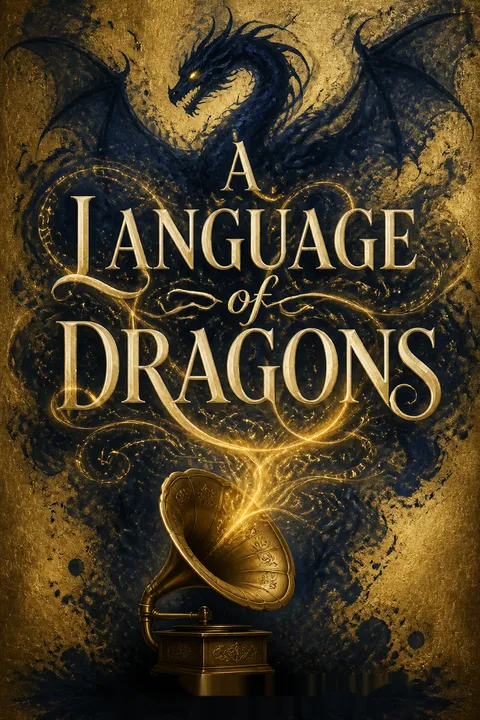


Plot Summary
A Portfolio Stained Red
Seventeen-year-old Vivien Featherswallow1 wants a summer place at the Academy for Draconic Linguistics, and an evening visit from its chancellor8 seems her best chance. She already carries a private burden: childhood friend Sophie3 has been demoted to Third Class, and Vivien1 cannot face what happened between them.
On the way home with her charming cousin2 Marquis,2 a protest against the class system erupts nearby. Guardians beat demonstrators; Vivien1 sees a girl killed and blood splashed across her portfolio.
At dinner, Chancellor Rita Hollingsworth8 presses Vivien's1 parents11 about their politics, then disappears into their study. Vivien1 follows, hoping to show her translations. Instead, she catches Hollingsworth8 searching a hidden drawer and realizes the dinner visit was a trap.
Vivien's ambition is not simple vanity. In a society where one examination can strip a family of security, professional achievement feels like protection from catastrophe. The blood on her portfolio makes that bargain visible: the institution she hopes to enter is entangled with the violence she has learned to ignore. Her shame about Sophie also establishes the private cost of her success. Before she can understand the public rebellion, Vivien must confront the harm she has already done to someone she loves.
The Library Dragon
Guardians arrest Vivien's1 parents11 and Uncle Thomas for suspected rebellion, seize papers from a secret compartment, and take Marquis2 as an adult. Her mother10 urges Vivien1 to flee London with Ursa,9 her five-year-old sister.9 Vivien1 hides Ursa9 with Sophie's3 parents, then breaks into the University of London's library to recruit its imprisoned dragon, Chumana.5
Vivien1 cuts the explosive detonator from Chumana's5 back and offers her freedom in return for burning the evidence held at the Prime Minister's6 office. Chumana5 escapes and carries out the attack, destroying the papers but setting off a political crisis. Vivien1 is caught near the fire and charged with breaking the Peace Agreement. Her attempt to save her family has made her a criminal too.
The bargain is Vivien's first deliberate step beyond the rules that have governed her life. She acts from loyalty, but chooses a solution that treats Chumana's freedom as a tool and political violence as a shortcut. The scene also reverses the familiar hierarchy between human and dragon: Vivien has a knife, but Chumana decides whether to trust her. Her rescue of Ursa is compassionate; her demand that Chumana burn an office shows how easily fear can turn compassion into dangerous calculation.
A Job Instead of Prison
At Highfall Prison, Prime Minister Wyvernmire6 explains that Vivien's1 arson has helped trigger a civil war between the government and the Human-Dragon Coalition. She offers a bargain: Vivien1 must serve the war effort, and her family may be pardoned if she succeeds.
Vivien1 insists Marquis2 be included, and Wyvernmire6 agrees. On the train out of London, a dragon attacks St Pancras Station; Vivien1 believes the escorting Guardians are dead, but Marquis2 joins her aboard. At Bletchley Park, Deputy Prime Minister Ravensloe18 introduces the secret Department for the Defence Against Dragons.
Vivien1 is assigned to Codebreaking, Marquis2 to Aviation, and Sophie3 appears among the recruits. Her childhood friend, whom Vivien1 abandoned after Sophie's3 demotion, is now trapped in the same government program.
Wyvernmire converts Vivien's guilt into leverage: the family she wants to save becomes the price of her obedience. The offer looks like a second chance, but it gives the state control over her choices without giving her meaningful freedom. The train attack punctures any illusion that Bletchley is a safe refuge. Sophie's reappearance sharpens the personal stakes, since the same system that punished her now places both girls in a competition whose rules Vivien does not yet understand.
The Glasshouse Listens
In the glasshouse, behaviourist Dr Dolores Seymour7 reveals why Vivien,1 Sophie,3 chess champion Katherine,14 and polyglot Gideon12 are Codebreakers. Dragons use sonar-like calls to communicate over distance, and Seymour's7 loquisonus machines can record and replay them.
The team must turn those sounds into intelligence for the government. Vivien1 is startled that the work is not ordinary translation, but the strange calls awaken her appetite for a difficult puzzle. On a field assignment, she meets Yndrir, a Welsh dragon guarding the manor grounds.
Soon a wounded Bulgarian dragon, Borislav, arrives. The local patrol dragons cannot understand his language, so Vivien1 translates his message: Bulgaria has agreed to something with Wyvernmire.6 The government keeps the meaning from the dragons who serve it.
The glasshouse turns linguistic study into surveillance. The machine offers Vivien the thrill of discovery while quietly changing the moral nature of her expertise: understanding a language can expose its speakers to power. Borislav's message reveals that the government is negotiating beyond the recruits' knowledge, and that even its dragon allies are excluded from those decisions. Vivien still sees translation as a bridge between peoples, but the work at Bletchley begins to show how a bridge can also become an instrument for crossing unseen.
The Cost of Class
As the recruits struggle to identify repeated sonar calls, Vivien1 and Sophie3 cautiously begin working near each other again. Sophie3 explains that after her demotion she lived in a dangerous halfway house, where a fire trapped her and her boyfriend Nicolas.
He died from burns that a better-equipped hospital might have treated. Vivien's1 assumptions about Third Class life begin to crack. Then a government announcement reports thousands dead in London, including the area where Ursa9 was staying.
Vivien1 collapses outside, and Ralph Wyvernmire,17 a Guardian and the Prime Minister's nephew,17 accuses her of endangering Bletchley. When she refuses to reveal the glasshouse key, Ralph17 breaks her arm. In the sanatorium, she learns Ursa9 is alive but will soon become a ward of the state.
Sophie gives Vivien what official descriptions of the class system conceal: its consequences in bodies, hospitals, food, and grief. Nicolas's death makes inequality more than an argument, while Vivien's injured arm shows that state violence reaches even those it calls useful. The news about London also exposes the flaw in Vivien's protective instincts. She has tried to secure one small circle of loved ones by trusting institutions that repeatedly abandon people outside it.
A Language Between Families
While recovering, Vivien1 learns that Seymour7 secretly uses a tiny dragon messenger and persuades her to send word to Ursa.9 Back at work, observations of the patrol dragons suggest that similar sonar calls vary between pairs.
Vivien1 suspects family-specific forms of communication, then finds Seymour's7 messenger tending eggs that respond to its calls. At Bletchley's Christmas ball, a radio broadcast exposes new government restrictions on studying and speaking dragon tongues.
Vivien1 also learns that the secret Peace Agreement permits criminal children to be sent to Canna as prey for dragons. The revelation destroys her faith in the treaty's fairness. Wyvernmire6 then announces that the recruits will compete individually, with only one winner per department earning a pardon.
The egg scene changes the stakes of Vivien's research. What the government calls a code may be part of the intimate process by which young dragons develop, not a military trick invented for war. Yet Vivien is still tempted by achievement and the chance to secure her family's release. The ball's elegance sharpens the contradiction: powerful guests celebrate while concealing clauses that sacrifice children and restrict knowledge. The new competition replaces cooperation with engineered scarcity, turning frightened recruits into possible threats to one another.
Bletchley Turns Brutal
After Wyvernmire6 makes the recruits compete for individual pardons, Gideon12 tries to strangle Vivien1 in the common room, hoping to remove his strongest rival. Marquis2 and Karim16 stop him, but Gideon's12 attack leaves the group suspicious of one another.
Dodie,13 unwilling to continue the work, tries to escape and is shot by the Guardians. Later, Katherine's14 poisoned gingerbread kills her before she can harm Vivien.1 Gideon12 takes a gun, shoots Guardian Owen, and flees. Vivien1 and the remaining recruits hide in the library.
There she admits she has begun to understand the dragon calls, but explains that the language is sacred and carries more than military information. Atlas4 reveals that he is a member of the Coalition and urges them to resist Wyvernmire.6
The contest makes the government's stated promise of redemption self-defeating. By forcing recruits to compete for survival, Wyvernmire reproduces the same scarcity that has shaped the class system, then calls the resulting violence individual failure. Dodie, Katherine, and Owen's deaths show how quickly administrative pressure becomes bodily danger. Vivien's discovery begins to separate knowledge from victory: the more she understands, the less certain she becomes that handing the language to the state is a form of rescue.
The Price of Forgiveness
Vivien learns that Seymour7 is a Coalition informant and that the recruits' earlier failures were partly engineered to delay the government's research. Chumana5 warns Vivien1 that the sonar language, called the Koinamens by dragons, can heal, nurture eggs, and kill.
Vivien1 also discovers that Wyvernmire6 plans to ally with Bulgarian dragons, threatening a larger massacre. She refuses to hand over the language, then tells Sophie3 the truth: she altered Sophie's3 Examination answers so a rival could take Sophie's3 university place.
Sophie3 rejects her apology, but Marquis2 supports Vivien1 as she chooses the Coalition. Chumana5 explains that she helped kill humans during the Bulgarian massacre under Queen Ignacia's orders, and now seeks to make amends. Vivien1 recognizes that remorse matters only when it changes what she does next.
This section joins political history to personal accountability. Chumana is not an innocent guide: her complicity in the Bulgarian massacre makes her call for change costly and credible. Vivien's confession does not secure Sophie's forgiveness, nor should it. Instead, it ends Vivien's attempt to manage the truth for her own comfort. Her emerging ethic is not that guilt disappears, but that guilt can become a reason to stop repeating harm.
The Escape Plan Breaks
Marquis2 and Vivien1 warn the patrol dragons about Wyvernmire's6 Bulgarian alliance, and Rhydderch and Muirgen agree to consider helping the Coalition. The recruits plan a midnight escape. Karim16 carries three stolen dragonlings and two eggs toward Chumana,5 while Sophie,3 Marquis,2 and Atlas4 prepare to leave.
Dr Seymour7 and Vivien1 destroy the loquisonus machines and their translations to keep the Koinamens from the government. Ralph17 catches them, however, and the Guardians imprison Vivien,1 Seymour,7 and Atlas.4
Wyvernmire6 arrives with Ursa9 as a hostage and orders Vivien1 to translate. At the glasshouse, Vivien1 plays calls meant to summon help rather than give the government its answers. Ralph17 attacks her, but Marquis2 intervenes, and Chumana5 returns to carry them into the battle.
The escape attempt turns Vivien's new convictions into action, but it does not erase the power imbalance: Wyvernmire can still reach her through Ursa. Vivien's use of the machine is a moral pivot. She redirects a technology built for exploitation toward communication and rescue, accepting immediate danger rather than surrendering the language. The dragonlings make the conflict tangible. Their stolen eggs represent the future the government hopes to command, while the recruits' decision to protect them rejects the idea that victory justifies any method.
A Fire-Breathing Plane
Chumana5 burns the glasshouse, and Marquis,2 Atlas,4 Vivien,1 and their allies race through the manor to recover Ursa9 and the dragonlings. Gideon12 and Serena15 reappear with weapons, having helped free Ursa9 and Seymour.7 Outside, Coalition fighters breach Bletchley's gates.
Marquis's2 team launches the fighter plane they built, complete with a mechanism based on dragon anatomy that lets it breathe fire. Then the Bulgarian army arrives ahead of schedule, vastly outnumbering the rebels. Rhydderch is killed in the first assault.
Vivien1 boards the plane with Sophie,3 but when she sees Atlas4 in danger below, she lets go of the ladder and returns to the battlefield. She believes that the remaining loquisonus machine may be the only way to stop Wyvernmire's6 alliance from consuming the country.
The plane is both a practical invention and a sign of what the recruits can make together when they are not forced to compete. Its first flight briefly offers escape, but the early arrival of Bulgaria makes the old conflict seem suddenly small. Vivien's return to the ground rejects survival purchased by leaving everyone else behind. That decision is not proof that she has become fearless; she is still choosing under pressure. What has changed is the range of people she now considers part of her responsibility.
The Machine Falls Silent
Vivien1 returns to the burning grounds with Atlas4 and finds Wyvernmire6 beside General Goranov, the Bulgarian commander. She offers to serve as the Prime Minister's6 translator only if the recruits are pardoned, the Third Class receive equal rights, and dragons regain a place in society.
Wyvernmire6 accepts only the immediate release terms and insists on keeping the class system. Vivien1 recognizes that the promised career and family reunion would bind her to the same injustice.
As Chumana5 attacks Goranov, Vivien1 smashes the last loquisonus machine with a stone, denying both armies a way to reproduce the Koinamens. Marquis's2 plane circles overhead, but Ralph17 shoots Atlas4 before Vivien1 can escape. She returns to him as the battle continues around them.
Wyvernmire offers Vivien exactly what she once wanted: status, study, and the return of her family. The offer is powerful because it is plausible, not because Vivien has stopped caring about those things. She rejects it when she sees that private safety would depend on public subordination. Destroying the machine makes that refusal irreversible. The cost is immediate and intimate: Atlas is shot, and Vivien must face the possibility that a principled choice cannot protect everyone she loves.
A Loss, Not an Ending
Atlas4 dies in Vivien's1 arms before she can get him medical help. Chumana5 drives back the immediate attack, while Chancellor Hollingsworth8 arrives by car and pulls Vivien1 away from the battlefield. She reveals that she has been a Coalition leader working undercover inside the government, and that Vivien's1 parents knew their arrest might come.
Marquis's2 plane lands at a farm, where Vivien1 is reunited with Ursa,9 Sophie,3 Marquis,2 Karim,16 Serena,15 Gideon,12 and Seymour.7 Vivien1 tells Sophie3 she will not demand forgiveness, but will try to live differently. They fly to Eigg, the Coalition's new headquarters. Vivien1 learns the war continues, and resolves to help free her parents and oppose the class system without surrendering the dragons' language.
The ending refuses a clean reward for Vivien's moral growth. Atlas is gone, her parents remain imprisoned, and the political crisis has widened rather than ended. Still, Vivien reaches Eigg with Ursa and the friend she betrayed, and she no longer confuses self-forgiveness with being absolved by others. The destination matters: a decentralized refuge offers no guarantee of justice, only a place from which people can keep working toward it. Vivien's future rests on choices she has not yet made.
Analysis
A Language of Dragons builds its political conflict around a question that Vivien1 first treats as academic: what does it mean to understand another language? In Britannia, translation is controlled because communication creates relationships the state cannot easily manage. The Class System similarly presents hierarchy as an orderly arrangement while withholding the material conditions that make its promises unequal. Vivien's1 early faith in both institutions is not foolishness in isolation; she has been trained to experience compliance as safety and achievement as the only reliable protection against demotion.
The Koinamens pushes the language theme beyond words. Its calls carry emotion and biological consequence, so recording them does not simply preserve information. It risks severing a form of communication from the relationships that give it meaning. Vivien's1 crisis is therefore not whether she can decode a difficult system, but whether expertise makes her entitled to use it. The novel refuses the comforting idea that knowledge is neutral or that good intentions erase the danger of its application.
Vivien's1 guilt over Sophie3 supplies the intimate counterpart to the political plot. Her confession cannot undo the lost university place or Nicolas's death, and Sophie3 is not required to forgive her. Yet accountability becomes possible when Vivien1 stops defining herself as irredeemably bad. That belief had let her treat selfish harm as inevitable. Choosing differently does not restore what was lost, but it changes what she is willing to protect.
The ending offers no finished revolution. Vivien1 reaches Eigg with family and allies, but her parents remain imprisoned and the larger conflict continues. Hope rests not on a perfect treaty or a single heroic victory, but on the difficult work of making future agreements answerable to the people and dragons who must live under them.
Review Summary
A Language of Dragons received mixed reviews. Many praised its unique concept, political themes, and dragon worldbuilding. The main character Vivien was controversial, with some finding her frustratingly naive while others appreciated her character arc. Readers enjoyed the linguistic aspects and dark academia vibes. However, some felt the romance was underdeveloped and the pacing uneven. The ending left many wanting more, uncertain if there would be a sequel. Overall, it was seen as a promising debut with room for improvement.
People Also Read








Characters
Vivien Featherswallow
Ambitious dragon linguistVivien is a gifted student who speaks several human and dragon languages and dreams of becoming a professional translator. Raised to treat grades, class standing, and obedience as safeguards, she is competitive, quick-witted, and often more practiced at hiding fear than admitting it. Her family and her oldest friendship with Sophie3 matter deeply to her, though ambition has sometimes made her place achievement ahead of loyalty. Vivien's interest in language is intellectual, but also emotional: she believes translation can let people understand one another. Her central struggle is learning that skill alone does not determine what kind of person she is; what matters is how she chooses to use it.
Marquis Featherswallow
Vivien's daring cousinMarquis is Vivien's1 older cousin, a charismatic young man whose charm helps him move easily through social spaces. He enjoys flirtation, clothes, sketching dragons, and making people laugh, but his light manner conceals a serious awareness of how class shapes opportunity. He is brave to the point of recklessness and often acts before fear can stop him. Unlike Vivien1, he questions whether preserving his family's comfort is worth accepting a system that harms others. His loyalty to Vivien1 is affectionate rather than unquestioning; he can challenge her directly while remaining a source of warmth and practical help.
Sophie Rundell
Vivien's wounded best friendSophie grew up beside Vivien1 and shared her dream of attending university. A capable mathematician with experience in Morse code, she is observant, disciplined, and frank about the gap between official promises and lived reality. Her demotion exposes her to the hazards of the Third Class, but does not make her defined by suffering: she forms attachments, questions authority, and retains a sharp sense of humor. Sophie's anger at Vivien1 is grounded in real betrayal, not misunderstanding. She represents the ethical limit of Vivien's1 wish to make things right: friendship cannot be repaired by demanding that the injured person forgive.
Atlas King
Idealistic seminarianAtlas is a thoughtful, physically capable young man from the Third Class who is training for the priesthood. His faith shapes his ideas about forgiveness and service, though it does not make him meek; he challenges authority and intervenes when he sees someone being harmed. Atlas reads people closely and recognizes that guilt can become another form of self-punishment. His connection with Vivien1 grows through arguments about responsibility, belief, and the society they inhabit. He is also patient with practical work, including carpentry and the study of young dragons. His idealism is strongest when it asks him to protect people beyond his own circle.
Chumana
Imprisoned Bolgorith rebelChumana is a formidable Bulgarian dragon, once imprisoned in the University of London's library and fitted with a lethal detonator. Her amber eyes, vast body, and dry wit make her intimidating, but she is more than a symbol of dragon power. She carries the memory of political violence and the guilt of actions taken under a ruler's orders. Chumana distrusts human attempts to classify or control dragon life, especially when presented as scholarship. Her belief that dragons must be allowed to change is rooted in her own struggle with culpability. She challenges Vivien1 to distinguish feeling sorry from acting differently.
Prime Minister Wyvernmire
Authoritarian wartime leaderWyvernmire is Britannia's first female Prime Minister, an accomplished politician who presents herself as a guardian of peace and national order. She is controlled, persuasive, and skilled at identifying what people most fear losing. Her public image rests on having preserved the Peace Agreement, while her private decisions reveal a willingness to use surveillance, coercion, and hidden bargains. She sees talent as a resource to be directed toward the state and interprets sacrifice as the necessary price of ambition. Her confidence makes her dangerous, but it is also vulnerable to the belief that her power is the same thing as the country's welfare.
Dr Dolores Seymour
Inventor of dragon sonarSeymour is a dragon behaviourist and the head of Codebreaking at Bletchley Park. She designs the loquisonus machines and understands the scientific promise of studying dragon communication, yet she is troubled by the harm that knowledge could enable. Careful, intelligent, and initially guarded, she tries to balance her government role with concern for the people and dragons affected by it. Her research brings her into close contact with recruits whose safety depends on her judgment. Seymour's central tension is that the instruments she creates can serve discovery and coercion at once, leaving her responsible for choices beyond the laboratory.
Rita Hollingsworth
Chancellor and political operatorHollingsworth is the silver-haired chancellor of the Academy for Draconic Linguistics, a celebrated scholar who has documented several dragon tongues. She is observant, composed, and adept at moving among powerful officials without surrendering her interest in linguistic scholarship. Her curiosity about Vivien1 is genuine, but she also understands how institutions control what can be studied and published. Hollingsworth treats language as a form of power because the people who define a language's written form can influence who is able to read and shape its history. Her polished public manner makes it difficult for others to know what she intends.
Ursa Featherswallow
Vivien's little sisterUrsa is Vivien's1 five-year-old sister, affectionate, curious, and accustomed to asking after people she misses. Her class pass is a small but constant reminder that even a child must display her place in society. Ursa depends on Vivien1 and her parents for safety, yet she has her own bright interests, including secret places, lessons, and her cat Mina. Her presence makes Vivien's1 political choices immediate: policies that can seem abstract to an older student determine whether Ursa stays with family or becomes subject to the state.
Helina Featherswallow
Bulgarian dragon scholarHelina is Vivien's1 mother, a Bulgarian refugee and respected dragon anthropologist. Her work argues that dragon languages contain forms of variation that scholars have overlooked. Patient with her younger daughter and intellectually persistent, she studies dragons despite the violence her own family suffered. Helina's scholarship reflects both curiosity and an effort to recognize the cultural lives of dragons. Her research gives Vivien1 a way to approach unfamiliar communication without assuming that existing institutions already understand it.
John Featherswallow
Vivien's conflicted fatherJohn is Vivien's1 father, an academic who helped raise her within the demanding expectations of the class system. He loves his daughters, but his earlier severity has taught Vivien1 to fear failure and demotion. Alcohol loosens the restraint with which he usually speaks, exposing doubts about the society he once appeared to accept. His concern for his family's future sits uneasily beside the rules he enforced, making him part of Vivien's1 understanding of how people can participate in systems they later oppose.
Gideon
Polyglot codebreakerGideon is a young recruit assigned to Codebreaking because he speaks several human languages and has experience around dragons. He is intelligent and technically curious, but often relies on inherited assumptions about class and species. Fear of losing the chance to escape his past can make him defensive and dangerous. His presence shows how a person may be both skilled and vulnerable to the competitive structure imposed at Bletchley.
Dodie
Gentle recruit with resolveDodie is a soft-spoken Second Class recruit with red hair and a thoughtful manner. She tends to respond to tension with kindness, including small gestures of care for the other recruits. Her quietness should not be mistaken for passivity: she forms her own judgments about the work and the treatment of dragons. Dodie gives the group a reminder that courage can be gentle and that refusal may be the only control a person has left.
Katherine
Prison chess championKatherine is a small, sharp-minded recruit whose talent for chess brings her into the Codebreaking group. She is playful and sociable, but prison has taught her to anticipate danger and keep means of self-defense close. Her background gives her a practical understanding of how precarious life is for those without status or protection. She is drawn to puzzles because they reward attention and foresight, qualities that also shape how she reads the other recruits.
Serena Serpentine
Inventive First Class aviatorSerena is a wealthy First Class recruit with a talent for designing models of flying machines. Confident, stylish, and sometimes cutting, she has been raised among people who expect her to obey family plans for her future. Her privilege gives her room to reject expectations, but it does not mean she is free from coercion. Serena's inventive skill and her uneasy relationship with class privilege make her an important counterpoint to recruits whose choices have been shaped by poverty.
Karim
Quiet recruit and loverKarim is a reserved recruit who comes from the Third Class and is skilled with wiring and embroidery. He speaks gently, listens carefully, and forms a close relationship with Marquis2. His family's precarious finances have forced him to make choices the government treats as crimes, though his motives are rooted in keeping them afloat. Karim's practical talents and quiet loyalty contrast with the forceful personalities around him.
Ralph Wyvernmire
Cruel Guardian nephewRalph is a young Guardian and the Prime Minister's nephew17. He is resentful of being assigned to supervise recruits rather than pursue the dragon-combat work he values. His sense of humiliation turns readily into cruelty, especially toward people he considers beneath him. Ralph uses his official position to threaten and intimidate, making him a personal face of the state violence that the Prime Minister6 presents as necessary order.
Deputy Prime Minister Ravensloe
Bletchley's stern directorRavensloe oversees the recruits at Bletchley and presents the Department's work as their chance at redemption. Paternal in tone but rigid in practice, he treats people as useful only while they contribute. He is comfortable using secrecy, surveillance, and threats to keep the program moving. His polished speeches and punitive decisions expose the distance between the government's promise of a second chance and its willingness to let vulnerable recruits make their own choices.
Plot Devices
The Class System
Ranks shape every choiceBritannia divides people into First, Second, and Third Classes, with status affecting where they may live, what resources they can access, and whether they can pursue certain education or work. An examination can preserve or lower a person's position, making academic failure a threat to family security. The system drives Vivien's1 ambition, Sophie's3 demotion, and the recruits' fear of punishment. It also lets the government describe inequality as opportunity, even when a person's starting resources determine how much opportunity they can use.
The Peace Agreement
Peace conceals unequal termsThe treaty between Britannia's government and the Dragon Queen is presented as the reason humans and dragons coexist without open war. Its restrictions govern travel, flight, and relations between species, while hidden clauses permit abuses that the public version does not reveal. Vivien1 initially trusts the treaty because it promises stability. As she learns what it allows and whom it excludes, the agreement becomes a political battleground rather than a neutral guarantee of peace.
The Loquisonus Machines
Turns dragon calls into evidenceDr Seymour's7 machines detect dragon echolocation and convert it into sounds humans can hear, letting the Codebreakers record, sort, and attempt to interpret calls. The devices make a previously inaccessible form of communication available to human study, but they also create the possibility of surveillance and imitation. Their recordings help Vivien1 recognize patterns, while the machine's limits become increasingly important: audible conversion cannot carry all the meaning that dragons experience in their calls.
Class Passes
Make status visibleCitizens wear passes identifying their class and age. The small badges determine whether someone may enter a quarter, attend a school, or remain where they are. Ursa's9 fraying pass worries Vivien1 because a missing badge can expose a child to questioning. For Sophie3, the loss of her former status changes where she can live and what help she can access. The passes turn social ranking into an everyday physical object, carried close to the body.
The Koinamens
A language beyond translationDragons call their natural echolocation language the Koinamens. Humans can detect aspects of it with specialized equipment, but the calls carry meanings tied to emotion and bonds between dragons. Vivien1 initially approaches it as a code that can be transcribed and mastered. Her discoveries show that it is also connected to healing, development, and communication within dragon families. This device forces her to ask whether understanding something grants the right to reproduce or control it.
A Language of Dragons Series
Download PDF
Download EPUB
.epub digital book format is ideal for reading ebooks on phones, tablets, and e-readers.








