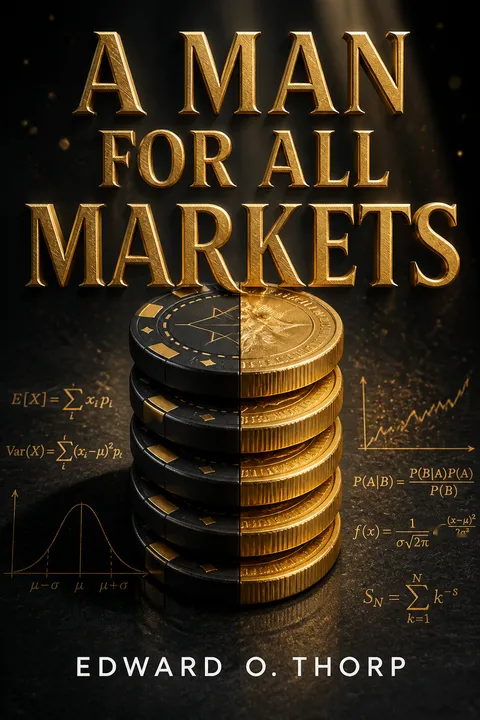


Key Takeaways
Treat consensus as a hypothesis, then test it against reality.
Build your own model. Raised during the Depression, Thorp learned early to question received explanations and check them through experiments. A model is a simplified picture of how something works, useful when it helps explain observations and predict new ones. He tested rules with everything from arithmetic to homemade science projects, then used quick mental calculations to spot when financial news exaggerated a market move.
Follow the evidence. When people insisted that casinos could not be beaten, Thorp did not treat their confidence as proof. He investigated blackjack mathematically, looking for the assumptions behind the accepted claim. That habit, rather than an early urge to gamble, launched his path from academic mathematics to Las Vegas and, eventually, Wall Street.
The book’s central method resembles experimental science at its best: make a claim precise enough to test, build a model, and let results correct intuition. That discipline is useful well beyond mathematics, especially when confident explanations arrive faster than evidence. There is a limit, though: a successful test in one setting does not establish a general law. Models simplify, and their usefulness depends on whether the important features of reality have survived the simplification.
In blackjack, count what remains, not how lucky you feel.
Cards change the odds. Basic blackjack strategy assumes cards are equally likely throughout play. Thorp recognized that this assumption stops being true once cards have been dealt. A deck unusually rich in high cards helps the player, partly because blackjacks pay the player more than they pay the dealer. A deck depleted of small cards also shifts the advantage toward the player.
Turn knowledge into action. Thorp used computer calculations to measure how changing card proportions affected the odds. Removing four 5s from a single deck shifted the game from a slight casino advantage to a 3.29 percent player advantage under the rules he studied. His simpler High-Low count tracked small cards against high cards, giving players a practical signal for when to bet more and when to hold back. The edge came from changing information, not a lucky betting pattern.
This is a clear example of conditional probability: the odds of an event depend on what has already happened, even when the process looks random. The distinction separates card counting from systems that merely change bet size after wins or losses. It also shows why a real edge requires both an explanatory mechanism and a way to recognize it in time. The numerical advantage is specific to the rules and conditions studied, not a promise that every blackjack table offers profitable play.
Scale every bet to survive being wrong about your edge.
An advantage is not immunity. Thorp used the Kelly Criterion, a method for sizing a wager according to its estimated edge and risk. When the odds improve, the bet can increase. But risking too much can wipe out a player before the long-run advantage has time to work. Thorp’s first Nevada test of his blackjack system lost money, a result he expected was possible even if the mathematics was sound.
Bankroll and temperament matter. For a later test, backers wanted to wager aggressively with a large bankroll. Thorp instead chose smaller bets that he could handle calmly. Over about thirty hours of play, $10,000 grew to $21,000, with the largest temporary drop around $1,300. His partner Manny Kimmel, by contrast, sometimes bet wildly and returned winnings to the casino. Thorp’s practical lesson was to size risk for the capital and discipline actually available.
Bet sizing connects probability to survival. A strategy can have positive expected returns and still fail if losses arrive before gains, or if a person abandons the plan under pressure. The Kelly approach makes that trade-off explicit, but its output depends on estimates that may be wrong. In markets, probabilities are less knowable than in a fixed card game, so conservative sizing is not timidity. It is a response to uncertainty about the model itself.
A physical process can hide a measurable edge inside apparent chance.
Measure the motion. With Claude Shannon, Thorp built a tiny computer to predict where a roulette ball would land. The team timed the ball and spinning wheel, then estimated where the ball would leave its track. The ball’s bounce introduced uncertainty, but not enough to erase their prediction advantage. Betting on five neighboring pockets produced an estimated edge of about 44 percent under their tests.
A winning idea has costs. The computer was worn under clothing, with toe-operated switches and a concealed radio receiver. Thorp and Shannon tested it in Las Vegas and won, but fragile wires broke, casino attention was a risk, and continued play would have required elaborate disguises and constant performance. Thorp chose not to build a career around the device. A profitable opportunity can still be a poor life choice if exploiting it consumes too much time or freedom.
The roulette experiment is a memorable lesson in measurement: uncertainty does not mean that every outcome is equally unpredictable. Small physical regularities can matter when timing and observation are good enough. Yet the story also makes an important distinction between technical success and practical value. A model may identify an edge while leaving unanswered whether it can be exploited repeatedly, safely, and without excessive cost. Feasibility is part of the calculation, not an afterthought.
Hedge mispricing, not broad market direction, to make risk manageable.
Compare related securities. Thorp moved from casino odds to warrants, options, and convertible bonds. These securities are linked to a company’s stock, so their prices can be compared. If one appears cheap relative to the other, an investor can buy the underpriced security and short the overpriced one. The offsetting positions are designed to reduce exposure to the stock’s general movement while seeking profit as the price gap closes.
Models became a business. Thorp developed a practical formula for valuing warrants and options, then used it to build Princeton Newport Partners, an early quantitative hedge fund. Its limited partners earned a 15.1 percent annual compound return from 1969 through 1988, compared with 10.2 percent for the S&P 500 including dividends. Hedging reduced risk, but did not remove it: prices, financing, counterparties, and the model’s assumptions could still disappoint.
Relative-value investing asks a narrower question than forecasting whether an entire market will rise or fall: are two economically connected prices inconsistent? That can make risk easier to isolate and test. It also creates a new set of dependencies, including borrowing costs, liquidity, and the stability of the relationship being modeled. A hedge is therefore not the absence of risk. It is a deliberate exchange of broad exposure for more specific risks that must still be understood.
Index by default; stock-pick only when you can prove an edge.
The group pays for its choices. Thorp argues that all active investors, taken together, hold the market portfolio before costs. Their combined result therefore matches the index, while research, trading, and management expenses push their average return below it. His estimate was that active investors lose roughly two percentage points a year to costs, while a low-cost index fund can keep expenses and trading costs below a quarter-point.
Mispricing exists, but access matters. In 2000, Thorp’s son Jeff spotted a gap between Palm shares and 3Com shares, which included a future distribution of Palm stock. The market valued Palm so highly that it implied the rest of 3Com was worth less than zero. The gap was real, but limited borrowing opportunities constrained the trade. For most investors without a specific, demonstrable advantage, Thorp’s recommendation is a broad, low-cost index fund.
The case for indexing is unusually powerful because it does not require believing that every price is correct. It follows from arithmetic about investors as a group, then adds the drag of fees and trading. The Palm and 3Com episode supplies the complementary point: markets can misprice assets, yet practical limits may prevent most investors from profiting. An index is a strong default, not a prohibition on active investing when an investor can identify and capture a genuine advantage.
Stress-test a position for ruin, not merely ordinary volatility.
Leverage shrinks the margin for error. Thorp was right that silver had a favorable supply-and-demand outlook, but borrowed heavily to increase his position. When the price briefly fell, lenders forced sales and the decline wiped out his investment before silver resumed rising. A sound thesis had not protected him from a fragile financing structure.
Ordinary models miss extraordinary damage. Long-Term Capital Management used heavy leverage on trades expected to be low-risk, then lost nearly all its capital when market relationships shifted. In 2008, excessive borrowing and interconnected financial contracts spread losses through the system. Thorp favored asking how a portfolio would fare in extreme scenarios, keeping enough collateral, and avoiding illiquid positions that cannot be sold when needed. The central test is whether a bad outcome is survivable, not whether it seems unlikely.
Risk models often describe familiar fluctuations more precisely than unfamiliar crises. That makes stress testing valuable, especially when losses can force sales or threaten an institution’s survival. But no list of past disasters can fully describe the next one. The more robust lesson is structural: limit leverage, understand who can demand cash and when, and preserve room to adapt. The silver episode shows that being right about value is not enough if timing and financing can end the bet first.
Verify the trades and incentives behind every too-smooth return.
A good story is not proof. In 1991, Thorp reviewed an investment manager’s unusually steady returns and found that the claimed options strategy could not plausibly produce them. He examined transaction records and found that about half of a sample of trades did not appear on the exchange where they were said to have occurred. Some reported volumes also exceeded the exchange’s total. His client withdrew its money from Bernard Madoff’s operation.
Check the machinery. Thorp also found that Madoff used a tiny, friendly accounting firm and delayed trade confirmations. The warning signs were not obscure mathematics alone; they were gaps between reported activity and independently checkable records. Investors and regulators still failed to act on many warnings. When performance looks unusually smooth, test whether the stated process could generate it, verify holdings and trades independently, and ask who benefits from your trust.
Fraud prevention is partly a technical problem and partly a social one. Independent verification tests whether records correspond to real transactions; incentive analysis asks whether an adviser is rewarded for accuracy or merely for attracting assets. Madoff’s reputation and the confidence of other investors became substitutes for verification, a costly shortcut. No screening process guarantees safety, but a refusal to provide auditable evidence should carry more weight than a prestigious name or a flawless-looking track record.
Let compound growth buy time, then decide what enough means.
Small gains can grow large. Thorp uses the rule of 72 to estimate doubling time: divide 72 by the annual percentage return. At 8 percent, money roughly doubles every nine years. He tells of Anne Scheiber, who invested $5,000 in 1944, reinvested dividends, and left a $22 million portfolio when she died in 1995. Her example shows the force of sustained reinvestment, though actual results depend on markets, taxes, and inflation.
Wealth is a means. After building a successful investment firm, Thorp chose not to restart a large operation when Princeton Newport Partners closed. He and his wife had enough to spend more time with family, travel, and support causes they valued. Their endowment for a university mathematics chair was designed to spend only 2 percent annually so the principal could continue growing. The book’s final measure of success is not unlimited accumulation, but the life that money makes possible.
Compounding is powerful because gains begin earning gains, but the result requires time, reinvestment, and a tolerable level of risk. Scheiber’s portfolio is an exceptional illustration, not a typical forecast. The deeper insight is about the purpose of accumulation: money can purchase choice, security, and time, while additional wealth may matter less once those needs are met. Naming a personal threshold for enough can prevent a successful strategy from becoming an endless demand for more.
Analysis
This memoir is organized around a method more than a single career: notice an assumption, build a model, test it, and control the size of the bet. That method links a boy experimenting with numbers and radio to a mathematician who counts cards, predicts roulette, prices options, and runs a hedge fund. The narrative’s unusual strength is that technical discoveries are inseparable from practical constraints. Thorp asks not only whether an edge exists, but whether it can be recognized, financed, exploited, and survived.
The most portable lesson is not that a clever person can beat every system. It is that some environments contain measurable advantages, while most people cannot reliably identify them. Blackjack offers unusually clear probabilities; financial markets involve shifting rules, competition, and uncertain models. The book’s impressive fund results demonstrate what Thorp reports achieving, but they cannot establish that the same edge is available to readers now. Strategies attract competitors, and the author’s own account shows that opportunities can shrink as capital and imitation grow.
That tension strengthens the practical advice. Indexing is not a retreat from intelligence. It is a reasoned baseline when a person cannot demonstrate a durable advantage after costs and taxes. For those who do find an edge, risk control matters as much as discovery. Thorp’s silver loss, casino experience, and warnings about leverage all expose the gap between being right eventually and remaining solvent long enough to benefit.
The memoir also resists the standard success story in which greater wealth automatically justifies greater ambition. Thorp’s decision to stop expanding his business gives the technical narrative a human endpoint: freedom over scale. Its lasting invitation is therefore double. Learn to reason quantitatively, and use that reasoning to decide what is worth pursuing, what risks are tolerable, and when the gain is no longer worth the life it costs.
Review Summary
A Man for All Markets receives praise for its fascinating insights into Thorp's life, from beating casinos to pioneering quantitative finance. Readers appreciate his clear writing and valuable investment advice. However, some find the book self-aggrandizing and criticize the later chapters for basic financial information. The autobiography is lauded for its engaging anecdotes and Thorp's unique perspective on markets, though opinions vary on its overall quality and relevance to modern investors.
People Also Read








Glossary
Kelly Criterion
Edge-based bet sizingA method for choosing how much of a bankroll to risk when the probabilities and payoffs of a favorable wager can be estimated. The wager grows with the estimated advantage and shrinks as risk rises. Thorp used the method for blackjack, roulette, baccarat, and investment decisions, while emphasizing that uncertain estimates call for conservative sizing.
High-Low System
A simple blackjack countA card-counting method that tracks the changing balance of small and high cards during blackjack play. Small cards increase the running count, high cards decrease it, and middle cards do not change it. The count helps estimate whether the remaining deck favors the player or the casino, informing both playing decisions and bet size.
market-neutral
Low market correlationA portfolio is market-neutral when its gains and losses are designed to have little relationship to broad market movements. Thorp’s approach often paired long positions in securities judged relatively cheap with short positions in related securities judged relatively expensive. Neutrality can reduce exposure to general market direction, but it does not eliminate other risks or guarantee a profit.
statistical arbitrage
Model-based relative-value tradingA quantitative strategy that uses statistical analysis to identify securities whose prices appear out of line, then combines long and short positions to reduce exposure to shared market forces. Thorp’s versions used many stocks at once and sought gains from recurring price relationships. The approach depends on historical patterns persisting and can weaken as more capital pursues the same opportunities.
Sharpe's Principle
Active investors collectively indexThe arithmetic principle that, before costs, all active investors combined hold the market portfolio. If passive investors also hold the market portfolio, the remaining active investors as a group must do so as well. Individual active investors may outperform or underperform, but fees and trading costs reduce the group’s return relative to a low-cost index.
Black-Scholes formula
A model for option pricingA mathematical formula for estimating the fair value of an option using features such as the underlying stock price, time to expiration, volatility, interest rates, and exercise price. Thorp developed a closely related practical formula for warrants and options before Black and Scholes published their derivation. The formula became a foundation for modern derivatives markets, though its assumptions do not capture every market condition.
FAQ
What's A Man for All Markets about?
- Personal Journey: The book follows Edward O. Thorp's life from the Great Depression to his success as a mathematician, gambler, and investor. It highlights his application of mathematical principles in gambling and investing.
- Gambling and Investment: Thorp shares his strategies for beating casinos at games like blackjack and roulette, and how he transitioned these methods to Wall Street.
- Life Lessons: The narrative emphasizes rational thinking, experimentation, and knowledge pursuit, inspiring readers to critically assess risk and wealth-building.
Why should I read A Man for All Markets?
- Unique Perspective: Thorp combines personal memoir with practical advice, offering insights into gambling and investing.
- Mathematical Insights: The book makes complex mathematical concepts accessible, enhancing understanding of probability and risk management.
- Inspiration and Motivation: Thorp's journey from a challenging childhood to a pioneer in quantitative finance encourages readers to pursue passions and think innovatively.
What are the key takeaways of A Man for All Markets?
- Think Rationally: Emphasizes evidence-based decision-making in gambling and investing, advocating for informed judgments.
- Card Counting Strategy: Introduces card counting in blackjack, allowing players to adjust betting strategies based on remaining cards.
- Risk Management: Highlights effective risk management strategies, like the Kelly Criterion, for optimal bet sizing based on player edge.
What are the best quotes from A Man for All Markets and what do they mean?
- “I learned how to think.” Reflects Thorp's belief in critical thinking and rational analysis as keys to success.
- “The greatest casino on Earth.” Compares Wall Street to gambling, emphasizing the need for strategy and skill in both arenas.
- “You can’t beat the casinos.” Challenges conventional wisdom by demonstrating how mathematical strategies can overcome odds.
What is card counting, and how does it work in blackjack according to A Man for All Markets?
- Basic Concept: Card counting tracks the ratio of high to low cards remaining in the deck to gain an advantage.
- Point System: Thorp's system assigns values to cards, maintaining a running count to indicate favorable betting conditions.
- Betting Strategy: Players increase bets with a positive count and minimize them with a negative count, managing risk and maximizing gains.
What is the Kelly Criterion, and how does it apply to gambling and investing in A Man for All Markets?
- Definition: A formula to determine optimal bet size based on edge and winning odds.
- Application in Gambling: Suggests betting a bankroll percentage proportional to the player's edge in blackjack.
- Investment Strategy: Guides asset allocation based on expected returns and risks, promoting disciplined capital management.
How did Thorp transition from gambling to Wall Street in A Man for All Markets?
- Mathematical Models: Applied gambling strategies to financial markets, using mathematical models for analysis.
- Quantitative Finance Pioneer: Used statistical methods to identify profitable stock market opportunities.
- Building Partnerships: Collaborated with investors and mathematicians to enhance investment strategies.
What challenges did Thorp face in his gambling career as described in A Man for All Markets?
- Casino Countermeasures: Casinos implemented strategies like frequent reshuffling to counter card counting.
- Legal and Ethical Dilemmas: Faced challenges related to being barred from casinos and ethical considerations of exploiting advantages.
- Public Scrutiny: Dealt with intense public interest and pressure following the publication of Beat the Dealer.
What is statistical arbitrage, and how does Thorp describe it in A Man for All Markets?
- Definition: A trading strategy using statistical methods to exploit price discrepancies in securities.
- Thorp's Approach: Applied statistical arbitrage in his hedge fund, using quantitative models for market analysis.
- Success Metrics: Demonstrated consistent returns while managing risk through market neutrality.
How does Thorp view the concept of efficient markets in A Man for All Markets?
- Critique of EMH: Challenges the Efficient Market Hypothesis, arguing that markets are not always efficient.
- Behavioral Economics: Highlights psychological factors leading to market inefficiencies, exploitable by savvy investors.
- Practical Implications: Emphasizes quantitative analysis and statistical methods for successful investment strategies.
What impact did Beat the Dealer have on the gambling world according to A Man for All Markets?
- Revolutionized Blackjack: Introduced card counting, shifting blackjack from a game of chance to skill and strategy.
- Increased Popularity: Led to a surge in blackjack players, prompting casinos to adapt strategies and rules.
- Ongoing Blackjack War: Initiated a dynamic between casinos and skilled players, shaping the gambling landscape.
What are Thorp's future plans after winding down PNP as mentioned in A Man for All Markets?
- Focus on Family: Desires to spend more time with family and enjoy life outside the investment world.
- Continued Learning: Plans to explore new interests and expand knowledge in mathematics and finance.
- Legacy of Innovation: Aims to inspire future generations through writings and teachings on risk and opportunity.
Download PDF
Download EPUB
.epub digital book format is ideal for reading ebooks on phones, tablets, and e-readers.








