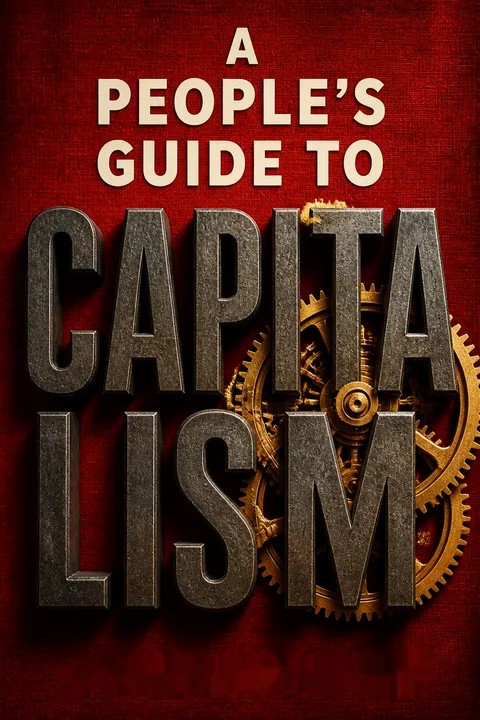


Key Takeaways
See capitalism as a class relation built by dispossession, not human nature
A recent arrangement. Capitalism is not presented as the inevitable expression of human greed. It arose through a historical transformation that separated many people from land, tools, and other ways to support themselves. In England, enclosure fenced off common lands and pushed peasants toward wage work. The expansion of European capitalism also depended on enslaved African labor and the seizure of Indigenous lands in the Americas.
Freedom with a price. Workers became legally free to choose employers, but often lacked any practical alternative to selling their labor to survive. The state helped establish and defend this new order. The book’s point is not that earlier societies were fair, but that capitalism’s specific forms of ownership and dependence were made, not given by nature.
The historical lens does useful work: it makes arrangements that feel permanent available for political scrutiny. It also connects labor history to colonial history, challenging accounts that treat European industrial growth as a self-contained achievement. The claim that capitalism arose through a single, clearly bounded transition is more contested than this primer can explore. Historians disagree about its timing and causes, and different regions followed different paths. That complexity strengthens the central insight rather than erasing it: present economic institutions have histories, and their histories include coercion as well as innovation.
Separate usefulness from market worth to see what capitalism prioritizes
Two kinds of value. A commodity is something made through labor, useful to someone, and produced for sale. Its use-value is what it does for a person. Its exchange-value is the quantity in which it trades for other goods or money. A loaf baked for dinner has use-value; a loaf baked to sell is also a commodity.
The market's filter. In this account, a product must be useful to some buyer, but social need alone does not ensure production. Grain may go unsold while people go hungry if they cannot pay, while disposable products can be profitable to manufacture. The book argues that socially necessary labor-time, the average labor required under prevailing conditions, underlies commodity value. Prices, however, fluctuate and are not identical to value.
The distinction between usefulness and saleability clarifies why unmet need can coexist with unsold goods. It also helps readers see that prices are not neutral scorecards of social importance. A public-health or ecological analysis asks what a good does and who benefits; a market analysis asks whether it can be sold profitably. Those questions can produce very different priorities. The labor theory of value is a theoretical account of value, not a reliable shortcut for calculating each item's price. The book makes that distinction, though readers may still want to compare it with other theories of how prices form.
Treat money as a measure of exchange, not a mysterious source of wealth
A useful stand-in. Money makes exchange easier by giving unlike goods a common measure, serving as a medium of payment, and storing purchasing power. Historically, different goods filled this role, including cattle, salt, and precious metals. Gold became prominent because it was durable, divisible, and portable, while British power helped establish its international importance.
The veil of prices. Today, money is largely paper and electronic records rather than a commodity redeemable for gold. Its use depends on public institutions and confidence in the currency. A supermarket price conceals the people and conditions behind a product: a buyer sees a price for lettuce, not who grew or harvested it. The book calls this concealment commodity fetishism, the appearance that relations among people are simply relations among things.
Money is both infrastructure and story: it coordinates transactions, yet its apparent independence can make social relations hard to see. This resembles a broader insight from sociology, that institutions created by people can come to feel like external forces governing them. The account also usefully distinguishes currency from the work and institutions that support its circulation. Still, money is not merely a passive label for labor value. Credit creation, state policy, and confidence can shape spending and prices in powerful ways. The book addresses these forces elsewhere, but this section is strongest when read as demystification, not as a complete theory of monetary policy.
Notice what your wage buys, and what your work produces beyond it
Labor-power for sale. Workers generally sell labor-power, meaning their capacity to work for an agreed time, rather than selling the finished products they make. The wage reflects the socially and historically shaped cost of sustaining workers and their families. But the value created during a shift can exceed that wage. The unpaid portion is surplus labor, and the value it produces for the owner is surplus value.
A simple illustration. The book imagines a barista paid $120 for a shift who produces that much value in drinks early in the day, then continues working. The numbers simplify a real business, but show the mechanism: the employer controls the work process and owns its output. Unpaid domestic work, often performed by women, also helps reproduce the workforce without appearing on a paycheck.
The distinction between a worker's capacity and the products of work helps explain exploitation without requiring a dishonest employer or an illegal transaction. It also connects workplace economics to feminist accounts of social reproduction: paid production relies on care, cooking, and household labor that markets often treat as free. The model is intentionally abstract. Real wages, productivity, prices, and ownership vary, and the example cannot measure the surplus in a particular workplace. Its value is explanatory: it asks who controls production and who receives its proceeds, rather than assuming that a formally agreed wage settles the question of fairness.
Competition makes endless accumulation compulsory, even for conscientious owners
Grow to survive. Capital follows a recurring circuit: money is invested in production, commodities are made and sold, and the resulting money is expected to exceed the initial investment. The surplus is not simply a reward for clever trading. In the book's account, it is created through production and the difference between workers' wages and the value their labor creates.
The pressure is structural. Firms must lower costs, expand output, or risk losing buyers to competitors. Henry Ford's assembly line helped cut the time to make a Model T, allowing Ford to sell cars more cheaply. A firm that spends its gains on consumption instead of investment may fall behind. Over time, accumulation concentrates capital in growing firms, while mergers and takeovers centralize control among fewer companies.
This framework shifts attention from individual virtue to the incentives built into competition. A business owner may favor decent conditions, but a firm that bears higher costs than rivals can be punished by the market. That is a useful corrective to explanations that reduce corporate harm to bad personalities. The argument does not imply that every business behaves identically or that regulation and worker organization are powerless. Rather, it explains why voluntary goodwill alone is fragile when competitors face pressure to cut costs. The distinction between growth within a firm and consolidation across firms also helps explain how competition can produce concentrated power.
Expect production booms to overshoot what buyers can afford
Profit before need. Companies expand production to increase profits, not to match a society-wide plan of what people need. Because production and sale happen at different times, there is no guarantee that goods will find buyers. The book calls a glut of goods that cannot be sold profitably overproduction. It does not mean everyone has enough; it means supply exceeds demand backed by purchasing power.
The downturn spreads. A boom in one industry supports suppliers, workers, and local businesses, so a slowdown can ripple outward. The oil boom in North Dakota created rapid population growth and soaring rents; when oil prices collapsed, jobs and investment followed. Companies may keep producing after demand weakens because they cannot instantly change course and fear surrendering market share. Layoffs then further reduce customers' spending power.
This account explains an economic paradox: empty homes can sit beside homelessness, or factories can idle while people lack goods, because production responds to profitable demand rather than need alone. It also emphasizes time lags. Investment decisions made during a boom can keep output flowing after market conditions change, much like delayed feedback in complex systems. The framework is not a claim that every downturn has one cause. Supply shocks, policy decisions, and financial speculation can matter. Its central contribution is to show how a decentralized system can generate recurring imbalances without requiring a single planner to make a mistake.
Read finance as production's accelerator, not a separate economy
Credit speeds the circuit. Loans let companies invest before they have accumulated enough cash, and let households buy costly goods such as homes and cars. Finance can therefore keep production and purchasing moving. But loans and securities are claims on future payments, not proof that those payments will arrive. The book calls these claims fictitious capital.
Housing shows the danger. Before the Great Recession, lenders issued risky mortgages, then bundled pieces of mortgage debt into securities for investors. Credit default swaps added further bets on whether those securities would pay. When home prices fell and borrowers defaulted, the financial claims unraveled. The crisis began in housing and spread through financial markets, showing how financial risk can magnify problems rooted in production, income, and the ability to repay.
The phrase fictitious capital does not mean that financial claims are imaginary or harmless. They are legally enforceable and can reshape real lives; the term signals that their value depends on future income and repayment. The housing example makes this dependence vivid. It also cautions against treating finance as an independent villain: lending can fund useful investment, while the structure and incentives of lending determine how risk is distributed. The book's production-centered account is a strong counterweight to narratives that blame only reckless borrowers. A full explanation also has to track policy, regulation, and the choices of lenders and investors.
Trace corporate profit through public policy, empire, and ecological damage
Markets have scaffolding. States enforce property rules, build infrastructure, and can protect domestic businesses. The book argues that governments are not neutral referees standing outside the economy. Internationally, loans and trade arrangements can give powerful countries leverage over poorer ones. Historically, colonial conquest and slavery helped build the wealth and industrial capacity of European capitalism.
Nature bears costs too. The same pressure to produce cheaply and continually expand can treat land, workers, and ecosystems as inputs. The book uses Marx's idea of a metabolic rift for the damage caused when production separates people from ecological cycles, such as farming that depletes soil. In the 2020 pandemic afterword, it connects industrial farming, weakened health systems, and unequal exposure to risk, while arguing that profit-driven priorities shaped the response.
This section brings political economy into conversation with environmental history: production is never just a flow of prices, but a material process that consumes energy, land, and labor. It also makes visible how public authority can both constrain markets and actively support private accumulation. The analysis is most persuasive when it identifies mechanisms, such as subsidies, colonial extraction, or underfunded public services, rather than treating every state action as serving one unified interest. Governments contain conflicts and can respond to organized pressure. The book's larger challenge remains potent: assess economic success by social and ecological outcomes, not output or profit alone.
Build collective worker power where production can be stopped
Shared position, possible leverage. The working class is defined here by its relationship to production: people who must sell their labor and lack independent access to the means of production. Job title or income alone does not settle class position. Workers may have different wages and levels of autonomy, while remaining dependent on employers who control the workplace.
Organization changes the balance. A strike can interrupt profits when workers coordinate their withdrawal of labor. The book points to New York City transit workers, whose 2005 strike disrupted the city, and seventy auto-parts workers in Toledo, whose walkout threatened wider just-in-time production. Such leverage is not automatic. Racism, sexism, nationalism, and anti-union repression can divide workers. The proposed alternative is collective control of production oriented toward human needs rather than private profit.
The conclusion translates an economic analysis into a theory of political leverage: workers matter not only because they are numerous, but because production depends on their coordinated activity. This echoes research on collective action, where shared interests do not produce organization by themselves; trust, leadership, and institutions matter. The account is appropriately clear that structural position is potential power, not guaranteed victory. It also leaves hard questions about democratic planning, disagreement, and how to prevent new concentrations of authority. Those questions do not erase the book's central distinction between owning production and sustaining it through work.
Analysis
Thier's central achievement is to make Marxist economics usable as a way of reading ordinary scenes: a wage arriving in a bank account, a house becoming an investment, or a factory shutting down despite unmet needs. The book moves from capitalism's violent historical formation to commodities, money, labor exploitation, accumulation, crisis, and finance. That sequence matters. It shows how familiar transactions rest on less visible relations of ownership and dependence, then follows how competition scales those relations into corporate power and economic instability.
The strongest explanatory thread is the separation of production from social need. Firms make goods for profitable sale, workers receive wages rather than control over products, and financial claims project expected future income into the present. This helps connect apparently separate problems, including poverty amid abundance, layoffs, debt, and ecological damage. The account also avoids treating bosses as the sole cause: competitive pressure disciplines individual firms even as their owners benefit from the system.
The framework is explicitly political, not a neutral survey of competing economic theories. Its labor theory of value is offered as an account of capitalism's underlying social relations, not a method for predicting every market price. Readers should distinguish that analytical ambition from claims accepted across economics. Some historical transitions and crisis mechanisms remain debated, and the book's compressed treatment cannot resolve those disputes. Its account is most valuable as a map of questions: who owns productive resources, who controls work, where profits arise, and who absorbs losses. Its proposed answer, collective worker power and production organized around need, follows from the diagnosis but opens further questions about institutions, representation, and ecological limits. The book gives readers a strong interpretive toolkit, while leaving those political design problems for continued debate.
Review Summary
A People's Guide to Capitalism receives high praise for its accessible introduction to Marxist economics. Readers appreciate its clear explanations of complex concepts, modern examples, and relevance to contemporary issues. Many find it helpful as a companion to Marx's Capital or as a standalone primer. Some criticize its lack of solutions or perceived bias against socialist states. Overall, reviewers commend the book for demystifying capitalism's workings and providing a solid foundation for understanding Marxist economic theory.
People Also Read




Glossary
Commodity
Good made for saleA commodity is a good or service produced through human labor, useful to someone, and made for exchange on a market. A loaf baked for personal consumption is not a commodity in this sense; a loaf made to sell is. The distinction helps separate production for direct use from production for sale.
Use-value
A thing's practical usefulnessUse-value is the qualitative usefulness of a good or service, meaning the way it satisfies a need or want. Its usefulness may be essential, trivial, or harmful, and can vary among people and societies. In the book's account, something must have use-value to someone to be saleable, but usefulness alone does not ensure that it will be produced.
Exchange-value
A commodity's exchange ratioExchange-value is the quantitative relation in which one commodity exchanges for another, usually represented through money and prices. It differs from use-value: nourishment is bread's use, while its exchange-value is expressed in what it can be traded for. The book treats exchange-value as a social relation, not an inherent physical property of the good.
Socially necessary labor-time
Average labor needed to produceSocially necessary labor-time is the average labor required to produce a commodity under the normal conditions, technology, skill, and intensity of work prevailing in a society. An unusually slow producer does not make a product more valuable simply by taking longer. The concept makes value socially determined and able to change as production methods change.
Commodity fetishism
Social relations hidden by goodsCommodity fetishism describes how relations among people involved in production appear as relations among commodities, prices, and money. A shopper sees the price of lettuce but cannot tell who grew it or under what conditions. The concept explains how market exchange can obscure the labor, ownership, and power relationships behind ordinary products.
Labor-power
Capacity to workLabor-power is a person's capacity to work, which workers sell to employers for a wage and a specified period. The employer purchases the right to use that capacity during the work process and owns the resulting product. In the book's framework, labor-power is distinctive because its use can create more value than its wage costs.
Surplus value
Value from unpaid laborSurplus value is the value created by workers beyond the value represented by their wages and appropriated by owners of production. The book explains it through the difference between necessary labor, which reproduces the cost of labor-power, and surplus labor, which creates additional value for the employer. It is the source of profit in the framework.
Constant capital
Investment in production inputsConstant capital is the capital invested in means of production, such as equipment, buildings, and materials. In Marx's account, these inputs transfer their existing value into new commodities but do not create additional value by themselves. Materials transfer value as they are used; machinery transfers value gradually through wear and depreciation.
Variable capital
Investment in labor-powerVariable capital is the capital invested in hiring workers. It is called variable because, in the book's framework, workers can create more value through labor than the value represented by their wages. The excess is surplus value. The distinction contrasts labor-power with constant capital, whose value is transferred rather than expanded in production.
Primitive accumulation
Dispossession that created capitalismPrimitive accumulation refers to the historical processes that concentrated land and productive resources in private hands while separating many people from the means of supporting themselves. Thier emphasizes enclosure in England, colonial seizure, and slavery. This account challenges the idea that capitalism began mainly because a frugal elite saved wealth and gradually hired workers.
Social reproduction
Maintaining workers and communitiesSocial reproduction is the daily and generational work that sustains people and renews the workforce. It includes activities such as childcare, cooking, cleaning, education, and care for family members. Much of this labor takes place outside paid workplaces and has historically fallen disproportionately on women, while remaining essential to the functioning of paid production.
Accumulation
Reinvesting surplus as capitalAccumulation is the conversion of part of surplus value into additional capital, rather than using it for personal consumption. Firms reinvest to expand production, adopt more efficient technology, and compete with rivals. The process makes growth a recurring requirement for individual businesses and contributes to the expansion and concentration of capital across the economy.
Overproduction
Goods exceed profitable demandOverproduction occurs when more goods are produced than can be sold profitably at prevailing prices. It does not mean that people have all the goods they need. In the book's account, demand means purchasing power, so unsold housing can coexist with homelessness. When overproduction spreads across connected industries, falling sales and layoffs can deepen a crisis.
Fictitious capital
Claims on future incomeFictitious capital consists of financial claims whose present value depends on expected future payments, such as interest, dividends, or debt repayment. The term does not mean that the claims are unreal in their legal or social effects. It highlights that their value can exceed or lose connection with the income and productive activity expected to support them.
Financialization
Finance's growing economic influenceFinancialization describes the increasing scale, complexity, and influence of financial markets, institutions, and motives in economic life. It includes expanded trading in securities and the conversion of debts into marketable financial products. Thier argues that finance remains connected to production, while its growth can intensify speculation and magnify the effects of economic crises.
Organic composition of capital
Capital's equipment-to-labor ratioThe organic composition of capital is the value ratio between constant capital, invested in production inputs, and variable capital, invested in labor-power. The book argues that competition tends to increase this ratio as firms use more machinery relative to workers. This trend is central to Marx's account of pressure on the rate of profit.
Tendency for the rate of profit to fall
Long-term pressure on profitabilityThis tendency describes the pressure on profit rates that can arise as firms invest increasingly in machinery and other inputs relative to labor, the source of new value in Marx's framework. It is a tendency, not a prediction that profits must fall steadily or reach zero. Higher exploitation and cheaper production inputs can counteract or delay it.
Download PDF
Download EPUB
.epub digital book format is ideal for reading ebooks on phones, tablets, and e-readers.








