

Key Takeaways
Pair analysis with creativity, empathy, and meaning to build a whole mind
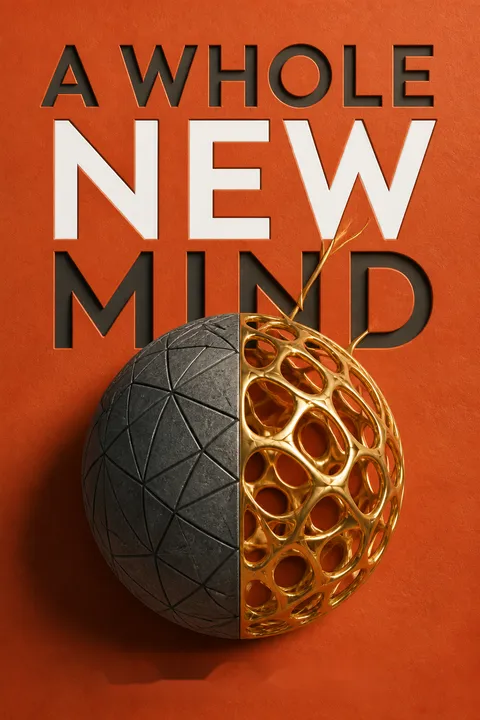
Two styles, one brain. Daniel Pink contrasts L-Directed Thinking, which works sequentially and analytically, with R-Directed Thinking, which interprets context, emotion, and patterns. Brain-imaging examples show different emphases: recognizing facial expressions draws more strongly on the right hemisphere, while interpreting threatening scenes can involve more left-sided processing because danger is learned and analyzed. Neither side works alone, and the brain is not divided into two personality types.
A useful metaphor. Pink uses these specialties to describe a wider cultural shift. High concept means spotting patterns, combining ideas, and shaping compelling experiences. High touch means understanding people and pursuing purpose. The argument is not to abandon logic, but to add capacities that schools and workplaces often treated as secondary.
The strongest version of this idea is about integration, not a contest between artists and analysts. Complex work requires both careful decomposition and the ability to see how parts interact. The hemispheric language makes that contrast memorable, but it can mislead if taken literally: thought depends on connected brain networks, not a tidy left-versus-right switch. Read the model as a prompt to notice which capacities an organization rewards, and which it leaves underdeveloped.
Redesign your work around what abundance, offshoring, and software cannot commoditize
Three economic pressures. Pink argues that prosperity, global competition, and automation are changing the value of work. Abundance makes basic function less distinctive: a mass retailer can sell inexpensive goods bearing famous designers' names. Offshoring moves standardized analysis and coding to skilled workers in lower-cost countries. Automation handles repeatable tasks at a speed people cannot match. Pink's 2003 account contrasted US programmers earning roughly $70,000 a year with Indian counterparts earning about $15,000.
A practical audit. Ask whether someone abroad can do the work cheaper, a computer can do it faster, and customers still want it amid abundant choice. The story of chess champion Garry Kasparov facing powerful computers dramatizes the problem: calculation alone is a vulnerable advantage. The proposed response is to move toward novel problems, human relationships, synthesis, and distinctive experiences.
This is a task-level account of economic change, not merely a prediction that whole occupations vanish. A job can contain automatable routines alongside work that requires judgment, communication, or invention. That distinction helps workers and employers redesign roles rather than label entire professions safe or doomed. Still, personal adaptability cannot neutralize every structural shock. Training access, bargaining power, and social protections shape who benefits from technological change, so responsibility cannot sit solely with individual workers.
Make useful things feel meaningful, not merely functional
More than decoration. Pink defines design as utility joined to significance: something should work, but it can also communicate beauty, personality, or meaning. When price and basic quality become common, design helps a product stand apart. The book points to designer goods sold at ordinary retailers, from clothing to a toilet brush, as evidence that visual appeal is no longer reserved for luxury buyers.
Design has consequences. At Philadelphia's Charter High School for Architecture and Design, students used design projects to connect art with subjects such as history and mathematics. The stakes can be much larger than taste: a confusing Florida ballot in the 2000 presidential election led many voters to mark unintended choices or invalidate ballots. Pink's point is that design shapes decisions, access, and everyday experience.
Design is most consequential when it is treated as a way of arranging choices, not as a finishing coat of style. A ballot, hospital room, or school building can make an experience clearer or more difficult, with effects on participation and well-being. That broad definition also raises a useful test: whose needs does a design serve, and who is excluded by it? Aesthetic novelty alone is not progress, especially when it fuels waste or hides a product's poor function.
Give information a story so people remember what it means
Facts need context. Pink opens this chapter with a memory test: readers are more likely to recall a story about a chess champion confronting a computer than an isolated statistic about jobs moving overseas. He argues that stories combine information with context and emotion, making complex ideas easier to grasp and remember. In an age when facts are easy to retrieve, the ability to explain why they matter gains value.
Stories can improve care. Narrative medicine is an approach that trains physicians to listen to patients' accounts and understand illness within the wider context of a person's life. Columbia physician Rita Charon's students kept conventional medical records alongside reflective narratives about patients. The aim was not to replace diagnosis, but to strengthen listening, interpretation, and trust. Stories also help organizations share knowledge that may never appear in formal manuals.
Narrative is a powerful interface between evidence and understanding. It can help an audience see how a fact applies to a real situation, and it can reveal details that standardized questions miss. But memorability is not proof: a vivid story can distort how common an event is or make weak evidence feel persuasive. The most responsible communication uses narrative to make evidence legible, then makes the evidence available for scrutiny. In medicine, listening to a patient's story should enrich clinical judgment, not displace it.
Connect distant ideas instead of perfecting one narrow specialty
The power of synthesis. Pink calls this aptitude Symphony: combining information, skills, and perspectives into a useful whole. In a drawing class, he learns that a convincing portrait depends less on memorized symbols than on seeing relationships among shapes, spaces, and proportions. The lesson extends beyond art: people who can cross boundaries may notice connections specialists miss.
Make new combinations. An inventor named John Fabel linked the structure of a suspension bridge to a backpack to solve a practical problem with shoulder straps. Pink also highlights metaphor, which lets people understand one domain through another, and big-picture thinking, which reveals how parts influence one another. The aim is not shallow familiarity with everything. It is enough range to connect disciplines and enough depth to make those connections useful.
Synthesis is not the opposite of expertise. It depends on having real material to connect, then moving between perspectives without losing accuracy. The idea aligns with interdisciplinary problem-solving: different fields bring different assumptions, tools, and blind spots. Yet broadness can become dilettantism if it is mistaken for mastery. A practical approach is to develop depth in at least one area while deliberately seeking collaborators, analogies, and evidence from elsewhere. The valuable leap is not novelty alone, but a connection that solves a real problem.
Listen for the person behind symptoms, words, and data
Empathy is perspective-taking. Pink distinguishes empathy, trying to understand what another person feels, from sympathy, feeling concern for that person. It helps people read nonverbal signals, understand subtext, and respond to needs that are not neatly stated. Researcher Paul Ekman's work on facial expressions supports the book's claim that many emotional expressions are widely recognized across cultures, though reading faces is not infallible.
Listening can change outcomes. Pink contrasts two doctors responding to postal workers during an anthrax scare. One followed routine guidance and sent a patient home; the patient later died. Another listened when a worker said something felt wrong, ordered further testing, and kept him in hospital. The worker had anthrax and survived. The story shows empathy as a complement to technical knowledge: it can prompt a professional to notice what a checklist misses.
Empathy improves attention to information that a form or protocol may not capture, and it can make interactions more humane. The clinical example also shows why empathy should not be reduced to warmth: it can motivate questions, testing, and a second look. At the same time, intuition and facial interpretation can be biased. A sound practice is to treat a perceived emotion as a hypothesis, then check it by asking rather than assuming. Empathy guides inquiry; it does not guarantee that an interpretation is correct.
Protect playful experimentation from a culture of permanent seriousness
Play trains real skills. Pink describes games, humor, and joyfulness as serious human capacities, not distractions from all productive work. The US Army created the free video game America's Army to give potential recruits a simulated experience of military teamwork and responsibility. Research cited in the book linked game-playing with stronger visual attention, and one study found that surgeons who played video games made fewer errors in laparoscopic procedures.
Laughter has uses. In Mumbai, physician Madan Kataria started laughter clubs where people practiced laughter through group exercises, even without jokes. Pink presents evidence that laughter can ease stress and strengthen social connection, while noting that humor can also divide or humiliate. Play is most useful when it supports learning, experimentation, and cooperation, not when it is forced or used to excuse poor working conditions.
Play creates a low-stakes setting for trying alternatives, learning from feedback, and coordinating with others. In organizational life, that connects to psychological safety: the shared sense that people can speak up or make a mistake without humiliation. Games can teach through repeated action in ways a lecture may not. But the benefits depend on design and context. A game can reward shallow competition, and compulsory fun can feel manipulative. Play helps work when people have genuine room to experiment and the activity serves a clear purpose.
Spend prosperity on purpose, not endless accumulation
Meaning becomes a priority. Pink opens with Viktor Frankl, an Austrian psychiatrist imprisoned in Nazi concentration camps who lost his family and the manuscript of his work. He later rebuilt it and argued that people seek meaning, including under terrible conditions. His story does not make suffering necessary for purpose; rather, it shows that meaning can persist even when comfort and control disappear.
Turn values into practice. Psychologist Martin Seligman distinguishes a Pleasant Life, built around positive feelings, from a Good Life, using personal strengths in absorbing work, and a meaningful life, serving something larger than oneself. Pink offers practical prompts: ask whether you would keep your work with $20 million or ten years to live, and compare your stated priorities with how you spend your time. Meaning is not another possession to acquire; it is a direction expressed through choices.
The book's strongest claim is that material comfort can create room for questions that survival once crowded out. That is a possibility, not a universal sequence: poverty, illness, and insecurity remain real constraints, and purpose cannot replace material support. Frankl's example is morally powerful but must not be turned into a demand that people find a lesson in trauma. Meaning also varies across people and traditions. The useful test is practical: do daily commitments reflect what a person says matters, and can those commitments be revised?
Analysis
A Whole New Mind is a book about changing what counts as valuable work. Its central move is to connect technological and economic change with a neglected human repertoire: aesthetic judgment, narrative, synthesis, emotional understanding, play, and purpose. The memorable contrast between left-directed and right-directed thinking makes that shift easy to picture, while the six senses translate it into capacities readers can practice.
The book is strongest when it describes work at the task level. Routine analysis can be standardized, automated, or moved to lower-cost labor markets; work involving novel problems, context, trust, or design is harder to reduce to instructions. This is a useful way to think about technological change because it avoids treating occupations as indivisible. A profession can lose routine tasks while gaining new demands for judgment and communication.
The brain metaphor is more vulnerable. Pink explicitly warns against treating the hemispheres as independent switches, but the shorthand can still encourage a false binary between rational and creative people. Creativity is not an alternative to analysis, and empathy is not the property of one hemisphere. The book's own most persuasive idea is therefore its title: a whole mind combines capacities rather than choosing a side.
Its economic optimism also needs a structural qualification. Developing creative and interpersonal abilities may improve a worker's adaptability, but it cannot guarantee security in a labor market shaped by bargaining power, education access, and public policy. The same abundance that makes design valuable is unevenly distributed. Nor should meaning become a corporate tool for persuading people to accept poor conditions.
Read this book as a cultural argument and a set of prompts, not as a precise forecast or neuroscience manual. Its durable lesson is that technical competence matters, but advantage increasingly depends on how well people interpret context, make connections, and create experiences that feel distinctly human.
Review Summary
A Whole New Mind receives mixed reviews. Many praise its insights on the importance of right-brain skills in the future economy, finding it inspiring and well-written. Critics argue it lacks substantial evidence and oversimplifies complex issues. Some appreciate the practical exercises for developing creativity, while others find them superficial. The book's focus on middle-class American workers and its treatment of Asian outsourcing draw criticism. Overall, readers tend to find the book either thought-provoking or overly simplistic, depending on their perspective.
People Also Read







Glossary
L-Directed Thinking
Sequential analytical thinkingPink's term for an approach associated metaphorically with the left hemisphere. It emphasizes sequential reasoning, literal language, function, analysis, and attention to details. The book argues that these abilities remain essential, but become less sufficient when routine knowledge work can be automated or performed at lower cost elsewhere.
R-Directed Thinking
Contextual synthetic thinkingPink's term for an approach associated metaphorically with the right hemisphere. It emphasizes simultaneous perception, context, emotion, aesthetics, and synthesis across separate elements. Pink presents it as a complement to analytical thinking, not a replacement, and uses it to describe abilities he believes are increasingly valuable in work and everyday life.
Conceptual Age
Era valuing human interpretationPink's name for an emerging economic and cultural period in which creators, empathizers, pattern recognizers, and meaning makers gain importance. He links its rise to abundance, globalization of knowledge work, and automation. In this account, analytical expertise remains useful, while design, communication, synthesis, and human connection become stronger sources of distinction.
High concept and high touch
Invention joined with empathyHigh concept describes the ability to recognize patterns, create beauty, build narratives, and combine ideas into something new. High touch describes the ability to understand people, read social situations, bring joy, and pursue purpose. Pink argues that these capacities help distinguish individuals and organizations when routine analytical work is widely available or easily replicated.
Six senses
Six whole-minded aptitudesPink's framework for developing high-concept and high-touch abilities: Design, Story, Symphony, Empathy, Play, and Meaning. Each sense names a capacity that complements a narrower focus on function, facts, specialization, logic, seriousness, or material accumulation. Together they offer a practical map for the book's argument about work and personal fulfillment.
Symphony
Connecting parts into wholesPink's term for the ability to synthesize information and experience. It includes crossing disciplinary boundaries, combining existing ideas in new ways, thinking through metaphor, recognizing patterns, and understanding how parts fit into larger systems. The concept does not reject specialization; it emphasizes making useful connections across specialized knowledge.
Narrative medicine
Clinical care through patient storiesAn approach to medical education and practice that treats a patient's account as important evidence about illness and care. Physicians learn to listen to, interpret, and respond to stories, alongside using clinical tests and technical knowledge. In Pink's account, narrative competence can deepen empathy and help clinicians understand symptoms in the context of a person's life.
Logotherapy
Meaning-centered psychotherapyViktor Frankl's therapeutic approach, named from the Greek word logos, meaning meaning. It holds that the search for meaning is a central human motivation. Frankl developed the ideas before his imprisonment and drew on his experiences in concentration camps to argue that people may find meaning even amid suffering, without implying that suffering is required.
Hero's journey
Departure, transformation, returnJoseph Campbell's account of a recurring story pattern in myths and other narratives. A protagonist leaves a familiar world, faces trials and changes through initiation, then returns with a transformed understanding. Pink uses the pattern to frame the transition from knowledge work toward a broader combination of analytical and human-centered abilities.
FAQ
What's A Whole New Mind about?
- Shift in Thinking: Daniel H. Pink's book discusses the transition from the Information Age to the Conceptual Age, emphasizing the growing importance of right-brain thinking.
- Emerging Skills: It highlights the need for creative and empathetic skills, which are becoming more valuable as routine tasks are automated or outsourced.
- Six Essential Aptitudes: Pink introduces "the six senses"—Design, Story, Symphony, Empathy, Play, and Meaning—as crucial skills for success in the Conceptual Age.
Why should I read A Whole New Mind?
- Relevance to Modern Life: The book provides insights into how the changing economy and technology affect personal and professional success.
- Practical Guidance: It offers practical advice and exercises to help readers develop their right-brain skills, leading to greater fulfillment and creativity.
- Broader Perspective: Understanding the importance of emotional intelligence and creativity can enhance both personal and professional contexts.
What are the key takeaways of A Whole New Mind?
- Importance of Right-Brain Skills: Skills like empathy, creativity, and design thinking are becoming more valuable than traditional left-brain skills.
- Adaptation to Change: The book emphasizes adapting to the forces of Abundance, Asia, and Automation, which are reshaping the workforce.
- Emphasis on Human Experience: The six senses highlight the need for a holistic approach to work and life, focusing on human experiences and connections.
What are the six essential aptitudes in A Whole New Mind?
- Design: Focuses on creating products that are not only functional but also beautiful and emotionally engaging.
- Story: The ability to craft compelling narratives is essential for effective communication and persuasion.
- Symphony: Involves synthesizing information from various sources and seeing the big picture to foster innovation.
- Empathy: Understanding and relating to others' emotions is vital for personal and professional interactions.
- Play: Incorporating playfulness and humor into work can boost creativity and well-being.
- Meaning: Pursuing purpose and significance in life is increasingly important in a world of material abundance.
How does A Whole New Mind define the Conceptual Age?
- New Economic Era: Characterized by a shift from an economy based on information to one that values creativity and emotional intelligence.
- R-Directed Thinking: Right-brain skills such as empathy, creativity, and holistic thinking are essential for success.
- Cultural Shift: Society is moving towards valuing human experiences and connections over mere data and analysis.
What are the best quotes from A Whole New Mind and what do they mean?
- Future Belongs to Different Minds: Emphasizes the changing skills needed for success, focusing on creativity and empathy.
- Design as Human Nature: Highlights the intrinsic human drive to create and improve our surroundings.
- Stories Over Logic: Suggests that narratives resonate more deeply than mere facts, emphasizing the power of storytelling.
How does A Whole New Mind address the impact of technology on work?
- Automation and Outsourcing: Many routine jobs are being automated or outsourced, necessitating new skills.
- Shift in Job Market: Growing demand for roles requiring creativity, emotional intelligence, and the ability to synthesize information.
- Emphasis on Human Skills: Future workforce needs to focus on uniquely human skills that machines cannot easily replicate.
What role does empathy play in A Whole New Mind?
- Essential for Connection: Empathy is crucial for building relationships and understanding others' perspectives.
- Key to Leadership: Leaders who empathize with their teams and clients are more likely to succeed.
- Improves Problem-Solving: Empathetic individuals are better equipped to address others' needs, leading to effective solutions.
How can I apply the concepts from A Whole New Mind in my life?
- Develop Right-Brain Skills: Enhance creativity, empathy, and storytelling abilities through practice and exercises.
- Embrace a Holistic Approach: Look for connections between different areas of life and work for a more integrated understanding.
- Seek Meaning and Purpose: Reflect on what gives life meaning and pursue activities aligned with values and passions.
How does A Whole New Mind suggest we develop our empathy?
- Empathy Exercises: Engage in active listening and perspective-taking conversations to connect with others.
- Storytelling: Sharing personal narratives helps understand others' experiences and emotions.
- Mindfulness Practices: Heightened awareness through mindfulness can improve empathetic responses.
What role does play have in the Conceptual Age according to A Whole New Mind?
- Creativity and Innovation: Play fosters creativity and innovation, essential skills in the Conceptual Age.
- Work-Life Balance: Incorporating play into work enhances job satisfaction and reduces stress.
- Social Connections: Play encourages collaboration and strengthens relationships among colleagues.
How does A Whole New Mind define meaning, and why is it important?
- Pursuit of Meaning: Finding purpose and significance in life is essential for personal fulfillment.
- Impact on Well-Being: Individuals who find meaning in their work and lives experience greater happiness and satisfaction.
- Integration of Values: Aligning actions with personal values leads to a more authentic and fulfilling life.
About the Author
Other books by Daniel H. Pink


Download PDF
Download EPUB
.epub digital book format is ideal for reading ebooks on phones, tablets, and e-readers.








