

Key Takeaways
Treat abstraction as skilled seeing, not an escape from drawing
Skill still matters. Debora Stewart first loved abstract painting, but an instructor urged her to learn drawing fundamentals. She spent years drawing figures and portraits before returning to abstraction. Those skills did not disappear: the practiced lines and observations became part of her later work. Her point is practical: abstraction is not simply a shortcut around representation. It still asks the artist to make deliberate choices about composition, value, color, and materials.
A personal route in. Stewart moved toward abstraction after realistic work began to feel limiting. She cropped photographs of plants and flowers, drew small sections, and found abstract possibilities inside recognizable subjects. The shift gave her new directions without making her earlier training irrelevant.
What's striking is the book's refusal to oppose abstraction and realism. Stewart presents abstract work as a transformation of observational skill, not its rejection. This is a useful corrective for beginners who mistake ambiguity for ease: a painting without a recognizable subject still has to organize attention. The same principle appears in music, where improvisation depends on practiced technique even when the result feels spontaneous. Yet technical fluency alone cannot guarantee compelling art. Skill gives the artist more choices; the artist still has to decide which choices carry meaning.
Abstract the world by changing what you choose to notice
Begin with a subject. Abstraction can be nonobjective, built from shapes, colors, and lines without a recognizable subject, or figurative, where a landscape, figure, animal, or still life is simplified. Stewart recommends starting from what is already familiar. A landscape painter, for instance, can reduce a scene to its main shapes and replace literal colors with choices shaped by feeling.
Zoom in and simplify. Looking at a whole tree may lead to a familiar picture; studying leaf shadows on a wall may reveal a new pattern. The same shift can uncover reflections in water or the changing shapes of sunlight through branches. Remove detail until the remaining forms, spaces, and relationships can carry the image. Reality can remain a source, even when the finished work no longer describes it directly.
This approach resembles a change in scale in scientific observation: a different frame can make patterns visible that the whole view conceals. It also gives abstraction a strong entry point for artists who feel that starting from a blank canvas means starting from nothing. The source supplies a constraint, while simplification creates room for invention. The caution is that simplification is not automatically expressive. Removing detail only becomes a meaningful choice when the remaining shapes, colors, and spaces are organized with intention.
Use play to loosen control before asking a painting to succeed
Make low-stakes work. Stewart recommends setting aside paper and materials for experiments that do not need to become finished art. Draw with the nondominant hand, follow music with charcoal marks, or let paint spread across paper. These exercises interrupt the urge to control every result and can reveal marks or textures worth revisiting.
Start before inspiration arrives. The purpose is not to produce a masterpiece during a warm-up. It is to change mental gears, test unfamiliar tools, and discover what a material can do. Stewart compares this preparation to a creative warm-up: when an artist feels stuck, doing something small and exploratory can be more useful than waiting to feel inspired. Keep a possible fragment, but give yourself permission to discard the rest.
The exercises turn uncertainty into something observable: instead of demanding originality on command, the artist varies a hand, a sound, or a tool and notices what changes. That is close to experimental learning, where a small trial gives feedback without requiring a costly commitment. Play can also reduce the pressure that makes every mark feel like a verdict. Still, spontaneity is not a substitute for selection. Random marks become useful material only when the artist later recognizes, edits, or develops them.
Let marks and color register feeling without treating them as a code
Translate emotion into form. Stewart proposes drawing emotions through line and color rather than illustrating them as scenes. In her exercises, anger might lead to forceful dark strokes, while fear can begin with small, inward-moving circles. Happiness may spread in lively marks, with yellow used to amplify its brightness. These are personal responses, not fixed rules.
Notice your own patterns. Repeat the exercise with words such as serenity, loneliness, or stress, using charcoal, pastel, or paint. Compare the results and ask which feelings were easiest to express. Stewart describes how red repeatedly appeared in her own work before she connected it with a desire for strength. The point is to observe how energy, memory, and mood influence mark making and color choices.
The exercise treats art-making as a form of reflection: a feeling that may be difficult to explain verbally can become visible as pressure, scale, direction, or color. That can be valuable even when the artist's interpretation changes over time. Color associations, however, are culturally and personally variable. Red may suggest strength to one artist and danger to another. The book's examples work best as invitations to investigate personal associations, not as a universal dictionary linking each color to one emotion.
Build abstract compositions with contrast, breathing room, and a clear focus
Use the same foundations. Abstract paintings still rely on line, shape, positive and negative space, texture, repetition, emphasis, value, and color. A work needs variety and balance, not identical treatment everywhere. Quiet areas can give busy marks room to register; a focal area can stand out through contrast, brighter color, or a distinctive texture.
Test the whole arrangement. Stewart suggests thinking of composition as a division of the picture surface. A grid, triangle, diagonal, or curved path can organize that division, but these are starting structures, not recipes. A diagonal can create energy, while an asymmetrical arrangement can balance a large shape with several smaller ones. Check whether the eye has somewhere to land, whether the values differ, and whether the parts feel like one painting.
The guidance makes abstraction assessable without reducing it to a checklist. Balance, contrast, and emphasis are ways to describe how a viewer's attention moves through an image. The analogy to music is apt: repetition establishes a pattern, while variation keeps that pattern alive. A composition can deliberately resist a single focal point or conventional balance, but that resistance still has to produce an intelligible experience. The useful question is not whether a painting follows a rule, but whether its choices create the intended tension or coherence.
Make small source drawings before committing to a large surface
Create a visual guide. A source drawing is a small sketch that helps an artist develop an abstract composition. Stewart makes these from grayscale photographs, contour drawings, spontaneous marks, or cropped sections of finished work. A viewfinder, a small window used to isolate part of an image, can help locate promising shapes and spaces.
Simplify before scaling up. Make several thumbnail sketches, small enough to focus on the main divisions rather than detail. Look for a few dominant shapes, strong light and dark areas, and open space. Add a limited color idea if useful, but do not copy the source's colors automatically. Small studies let an artist test alternatives cheaply and give a larger painting direction without requiring the finished work to follow the plan exactly.
Small studies function as external memory. They hold a possible arrangement in view while the artist concentrates on paint, pastel, or texture, reducing the number of decisions that must be made at once. Cropping also encourages a designer's way of seeing: the source becomes a field of relationships rather than a familiar object. The limitation is that planning can harden into obedience. A sketch is most useful as a starting hypothesis, not a contract that prevents discovery on the larger surface.
Use underpainting to solve structure before adding expressive layers
Lay a foundation. An underpainting is an initial layer used to establish composition, value, color, or movement before the later layers. Stewart uses charcoal washed with rubbing alcohol, diluted acrylic, watercolor, pastel, oil color, or colored gesso, depending on the surface and desired effect. A dark and light value pattern can clarify the structure before a painting becomes busy.
Let the first layer contribute. The underpainting does not need finished detail. Its brushstrokes, lines, and color can remain partly visible, giving the final work depth and energy. For pastel, fluid acrylic can color sanded paper without clogging its texture; pastel ground can then prepare a surface for additional pastel. On canvas, molding paste can create raised texture, but it needs time to dry before painting over it.
An underpainting separates structural decisions from surface decisions. That division is valuable because artists can test large relationships before investing attention in small marks. It also makes revision less intimidating: an early layer can be altered or covered rather than treated as precious. The material advice matters as much as the concept, since a ground or paint that is unsuitable for a surface can frustrate the process. Experimentation should therefore be paired with basic material compatibility and archival care.
Choose color by value and relationship, not by collecting more hues
Limit the palette. Stewart recommends beginning with a main color and its complement, then exploring variations of each. In a red and green painting, those variations might include warmer or cooler reds and greens, along with mixed neutrals. A color wheel can help identify complementary and neighboring colors, but it is a planning aid, not a requirement to use every scheme it displays.
Plan light and dark. Value means how light or dark a color appears. Arrange selected colors from light to dark before painting, and use the underpainting as a guide. Neutrals matter because too many intense colors compete for attention. A muted blue-gray beside a small, bright orange accent can make the orange feel more vivid than it would beside another equally strong color. Make small color studies to see how a palette behaves before enlarging it.
Limiting color reduces competition and makes relationships easier to perceive. The key insight is relational: a color's impact depends partly on what surrounds it, not just on its name or intensity. Value planning adds another layer, helping distinguish focal areas from supporting ones. This disciplined approach can be especially helpful with a large pastel collection, where abundance makes selection feel like progress. Yet a restricted palette is not inherently superior; its value lies in creating the particular unity, contrast, or mood the artist wants.
Work across the whole painting, then step back and revise what you see
Develop the image together. Stewart advises moving across the entire surface instead of polishing one corner while ignoring the rest. Begin with broad, thin layers, then add thicker paint, smaller marks, and emphasis. In pastel, work lightly at first to preserve room for layers. Repeating a color in more than one area can help connect separate parts of the composition.
Change your viewpoint. Take breaks, turn the work upside down, inspect it in a mirror, or photograph it and view it in grayscale. These shifts can reveal imbalances, weak value contrast, or a focal point that is not working. Stewart's horse demonstration keeps the subject only partly defined, with its off-center placement helping suggest movement. The aim is not to clarify every detail, but to finish the whole painting with its expressive character intact.
Changing viewpoint is a simple form of perceptual debugging. Familiarity makes it difficult to judge a work while making it, so a photograph, mirror, or pause can reveal patterns that the artist's close attention has missed. Working globally also guards against local polish that weakens the whole. The horse example shows that completion need not mean maximum detail: a painting can feel resolved while leaving parts ambiguous. The harder judgment is knowing when ambiguity serves the image and when it merely avoids a decision.
Analysis
Stewart's central claim is that abstraction is not the absence of structure, but a shift in how structure is found and used. Her own path gives that claim its shape: early fascination, years of representational study, dissatisfaction with copying what was visible, and a return to abstraction through cropped plant photographs and tactile drawing materials. The narrative makes the instruction credible because it presents abstraction as learned practice rather than a mysterious gift.
The book's most useful teaching move is to connect inner expression with observable craft. Emotion may influence a mark, but the artist still evaluates space, value, color, texture, and emphasis. This avoids two common dead ends: treating abstract work as arbitrary gesture, or treating technique as a recipe that can manufacture a personal voice. Thumbnail sketches and underpaintings bridge those poles. They provide enough structure to begin, while remaining provisional enough for the work to change direction.
The book is especially effective for representational artists who feel trapped by literal depiction. Cropping, contour drawing, and simplification offer a gradual transition rather than a demand to abandon familiar subjects. Its material demonstrations also make the process concrete, from charcoal and alcohol washes to pastel ground and layered acrylic. The advice is personal rather than a universal technical manual, so readers should test materials on their own surfaces and treat color symbolism as individual. The deeper lesson is that artistic freedom is not the removal of decisions. It is the growing ability to make decisions without needing every outcome to be known in advance.
Review Summary
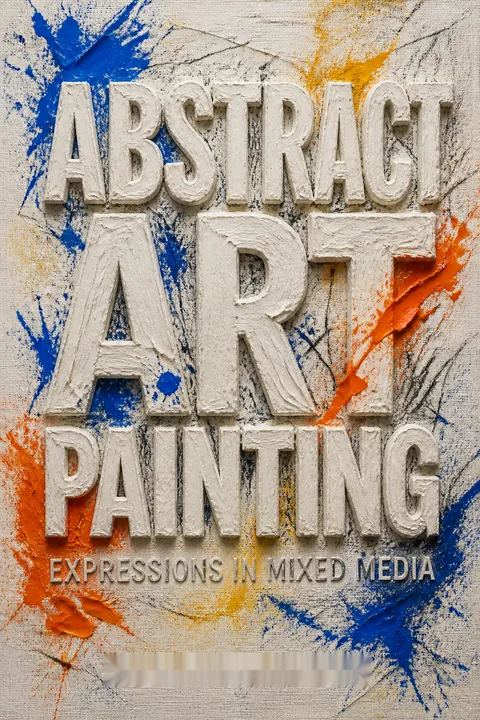
Abstract Art Painting receives mostly positive reviews, with readers praising its instructional value, beautiful artwork, and inspiring content. Many find it helpful for beginners, offering exercises and tips on composition, color, and techniques. Some appreciate the step-by-step approach and confidence-building advice. Critics note it's more introspective than instructional, and a few find it basic or repetitive. Overall, readers value the book as a useful reference for abstract art, though opinions vary on its depth and applicability.
People Also Read






Glossary
Nonobjective
Abstraction without recognizable subjectsA type of abstract art organized through elements such as shape, color, and line without depicting a recognizable subject. Stewart contrasts it with figurative abstraction, which simplifies a landscape, figure, animal, or still life. Nonobjective work still depends on deliberate choices about composition and the relationships among visual elements.
Figurative abstraction
Simplified recognizable subjectsAn approach to abstraction that begins with a recognizable subject, such as a landscape, figure, animal, or still life, and simplifies or transforms it. The image may retain traces of its source while changing its shapes, colors, marks, or level of detail. It offers artists a route into abstraction through subjects they already know.
Source drawings
Small composition guidesSmall drawings or sketches used to generate and test possible abstract compositions. Stewart creates them from photographs, contour drawings, spontaneous marks, or sections of existing artwork. They help identify major shapes, divisions of space, and value patterns before an artist commits to a larger painting. They guide the process without requiring the final work to copy them exactly.
Underpainting
Initial structural paint layerAn early layer applied before the main pastel or paint layers. It can establish composition, value, color, and movement, giving the finished work structure and depth. Stewart describes underpaintings made with materials including charcoal, diluted acrylic, watercolor, oil color, pastel, and colored gesso. Some of the initial marks or colors may remain visible in the finished work.
Pastel ground
Textured pastel-ready coatingAn acrylic coating that creates a textured surface for pastel. Stewart applies it to paper or canvas, sometimes over an underpainting, and may tint it with fluid acrylic. Its texture helps pastel adhere and can add visible brush marks or surface variation. The amount and manner of application affect the texture of the resulting surface.
Notan
Small black-and-white composition studyA small black-and-white drawing that simplifies a composition into its basic shapes and value relationships. Stewart notes that landscape artists use notans to plan arrangements and simplify scenes, and that abstract artists can use a similar method. The book calls its own small planning studies source drawings, which may be made through several different processes.
Download PDF
Download EPUB
.epub digital book format is ideal for reading ebooks on phones, tablets, and e-readers.








