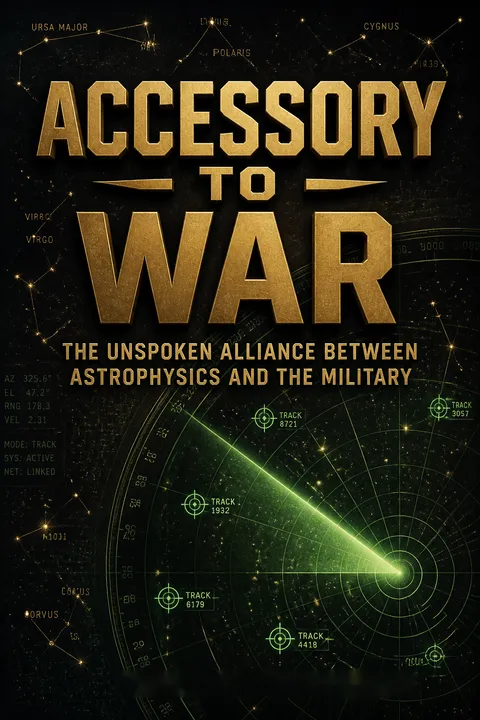


Key Takeaways
Astrophysics does not build bombs, but its tools help wars find targets.
A quiet alliance. The book’s central claim is not that astrophysicists design weapons. Rather, they and the military need overlapping capabilities: detecting faint signals, tracking motion, analyzing images, and operating in space. The knowledge and technology move in both directions, often through government contracts and shared engineering work.
A personal reckoning. Tyson recalls a 1991 astronomy meeting interrupted by news of the Gulf War, then a 2003 space symposium where attendees applauded as companies supplying weapons appeared on war coverage. He had regarded the gathering as mainly about exploration. Watching the applause made the connection impossible to ignore: peaceful science and military power were drawing on the same technical system.
What's striking is the difference between personal intent and institutional effect. A scientist can pursue a distant galaxy without wanting to aid a war, yet the instrument, workforce, and funding structure may still support military surveillance. This resembles a familiar problem in technology ethics: responsibility is distributed across researchers, contractors, agencies, and elected officials, so no single participant feels fully accountable. The book's strongest contribution is making that otherwise invisible chain legible. Its argument does not require treating scientists as villains; it asks readers to notice what their work enables, and who gets to decide how it is used.
Read calendars and maps as instruments of power, not neutral descriptions.
The sky kept time. Ancient communities used celestial cycles to organize planting, harvesting, festivals, taxes, and travel. Egyptian farmers watched for Sirius, whose appearance before sunrise coincided with the Nile’s rising. Astronomers in China and Mesopotamia recorded celestial events for rulers, who treated knowledge of the sky as politically sensitive.
Navigation expanded control. Sailors used stars, instruments, and eventually accurate clocks to locate themselves. Portuguese expeditions gathered astronomical measurements while pursuing trade, conversion, slavery, and territorial claims. Maps made unfamiliar coasts legible to distant rulers, but they also helped those rulers divide and claim lands without consulting the people already living there. The book treats measurement as both practical knowledge and a tool of empire.
A coordinate system can look like pure mathematics while quietly answering political questions: whose territory is being measured, which boundary counts, and whose account becomes authoritative? The history here shows that reliable measurement is socially powerful because it lets decisions travel farther than the observer. That does not make maps inherently imperial. Shared standards also let ships navigate safely and scientists compare observations. The important distinction is between accuracy and legitimacy. A map can be technically excellent while its claims about ownership remain unjustified.
Every leap in seeing has served discovery and surveillance at once.
The telescope arrived with two audiences. In 1608, Hans Lipperhey demonstrated a lens-equipped tube in the Netherlands during negotiations with Spain. Dutch officials immediately recognized its military use for spotting enemy movements. Galileo soon improved the instrument, presented it to Venice’s leaders, and emphasized its value at sea and on land. He also turned it toward the Moon and planets.
Better optics multiplied uses. Photographic plates and spectroscopy let astronomers record celestial light and infer what distant objects contain. The same broader ambition to detect more also served military reconnaissance. During World War I, shortages of optical glass revealed that precision sights and rangefinders depended on an industrial supply chain that governments had neglected. In wartime, manufacturers and scientists rapidly built it.
The telescope is a particularly clear case of technological ambiguity because the same improvement, sharper vision, benefits both the astronomer and the commander. That pattern complicates the idea that a technology has a stable moral character. Its consequences depend on who controls the instrument, the information it produces, and the decisions made from that information. The book also shows that scientific progress relies on mundane infrastructure, such as reliable glass and skilled manufacturing. Discovery is not only a matter of brilliant ideas; it depends on systems that can be redirected toward other ends.
Follow research funding to see how military needs shape scientific tools.
A research pipeline. Military investment has supported technologies that later served astronomy, while astronomy has supplied methods useful to defense. Adaptive optics, which corrects for atmospheric distortion by rapidly adjusting a telescope’s mirror, is one example. The military developed it in classified work to improve tracking; astronomers adopted it after the technique became public. Radio astronomy also emerged from Karl Jansky’s attempt at Bell Labs to identify interference in radio communications.
A mirror tells two stories. Hubble was designed for long exposures of distant objects, but its basic architecture resembled a classified reconnaissance satellite. Military experience with short exposures did not reveal Hubble’s vibration problem, because the problem mattered little to spy imagery. Later, a declassified agency donated telescope mirrors to NASA. Shared hardware can accelerate science, but secret compartments can also prevent useful knowledge from crossing over.
The funding relationship is more than a transfer of money. It influences which problems get solved first, which engineering standards are prioritized, and which discoveries become possible. The Hubble example is especially revealing: a design can migrate across sectors while the knowledge attached to it remains compartmentalized. This suggests that open scientific exchange is not merely an ideal; it can improve technical reliability. At the same time, military sponsorship may favor projects with short-term operational outcomes. The resulting science can be excellent, but its agenda is not necessarily set by scientific curiosity alone.
Satellite precision can improve targeting without improving the wisdom of war.
The battlefield gained a sky layer. In the 1991 Gulf War, satellites supported navigation, communications, weather forecasting, early warning, and surveillance. GPS helped troops cross desert terrain, while weather images shaped decisions about air strikes. Yet the system was incomplete: only sixteen GPS satellites were available, and too few military receivers existed, so commercial receivers were pressed into service.
Better tools did not guarantee better outcomes. By the 2003 Iraq invasion, satellite coverage and GPS accuracy had improved, and data could reach troops faster. The technology made military operations more coordinated and weapons more precise. But the authors contrast that technical success with the war’s lasting destruction and instability. Knowing where a target is, or striking it accurately, cannot determine whether the decision to attack is justified or whether the aftermath will protect people.
Precision is a property of measurement, not a synonym for restraint. A more accurate weapon may reduce some forms of error while making force easier to deploy and less visible to those authorizing it. The distinction matters because technical language can make political choices sound automatic: a target is identified, a weapon is guided, an objective is declared complete. The book pushes against that illusion by placing satellite capability beside civilian consequences. Operational efficiency should be evaluated alongside the quality of the intelligence, the legitimacy of the target, and the conditions left behind.
Do not mistake deterrence rhetoric for a workable shield against catastrophe.
A promise with a hard test. The Strategic Defense Initiative, announced by Ronald Reagan in 1983 and nicknamed Star Wars, proposed intercepting incoming nuclear missiles with systems including lasers and space-based interceptors. The technical challenge was immense: a defense would have to detect, distinguish, track, and hit missiles and possible decoys at extraordinary speed. Many scientists and engineers argued that the proposed protection was not feasible as advertised.
Arsenals carry their own logic. Nuclear policy repeatedly treated weapons as usable instruments, not simply as threats held in reserve. The book recounts planning documents that contemplated nuclear retaliation and attacks on population centers. Arms-control agreements reduced some risks, but they did not eliminate weapons or settle disagreements about first use. Deterrence may discourage an attack, yet it depends on leaders making rational choices under pressure and on systems that can fail safely.
The appeal of a perfect shield is understandable: it promises safety without requiring trust. But a defense that works only if it is nearly flawless can invite dangerous confidence, while an imperfect shield may encourage each side to build more weapons or develop ways around it. This is a classic security dilemma: measures described as protective can look offensive to a rival, prompting reciprocal buildup. The book’s history also shows that grand technical promises can serve political purposes even when deployment remains doubtful. Feasibility and strategic effect need to be assessed separately.
A satellite strike creates orbital debris that threatens everyone, including its attacker.
Space is not empty infrastructure. Satellites support navigation, communications, weather forecasts, and military operations. Destroying one can therefore disrupt services well beyond the intended target. The 2007 Chinese test against an old weather satellite produced tens of thousands of fragments in orbit. The 2009 accidental collision between Russian and American communications satellites added more debris.
A weapon can outlast its purpose. Debris travels at extreme speed, so even small fragments can damage working spacecraft. The book describes hundreds of thousands of trackable pieces and many more too small to monitor routinely. The 1967 Outer Space Treaty bars weapons of mass destruction in orbit but does not clearly prohibit many conventional weapons or forms of interference. The gap leaves room for escalation, while the physical consequences cross national lines.
Orbital debris turns the idea of a shared resource into a practical constraint. Unlike a damaged military base, a debris field does not stay within a border or distinguish friend from foe. This creates an unusually strong case for cooperation based on mutual self-interest, even among rivals. The challenge is that the most tempting short-term demonstration of power may create long-term costs that are widely distributed. Treaties can help establish norms, but monitoring, verification, and the definition of prohibited conduct remain difficult. A useful rule must address behavior, not merely label intentions peaceful.
Accept that space is multipolar, then build security through cooperation.
The old two-power race has widened. More than seventy government space agencies and dozens of satellite-operating countries now participate in space activity. China has developed launch facilities, human spaceflight, a space station, and a quantum communications satellite. India, Japan, Canada, Europe, and Russia each contribute distinct capabilities. The United States remains powerful, but it cannot assume exclusive control of space or its infrastructure.
Cooperation can survive conflict. The International Space Station brings together several countries, including the United States and Russia, despite serious political disputes on Earth. Its operation depends on shared systems and practical interdependence. By contrast, excluding China from the station encouraged it to develop a separate program with other partners. Collaboration is not effortless or free of strategic bargaining, but isolation can create new competitors rather than remove the underlying rivalry.
Multipolarity changes the meaning of security. When many states and private companies own or depend on space systems, no single actor can reliably control the whole environment. That reality can be framed as a threat, or as a reason to build shared rules and redundant capabilities. The station illustrates a modest but important point: cooperation does not require political trust in every domain. It can begin where mutual dependence is concrete. Still, partnership should not be romanticized. Access, decision-making, and benefits are unequal, so cooperation needs transparent terms rather than simple declarations of goodwill.
Redirect competition toward shared threats, not fantasies of permanent supremacy.
War is not the only engine of ingenuity. The authors suggest that space resources could ease some earthly scarcities: certain asteroids contain metals, comets contain water, and sunlight is abundant beyond Earth. These possibilities remain engineering challenges, not an immediate cure for conflict. The more immediate shared tasks include tracking hazardous asteroids, monitoring climate change, and preventing orbital debris from damaging satellites.
Budgets reveal priorities. The book estimates global astrophysics spending at less than three billion dollars a year, compared with nearly 1.7 trillion dollars for military spending. It argues that scientific discovery costs far less than preparing for war, even though military investment has often enabled discoveries. The closing vision is not that science automatically makes people peaceful. It is that people can choose to direct technical skill toward common survival rather than domination.
The resource argument is provocative, but abundance does not by itself guarantee justice. Mining an asteroid could reduce dependence on a scarce supplier, yet ownership, access, environmental effects, and the distribution of profits would still be political questions. The more durable insight is about changing incentives: shared dangers such as climate instability, asteroid impacts, and debris make cooperation materially valuable. The spending comparison sharpens that choice, though its categories are not perfectly comparable. A dollar spent on basic research and a dollar spent on military operations do different jobs, but the gap still exposes how readily societies fund imagined enemies over common vulnerabilities.
Analysis
Accessory to War is strongest when it treats the science-military relationship as a system rather than a morality play. The authors do not argue that astrophysicists secretly want war, or that every military contract corrupts research. Instead, they trace how shared technical problems, public funding, corporate structures, and national competition create durable links between cosmic inquiry and military power. The narrative moves from ancient calendars and navigation to telescopes, radar, satellites, and contemporary space policy, showing that the tools change while the political uses of knowledge persist. The personal scenes give this history an ethical center. Tyson’s memories of Vietnam, the Gulf War announcement at an astronomy meeting, and the applause at a space symposium make institutional complicity tangible without claiming that individual scientists control the whole apparatus. The later histories of radar, adaptive optics, and Hubble demonstrate why a simple refusal of military funding is not an easy answer: military work can create capabilities and knowledge that civilian science could not otherwise afford, while secrecy and mission priorities can also constrain scientific choices.
The book’s most consequential distinction is between technical achievement and political success. GPS can guide a weapon accurately; it cannot decide whether a war is justified or secure a stable peace. A satellite network can improve surveillance; it can also increase dependence and create new vulnerabilities. This perspective resists the seductive idea that technological superiority automatically produces safety.
The hopeful ending deserves both attention and caution. Space resources may reduce some forms of scarcity, but extraction does not abolish questions of ownership or distribution. Nor does seeing Earth from orbit erase political conflict. The more defensible promise is institutional: shared hazards and shared infrastructure create incentives for coordination. The book ultimately asks readers to recognize that scientific knowledge is neither innocent nor doomed to serve violence. Its uses are shaped by choices about funding, access, governance, and what societies decide is worth protecting.
Review Summary
Accessory to War received mixed reviews. Some praised its detailed history of astrophysics and military connections, while others found it dry and unfocused. Positive reviewers appreciated the thorough exploration of science-military relationships and space policy. Critics felt it lacked coherence and strayed from the promised topic. Many noted the book's dense content and academic style. Some highlighted interesting sections on modern space programs and international cooperation. Overall, readers expecting a typical Neil deGrasse Tyson book were often disappointed by its scope and complexity.
People Also Read

Glossary
dual use
civilian and military applicationA technology, instrument, or body of knowledge that can serve both civilian and military purposes. Satellite cameras, navigation systems, rockets, and optical methods may support science, commerce, disaster response, surveillance, or weapons operations. In the book, dual use explains why a clear boundary between peaceful space research and military activity is often difficult to maintain.
situational awareness
understanding current conditionsA military term for gathering and interpreting information about the environment, threats, and relevant activity. In space operations, it can include tracking satellites and debris; in warfare, it includes information about enemy movements and targets. The book emphasizes that awareness depends on intelligence, surveillance, reconnaissance, communications, and the ability to act on what those systems reveal.
ISR
intelligence, surveillance, reconnaissanceAn abbreviation for intelligence, surveillance, and reconnaissance, the collection and analysis of information about potential threats, targets, and operating conditions. Satellites, aircraft, radar, and other sensors can contribute to ISR. The book presents it as a modern label for an old military need: learning what an adversary is doing before deciding how to respond.
albedo
average reflected lightThe average proportion of incoming light that an object reflects rather than absorbs. A high-albedo object appears bright to a detector, while a low-albedo object reflects less light and can be harder to detect. The book connects this astronomical measurement to military stealth, where reducing reflected radar energy can make an aircraft less visible to enemy sensors.
adaptive optics
real-time atmospheric correctionA system that compensates for distortions caused by Earth’s turbulent atmosphere. It measures changes in incoming light and rapidly adjusts a deformable telescope mirror to sharpen the image. The military developed the technology for tracking objects through the atmosphere; astronomers later used it to obtain clearer images from ground-based telescopes.
space power
capability to act in spaceThe knowledge, equipment, and political will that allow a nation or organization to operate beyond Earth’s atmosphere. Space power can enable communication, navigation, surveillance, research, deterrence, and military action. The book emphasizes that civilian and military space capabilities often overlap, and that the growth of many spacefaring nations limits any one country’s ability to dominate the domain.
Outer Space Treaty
foundational international space treatyThe 1967 agreement establishing principles for the exploration and use of outer space. It rejects national appropriation of celestial bodies and prohibits placing nuclear weapons or other weapons of mass destruction in orbit or on celestial bodies. It does not clearly prohibit every conventional weapon or form of interference, leaving disputes about militarization and space security unresolved.
Vela Hotel satellites
space-based nuclear test detectorsA series of US satellites launched after the 1963 Limited Test Ban Treaty to detect gamma-ray signals from nuclear explosions in Earth’s atmosphere or space. The satellites were intended to help verify compliance with the treaty. Their observations unexpectedly revealed gamma-ray bursts from cosmic sources, giving a powerful stimulus to a new area of astrophysics.
About the Author
Other books by Neil deGrasse Tyson





Download PDF
Download EPUB
.epub digital book format is ideal for reading ebooks on phones, tablets, and e-readers.








