

Key Takeaways
See the computer as a machine for transforming symbols, not merely numbers
Beyond calculation. In the 1840s, Ada Lovelace explained why Charles Babbage’s proposed Analytical Engine was more than a faster calculator. It was a machine designed to follow instructions for manipulating symbols, with numbers as one possible kind of symbol. Lovelace distinguished the information being processed from the operations performed on it, a distinction that underlies how we think about computing today.
A wider horizon. She imagined that if music could be represented in a form the machine could process, it might produce complex compositions. The Analytical Engine was never completed, so this vision could not be tested in her lifetime. But Lovelace saw that a machine built for mathematical operations might have uses beyond arithmetic, while Babbage largely focused on calculation.
The important shift is from a machine that answers sums to a machine that applies rules to representations. That perspective makes computing relevant to music, language, images, and other forms of information, not only mathematics. It also helps explain why Lovelace’s contribution is conceptual as well as technical. Still, an expansive vision is not the same as a working device: the Analytical Engine remained a design, and its proposed versatility was not demonstrated. The distinction between anticipating a general-purpose machine and building one keeps the historical achievement impressive without turning it into a myth of solitary invention.
Use the Jacquard loom to see how punched cards turn designs into instructions
A pattern made mechanical. The Jacquard loom used a chain of punched cards to control which threads rose and fell, allowing a weaver to produce intricate patterns automatically. Before this system, making figured silk could require two workers and yield about an inch of fabric a day. With the loom, one weaver could produce roughly two feet daily. The cards encoded a design as a sequence of mechanical choices.
From cloth to calculation. Babbage adapted this principle for the Analytical Engine: cards would direct the machine’s operations, just as Jacquard’s cards directed threads. Lovelace recognized the deeper connection. Both machines followed instructions to create a result. The loom’s holes and unpunched spaces also resemble a two-state code, though they were not electronic computer bits.
The loom makes an abstract idea visible: instructions can be stored outside the machine and then used to control its behavior. That is a powerful way to understand the move from craft to programmable machinery. The analogy also guards against imagining computing as something that began suddenly with electronics. Yet the loom and the Analytical Engine were not identical technologies, and their resemblance should not erase their different purposes or histories. The value of the connection is that it shows how an innovation can migrate: a control technique developed for textiles could inspire a new way to organize calculation.
Separate instructions, data, and calculation to understand Babbage's machine
Two machines, two ambitions. Babbage’s Difference Engine was designed to calculate mathematical tables automatically, using the method of differences, which replaces difficult calculations with repeated additions. His later Analytical Engine was more general. He described a store for holding quantities and a mill for carrying out operations, an early conceptual division between memory and processing.
Cards direct the work. The proposed Engine used different cards to specify operations, identify where variables were held, and supply numbers. In principle, changing the cards could change what the machine did. The Difference Engine could automate a defined class of calculations; the Analytical Engine was designed to follow different sets of instructions. Neither machine was completed in Babbage’s lifetime, so the architecture remained a design rather than a working system.
This architecture is memorable because it separates three questions that are easily blurred: what information is available, what operation is wanted, and how the operation is carried out. That separation is a useful mental model for understanding software and hardware, even though Babbage’s mechanical design differs sharply from modern electronics. The distinction also clarifies the historical stakes. A calculator can automate a task, while a programmable machine can be redirected to another task by changing its instructions. The latter promise was visible in Babbage’s design, but its practical realization depended on engineering capacity and resources that he could not secure.
Treat Ada's Bernoulli procedure as pioneering, but not quite a modern program
A procedure in print. In 1843, Lovelace translated an article by Luigi Menabrea about the Analytical Engine and added extensive notes of her own. Her final note described, step by step, how the proposed machine could calculate Bernoulli numbers, a sequence important in mathematics. An algorithm is a defined series of steps for solving a problem; this procedure is often described as the first computer program.
Credit and caution. Babbage said he offered to help with this section, and Lovelace corrected a serious mistake in his working. The surviving correspondence supports her substantial role, though the precise division of labor remains debated. The Engine was never built, so the procedure could not be run. Some historians describe it as a trace of how a program would execute, rather than a program in the modern, executable sense.
The debate over Note G is a useful lesson in how historical credit resists simple labels. Lovelace’s work was neither merely a translation nor demonstrably equivalent to writing software for a functioning computer. Its significance lies in formalizing a sequence of operations for a machine designed to follow instructions. That is substantial even if the exact modern category remains unsettled. The debate also shows why collaboration needs careful attribution: Babbage supplied the machine concept and technical guidance, while Lovelace made important intellectual contributions that should not disappear behind the better-known inventor.
Let imagination ask what a machine could do beyond its inventor's plan
A mind permitted to wander. As a girl, Lovelace imagined building wings and later a steam-powered flying machine. Her mother, Lady Byron, worried that imagination would make Ada reckless, and imposed a rigorous education intended to discipline it. Mathematics became one of the subjects Ada pursued intensely, but she did not abandon speculative thinking. When she encountered Babbage’s calculating machines, she could connect their mechanics to possibilities beyond the immediate task of producing tables.
A productive combination. Lovelace’s distinctive contribution was not imagination alone, nor mathematics alone, but the ability to use one to extend the other. She saw that a machine might manipulate symbols in ways that could apply beyond arithmetic. Her early fascination with flight and later interest in computing suggest a persistent habit: treating technical limits as questions to investigate, not as reasons to stop imagining.
Lovelace’s story complicates the familiar opposition between artistic imagination and technical discipline. Her leap beyond calculation depended on understanding the machine well enough to identify what its design could support. In that sense, speculation was not a substitute for technical knowledge; it was a way of finding new questions inside it. Her biography also cautions against treating childhood interests as predictions of destiny. The flying-machine plans did not lead to flight, and her later computing insight required a particular meeting of education, opportunity, and Babbage’s work.
Give talented women training, allies, and room to define their own work
Education without a profession. Lady Byron gave Ada mathematical instruction unusual for a girl of her rank and time, and later arranged lessons with the mathematician Augustus De Morgan. De Morgan recognized Lovelace’s unusual ability, yet worried that sustained mathematical work exceeded women’s physical capacity. His assumptions reflected the era’s barriers, not a lack of ambition or talent in Lovelace.
Ability meets restriction. Women had few recognized routes into professional science. Lovelace’s notes on the Analytical Engine were published under her initials, but her authorship became known and her work did not bring the public recognition she hoped for. Her access to tutors and intellectual circles depended partly on wealth and family connections. The story therefore shows both what education can make possible and how social rules can narrow the uses to which talent may be put.
Lovelace had advantages unavailable to most women of her time, including private tutors, money, and entry into elite scientific circles. That privilege matters: her story cannot stand in for the experience of women excluded from education altogether. But access did not remove the gendered limits placed on her authority or career. The contrast between De Morgan’s evident respect for her aptitude and his doubts about women’s capacity exposes how prejudice can survive alongside personal evidence. A fair account must hold both facts together: exceptional access helped her work, while social expectations constrained its recognition and reach.
Pair technical brilliance with diplomacy before asking institutions to fund it
A funding failure. Babbage received substantial government support for the Difference Engine, but by 1833 the government had spent about £17,500 and only a demonstration section had been built. His later effort to secure support for the Analytical Engine also faltered. In a meeting with Prime Minister Robert Peel, Babbage focused on grievances and felt misunderstood, while failing to make the machine’s practical value clear to a skeptical political audience.
Ada saw another need. In 1843, she offered to take responsibility for practical matters involving other people, while Babbage concentrated on the Engine. He rejected her conditions. Her proposal recognized that a major invention needed more than technical design: it also needed advocacy, organization, and trust. The book cannot prove that her approach would have secured the Engine’s construction, but it reveals a gap Babbage struggled to address.
Babbage’s difficulty was not simply that officials failed to appreciate genius. Public funding requires a credible account of costs, benefits, risks, and delivery, especially when a previous project has consumed years of support without producing a complete machine. His meeting with Peel shows how personal grievance can crowd out persuasion. Lovelace’s offer recognized that technical leadership and institutional leadership are different capacities. The counterfactual remains uncertain: better advocacy might have improved the Engine’s prospects, but it could not guarantee funding or overcome every engineering constraint.
Remember: Ada's machine never ran, but her idea exceeded calculation
A vision without a finished engine. The Analytical Engine was never built, and Babbage’s Difference Engine and Analytical Engine had no direct line of descent into the modern computer. Lovelace’s notes nevertheless anticipated a machine that could manipulate symbols according to instructions, and she was careful not to claim that it could invent its own ideas. In her account, a machine could carry out what people knew how to specify.
A question that endured. Alan Turing later called this limit the Lovelace objection: the claim that a computer cannot originate anything. Turing argued that machines could still surprise people through consequences they had not anticipated. The book’s legacy is therefore not a simple claim that Ada built the first computer. It is the sharper claim that she recognized what programmable calculation might become, while the machine itself remained unrealized.
The unbuilt Engine makes Lovelace’s achievement both easier and harder to judge. It is easier to see the conceptual reach of her writing without confusing it with a successful machine; harder to know exactly how its design would have performed. Her statement about a machine’s inability to originate anything remains relevant because it distinguishes following rules from understanding or inventing them. Turing’s response usefully complicates that boundary: outputs may surprise their makers even when the machine follows specified procedures. Historical foresight deserves recognition, but it should not be confused with proof of capability.
Analysis
The book’s strongest argument is not that Ada Lovelace single-handedly invented computing, but that she recognized a general principle inside a specific machine design. The Analytical Engine’s proposed cards, store, and mill supplied the technical basis; the Jacquard loom supplied a precedent for encoding instructions; Lovelace connected these ideas to a broader account of symbolic operations. This makes her contribution an act of synthesis, not a miraculous prediction detached from contemporary engineering.
That distinction also helps resolve the dispute over her status as the first programmer. Note G is a consequential description of a procedure intended for a machine, but the Engine never ran, and its form does not map cleanly onto modern executable software. The ambiguity is historically meaningful. It reveals how categories such as programmer and computer were not yet settled, and why later readers can both recognize Lovelace’s originality and question the label without denying her work.
The biography’s narrative of a woman constrained by gender is compelling, especially in the contrast between De Morgan’s recognition of Lovelace’s unusual ability and his assumptions about women’s intellectual endurance. Yet the account is strongest when it treats social exclusion as a system, not merely as the hostility of individual men. Lovelace had unusual resources, education, and access to intellectual networks. Those advantages enabled work that most women could not attempt, while social expectations still limited its public authority.
The book also presents a revealing contrast between Babbage’s technical ambition and Lovelace’s attention to communication and application. It is plausible that her organizational offer might have helped, but no evidence can establish that it would have brought the Engine to completion. The enduring lesson is more precise: invention requires concepts, machinery, money, institutions, and people capable of translating among them. Lovelace saw the conceptual horizon clearly; the material and political conditions never converged around her vision.
Review Summary
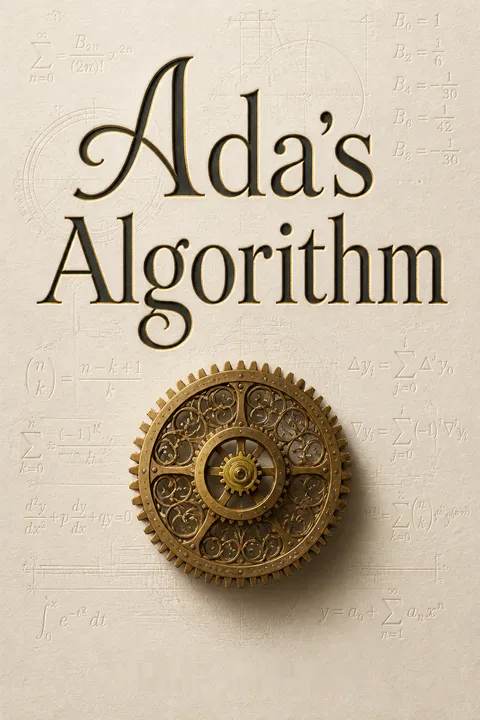
Ada's Algorithm receives mixed reviews. Some praise its exploration of Ada Lovelace's life and contributions to computing, while others criticize the writing style and excessive focus on peripheral figures. Readers appreciate learning about Ada's visionary ideas but feel the book lacks depth in exploring her work. Many note an overemphasis on Charles Babbage and Ada's parents. The biography is seen as accessible but potentially biased, with some questioning the extent of Ada's impact on the digital age.
People Also Read









Glossary
Analytical Engine
Programmable mechanical computerCharles Babbage’s proposed general-purpose calculating machine, designed to use punched cards to direct operations. Its planned parts included a store for quantities and a mill for processing them. Unlike the Difference Engine, which was intended to produce mathematical tables, the Analytical Engine was meant to follow different instructions for different calculations. Babbage never completed it.
Difference Engine
Automatic table calculatorBabbage’s proposed mechanical machine for calculating mathematical tables, using repeated additions based on the method of differences. A demonstration section was built, but the complete machine was not. The project exposed the difficulty of producing large numbers of precise mechanical parts and became the precursor to Babbage’s more general Analytical Engine.
Method of Differences
Repeated additions for tablesA calculation technique used to generate certain mathematical series through repeated additions of differences between successive values. It can replace more complex calculations with simpler additions, which makes it suitable for mechanization. Babbage used this principle in the design of the Difference Engine, which was intended to calculate tables automatically.
Lovelace objection
Claim machines cannot originateA claim, named by Alan Turing, that a computer cannot originate anything and can only perform what people instruct it to do. Turing challenged the idea that this settles the question of machine creativity, arguing that a computer can surprise its users when the consequences of its operations are not obvious. The phrase derives from Lovelace’s discussion of the Analytical Engine.
Jacquard loom
Punched-card weaving machineA loom developed by Joseph-Marie Jacquard that used chains of punched cards to control which threads were raised during weaving. This allowed a single weaver to produce elaborate figured patterns with far less manual coordination than earlier methods required. Babbage adapted the loom’s card-based control principle for the proposed Analytical Engine.
Bernoulli numbers
Important mathematical sequenceA sequence of rational numbers used in several areas of mathematics. In Note G of her 1843 work on the Analytical Engine, Lovelace described a procedure by which the proposed machine could calculate them. Because the Engine was never built, the procedure could not be tested on the machine, and historians differ over whether to call it a computer program in the modern sense.
FAQ
What's "Ada's Algorithm" about?
- Biography of Ada Lovelace: "Ada's Algorithm" by James Essinger is a biography of Ada Lovelace, the daughter of Lord Byron, who is credited with being the first computer programmer.
- Historical Context: The book explores the 19th-century context in which Lovelace lived, highlighting her contributions to the early development of computing.
- Collaboration with Babbage: It details her collaboration with Charles Babbage on the Analytical Engine, a precursor to modern computers.
- Legacy and Impact: The book examines Lovelace's lasting impact on technology and her recognition as a pioneer in the digital age.
Why should I read "Ada's Algorithm"?
- Inspiration from Ada's Life: Ada Lovelace's story is one of overcoming societal norms to make significant contributions to science and technology.
- Understanding Computing History: The book provides insights into the early history of computing and the foundational work that led to modern technology.
- Rich Historical Detail: James Essinger offers a well-researched narrative that brings to life the Victorian era and its scientific advancements.
- Empowerment and Gender Roles: It highlights the challenges faced by women in science, making it a compelling read for those interested in gender studies.
What are the key takeaways of "Ada's Algorithm"?
- Pioneering Work: Ada Lovelace's work on the Analytical Engine laid the groundwork for future developments in computing.
- Visionary Thinking: Lovelace's ability to foresee the potential of computers beyond mere calculation was groundbreaking.
- Collaboration and Innovation: Her partnership with Charles Babbage exemplifies the importance of collaboration in scientific progress.
- Legacy of Women in STEM: The book underscores the often-overlooked contributions of women in science and technology.
How did Ada Lovelace contribute to computing?
- Analytical Engine Notes: Lovelace wrote extensive notes on Babbage's Analytical Engine, which included what is considered the first algorithm intended for a machine.
- Conceptual Leap: She envisioned the machine's potential to go beyond calculations, suggesting it could process symbols and create music.
- Programming Pioneer: Her work is recognized as the first instance of computer programming, earning her the title of the first computer programmer.
- Influence on Future Generations: Lovelace's insights laid the foundation for future developments in computer science.
What role did Charles Babbage play in Ada's life?
- Mentor and Collaborator: Babbage was a mentor to Lovelace, introducing her to the world of computing and mathematics.
- Analytical Engine Development: He designed the Analytical Engine, which Lovelace extensively studied and documented.
- Intellectual Partnership: Their collaboration was marked by mutual respect and intellectual exchange, crucial for the development of their ideas.
- Support and Recognition: Babbage recognized Lovelace's talents and referred to her as the "Enchantress of Number."
What challenges did Ada Lovelace face in her career?
- Societal Expectations: As a woman in the 19th century, Lovelace faced societal constraints that limited women's roles in science and mathematics.
- Health Issues: She struggled with health problems throughout her life, which affected her work and productivity.
- Recognition and Credit: Despite her contributions, Lovelace's work was not fully recognized during her lifetime, partly due to gender biases.
- Financial and Personal Struggles: Lovelace faced financial difficulties and personal challenges, including a complex relationship with her mother.
How does "Ada's Algorithm" portray Ada's relationship with her mother?
- Complex Dynamics: The book explores the complex and often strained relationship between Ada and her mother, Lady Byron.
- Educational Influence: Lady Byron was instrumental in Ada's education, emphasizing mathematics to counteract what she saw as Byron's dangerous imagination.
- Control and Independence: Ada's mother exerted significant control over her life, which Ada struggled against in her pursuit of intellectual freedom.
- Emotional Impact: The relationship had a profound emotional impact on Ada, influencing her personal and professional life.
What are the best quotes from "Ada's Algorithm" and what do they mean?
- "Enchantress of Number": This phrase, used by Babbage to describe Ada, highlights her unique ability to understand and envision the potential of the Analytical Engine.
- "A new, a vast, and a powerful language": Ada's description of the Analytical Engine's capabilities reflects her visionary understanding of computing as a transformative tool.
- "The science of operations": Ada's term for computing, emphasizing its distinct nature from mathematics and its potential to revolutionize various fields.
- "The Analytical Engine weaves algebraical patterns": This metaphor illustrates Ada's insight into the machine's ability to process complex calculations, akin to weaving intricate designs.
How did Ada Lovelace's work influence modern computing?
- Foundation for Algorithms: Her notes on the Analytical Engine are considered the first algorithm intended for implementation on a machine.
- Vision of Computing's Potential: Lovelace foresaw the broader applications of computing, influencing future generations of computer scientists.
- Recognition as a Pioneer: Her work laid the groundwork for the development of programming languages and computer science as a discipline.
- Inspiration for Women in STEM: Lovelace's legacy continues to inspire women pursuing careers in science, technology, engineering, and mathematics.
What is the significance of the Jacquard Loom in "Ada's Algorithm"?
- Inspiration for the Analytical Engine: The Jacquard Loom's use of punched cards to control weaving patterns inspired Babbage's design for the Analytical Engine.
- Metaphor for Computing: Ada used the loom as a metaphor to explain how the Analytical Engine could process information and create complex outputs.
- Historical Context: The loom represents the intersection of industrial technology and computing, highlighting the innovative spirit of the era.
- Symbol of Innovation: The Jacquard Loom exemplifies how existing technologies can inspire new inventions, a theme central to Ada's work.
How does James Essinger's writing style contribute to the narrative?
- Engaging Prose: Essinger's writing is both informative and engaging, making complex scientific concepts accessible to a general audience.
- Historical Detail: The book is rich in historical context, providing a vivid picture of the Victorian era and its scientific advancements.
- Character Development: Essinger delves into the personalities and relationships of key figures, bringing Ada and her contemporaries to life.
- Balanced Perspective: The author presents a balanced view of Ada's achievements and challenges, offering a nuanced portrayal of her life and legacy.
What lessons can be learned from "Ada's Algorithm"?
- Perseverance in Adversity: Ada's determination to pursue her intellectual passions despite societal and personal challenges is a testament to perseverance.
- Importance of Collaboration: Her partnership with Babbage underscores the value of collaboration in scientific and technological innovation.
- Visionary Thinking: Ada's ability to envision the future of computing highlights the importance of thinking beyond current limitations.
- Legacy of Women in Science: The book serves as a reminder of the contributions of women in science and the need to recognize and support their achievements.
Download PDF
Download EPUB
.epub digital book format is ideal for reading ebooks on phones, tablets, and e-readers.








