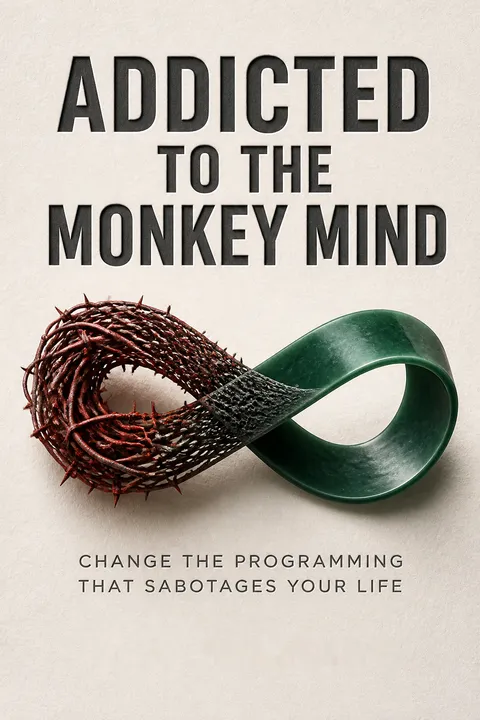


Key Takeaways
Notice the Monkey Mind, then let the Observing Mind choose your response
Two inner narrators. The Monkey Mind is the fast, judgmental voice that turns events into threats and verdicts about personal worth. The Observing Mind notices thoughts and feelings without treating them as facts, making room for a considered response. They are metaphors for ways of thinking, not separate parts of the brain. Kevin’s opening story shows the cost of letting self-criticism lead: after a painful argument, he drinks, drives, and kills a neighbor’s dog.
Create a pause. The aim is not to silence every critical thought. It is to hear the thought as a thought, notice what it stirs up, and decide what to do next. The book follows Kevin and Elizabeth as this small shift helps them respond with more honesty and less panic.
The distinction is memorable because it separates an inner event from an instruction: a thought can be loud without being authoritative. That is useful in conflict, where a rapid interpretation often feels identical to the facts. The model also preserves agency without demanding perfect calm. Its limit is that observation alone does not solve every practical problem; noticing fear still needs to be followed by action, support, or a boundary when circumstances call for it.
Trace today's trigger to the childhood rule it keeps replaying
Old lessons persist. The book argues that repeated childhood messages can become rules about identity, such as “showing emotion is weak” or “mistakes mean I am bad.” A child may absorb a parent’s stress or criticism as a judgment about the self, even when the adult meant to teach or protect. In one contrast, Patrick is scolded after spilling juice, while Charlie is comforted after breaking a plate, then helped to clean up. Both make mistakes, but the responses teach different lessons about worth and repair.
Find the echo. Kevin learned to hide grief after his father dismissed his childhood tears. As an adult, he shuts Jamie out when his uncle dies. Elizabeth’s distrust and sense of inadequacy also echo painful family experiences. The past helps explain a reaction, but it does not have to dictate the next one.
Tracing a present reaction to an earlier rule can make behavior intelligible instead of mysterious. It also changes the question from “What is wrong with me?” to “What did I learn to expect?” That shift can invite compassion while leaving room for accountability. The family examples are clear, though childhood is not the sole source of every pattern. Later relationships, temperament, trauma, and present conditions can also shape how a person responds.
Question the belief beneath the event, not just the event itself
Beliefs color experience. At one dinner, five friends share the same table, food, and waiter, yet one feels happy, another jealous, another anxious, and another overlooked. Each person brings different assumptions to the evening. The point is not that the outside world is imaginary, but that beliefs shape what people notice and how they respond.
Watch the cycle. Patrick and Charlie both lose a parking space before important meetings. Patrick treats the setback as proof that others are against him and that he is failing. Charlie acknowledges the delay, enters the meeting, and focuses on presenting. A belief can also create the evidence it expects: someone who assumes a colleague dismisses their ideas may stop sharing them, leaving the colleague with less reason to seek their input. Ask what an event seems to say about you, then test that conclusion.
This is a practical form of separating observation from interpretation. The distinction matters because “the meeting started late” is different from “I am a failure,” even when the second thought arrives instantly. The book’s emphasis on inward examination can restore choice, but it needs a careful boundary: other people’s actions and structural conditions are real, not merely projections. A balanced reading asks both what is within personal control and what requires an external response.
Trade shame for responsibility; shame often feeds the behavior it condemns
Guilt points to an act. In the book’s distinction, guilt can signal that a specific action needs correction. Shame turns that action into a sweeping judgment about the whole person. Kevin’s self-criticism about drinking and emotional withdrawal leaves him feeling worse, not more capable of changing. He uses alcohol to escape the anxiety created by those judgments, which then adds more reasons to condemn himself.
Find the first link. The book describes a chain: an old belief, such as “emotion is weakness,” contributes to a conflict; the conflict then fuels a new judgment, such as “I am a failure.” The second judgment can distract from the original belief and intensify shame. Examining the first link gives Kevin a chance to understand his withdrawal and practice a different response, rather than treating self-hatred as a cure.
The key contribution is the distinction between evaluating conduct and condemning identity. Accountability can support repair: a person can acknowledge harm, make amends, and seek help without concluding that change is impossible. The cycle also explains why punishment may backfire when it increases the distress a coping behavior is used to escape. Still, addiction is not reducible to shame or beliefs. The book itself frames its methods as supportive tools, not a replacement for appropriate professional care.
Let emotion point toward a belief instead of dictating your next move
Feel the signal. The book treats emotions as bodily experiences, distinct from the stories used to explain them. It groups them into five broad categories: anger, sadness, happiness, fear, and shame. An emotion can signal that a belief deserves attention, much as an alarm signals a problem without identifying its cause. Suppressing a feeling or acting it out may hide the clue rather than resolve it.
Follow the feeling. When Ted explodes at a caterer over a missing food order, he discovers that his deeper anger is about feeling unable to refuse his mother’s request to host a dinner. Paula’s sadness over a friend’s trip leads her to an older fear of being unwanted. In both cases, staying with the feeling helps uncover what the event means to the person. Feelings offer information, not infallible instructions.
Treating emotion as information can replace two common extremes: obeying every impulse or trying to suppress every uncomfortable state. The examples show how a top-layer reaction can conceal a more vulnerable concern, such as fear beneath anger. The “alarm” metaphor is helpful precisely because it does not promise that feelings are always accurate. A signal invites investigation. It does not prove that the first explanation is true or that every feeling has one simple cause.
Use curious questions to move from accusation to the belief underneath
Inquiry replaces certainty. Mindful Inquiry is the book’s method of examining thoughts through genuine questions rather than self-attack or accusation. Start with something noticeable, such as a strong emotion, a physical reaction, an assumption about another person, or a coping habit. Ask what happened, what you feel, what you believe the event means about you, and whether that meaning is true.
Keep moving inward. A tool the author calls “Inside My Skin or Outside My Skin” sorts explanations into external events and internal beliefs. Patrick moves from the person who took his parking space, to lateness, to fear of judgment, and finally to the belief that losing his job would mean he is a failure. In another session, Paula traces anger about a rug to the belief that her husband’s disapproval makes her a bad wife. A real question stays open to an answer.
The method offers a repeatable route from vague distress to a specific assumption that can be examined. Its strongest safeguard is curiosity: questions asked to understand differ from rhetorical questions designed to prosecute. This makes the process useful for relationships as well as private reflection. The risk is turning every difficulty into an inward search for a core belief. Sometimes the direct answer is that another person behaved badly, a request is unreasonable, or practical problem-solving is needed.
Breathe long enough to interrupt the story before reacting
Make room to respond. Conscious Breath is a deliberate, continuous focus on breathing while noticing thoughts without trying to erase them. The book presents it as a way to slow the rush from someone’s words, to the Monkey Mind’s interpretation, to a defensive reply. Paula hears a casual question about bringing pizza to a team event as criticism and snaps back. A breath might have helped her check what was actually meant before responding.
Practice before crisis. Kevin first tries the exercise for two minutes and notices ordinary thoughts about errands, applications, and lunch. The author recommends building toward twenty minutes twice daily, then carrying the practice into everyday activities. The intended benefit is not to force calm, but to become more able to notice thoughts and feelings without immediately following them.
Breath works here as an accessible anchor: it brings attention to something occurring now, while creating a delay between interpretation and action. The everyday examples matter because a skill rehearsed only during a crisis may be hard to retrieve under pressure. The book’s schedule is a recommendation, not a universal prescription. People differ in what feels manageable, and focused breathing can be uncomfortable for some. A flexible practice should support, rather than become another standard for self-criticism.
Test a replacement belief in real life, then gather evidence
Beliefs guide destinations. After questioning an old belief, the book recommends adopting a more useful perspective and acting from it repeatedly. This is not simply reciting a positive slogan. Elizabeth experiments with seeing herself as worthy and with judging men by their actual behavior rather than assuming they are untrustworthy. At a family wedding, she speaks warmly with Carlos, declines his investment pitch, and accepts a dance with Bruce. She remains open without giving up discernment.
Use facts as evidence. Kevin challenges the thought that he is not smart enough by recalling concrete accomplishments: he stopped drinking, earned admission to medical school, and was recognized at work. Elizabeth also learns to focus on what is happening in front of her rather than rehearsing past failures or future fears. New beliefs become more credible when actions and accurate observations support them.
This is more grounded than forced positivity because the new perspective is tested against actual behavior. Elizabeth does not have to decide that Carlos is trustworthy; she can welcome a conversation, set a limit, and judge what follows. Kevin’s factual inventory likewise counters selective attention to failure without inventing praise. The approach works best when replacement beliefs remain provisional and reality-sensitive. A hopeful assumption can open a door, but evidence and boundaries determine whether to keep it open.
A recovered life still has triggers; progress is choosing a different response
Mistakes are information. The book argues against turning every setback into proof that no growth has occurred. When Kevin snaps at Jamie, he looks for the desire underneath the argument, such as wanting private time with his new family. He can accept that desire while recognizing that arguing may not be the best way to express it. This is different from excusing hurtful behavior; it makes repair and a better next attempt possible.
End the inner war. Near the book’s close, Elizabeth sees her critical father as a complicated, aging person rather than only the source of old wounds. Kevin hears his father describe a family loss and allows connection to matter more than the urge to resent what was never shared. Neither man becomes flawless. Their change is that old thoughts can arise without deciding every action or relationship.
The ending resists a familiar self-help fantasy: that insight permanently removes difficult thoughts. Instead, progress means recognizing a familiar reaction sooner, treating oneself with enough compassion to keep learning, and choosing a response that fits present values. That framing makes room for genuine repair without confusing acceptance with approval. It also captures a relational payoff: when self-worth is less dependent on winning an argument or earning approval, attention can return to the actual person in front of you.
Analysis
The book’s core argument is that many painful behaviors make sense as attempts to manage shame and anxiety. Repeated criticism becomes an internal rule; a present-day trigger activates that rule; the resulting distress prompts familiar coping, such as withdrawal, anger, drinking, or overcontrol. The cycle can then generate consequences that appear to confirm the original judgment. The proposed interruption is not positive thinking but observation, emotional attention, questioning, and a new response practiced in ordinary life.
The narrative structure gives this model a human shape. Kevin’s emotional suppression and alcohol use, and Elizabeth’s distrust and drinking, demonstrate how different histories can lead to similar self-attack. Their progress also unfolds through conversations and specific decisions, not abstract declarations. The many supporting characters extend the model into parenting, work, friendship, grief, and chronic pain. Since the author says the characters are simulated, they function as illustrative composites rather than evidence that the method produces the same outcome for every reader.
The strongest insight is the distinction between an event and the verdict attached to it. A missed promotion is painful; “I am a failure” is an interpretation that can be tested. This resembles a broad therapeutic practice of examining automatic thoughts, though the book presents its own vocabulary and experiential exercises. Its emphasis on bodily emotion and curiosity can make reflection less prosecutorial and more usable.
The model needs limits. A focus on internal beliefs can empower people to change their responses, but it can also be misread as saying that external harm, discrimination, illness, or unsafe conditions are merely interpretations. They are not. Likewise, addiction and chronic pain can involve biological, social, and medical factors that cannot be solved by reframing alone. The book’s disclaimer appropriately presents these practices as adjunctive rather than medical care. Read with that distinction, its practical promise is not control over every circumstance, but more freedom in how one meets circumstances while seeking the help or change they require.
Review Summary
Addicted to the Monkey Mind received mixed reviews. Many readers found the content insightful and helpful for managing anxiety and negative thoughts. The book's dialogue-heavy format was divisive, with some appreciating the relatable examples and others finding it tedious. Readers praised the practical tools and techniques for developing an "observing mind." Some felt the book was too long and repetitive, while others found it transformative. The focus on addiction and alcoholism was noted, though many felt the concepts were broadly applicable.
People Also Read








Glossary
Monkey Mind
Self-critical reactive thinkingThe book’s term for a habitual pattern of fast, judgmental thinking shaped by past messages and experiences. It tends to blame others, predict danger, and interpret setbacks as evidence of personal inadequacy. Its stories can intensify anxiety and prompt familiar coping behaviors. The term is a metaphor for a way of responding, not a separate mind or diagnosis.
Observing Mind
Nonjudgmental reflective awarenessThe book’s name for the capacity to notice thoughts, emotions, bodily sensations, and events without immediately judging or obeying them. It favors curiosity, attention to present facts, and questions about what a reaction means. This perspective is intended to create room for a considered response, rather than to suppress difficult feelings or eliminate all critical thoughts.
Mindful Inquiry
Questions that uncover beliefsA reflective process for moving from a strong feeling, bodily reaction, external judgment, or coping behavior toward the belief beneath it. The person asks open, nonjudgmental questions, examines what an event seems to mean about the self, and tests whether that conclusion is accurate. The purpose is to expose assumptions that shape reactions and consider a different response.
Conscious Breath
Breathing with present awarenessA practice of breathing continuously while noticing thoughts and feelings without trying to empty the mind, solve every problem, or force a particular emotional state. The book recommends regular practice and using the breath during daily activities, so it can create a pause between a perceived provocation and a reaction. It is presented as an awareness tool, not medical treatment.
Inside My Skin or Outside My Skin
A tool for locating beliefsA questioning technique that separates external events from internal interpretations. A person follows the reasons for distress through outside factors, such as another person’s action or a lost job, then asks what those events seem to mean about the self. The process aims to identify a core belief, such as “I am a failure,” that can be examined rather than assumed true.
Experiential Engagement Therapy
Experiential core-belief workThe therapeutic methodology the author identifies as his own, described as focusing on underlying core beliefs through experiential techniques. The book’s examples use guided conversations, attention to feelings and bodily reactions, and exercises that revisit the meaning attached to past and present events. The text does not provide a full clinical protocol or comparative evidence for the method.
FAQ
What's Addicted to the Monkey Mind about?
- Focus on Mindsets: The book delves into the "Monkey Mind," which represents negative, self-critical thoughts, and contrasts it with the "Observing Mind," which offers an objective perspective.
- Personal Stories: Through characters like Kevin and Elizabeth, the book illustrates how childhood programming affects adult behavior and emotional responses.
- Tools for Change: It provides practical tools to help readers shift from the Monkey Mind to the Observing Mind, leading to healthier emotional responses and improved relationships.
Why should I read Addicted to the Monkey Mind?
- Self-Improvement Focus: The book offers insights and methods for overcoming self-sabotaging behaviors, encouraging reflection on beliefs and emotional patterns.
- Relatable Characters: The characters' journeys make the concepts accessible, motivating readers to apply the lessons in their own lives.
- Practical Techniques: It provides actionable advice and exercises that can be implemented immediately to change thought patterns and emotional responses.
What are the key takeaways of Addicted to the Monkey Mind?
- Understanding the Monkey Mind: Recognizing negative self-talk and beliefs from childhood is crucial for personal growth.
- Shifting to the Observing Mind: Adopting this perspective allows for non-judgmental viewing of experiences, breaking cycles of anxiety and self-criticism.
- Emotions as Guidance: Emotions are signals to understand beliefs and experiences, leading to greater self-awareness and healing.
How does Addicted to the Monkey Mind define the Monkey Mind and the Observing Mind?
- Monkey Mind Defined: It is the reactive part of our mind focused on blame, criticism, and anxiety, leading to self-sabotaging behaviors.
- Observing Mind Defined: This is the calm, objective part of consciousness that witnesses thoughts and feelings without judgment.
- Importance of Both: Learning to shift from the Monkey Mind to the Observing Mind is essential for emotional well-being and personal growth.
What specific methods does J.F. Benoist recommend in Addicted to the Monkey Mind?
- Mindful Inquiry Process: Involves questioning your mindset and beliefs to uncover root causes of emotional responses.
- Awareness Techniques: Encourages practicing awareness of thoughts and feelings, distinguishing between judgments and observations.
- Emotional Fluidity: Emphasizes allowing emotions to flow without judgment, using them as a compass for personal growth.
What is the Inside My Skin or Outside My Skin method in Addicted to the Monkey Mind?
- Identifying Triggers: Examines emotional responses to determine if feelings are internally or externally sourced.
- Step-by-Step Process: Involves asking questions to reach the core belief driving the emotional response.
- Empowerment Through Insight: Identifying internal beliefs that trigger emotions allows for challenging and changing those beliefs.
What is Conscious Breath and how can it help according to Addicted to the Monkey Mind?
- Breathing Technique: A mindfulness practice focusing on breath to create awareness and calmness.
- Emotional Regulation: Helps manage anxiety and emotional responses, promoting thoughtful rather than impulsive reactions.
- Daily Integration: Incorporating it into daily routines enhances emotional well-being and reduces negative thought patterns.
How does Addicted to the Monkey Mind address the concept of self-acceptance?
- Embracing Mistakes: Encourages accepting mistakes as part of the learning process, recognizing they don't define worth.
- Understanding Intentions: Identifying desires behind reactions fosters self-compassion and reduces shame.
- Moving Forward: Focuses on growth and improvement rather than dwelling on past failures, crucial for personal development.
What are some examples of the characters' struggles in Addicted to the Monkey Mind?
- Kevin's Journey: Struggles with addiction and self-worth due to childhood shame, illustrating trauma's impact on adult relationships.
- Elizabeth's Challenges: Faces trust and self-acceptance issues influenced by a critical father, showcasing relationship navigation difficulties.
- Transformation Stories: Both characters learn to recognize their Monkey Mind and embrace the Observing Mind, leading to healthier relationships.
What are the best quotes from Addicted to the Monkey Mind and what do they mean?
- "You are good enough.": Reminds that self-worth is inherent, encouraging challenges to negative beliefs.
- "Emotions are not ‘bad’ or ‘good’.": Emphasizes accepting all emotions as valid, suggesting understanding leads to growth.
- "Awareness creates change.": Highlights self-awareness's transformative power in breaking negative patterns.
How can I apply the concepts from Addicted to the Monkey Mind in my daily life?
- Practice Mindful Inquiry: Regularly question thoughts and beliefs to uncover underlying issues affecting emotional state.
- Embrace Your Emotions: Allow emotions without judgment, recognizing them as signals for understanding beliefs.
- Shift to the Observing Mind: Consciously observe thoughts and feelings non-judgmentally, reducing anxiety and self-criticism.
How does Addicted to the Monkey Mind suggest overcoming shame-inducing beliefs?
- Awareness of Shame: Recognize when shame influences thoughts and behaviors, understanding its childhood roots.
- Challenge Negative Thoughts: Question the validity of shame-inducing beliefs, reframing them with positive affirmations.
- Practice Self-Compassion: Develop a compassionate attitude toward oneself to break the cycle of self-judgment and shame.
Download PDF
Download EPUB
.epub digital book format is ideal for reading ebooks on phones, tablets, and e-readers.








