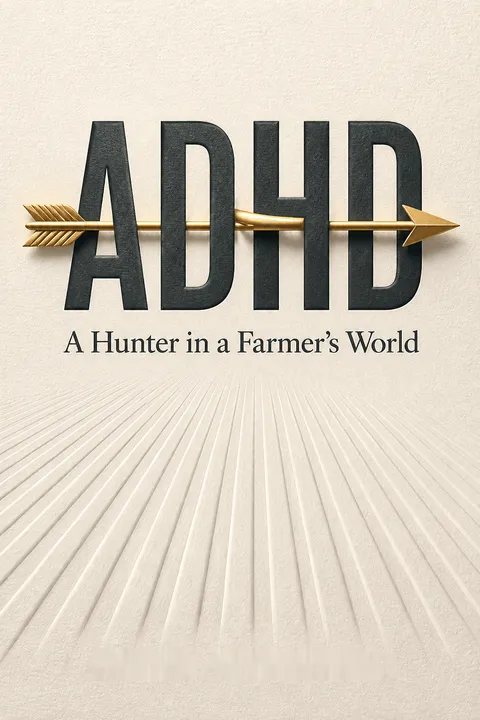


Key Takeaways
See ADHD as a different operating style, not proof of a broken person
A different frame. Hartmann’s central argument is that ADHD-associated traits do not automatically mean a person is defective. Distractibility, impatience, impulsivity, disorganization, and stimulation-seeking can cause serious trouble in classrooms and repetitive jobs. In other settings, alertness, curiosity, improvisation, and intense engagement with an interesting task can be valuable.
The origin story. Hartmann began exploring this idea after his son was diagnosed and described as damaged. He searched for an explanation that acknowledged real difficulties without making the child’s diagnosis a verdict on his future. The book does not reject diagnosis, therapy, or medication. It asks readers to consider both a person’s needs and the environment in which those needs arise.
The value of this reframe is that it separates a person’s worth from the friction they experience. That distinction can make it easier to seek support without absorbing shame. It also invites a practical question: which parts of the difficulty come from the person, and which from the setting? The frame should not turn every impairment into a hidden gift, though. Difficulty completing work, maintaining relationships, or managing risk deserves attention even when strengths are present.
Treat the Hunter-Farmer story as a useful hypothesis, not settled biology
Two survival styles. Hartmann contrasts the alert, flexible Hunter with the patient, methodical Farmer. A Hunter scans for changes, makes quick decisions, and focuses intensely when something matters. Farming rewards sustained effort, planning, repetition, and attention to detail. Hartmann argues that ADHD traits resemble the first profile and often clash with schools and jobs built around the second.
An evolutionary proposal. He points to research on dopamine-related gene variants, migration, and the Ariaal, a pastoralist group with both mobile and settled branches. The cited research found different outcomes associated with a variant across those settings. Hartmann treats such findings as support for an adaptive history, but they do not prove that ADHD arose as a Hunter adaptation or that people divide neatly into two types.
The metaphor makes an abstract mismatch easy to picture: the same alertness can be useful in one task and disruptive in another. Its scientific claim needs more restraint than its practical insight. A present-day association between a genetic variant and a behavior cannot, on its own, reconstruct why that variant spread in ancient populations. Human attention is also more varied than two archetypes suggest. The model works best as a prompt to examine fit, not as a biological classification.
Describe support needs without predicting a child’s diminished future
Expectations shape experience. Hartmann argues that a diagnosis can help explain a child’s struggles, but language that presents the child as permanently damaged can shrink expectations and self-belief. He illustrates this with a boy who proudly brings home a report card showing improvement and a teacher’s praise for his creativity. His father, trying to prepare him for disappointment, instead tells him that his difference means he will always struggle. The boy ends up believing the pessimistic story.
Name the challenge clearly. Hartmann also describes a study in which teachers’ expectations affected students’ later academic performance. His point is not that encouragement cures ADHD, but that adults can either notice a child’s progress and strengths or teach the child to discount them.
The story shows how a label can become more than a description. It can influence what adults notice, what help they offer, and what a child expects of themselves. The useful balance is neither fatalism nor empty praise. A child can be told plainly that certain tasks are hard, while also receiving concrete help and meaningful opportunities to succeed. Expectations matter most when they are paired with resources rather than used as a substitute for them.
Assess persistent patterns, not a child’s worst day or one classroom
Look for a pattern. The book describes ADHD as a spectrum rather than an all-or-nothing category. In its discussion of diagnosis, Hartmann emphasizes a history of persistent traits beginning in childhood and warns that anxiety, depression, bipolar disorder, and seasonal mood changes can resemble or accompany attention problems. A person’s behavior in one difficult class is not enough to explain the whole picture.
Use current professional guidance. The diagnostic standards Hartmann discusses come from an older edition of the psychiatric manual, so his lists should not be treated as a current checklist. A qualified clinician can assess development, functioning across settings, possible overlapping conditions, and the individual’s history. The book’s practical lesson remains useful: avoid reducing a complex person to one symptom or one test score.
This distinction protects against two errors: treating every restless or distracted child as having ADHD, and dismissing a person whose difficulties are less visible in a structured setting. Assessment is strongest when it considers history and everyday functioning, not just a snapshot. The book’s own diagnostic references are dated, which makes updated clinical guidance essential. A compassionate explanation can reduce blame, but only careful assessment can help identify which supports are appropriate.
Choose roles that reward novelty, alertness, and fast problem-solving
Match the work to the strengths. Hartmann suggests that people who thrive on variety may find better fit in roles involving exploration, quick response, persuasion, or creative problem-solving. He names fields such as sales, writing, emergency care, investigation, and entrepreneurship. These are possibilities, not guaranteed matches; the point is to examine which tasks energize a person and which repeatedly drain them.
Know when the job changes. Hartmann describes Hunter entrepreneurs who can launch a business but struggle when it grows and demands steady management. Once a small venture expands, careful planning and employee support may become more important than constant invention. His proposed solution is to delegate those responsibilities to a capable partner or colleague, while the founder shifts toward strategy, sales, or new projects.
Career fit is not just about choosing an exciting job. It also means noticing which responsibilities change as a role grows, then designing a team around complementary strengths. That is more useful than assuming every person must become a competent manager to advance. At the same time, the Hunter and Farmer labels should not become career boxes. A person can develop new skills, and routine tasks can sometimes be supported rather than avoided.
Turn vague demands into short targets with visible feedback
Make the next step visible. Hartmann recommends breaking large responsibilities into specific, measurable tasks. A manager could track daily outreach instead of giving only a distant sales target. Parents and teachers could use a weekly chart to track completed homework or materials brought to class. Short review cycles and nearby rewards help make progress easier to see.
Design the surroundings. Other suggestions include creating a quiet work period, reducing clutter, limiting distracting technology, and using project-based learning where possible. The aim is not to demand perfect self-organization from someone who struggles with it. It is to build external structure that keeps priorities in view and makes follow-through less dependent on memory or motivation.
These strategies treat organization as a design problem, not simply a character test. Written goals, visible cues, and frequent feedback can reduce the amount of information a person must hold in mind. The same logic can improve teamwork for people who do not have ADHD. Structure becomes counterproductive when it turns into constant surveillance or punishment, however. The best system clarifies what matters, helps someone recover from a missed step, and preserves room for independent work.
Delay high-stakes urges before spending, quitting, or sending
Create a pause. Hartmann describes impulsivity as a trait that can fuel action and invention, but can also produce avoidable harm. His simple technique is to write down a decision or message and wait until the next day before acting. The pause gives an intense first reaction time to fade and allows a person to reconsider the consequences.
Redirect the energy. He also suggests waiting out a craving or temporarily shifting attention to another goal. Large projects can be divided into small daily commitments, reducing the chance that a new impulse will displace the whole undertaking. A trusted, more methodical partner can help test an idea, provided both people understand that they bring different working styles.
A delay does not require treating desire as irrational. It acknowledges that urgency changes how attractive an option feels, and that a decision made under pressure may look different after the pressure passes. The technique is especially useful for actions that are hard to reverse. It is not a universal answer: emergencies require prompt action, and some people need more support than a pause can provide. The central move is to create enough space for choice.
Channel stimulation-seeking instead of treating it as mere defiance
Hartmann’s explanation. The book proposes a basic human need to experience aliveness. In Hartmann’s model, the thalamus helps regulate sensory input, while the Reticular Activating System helps regulate alertness. He suggests that some people experience ordinary stimulation as insufficient and seek stronger input through movement, novelty, risk, or disruptive behavior. In a classroom, a bored child might provoke a reaction simply to make the surroundings feel vivid again.
A proposal, not a diagnosis. This model is Hartmann’s explanation for some ADHD behaviors, not an established account of every person’s brain or motivation. Its practical implication is to ask what safe, useful forms of challenge or stimulation might engage someone, rather than assuming every restless act is deliberate misbehavior.
The model encourages curiosity about the function of behavior: what does the action provide that the current setting does not? That question can lead to better interventions than punishment alone. But an explanation is not an excuse, and stimulation-seeking does not account for every instance of impulsivity or distress. The safest application is experimental and individualized: offer engaging alternatives, observe what changes, and keep boundaries where behavior risks harm.
Practice attention with cues and feedback, not willpower alone
Build the skill deliberately. Hartmann compares concentration to learning to ride a bicycle: at first, staying on task requires conscious effort, and repeated practice makes it more automatic. He recommends short meditation practices, noticing when attention wanders, and turning spoken instructions into mental pictures. Breaking study into shorter sessions and explaining material aloud are other ways the book suggests making learning more active.
Use feedback carefully. Hartmann describes EEG neurofeedback, which measures brain activity and provides immediate signals during practice, as well as the Muse headband, a consumer meditation device. The proposed advantage is rapid feedback about attention. The book presents these tools as promising, but they should be understood as options rather than guaranteed treatments.
The bicycle comparison captures an important learning principle: people improve when they can notice an error and adjust close to the moment it occurs. That makes feedback and repeatable practice more actionable than simply being told to focus. The same idea can be applied without a device, through checklists, timers, or a study partner. Neurofeedback is more specialized, and buying technology should not replace professional advice or be mistaken for proof that every user will benefit.
Use medication as an option, not a verdict about identity
Benefits and uncertainty. Hartmann recounts people who say stimulant medication helped them concentrate, stay in conversations, manage school, or reduce self-medication. He does not argue that medication should be rejected. He also raises concerns about side effects and long-term effects, while acknowledging that the evidence he discusses does not settle every risk.
Keep the decision individual. The book’s broader position is that medication is one possible support, not the only way to function and not proof that a person is broken. It discusses combining treatment with adjustments to school, work, and daily routines. Its medical discussion includes claims and references from earlier decades, so choices about medication should be made with a qualified clinician using current evidence, not by stopping or changing treatment on one’s own.
This balanced framing resists two unhelpful extremes: medication as the sole answer, and medication as a moral failure. A treatment decision should be judged by its effects on the person’s functioning, well-being, and unwanted effects, not by whether it fits a preferred story about ADHD. Hartmann’s caution about long-term uncertainty reflects the limits of the literature he cites. Because medical evidence changes, current clinical guidance matters more than any older generalization.
Reduce children’s smoke exposure without turning correlation into blame
The book’s warning. Hartmann reviews studies that associate parental or household tobacco smoke exposure with attention and conduct problems in children. One study he cites reported that children of smokers were 40 to 50 percent more likely to show severe disruptive behavior; he also points to research reporting an exposure-related pattern and to animal studies on nicotine’s effects on the nervous system.
Interpret the evidence carefully. These findings make reducing children’s exposure a sensible precaution, but an association does not establish why a particular child has behavioral difficulties. The chapter presents research from the 1980s and 1990s, and its claims should be checked against current evidence. Smoke exposure should prompt prevention, not an assumption that parents caused a child’s ADHD.
The chapter connects a preventable environmental exposure to a question families may not think to ask. Its strongest practical implication is straightforward: keep children away from tobacco smoke. Its causal language deserves greater caution. Family history, social conditions, and other shared influences can complicate studies of parental smoking and child behavior. Separating population-level risk from individual blame makes the health message more credible and less likely to stigmatize families.
Build sleep routines around your pattern, not the clock’s moral code
Different sleep patterns. Hartmann discusses sleep-onset problems and delayed schedules among adults with ADHD. He also describes research in which people given fourteen hours of darkness eventually settled into two periods of sleep separated by a wakeful interval. Historical records he cites suggest that segmented sleep was once common in some communities. These observations do not mean everyone should adopt a divided night or that insomnia is harmless.
Make sleep easier to approach. The book recommends regular bed and wake times, a dark and quiet room, and using the bed mainly for sleep. If awake for a long time, it suggests leaving the bed for a relaxing activity and returning when sleepy. Persistent or severe sleep problems merit professional care, especially when they affect daily functioning.
The useful shift is from moral judgment to observation: sleep timing varies, and forcing one schedule can make rest harder for some people. The historical account is intriguing, but it does not establish that segmented sleep is ideal for modern life or for any specific individual. Sleep routines are practical experiments, not tests of discipline. A consistent pattern that supports health and daily responsibilities matters more than matching an inherited slogan about early rising.
Analysis
The book’s enduring contribution is less its claim that ADHD genes came from ancient hunters than its insistence that behavior cannot be evaluated apart from context. Hartmann turns an individual-deficit story into an ecological question: which environments reward rapid scanning, novelty, improvisation, and bursts of effort, and which penalize them? That shift can reduce shame and redirect attention toward classroom design, workplace roles, and practical supports. It also gives families a vocabulary for discussing differences without making a child’s identity synonymous with failure.
The evolutionary account is more speculative than the book’s confident presentation sometimes suggests. Contemporary traits and genetic variants cannot independently establish the selection pressures that shaped them in prehistory. The Hunter and Farmer categories are memorable but simplify a continuum of attention, motivation, and self-regulation. They should not be used to predict a person’s abilities or prescribe a career. The same caution applies to Hartmann’s proposed sensory explanation of stimulation-seeking and to historical figures he retrospectively portrays as likely ADHD.
The book is strongest when it moves from metaphor to testable adjustments: shorten tasks, make expectations visible, reduce unnecessary distractions, teach study strategies, and consider complementary strengths on a team. It is also appropriately unwilling to make medication an all-or-nothing question. Its limitations are clearest in medical claims drawn from older research, including discussions of tobacco exposure, neurofeedback, sleep, and medication risks. Those claims require current clinical context. The lasting lesson is not that ADHD is secretly a superpower, nor that it is merely a disorder. It is that human variation can create both real impairment and real advantage, and that good support must take both seriously.
Review Summary
ADHD: A Hunter in a Farmer's World receives mixed reviews. Many readers find the hunter-farmer metaphor insightful and validating, appreciating the positive framing of ADHD traits. Some praise the book's strategies and historical examples. However, critics note a lack of evidence, repetitiveness, and limited discussion of systemic issues. The updated edition is generally well-received, though some find it less coherent than earlier versions. Overall, readers value the book's perspective on ADHD as a difference rather than a disorder, despite its limitations.
People Also Read






Glossary
Hunter/Farmer theory
An evolutionary fit metaphorHartmann’s model compares ADHD-associated traits, such as environmental scanning, rapid decisions, and stimulation-seeking, with the demands of hunting cultures. He contrasts them with traits favored in agricultural and modern institutional settings, such as sustained routine and detailed planning. The model is an explanatory metaphor and hypothesis, not a formal diagnosis or settled account of ADHD’s evolutionary origin.
Edison Trait
Creative, flexible ADHD traitsHartmann uses this phrase for traits he associates with ADHD and with inventiveness, including curiosity, risk tolerance, flexible thinking, and intense interest-driven effort. The name invokes Thomas Edison as an example of someone who struggled in conventional schooling yet pursued many projects and inventions. It describes a possible strength profile, not a clinical category or a guarantee of creativity.
Task-Switching Deficit Disorder (TSDD)
Difficulty shifting attentionHartmann uses this label for the opposite end of his proposed attention spectrum: a tendency to remain focused on one task and find it difficult to switch activities or divide attention. He presents it as a contrast to the Hunter profile, whose attention may shift readily. The phrase is his conceptual counterpoint, not a standard medical diagnosis.
need to experience aliveness
Need for vivid stimulationHartmann proposes that some people need stronger or more frequent sensory and emotional stimulation to feel engaged with their surroundings. He uses this idea to interpret behaviors such as seeking novelty, taking risks, or acting out when bored. It is a proposed explanation within his book, not an established diagnostic feature or a universal account of ADHD behavior.
Reticular Activating System (RAS)
Regulates alertnessThe RAS is a brain system Hartmann describes as involved in alertness and wakefulness. In his explanatory model, it works with the thalamus to influence how strongly sensory information reaches conscious awareness. The book uses this account to explain differences in stimulation-seeking, but its simplified sensory-gate model should not be treated as a complete or settled explanation of ADHD.
open consciousness
Broad, shifting awarenessHartmann uses this term for a diffuse mode of attention that moves among sounds, sights, thoughts, and other cues. He contrasts it with focused consciousness, in which awareness is concentrated on a single task. In the Hunter/Farmer model, open awareness is described as a more natural baseline for Hunters, while focused awareness is described as more typical of Farmers.
FAQ
What's ADHD: A Hunter in a Farmer's World about?
- Evolutionary Perspective: The book presents ADHD as an evolutionary trait, suggesting that individuals with ADHD are descendants of hunters who thrived in hunter-gatherer societies.
- Hunter vs. Farmer Metaphor: Thom Hartmann uses this metaphor to explain behavioral differences, arguing that ADHD traits were advantageous in a hunting context but problematic in modern structured environments.
- Reframing ADHD: It aims to shift the perception of ADHD from a deficit to a unique mode of thought characterized by creativity and flexibility.
Why should I read ADHD: A Hunter in a Farmer's World?
- New Understanding: Offers a fresh perspective on ADHD, challenging traditional views that label it as a disorder, empowering individuals with ADHD and their families.
- Practical Strategies: Provides advice for parents, educators, and individuals with ADHD on thriving in a society that often misunderstands their traits.
- Cultural Context: Places ADHD within a broader cultural and historical context, helping readers understand societal shifts affecting ADHD perception.
What are the key takeaways of ADHD: A Hunter in a Farmer's World?
- ADHD as a Trait: Frames ADHD as an inherited trait advantageous in dynamic environments, not a disorder.
- Importance of Environment: Emphasizes that challenges faced by individuals with ADHD often stem from being in a "Farmer's world."
- Empowerment through Understanding: Understanding ADHD as a unique mode of thought can help individuals leverage their strengths.
How does Thom Hartmann define ADHD in ADHD: A Hunter in a Farmer's World?
- State of Mind: Defined as a state of mind characterized by distractibility, impulsivity, and a need for high stimulation.
- Evolutionary Advantage: Traits were beneficial for survival in hunter-gatherer societies, where quick decision-making was crucial.
- Not a Disorder: Posits that ADHD should be viewed as a different way of processing information, not a disorder.
How does ADHD: A Hunter in a Farmer's World explain the difference between Hunters and Farmers?
- Behavioral Characteristics: Hunters are impulsive and risk-taking, while Farmers are methodical and detail-oriented.
- Cultural Context: Modern society is structured for Farmers, leading to challenges for Hunters, particularly those with ADHD.
- Adaptive Traits: Traits associated with Hunters were adaptive in ancient environments but seen as problematic today.
What practical advice does ADHD: A Hunter in a Farmer's World offer for managing ADHD?
- Break Tasks into Goals: Suggests breaking larger tasks into smaller, manageable goals to maintain focus and motivation.
- Create Distraction-Free Zones: Establishing environments free from distractions can enhance productivity.
- Utilize Strengths: Encourages identifying unique strengths and seeking environments that align with natural tendencies.
How does ADHD: A Hunter in a Farmer's World address the stigma surrounding ADHD?
- Reframing the Narrative: Shifts the narrative from viewing ADHD as a disorder to recognizing it as a different cognitive style.
- Empowerment through Knowledge: Provides a deeper understanding of ADHD, empowering individuals to embrace their differences.
- Cultural Critique: Critiques societal norms that pathologize ADHD traits, encouraging a more inclusive perspective.
What role does genetics play in ADHD according to ADHD: A Hunter in a Farmer's World?
- Genetic Basis: Discusses research suggesting ADHD has a genetic component, with traits passed down through generations.
- Adaptive Evolution: Genetic traits associated with ADHD may have provided survival advantages in ancestral environments.
- Modern Implications: Understanding the genetic basis can help shift perceptions from disorder to evolutionary trait.
How can parents and educators support children with ADHD based on ADHD: A Hunter in a Farmer's World insights?
- Tailored Learning Environments: Advocates for educational settings that accommodate ADHD needs, like smaller class sizes.
- Positive Reinforcement: Encouraging and recognizing strengths can build self-esteem and motivate success.
- Open Communication: Fosters dialogue about ADHD, helping children understand their traits and navigate societal challenges.
What are some practical techniques mentioned in ADHD: A Hunter in a Farmer's World?
- Postpone Decisions: Practice postponing decisions to allow impulsive urges to fade, preventing hasty choices.
- Break Tasks into Smaller Parts: Advises breaking tasks into smaller pieces to maintain focus and motivation.
- Daily Evaluation Systems: Implementing daily check-ins can help individuals stay on track and maintain focus.
What are the best quotes from ADHD: A Hunter in a Farmer's World and what do they mean?
- “ADHDers aren’t abnormal; they are uniquely gifted individuals in their own right.”: Highlights ADHD traits as gifts, encouraging a positive self-image.
- “Good luck to the farmer! Good luck to the man who owns this place, the man who works it.”: Reflects the struggle of ADHD individuals in structured society, emphasizing the need for understanding.
- “You’re broken and we’re the only ones who can fix you.”: Critiques the medical model pathologizing ADHD, advocating for valuing diverse cognitive styles.
How does ADHD: A Hunter in a Farmer's World address the relationship between ADHD and creativity?
- Creativity as a Strength: Argues that many with ADHD possess heightened creativity and innovative thinking.
- Risk-Taking and Exploration: Highlights that risk-taking behaviors can foster creativity, leading to unique solutions.
- Nurturing Creative Potential: Provides strategies for nurturing creativity, such as allowing flexibility in learning environments.
About the Author
Other books by Thom Hartmann

Download PDF
Download EPUB
.epub digital book format is ideal for reading ebooks on phones, tablets, and e-readers.








