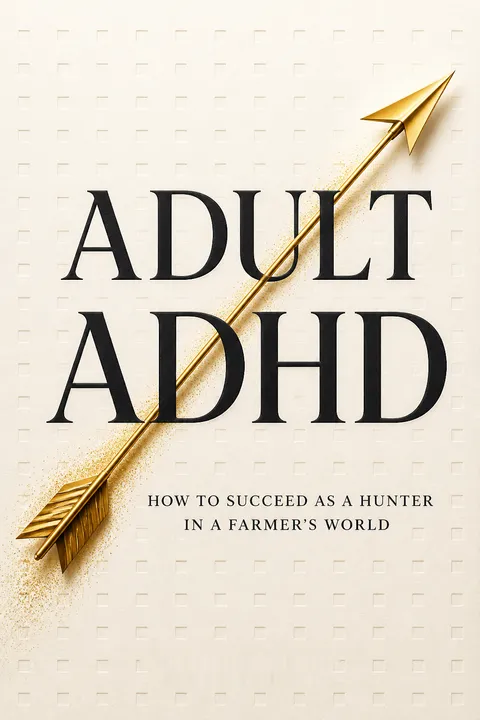


Key Takeaways
Treat ADHD as a context mismatch, not proof of prehistoric destiny.
A useful metaphor. Hartmann describes people with ADHD as Hunters: alert to change, drawn to novelty, and quick to shift attention. He contrasts them with Farmers, whom he associates with patience, routine, and sustained attention. His point is that traits that frustrate a quiet classroom or repetitive job may help in a fast-changing environment.
Separate image from evidence. Hartmann proposes that these differences echo prehistoric hunting and farming ways of life. That story gives readers a vivid alternative to seeing themselves as defective, but the book does not establish that ADHD comes from inherited Hunter adaptations. Treat the contrast as a way to think about fit, not as a scientific explanation or a label that predicts anyone’s abilities.
What's valuable here is the shift from asking whether a person is deficient to asking what a setting demands. That resembles person-environment fit in occupational psychology: performance depends partly on whether a role matches a person’s capacities and preferences. The metaphor can soften shame and invite practical changes. Its limit is equally important. ADHD is not a fixed package of advantages, and the Hunter story risks turning a complex, impairing condition into an appealing identity. A metaphor can guide reflection without being mistaken for biology.
Learn your ADHD pattern, then build supports without surrendering agency.
Name what gets difficult. The book describes ADHD as an ongoing pattern of inattention, hyperactivity, or impulsivity that interferes with daily life. It notes three presentations: inattentive, hyperactive-impulsive, and combined. The author emphasizes that adults can have ADHD too, and that the outward pattern can differ from one person to another.
Use recognition constructively. Hartmann recounts meeting adults whose abilities were recognized by a patient teacher or parent, alongside people who were repeatedly called lazy or defiant. He argues that understanding the pattern can reduce shame and help people find strategies. The diagnosis, however, is not a reason to excuse harmful behavior or assume every difficulty is ADHD. The book advises people uncertain about their symptoms to seek an informed professional assessment.
A name for a persistent pattern can turn moral judgment into a problem that can be examined and supported. That is a form of metacognition: noticing how attention and behavior operate, rather than treating each lapse as proof of bad character. It can also strengthen agency by making specific accommodations easier to request. The balance matters. A diagnosis does not explain every conflict or failure, and personal responsibility does not mean pretending neurological difficulties are voluntary. Useful support takes both realities seriously.
Choose work that rewards alertness, variety, and fast adaptation.
Find the right demands. Hartmann suggests that some people with ADHD do well in sales, journalism, creative work, teaching, consulting, and other roles with novelty or rapid feedback. He contrasts those with repetitive tasks that may become difficult to sustain. One pilot he interviewed said that the focus and awareness he struggled to maintain in ordinary settings came naturally in the cockpit, where the work demanded constant attention.
Fit beats status. The book also tells of Don, a factory worker who lost focus during repetitive assembly but felt competent while skydiving, where he noticed hazards other jumpers missed. Hartmann uses these stories to ask whether a job uses a person’s strengths. They are illustrations, not proof that high-risk work suits everyone with ADHD. Any career choice still needs to account for training, safety, income, and individual preference.
The practical insight is to assess a job by its actual tasks, not its prestige or familiar schedule. Job-crafting research and occupational psychology similarly emphasize that people can sometimes reshape duties, feedback, and work conditions to improve fit. Hartmann’s examples make that idea tangible. But stimulation is not the same as suitability: a thrilling role can also expose someone to risks or unstable income. The strongest application is not simply to seek excitement, but to identify which parts of a job reliably engage attention and which supports make the rest manageable.
Pair big-picture energy with someone who protects the follow-through.
Divide the work deliberately. Hartmann’s Hunter-Farmer team pairs a person who enjoys initiating, persuading, and spotting possibilities with someone who prefers organizing, tracking details, and maintaining relationships. In sales, the first person may win a customer while the second handles follow-up, paperwork, and scheduled contact. The book warns that a sale often involves several visits, so enthusiasm alone does not complete the process.
Give support real authority. Hartmann also describes a chief executive who relied on an executive assistant to manage schedules, documents, and reminders, based on decisions they made together. His larger point is that responsibility needs to come with authority. A detail-oriented partner cannot reliably protect a project if the person generating new ideas can override every plan at will.
This is a case for complementary skills, not for dividing people into two permanent personality species. Teams often perform better when someone generates options and someone else checks feasibility, remembers commitments, and closes loops. That resembles cognitive diversity in group problem-solving. The danger is building dependence on an invisible assistant, often a spouse or lower-status employee, without recognizing the labor involved. A durable arrangement makes the work explicit, compensates it fairly, and assigns decision rights rather than expecting one person to quietly rescue another.
Build a company that can run without its founder.
Design for transfer. Hartmann warns that entrepreneurs can create a job that depends on them rather than a business that can operate independently. Early on, a founder may handle sales, product decisions, and daily problems. As the company grows, those same habits can obstruct steady operations or pull attention away from what already works.
Write down how it works. His franchise-inspired approach is to define the company’s focus, list its functions, describe each job and its authority, specify needed skills, and document routine operations. Hartmann says these instructions should be clear enough for a capable newcomer to use. When the business matures, the founder can hand daily management to someone suited to it and concentrate on preferred work, advise the company, or sell it.
The franchise test is a memorable way to expose key-person risk: if only the founder knows how to sell, deliver, or solve routine problems, the company may be less transferable than it appears. In management terms, documenting work makes tacit knowledge available to the organization. That can improve continuity even when no sale is planned. Still, not every venture should be standardized into a franchise-like system. Some businesses depend on specialized judgment or personal relationships. The useful goal is resilience, not paperwork for its own sake.
Turn recurring frustrations into ideas by looking sideways at problems.
Try a different route. Hartmann contrasts vertical problem-solving, which repeats variations of the same approach, with horizontal problem-solving, which searches for another route or reframes the issue. His example is a stuck door: pushing harder is one strategy, while trying another entrance is a different one.
Start with a real inconvenience. When Hartmann and his wife needed a company to produce a newsletter, they found advertising agencies too expensive and print shops unable to provide the quality they wanted. They saw a gap and started a business to serve it. Hartmann recommends quiet time for ideas to surface, then recording them in a notebook or recorder. The frustration that inspired a business was personal, but the opportunity came from noticing that other customers might share it.
This resembles design thinking, where close attention to a user’s friction can reveal a service worth improving. Hartmann’s story is strongest because the problem was experienced directly, not invented in a conference room. Quiet reflection and recording ideas can also help people who move quickly from one thought to another. But a founder’s own annoyance is only a hypothesis about demand. Other people may tolerate the inconvenience, solve it differently, or reject the proposed price. Observation generates options; customer evidence helps distinguish an opportunity from an interesting idea.
Let exciting ideas cool, then test whether customers will pay.
Put a pause between idea and action. Hartmann argues that the urge to start something immediately can scatter attention just as much as procrastination can delay necessary work. His technique is to write down a promising idea and revisit it after a few days, when the initial rush has faded. If it still seems worthwhile, make a written plan with steps and points where work can be handed off.
Check demand early. The book recommends studying existing businesses, asking potential customers what they want, and testing a small offer before investing heavily. Hartmann describes researching travel agencies by visiting successful operators and learning how they worked before starting his own. A modest test can reveal whether people respond. The delay is not a reason to bury every bold idea. It is a way to distinguish sustained interest from a passing impulse.
A cooling-off period is a simple form of choice architecture: it inserts time between excitement and an irreversible decision. That can be especially useful when novelty makes a plan feel more certain than it is. Pairing the pause with customer testing is stronger than relying on introspection alone, because enthusiasm cannot measure demand. There is a counter-risk: excessive testing can become sophisticated avoidance. A good process sets a small, concrete experiment and a decision date, so caution produces evidence rather than another indefinite delay.
Put memory and priorities outside your head before work gets chaotic.
Make the next action visible. Hartmann describes an ABC organizational strategy. Each task is placed in one of three groups: A for urgent work, B for important work that can wait, and C for items to defer. He suggests listing and ranking A tasks, keeping B and C materials in separate places, and reviewing the list each morning. The system makes priorities visible instead of relying on memory alone.
Shrink the work. Large projects can feel impossible to begin, so Hartmann recommends dividing them into small units and scheduling manageable periods for each. He also advises estimating how long a task might take and allowing extra time, since people often underestimate. These are supports, not character tests. A written list cannot resolve every competing demand, but it can reduce the number of decisions a person must hold in mind at once.
This is cognitive offloading: using paper, labels, and routines to store information that would otherwise compete for limited working memory. The broader lesson is that organization need not mean having a naturally orderly mind. It can mean designing a reliable place for commitments to live. The ABC method works best when the categories remain simple and reviewed; elaborate systems can become another project to maintain. External reminders also need realistic priorities. A full list is not a plan if everything is marked urgent.
Treat ADHD care as an individualized choice, not a willpower test.
Consider several forms of support. Hartmann discusses prescription medication, psychotherapy, exercise, and other approaches. He notes that therapy may help with problems such as damaged self-esteem, while medication decisions depend on symptoms and individual circumstances. He also describes people using alcohol, caffeine, marijuana, or illegal stimulants to manage restlessness or boredom, and warns that self-medication can bring serious costs.
Get qualified guidance. The book includes medical claims and cautions drawn from sources available in its 2016 edition. They should not be treated as current treatment advice. A reader considering medication or other care should discuss likely benefits, risks, and alternatives with a qualified clinician. Hartmann’s practical point remains useful: needing support is not a moral failure, and choosing no medication is not automatically a sign of strength.
The strongest part of this discussion is its rejection of shame as a treatment plan. Contemporary clinical care generally treats ADHD management as an individualized process, where a clinician and patient weigh symptoms, goals, side effects, and other health factors. Exercise or therapy may complement care, but should not be presented as universal substitutes for medication. The book’s discussion reflects its publication era, so specific drug-risk statements and claims about alternative treatments need updating against current professional guidance. Decisions are best made collaboratively, not through self-experimentation or slogans.
Choose a purpose that serves people, then commit to one track.
Look for a durable motive. Hartmann asks readers to recall experiences that felt deeply fulfilling, people they admire, and the kinds of contribution they find meaningful. He argues that a business goal is more sustaining when it connects to a purpose and meets a genuine need. In his account, a company is not only a source of income; it can serve customers and employees through useful work.
Turn motive into action. Hartmann recommends writing down a clear goal and keeping it visible, then breaking it into steps. He also cautions against commitments made in a burst of enthusiasm and abandoned when the work becomes routine. His closing emphasis is not simply to dream bigger, but to direct energy toward a chosen objective and keep adjusting through experience.
Purpose can function as a decision filter: when several attractive projects compete, a clear value can help determine which deserves time. The service element also connects entrepreneurship to stakeholder thinking, where a company’s success includes whether it creates value for customers and workers. Still, purpose does not guarantee that a venture will succeed or that commitment will make external obstacles disappear. Its practical contribution is narrower and more reliable: it can help someone choose, persist, and notice when an appealing project no longer serves the reason it began.
Analysis
Hartmann’s most durable contribution is a change in the question. Instead of asking how a person with ADHD can imitate the most orderly coworker, he asks which environments reward rapid scanning, novelty, and improvisation, and which supports compensate for difficulties with follow-through. That is an unusually practical bridge between identity and work design. The advice becomes concrete in the book’s examples: a salesperson paired with someone who tracks customers, a founder who documents routine work, and a worker who chooses a role that actually holds attention.
The Hunter-Farmer account is the book’s memorable organizing metaphor, but its evolutionary explanation is much less secure than its workplace advice. The fact that a trait can be useful in one context does not establish that it evolved for that purpose. Nor does calling a tendency a strength make its costs disappear. ADHD can disrupt relationships, education, and employment, and the book sometimes risks turning the language of empowerment into an overly tidy division between novelty-seeking Hunters and steady Farmers. People are more varied than the model allows.
A careful reading preserves the useful framework while declining its overreach. Treat the metaphor as a prompt for investigating individual fit, not as a diagnosis, destiny, or account of ancestry. Treat the business recommendations as hypotheses to test: a role may suit one person and exhaust another; a founder’s frustration may reveal a market gap or simply a personal preference. The book’s older medication discussion also requires contemporary clinical review rather than direct adoption. Its practical wisdom is strongest where it helps readers build external supports, delegate explicitly, validate ideas with customers, and choose work by its real demands. Its value lies less in proving what ADHD means than in showing how a person can redesign daily work around what attention does well and where it needs help.
Review Summary
Adult ADHD receives mixed reviews, with readers appreciating its unique perspective on ADHD as a "hunter" trait. Many find the business-focused content helpful for entrepreneurs but less applicable to traditional work environments. The book's dated references and lack of scientific backing are criticized. Readers value the personal insights and practical tips but note the content can be redundant. Some find the hunter/farmer analogy inspiring, while others see it as oversimplified. Overall, the book is seen as a quick, thought-provoking read for those with ADHD.
People Also Read








Glossary
Hunter-Farmer
A context-fit metaphorHartmann’s metaphor contrasting people who are drawn to novelty, alert to changing surroundings, and quick to shift focus with people who prefer routine, patience, and sustained attention. He uses it to describe possible differences in how people approach work. It is a framework for thinking about fit, not an established clinical classification or proven evolutionary account of ADHD.
Hunter
Novelty-oriented work styleIn Hartmann’s vocabulary, a Hunter is a person with ADHD-like tendencies such as distractibility, restlessness, impulsiveness, rapid environmental scanning, and a strong appetite for stimulation. The term emphasizes how these tendencies may be useful in certain settings, such as sales or fast-changing work, while creating difficulties in routine tasks and follow-through.
Farmer
Routine-oriented work styleIn Hartmann’s metaphor, a Farmer is a person who is comparatively comfortable with steady routines, patient effort, organization, and detailed follow-through. The term helps explain why a role involving planning or maintenance may suit some people more than others. It is a descriptive contrast in the book, not a formal diagnosis or a fixed personality type.
horizontal problem-solving
Searching for another routeHartmann’s term for approaching a difficulty by changing the angle of attack rather than repeatedly intensifying the same strategy. His contrast is between pushing harder on a stuck door and looking for another way inside. He associates this flexible search for alternatives with creative thinking and business opportunities.
original awareness
Notice information as it arrivesHartmann’s term for deliberately paying attention at the moment an event or piece of information occurs, so it can be remembered later. His examples include noticing where keys are placed and repeating a new acquaintance’s name. The technique aims to prevent forgetfulness caused by never fully registering information in the first place.
ABC organizational strategy
Three levels of task priorityHartmann’s system for sorting work into A, B, and C priorities. A tasks need immediate attention, B tasks matter but can wait until A work is done, and C items can be deferred. He recommends recording tasks, ranking urgent items, separating supporting papers, and reviewing the list regularly so priorities are visible rather than held in memory.
FAQ
1. What is "Adult ADHD: How to Succeed as a Hunter in a Farmer's World" by Thom Hartmann about?
- Evolutionary Perspective on ADHD: The book reframes ADHD as an evolutionary adaptation, describing people with ADHD as "Hunters" in a modern "Farmer's" society.
- Success Strategies for Adults: It provides practical advice and tools for adults with ADHD to succeed in business, entrepreneurship, and life.
- Emphasis on Strengths: Hartmann highlights the unique strengths of ADHD individuals, such as creativity, risk-taking, and adaptability, rather than focusing solely on deficits.
- Real-World Examples: The book includes stories and case studies of successful ADHD adults, illustrating how to turn challenges into assets.
2. Why should I read "Adult ADHD: How to Succeed as a Hunter in a Farmer's World" by Thom Hartmann?
- Empowering Reframe: The book offers a positive, empowering perspective on ADHD, helping readers see their traits as strengths rather than flaws.
- Practical Tools: It provides actionable strategies for managing ADHD in the workplace, entrepreneurship, and personal life.
- Validation and Self-Acceptance: Readers gain validation and encouragement, reducing shame and increasing self-acceptance.
- Broad Applicability: The advice is useful for ADHD adults, their families, managers, and anyone interested in neurodiversity and workplace success.
3. What are the key takeaways from "Adult ADHD: How to Succeed as a Hunter in a Farmer's World"?
- ADHD as Adaptation: ADHD traits are reframed as survival skills from hunter-gatherer societies, not just medical deficits.
- Find the Right Environment: Success comes from aligning work and life with ADHD strengths—seeking stimulation, novelty, and autonomy.
- Teamwork is Crucial: Pairing "Hunters" (ADHD) with "Farmers" (detail-oriented people) creates effective teams in business and life.
- Self-Knowledge is Power: Understanding and accepting one's ADHD is the foundation for building compensatory strategies and thriving.
4. How does Thom Hartmann define the "Hunter vs. Farmer" theory in relation to ADHD?
- Hunters = ADHD Traits: "Hunters" are described as impulsive, distractible, risk-taking, and highly alert—traits that were advantageous in hunting societies.
- Farmers = Non-ADHD Traits: "Farmers" are methodical, patient, and detail-oriented, fitting the needs of agricultural societies.
- Evolutionary Mismatch: Modern society is structured for "Farmers," making it challenging for "Hunters" to fit in without adaptation.
- Genetic and Cultural Roots: Hartmann suggests these differences are both genetic and reinforced by cultural evolution.
5. What are the main characteristics of adults with ADHD according to "Adult ADHD" by Thom Hartmann?
- Distractibility and Impulsivity: Difficulty sustaining attention, frequent boredom, and impulsive decision-making are common.
- Creativity and Hyperfocus: Many ADHD adults are highly creative and can hyperfocus on stimulating tasks.
- Restlessness and Risk-Taking: A need for high stimulation, frequent job changes, and a tendency to seek novelty.
- Organizational Challenges: Struggles with follow-through, forgetfulness, and disorganization, especially with routine or repetitive tasks.
6. What practical strategies does "Adult ADHD" by Thom Hartmann recommend for succeeding in the workplace?
- Seek High-Stimulation Roles: Choose jobs in sales, creative fields, or fast-paced environments that match ADHD strengths.
- Use Team Pairings: Work in Hunter-Farmer teams, where ADHD individuals focus on initiating and energizing, while others handle details and follow-through.
- Structure Meetings and Tasks: Use clear agendas, written summaries, and time limits to make meetings productive and manageable.
- Leverage Organizational Tools: Implement daily to-do lists, visual reminders, and prioritization systems (like the ABC method) to stay on track.
7. How does "Adult ADHD" by Thom Hartmann address entrepreneurship for people with ADHD?
- Entrepreneurship as a Natural Fit: Many ADHD adults thrive as entrepreneurs due to their love of novelty, risk, and autonomy.
- Build a Business, Not a Job: Hartmann warns against creating a business that depends solely on the founder; instead, design systems that can run independently.
- Franchise Model Thinking: Organize businesses with clear manuals, job descriptions, and processes, making them scalable and sellable.
- Plan for Transition: Recognize when to hand off management to detail-oriented "Farmers" as the business matures.
8. What advice does "Adult ADHD" by Thom Hartmann give for managing ADHD in personal and family life?
- Accept and Leverage Differences: Recognize and accept ADHD traits in oneself and family members, reducing guilt and conflict.
- Delegate and Outsource: Hire help for routine tasks (like housekeeping) and involve family members in shared responsibilities.
- Set Clear Roles in Partnerships: In business or marriage, define responsibilities and authority to prevent resentment and burnout.
- Teach and Model Coping Skills: Share ADHD insights and strategies with children, especially if they also have ADHD.
9. What does "Adult ADHD" by Thom Hartmann say about medication and alternative therapies for ADHD?
- Medication as a Tool: Stimulant and non-stimulant medications can be effective, but should be considered carefully and individually.
- Risks and Benefits: The book discusses potential side effects, long-term unknowns, and the importance of professional guidance.
- Alternative Approaches: Exercise, meditation, mindfulness, and organizational strategies are also recommended for managing symptoms.
- Self-Medication Risks: Hartmann warns against self-medicating with substances like caffeine, alcohol, or marijuana without medical supervision.
10. How does "Adult ADHD" by Thom Hartmann suggest overcoming common ADHD challenges like procrastination, forgetfulness, and negative self-talk?
- Intentional Procrastination: Delay acting on new ideas for a few days to avoid impulsive decisions and focus on the best opportunities.
- Visual Memory Techniques: Use absurd visualizations to remember lists and important information.
- Original Awareness: Practice being fully present when placing items or receiving information to improve recall.
- Reframe Self-Talk: Challenge negative stories about oneself and replace them with empowering, realistic narratives.
11. What are the most important organizational and time-management tips from "Adult ADHD" by Thom Hartmann?
- ABC Prioritization: Sort tasks and papers into A (urgent), B (important but not urgent), and C (can wait) categories daily.
- Break Big Tasks Down: Divide large projects into small, manageable pieces and tackle them incrementally.
- Write Down Goals: Keep goals visible and concise to maintain focus and motivation.
- Learn to Say No: Avoid overcommitting by realistically assessing time and energy before agreeing to new projects.
12. What are the best quotes from "Adult ADHD: How to Succeed as a Hunter in a Farmer's World" by Thom Hartmann and what do they mean?
- “ADHD is not a disorder, but a different way of being—Hunters in a Farmer’s world.” (Reframes ADHD as a valuable difference, not a deficit.)
- “Self-knowledge, then, is the first and most important step in turning a disorder into an asset.” (Emphasizes the power of understanding oneself.)
- “Build a business, not a job.” (Warns entrepreneurs to create scalable, sustainable businesses rather than ones that depend solely on them.)
- “Whatever you can do or dream you can, begin it. Boldness has genius, power and magic in it. Begin it now.” (Encourages readers to take action and commit fully to their goals, echoing Goethe’s wisdom.)
- “For true Hunters in the business world, that voice is a constant validation, a perpetual reminder, and often a driving force.” (Affirms the importance of listening to one’s inner drive and intuition.)
About the Author
Other books by Thom Hartmann

Download PDF
Download EPUB
.epub digital book format is ideal for reading ebooks on phones, tablets, and e-readers.








