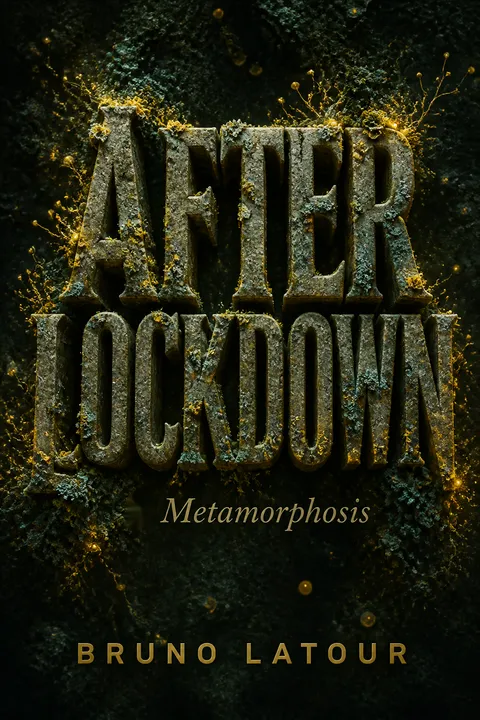


Key Takeaways
Become a terrestrial: your life extends through the beings that sustain it.
A body with a trail. Latour opens with Kafka’s Gregor Samsa, a salesman who wakes transformed into an insect. The change makes Gregor seem monstrous to his family, but Latour flips the story: Gregor’s many legs and connections may fit earthly life better than his family’s fantasy of being self-contained. Like a termite, he depends on a nest built by others, while also helping make that shared habitat.
Dependence is a position. A terrestrial is not a biological category, but someone who recognizes that their life is entangled with other lives and the conditions those lives have made. The pandemic made such ties harder to ignore: movement could carry a virus, emissions, or consequences for distant people and places. The metamorphosis is not a return to normal, but learning to live as a participant in these connections.
What's striking is the reversal of the usual image of freedom. Independence appears less like strength than like a story that hides the infrastructure, labor, and ecosystems making action possible. This resonates with distributed cognition, the idea that thinking and acting can depend on tools and other people beyond an individual mind. Yet shared dependence does not mean equal responsibility. A household, a corporation, and a state do not have the same power to shape the conditions others inherit. Seeing connections clearly should sharpen questions of accountability, not flatten them.
Earth is a living history, not a backdrop of inert matter.
The setting has makers. Latour argues that Earth, written as a proper noun, includes living beings and the environments they have shaped. A city is made by inhabitants and their predecessors; a mountain can preserve the remains of ancient sea life; breathable air depends on organisms that altered the atmosphere. The apparent scenery is a record of activity, not a neutral stage.
Gaia names this entanglement. Latour uses Gaia for the distinctive, ongoing arrangement of life and its effects on Earth. He does not mean that the planet is one harmonious organism with a single purpose. Living beings alter conditions, sometimes disastrously for others, and those effects become part of the world later beings must inhabit. The Universe, by contrast, is approached through scientific measurements and representations, not through ordinary, direct experience.
This framing makes environmental damage legible as the disruption of inherited conditions, not merely the loss of attractive scenery. It also resists a simplistic nature-versus-technology split: cities, instruments, and organisms all participate in shaping habitable conditions. The useful caution is that calling Earth a living history should not blur differences between geological processes and deliberate human decisions. A metaphor can reorient attention, but responsibility still requires tracing who caused particular changes, who benefits, and who bears the costs.
Treat Earth's thin critical zone as habitat, not an unlimited stage.
Life occupies a narrow layer. The critical zone is the relatively thin region at Earth’s surface where rock, water, air, soil, and living things interact. Latour describes its boundaries as uncertain, but contrasts this narrow habitat with the immense scales of the Universe. Humans cannot simply step outside it: even breathing depends on conditions maintained by other lifeforms.
Knowledge has an address. The Universe can be studied through instruments, data, and scientific representations, but these are produced from situated laboratories and communities. A satellite image, for example, is not a view from nowhere; it depends on equipment, calculation, and people interpreting data. Latour’s distinction is a guide to different kinds of access, not a claim that science is unreal or that Earth and Universe have perfectly sealed borders.
The critical zone offers a powerful corrective to the intuition that Earth is an inexhaustible platform beneath human activity. It also connects ecology with the sociology of knowledge: observations depend on instruments, institutions, and interpretive work. This does not make scientific findings merely subjective. Rather, it makes their production and limits visible. The boundary between Earth and Universe is deliberately simplified, and the book acknowledges that. Its value lies in asking readers to distinguish lived dependence from distant measurement.
Freedom now means inhabiting limits, not escaping into an imaginary elsewhere.
Escape changes its costume. Latour traces two versions of leaving earthly limits. Religious hope could locate salvation above ordinary life; modern progress relocated a similar promise into a future of abundance, mobility, and mastery. In both cases, the present world risks becoming a temporary obstacle rather than a place that must be cared for.
Return without retreat. The climate crisis challenges the fantasy of an unlimited outside. Latour’s alternative is not to abandon invention, technology, or hope, but to redirect them toward sustaining life where people already are. He draws on religious language to suggest that earthly existence can carry value without being a mere waiting room for another world. Freedom becomes the ability to act within constraints, rather than pretending constraints do not apply.
This argument links ecological politics to older debates about transcendence and utopia. It identifies a real danger: visions of a perfect future can excuse neglect of present harms. Still, the desire to escape is not always delusion. Migration, medical treatment, and political asylum can be necessary departures from intolerable conditions. The more precise challenge is to distinguish escape from domination from escape that exports its costs to others or treats the planet as disposable.
Question who designed the Economy before accepting its demands as inevitable.
The pause exposed a construction. During pandemic lockdowns, familiar economic activity stopped or slowed, while work often dismissed as secondary, including care, delivery, and health services, became visibly essential. Latour uses the capitalized Economy to mean more than economic analysis: it is a system presented as the unquestionable foundation of life.
Ask what the calculation hides. Markets and economic models depend on laws, accounting practices, property rules, institutions, and technologies. They are built, not simply discovered as natural facts. Latour does not argue that every calculation is useless. He objects when a calculation ends debate by treating a contested arrangement as unavoidable. In a dispute over pesticides, for instance, the question is not only how to preserve a crop or jobs, but also who and what bears the consequences.
The distinction between economic tools and the Economy as a governing story is analytically useful. Models can clarify trade-offs, but they cannot determine which people, species, or places should absorb the costs. That is a political judgment disguised as a technical one when left unexamined. At the same time, rejecting economic authority should not mean ignoring scarcity, prices, or livelihoods. The stronger move is to keep calculations available while refusing to let them close the conversation.
Map your territory by dependencies, not just borders or kilometres.
Trace what keeps you alive. A conventional map locates a place by coordinates and distance. Latour proposes another kind of territory, drawn by the beings and systems a person depends on, the threats to those dependencies, and the effects of that person’s own actions. A distant crop, river, or workplace may belong to this territory if it sustains or endangers someone’s life.
Use a practical compass. In workshops, participants stood at the centre of a diagram and identified four things: what supports them, what threatens them, what they can do to help, and what their actions might damage. As the list grew, other people could represent those dependencies and enter the discussion. The result was not a map of mere location, but a description of obligations and possible conflicts.
This method turns an abstract idea of interdependence into a deliberative practice. It resembles stakeholder mapping, but goes further by including nonhuman actors and ecological conditions. Its central advantage is that it makes hidden dependencies discussable rather than assuming that a border defines the relevant public. Its difficulty is also clear: lists can expand without limit, and not every affected party can participate directly. Institutions still need ways to decide whose testimony counts and how competing claims are handled.
Join the living processes you once treated as scenery.
The landscape gets moving. Latour criticizes the familiar scene in which a detached observer looks at nature as a collection of objects. A forest, lake, or animal appears frozen for human judgment, rather than as a set of beings acting to continue their own existence. This way of seeing turns people into spectators and living things into scenery.
Describe, then participate. Latour’s compass exercise places people among the beings and processes they depend on. A person becomes more specifically defined as their connections become clearer, and their actions can be judged by how they affect those connections. Instead of standing outside a landscape, the person joins its unfolding conflicts and decisions. More dependencies can mean more constraints, but they can also reveal new ways to act.
The move from spectator to participant echoes a central insight of environmental humanities: representation is never entirely separate from the systems it describes. A map, photograph, or plan can guide decisions that alter its subject. Latour’s account is especially useful because it connects perception to responsibility. Yet participation should not imply that every person can directly influence every ecological process. The practical task is to identify consequential points of leverage, rather than turning awareness of entanglement into another source of helplessness.
See your body as a shifting community, not a sealed object.
No single view contains a body. Latour describes his own care through cancer treatment, acupuncture, breathing exercises, and specialist medicine. Each practice attends to different bodily processes, and none alone captures the whole experience. He rejects both the idea of a purely biological machine and the idea of a unified inner self that can be separated from it.
A holobiont is a changing association. The term describes a living being together with the many other organisms and processes that help it persist. The human body, on this account, is not a perfectly bounded individual; it depends on microbes, organs, inherited biological histories, and medical interventions. This does not make medical measurement worthless. It shows that different methods reveal partial aspects of a body whose boundaries and dependencies are more complicated than a simple diagram suggests.
The holobiont idea unsettles the familiar image of the body as an autonomous container and fits with research on microbial life and symbiosis. It can encourage a more plural view of care, where distinct methods illuminate different problems. The caution is that plurality is not proof that all treatments are equally reliable. Acknowledging that medicine captures aspects of a body should invite better integration and patient-centered judgment, not a retreat from evidence or clinical standards.
Build political alliances around the conditions that let lives continue.
Old borders miss shared stakes. Latour argues that people may live within one nation while depending on resources, labor, and ecosystems beyond it. He distinguishes those who extract benefits while disowning the resulting damage from those trying to repair or reconnect damaged conditions, calling them Extractors and Menders. The conflict cuts across conventional political categories and includes human and nonhuman interests.
Belonging must be negotiated. Latour sketches four competing orientations: confidence in globalization, escape into protected enclaves, security through exclusionary nations, and renewed attention to peoples who have maintained different relations with land. He calls for diplomacy among groups whose interests and identities overlap. This is not a simple appeal to abolish borders; it is a demand to reconsider who and what political arrangements include, exclude, and depend on.
The Extractor and Mender contrast gives environmental conflict a memorable political shape, while the account of overlapping identities helps explain why old categories can fail to predict alliances. The framework also risks making repairers seem morally unified and extractors uniformly alike. In practice, people may depend on extractive systems while opposing their harms, and proposed repairs can create new burdens. The labels are most useful as questions about actions and consequences, not as permanent identities for sorting people into camps.
Push overshoot back by repairing the conditions that keep life going.
A date makes dependence visible. Earth Overshoot Day estimates when humanity has used the resources the planet can regenerate within that year. Latour cites July 29 as the global date discussed in the book, and notes that pandemic shutdowns temporarily pushed it back by about three weeks. The shift showed how much ordinary activity draws on ecological resources, but it was neither a durable solution nor a model worth repeating through crisis.
Experiment instead of charging ahead. Latour’s closing advice is to explore many possible ways of living, test them, learn from failure, and repair the conditions that sustain life. Earth’s history, in his account, advances through stepwise combinations rather than a single plan. Political change should likewise avoid assuming that one grand design or one universal fix can resolve every local conflict.
Overshoot indicators compress a sprawling ecological issue into a date people can understand, which makes them useful for public discussion. But a single global date can conceal stark differences among countries, industries, and households. The temporary lockdown shift also demonstrates the limits of aggregate measurement: less consumption can result from hardship rather than fair or lasting reform. The stronger lesson is to use such indicators as prompts for tracing responsibility and designing changes, not as a verdict on humanity in the abstract.
Analysis
Latour’s central wager is that climate disruption is not merely a problem within politics. It unsettles the picture of reality on which modern politics depends: autonomous individuals act upon inert nature, while the economy supplies an allegedly objective measure of what is possible. His counter-picture treats people, organisms, technologies, soils, and atmospheres as interdependent agents whose actions make and remake the conditions of life. The book’s sequence gives that abstract claim a narrative body. Gregor’s insect transformation becomes a figure for discovering that dependence is not a defect added to an otherwise complete self. It is the material of existence.
The strongest contribution is methodological. Rather than ask readers to care about an undifferentiated planet, Latour asks them to describe the actual beings and systems on which they depend, and to identify the consequences of their actions. This converts ecological concern into a question of territory, obligation, and political membership. His criticism of the Economy is similarly precise when understood as a criticism of its authority to close debate, not a rejection of accounting or economic analysis.
The book’s sharp binaries are also its main vulnerability. Earth and Universe, Extractors and Menders, and detached individuals versus entangled beings are illuminating contrasts, but lived reality crosses each boundary. Scientific knowledge of distant systems is still essential to understanding local ecological change, and people can be both dependent on extractive systems and committed to repairing their harms. The author’s own account of Earth as a vast network also invites hard questions about how to set priorities when obligations conflict.
The pandemic supplies a vivid interruption, not proof that a crisis can produce a just transition. Its pause revealed hidden labor and dependence, but emergency contraction is not a durable political program. The book is most persuasive as a demand to change the questions that govern collective life: what sustains this community, whose conditions are being damaged, and what institutions can negotiate those dependencies fairly? Its metamorphosis is a change in orientation, from the dream of standing outside the world to the difficult work of living with it.
Review Summary
After Lockdown receives mixed reviews, with ratings ranging from 1 to 5 stars. Many readers find Latour's ideas thought-provoking but challenging to grasp. The book explores lessons from the COVID-19 lockdown and their implications for addressing climate change. Latour uses Kafka's "The Metamorphosis" as a metaphor throughout. Some praise the book's philosophical depth and optimism, while others critique its complexity and perceived privileged perspective. Overall, readers appreciate Latour's unique approach to examining human relationships with the world post-pandemic.
People Also Read


Glossary
terrestrials
Earth-bound participantsLatour’s term for beings understood through their relations with Earth and with the conditions that make life possible. It does not identify a biological species or mean simply people who live on the planet. It names a way of locating oneself among predecessors, dependants, and other agents whose activities shape shared conditions of existence.
Gaia
Earth’s living entanglementLatour’s name for Earth understood as living organisms together with the environments and conditions they have transformed. Gaia is not a single planetary organism, a conscious deity, or a perfectly balanced system. It describes a historically changing web of beings and effects whose interactions help make the planet habitable for some forms of life and difficult for others.
critical zone
Earth’s thin habitable layerThe surface region in which rock, soil, water, air, and living organisms interact to support life. Its boundaries vary according to the process and timescale being studied, but it is narrow compared with the planet’s interior and outer space. Latour uses the term to emphasize that human life depends on a limited, actively maintained habitat.
holobiont
A community of dependent lifeA living association composed of an organism and other organisms and processes that help it persist. The concept challenges the idea that a biological individual has perfectly clear boundaries or can function independently. Latour extends its significance beyond biology: bodies, habitats, and political communities can all be understood through overlapping dependencies rather than as sealed units.
engendering concerns
Work required to sustain lifeThe concerns and activities involved in coming into existence, surviving, receiving care, and enabling future life. Latour applies the idea not only to human birth and family life, but also to organisms and the conditions they maintain or alter. It counters accounts of society that treat reproduction, care, and subsistence as secondary to production.
the Economy
Economics as unquestioned authorityLatour’s capitalized term for the idea that economic imperatives form an objective, unavoidable foundation for collective life. He distinguishes this authority from the practical work of accounting and economic analysis. His criticism is that the Economy can hide the political choices, institutions, and dependencies behind apparently settled calculations.
Extractors
Those who externalize damageLatour’s provisional name for actors and systems that take benefits from resources, labor, and territories while disavowing responsibility for the damage or dependencies involved. The term describes a political position rather than a fixed social identity. People may participate in extractive arrangements even while opposing their consequences.
Menders
Those who repair dependenciesLatour’s provisional name for people trying to reconnect political life with the human and nonhuman conditions it depends on, and to repair damaged conditions of subsistence. Menders do not form a unified group with one interest or identity. Their alliances must be built through specific conflicts over land, labor, resources, and the continuation of life.
Earth Overshoot Day
Annual resource-use markerAn indicator estimating the point in a year when humanity has used the resources that Earth can regenerate within that year. Latour uses its date to make ecological dependence and overuse politically visible. The global figure is a simplifying measure: it does not by itself show how resource use and responsibility differ among countries, industries, or people.
Kantelingen Series Series
Download PDF
Download EPUB
.epub digital book format is ideal for reading ebooks on phones, tablets, and e-readers.








