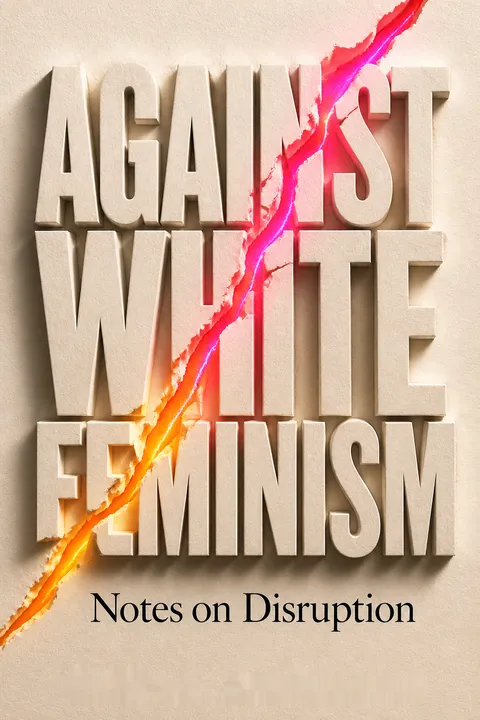


Key Takeaways
Remove whiteness from feminist power, not white women from feminism
A place at the table is not power. Zakaria opens with a Manhattan dinner where she edits her story of surviving an abusive marriage to remain easy for white feminist colleagues to relate to. Her experience is welcomed as a moving personal story, but not as knowledge that should shape feminist priorities. She defines white feminism not by a person’s skin color, but by assumptions and practices that treat white perspectives as universal and preserve racial privilege. A person of color can reproduce those practices, while a white woman can challenge them.
Change the structure, not the guest list. Adding marginalized women to existing panels or organizations does little if they cannot influence decisions. The book’s central demand is to dismantle whiteness as a system of authority within feminism, while keeping cross-racial feminist work possible.
The dinner scene makes an abstract power imbalance legible: one person must translate a complicated life into a version comfortable for the room. That is also an institutional problem, not merely a failure of empathy. Organizations can invite diverse testimony while keeping hiring, funding, and agenda-setting unchanged. The distinction between whiteness as a practice and white people as a group helps avoid treating identity as destiny. Still, structural critique works best when it specifies who holds which decisions and how those decisions can be redistributed, rather than making inclusion depend on personal declarations of good intent.
Read feminism's origin story alongside empire, not as a universal tale
Freedom was unevenly distributed. Zakaria traces how British women could gain room to travel and act in colonial territories while remaining constrained at home. Gertrude Bell, for example, felt more consequential in the Middle East partly because her Britishness placed her above colonized people. Some suffragists also contrasted their own limits with imagined, supposedly helpless women in Asia, using the comparison to argue for white women’s rights.
Local feminists had their own agendas. Indian women formed organizations, published writing, and pursued education and political change. Many considered freedom from British rule essential to women’s freedom, while British campaigners pressed a narrower franchise agenda. The history complicates the idea that feminism began in one place and spread outward as a finished project.
A movement’s origin story is a political tool: it decides whose ideas count as foundational and whose appear as late additions. Reading suffrage alongside empire exposes how a demand for equality can coexist with a hierarchy over other people. This is a useful model for examining any institution that celebrates a reform while overlooking who remained excluded from its benefits. Historical recovery should not, however, turn every white feminist into a single type or reduce colonized women to a unified opposition. The strongest account preserves disagreement among actors while making the unequal terms of their encounters visible.
Treat lived experience as expertise, not colorful testimony for donors
Visibility can still exclude. Zakaria recalls arriving at a community event prepared to speak about Pakistan, only to find a “global bazaar” where women of color stood beside tourist trinkets and were expected to explain their countries to white attendees. A century earlier, the 1893 Chicago World’s Fair had placed white women’s achievements in a dedicated building while Black women’s contributions were omitted and people of color were displayed as entertainment.
A story is not the same as authority. Zakaria argues that women of color are often invited to describe trauma or culture without being trusted to shape policy. Institutions may even treat personal experience as a threat to objectivity. But the supposedly neutral standard often reflects the lives and credentials of those already in power. Relatability, she argues, can disguise that bias as common sense.
The distinction between being seen and being heard is central here. An institution may gain legitimacy from displaying difference while retaining control over what that difference means. In organizational terms, consultation without decision rights is a weak form of participation: it collects information but does not share authority. Lived experience can reveal blind spots that formal training misses, though it is not automatically representative or infallible. A sound process values experience alongside other forms of expertise, makes room for disagreement within communities, and gives contributors a real role in setting priorities.
Fund collective political power, not donor-friendly symbols of empowerment
Ask who defines the solution. The book contrasts donor-led aid with the empowerment approach developed by DAWN, a network of feminists from the global south. For DAWN, empowerment meant collective political action that could transform unequal power relations, not simply increasing individual income. That idea was softened as aid agencies adopted the word while dropping its political edge.
The stove project shows the cost. International programs promoted cleaner stoves in rural India without asking women who cooked with them. Some women valued fuel gathering as social time and the traditional hearth as a meaningful center of household life. The replacement stoves could also be hard to repair and unsuitable for some recipes. Similar problems appeared in a chicken-donation scheme and Afghanistan’s costly PROMOTE program, whose reported results fell far short of its ambitious target.
The examples distinguish a solution that looks measurable to funders from one that changes people’s control over their lives. This is a familiar problem in policy design: easily counted outputs, such as stoves distributed or workshops attended, can crowd out harder questions about agency and long-term effects. Local consultation is not a magic safeguard, especially when intermediaries speak for communities or dissent carries a cost. The practical test is whether affected people help define the problem, control meaningful resources, and can reject a proposed intervention without losing access to support.
Refuse feminist progress that requires bombing, spying, or torture
Equality can serve the state. Zakaria uses the film Zero Dark Thirty, which celebrates a female CIA operative involved in the hunt for Osama bin Laden, to examine a feminism measured by women’s access to state power, even when that power is violent. She connects this image to public arguments that the War on Terror would liberate Afghan women, while military campaigns devastated communities.
Good intentions do not erase consequences. In Pakistan, the CIA used a false vaccination program as part of its search for bin Laden. The resulting distrust harmed public-health work and placed local health workers at greater risk. Zakaria calls the fusion of women’s-rights advocacy with counterterrorism securo-feminism. The term describes the idea that fighting extremism can itself count as advancing women’s rights, even when women bear the costs of the strategy.
This argument asks feminism to judge power by its consequences, not by the gender of the person wielding it. That is a valuable corrective to simple representation metrics: a woman’s promotion into a violent institution does not make the institution less violent. The vaccination example also shows how political trust is a form of infrastructure, easily damaged and difficult to restore. Yet opposition to military feminism should not make local women’s safety or political aims secondary. The necessary question is who defines security, who bears its costs, and whether affected communities can refuse the intervention.
Protect sexual choice without making sexual performance feminism's entry ticket
Freedom includes the right not to perform. In a graduate seminar, Zakaria felt pressure to demonstrate sexual openness so classmates would not mistake her Muslim identity for repression. She uses compulsory sexuality for the expectation that women should display a sexual identity and treat sexual activity as proof of liberation. The pressure can exist in societies that repress sexuality and in settings that celebrate it.
A market can sell rebellion back to you. Zakaria traces how sexual liberation became intertwined with consumer culture. Helen Gurley Brown’s Cosmopolitan promoted a self-made, sexually adventurous woman, while advertisers attached emancipation to products and lifestyle choices. The critique is not of pleasure or sexual autonomy. It is of shrinking feminism to individual sexual choice, while collective demands about work, care, violence, and economic power fade from view.
The distinction between freedom to act and pressure to act is essential. A norm can remain coercive even when it uses the language of choice, especially when social approval depends on performing the approved kind of liberation. The consumer-culture critique adds a useful question: does a new choice expand people’s agency, or mainly create a marketable identity? Sexual pleasure remains a legitimate feminist concern, and commercial visibility can matter to groups long excluded from public life. The problem arises when buying, displaying, or narrating liberation substitutes for political change.
Judge violence consistently, without turning culture into a racial indictment
Different labels can hide shared power. Zakaria compares so-called honor killings with intimate-partner violence in the United States. In both, men may use violence to punish women for asserting independence. The label “honor” can make violence seem uniquely foreign, while similar violence at home is treated as an individual aberration. She also traces how colonial governments classified practices such as infanticide and sati to portray colonized societies as morally inferior and justify intervention.
Critique harm without claiming ownership. In discussions of female genital cutting, Zakaria argues that genuine concern must not become a license for intrusive policing or racial stereotyping. Community-led work has helped reduce the practice, while airport questioning and examinations can target migrants without their consent. The point is not to excuse harmful practices, but to let affected women shape the response.
Consistency is a powerful check on moral double standards. Comparing violence across contexts can reveal how familiar institutions excuse conduct that becomes shocking when attached to racialized outsiders. The comparison also needs care: practices differ in history, prevalence, severity, and the available choices of those affected. Treating them as identical would flatten meaningful differences. A useful approach separates two questions: what harm is occurring, and who has the authority to define and address it? That allows strong opposition to abuse without turning whole cultures into defendants.
Build solidarity through shared power, material access, and political disagreement
Inclusion without redesign preserves the old rules. Kimberlé Crenshaw’s concept of intersectionality shows how race and gender can combine to produce forms of discrimination that single-category analysis misses. Zakaria connects this insight to feminist organizations: a Black woman candidate for leadership at the National Organization for Women faced racist heckling, while women of color in major organizations described being tokenized or sidelined.
Resources determine who can participate. Zakaria’s experience as a lawyer showed how clients facing workplace harassment could lack the money to bring a case, even when they had a valid complaint. She therefore pairs recognition of identity with redistribution of material resources. Transformational change, in this account, means altering the rules and power relations themselves, not simply appointing one new leader or creating another diversity committee.
This is a practical account of solidarity: shared language matters, but so do budgets, meeting formats, legal access, and who can take time away from work. The connection between recognition and redistribution prevents inclusion from becoming purely symbolic. Political disagreement is also part of the work, since a coalition that avoids conflict may preserve the interests of its most powerful members. Still, no single reform can resolve every tension among race, class, religion, and gender. Durable solidarity requires procedures for revisiting priorities and accountability when stated commitments fail.
Analysis
Zakaria’s central move is to redefine the problem from individual prejudice to the organization of feminist authority. The question is not only whether women of color appear in the story, but whether their knowledge changes the story’s agenda, its policies, and its distribution of resources. Her memoir scenes make this institutional argument tangible: the wine-bar conversation, the global bazaar, and the sexual-theory seminar show how belonging is offered conditionally, often in exchange for translating oneself into familiar terms. The book’s historical cases then widen the lens. Colonial suffrage rhetoric, development programs, War on Terror advocacy, and contemporary feminist organizations are treated as different expressions of a recurring pattern: emancipation for some can coexist with domination of others. Its strongest contribution is connecting symbolic representation to material authority. A person can be heard without being believed, consulted without setting priorities, or celebrated while remaining unable to access legal or economic resources.
The framework also demands careful application. “White feminism” is presented as a political practice rather than a biological identity, which helps avoid essentializing individuals. Yet broad categories such as white women, women of color, and the global south can still conceal disagreement and unequal power within each group. The book acknowledges this tension and argues for contestation rather than a single representative voice. Its comparisons of violence and cultural practices are most persuasive when they expose double standards without implying that distinct practices are interchangeable.
The proposed alternative is neither color-blind unity nor permanent separation. It is a coalition built through power-sharing, political argument, and material change. That standard is demanding by design: solidarity becomes something institutions demonstrate through decisions, not something they claim through vocabulary or good intentions.
Review Summary
Against White Feminism challenges mainstream feminism's focus on white women's experiences, arguing it perpetuates racism and colonialism. Zakaria critiques white savior mentalities, NGO practices, and Western-centric views of women's liberation. Some readers praise the book's insights on intersectionality and global perspectives, while others find it divisive or biased. Critics argue Zakaria overlooks certain issues faced by Muslim women. The book sparks debate on how to create a more inclusive feminism that addresses the needs of women of color and dismantles white privilege within the movement.
People Also Read

Glossary
white feminism
Feminism organized around whitenessA set of assumptions and practices that treats white, often middle-class concerns as universal feminist priorities and preserves the advantages attached to whiteness. The term describes an approach, not simply the race of a person. Zakaria argues that people of any race can reproduce it by accepting systems that sideline women of color while claiming solidarity with all women.
intersectionality
Overlapping systems of inequalityA framework Kimberlé Crenshaw developed to explain how systems such as racism and sexism can combine to shape experiences that cannot be understood by examining either system alone. Zakaria uses it to show why treating “women” as a single category can erase the specific discrimination faced by women of color, and why adding them to existing structures may not change those structures.
empowerment approach
Collective political transformationA development framework advanced by feminists from the global south, including the DAWN collective. It treats empowerment as collective political action that can transform power relations, supported by education and grassroots organizing. In Zakaria’s account, this differs from aid models that reduce empowerment to individual income, business activity, or skills training while avoiding political change.
securo-feminism
Feminism aligned with security agendasA term associated in the book with scholar Lila Abu-Lughod. It describes the alignment of women’s-rights advocacy with counterterrorism and security policy, especially when military or state power is presented as a means of liberating women. Zakaria uses it to question whether such policies advance women’s freedom when local communities bear the violence and consequences.
compulsory sexuality
Pressure to perform sexualityA system of norms that pressures people to adopt and display a sexual identity or activity as expected. Zakaria applies the concept to settings where sexual openness is treated as proof of feminist liberation, as well as to more sexually repressive contexts. The term highlights how both kinds of expectation can discipline women and narrow the meaning of freedom.
transformational change
Rebuilding underlying power structuresChange that revises the rules, priorities, and power relations that produce exclusion, rather than making a limited adjustment within the existing system. Zakaria contrasts it with measures such as appointing one person of color to leadership or creating a diversity committee. Transformational change asks whether institutional practices and resources are redistributed so marginalized people can shape decisions.
FAQ
What's Against White Feminism about?
- Critique of Whiteness in Feminism: The book critiques how mainstream Western feminism often centers white women’s experiences, sidelining women of color. This exclusion perpetuates systemic inequalities within the feminist movement.
- Intersectionality and Privilege: Rafia Zakaria emphasizes the importance of intersectionality, highlighting how race, class, and other identities intersect with gender. The book discusses how white feminists can claim solidarity while benefiting from racial privilege.
- Call for Structural Change: Zakaria advocates for dismantling existing feminist structures that do not serve all women equally, aiming for a more inclusive and equitable feminist movement.
Why should I read Against White Feminism?
- Understanding Feminist Dynamics: The book provides critical insights into the dynamics of race and privilege within feminism, essential for anyone interested in social justice.
- Empowerment of Marginalized Voices: By reading this book, you support the empowerment of marginalized voices in feminist discourse, encouraging a broader understanding of feminism.
- Provocative and Timely Discussion: It addresses contemporary issues in feminism, making it relevant to current discussions about race, gender, and power.
What are the key takeaways of Against White Feminism?
- Whiteness in Feminism: The book argues that whiteness has historically dominated feminist narratives, often at the expense of women of color.
- Importance of Intersectionality: Zakaria emphasizes that feminism must incorporate intersectional perspectives to be truly effective.
- Need for Structural Change: The author calls for restructuring feminist movements to prioritize the voices and experiences of women of color.
What are the best quotes from Against White Feminism and what do they mean?
- “A white feminist is someone who refuses to consider the role that whiteness and the racial privilege attached to it have played.”: This quote defines white feminism and highlights the need for awareness of racial privilege in feminist discourse.
- “The goal here is not to expel white women from feminism, but to excise whiteness.”: Zakaria emphasizes that the aim is not to exclude anyone from feminism but to remove systemic biases.
- “Relatability is subjectivity dressed up as objectivity.”: This statement critiques the notion that only certain experiences are valid in feminist discussions.
How does Rafia Zakaria define "white feminism" in Against White Feminism?
- Definition of White Feminism: Zakaria defines it as a form of feminism that centers the experiences and concerns of white women while ignoring or marginalizing those of women of color.
- Intersectionality Ignored: White feminists may profess support for intersectionality but often fail to include the voices of women of color in their activism.
- Privilege and Power Dynamics: The book discusses how white feminists can benefit from white supremacy while claiming to advocate for gender equality.
What is the significance of intersectionality in Against White Feminism?
- Intersectionality as a Framework: Zakaria argues that intersectionality is crucial for understanding the diverse experiences of women.
- Critique of Colorblind Feminism: The book critiques colorblind feminism, which ignores the specific challenges faced by women of color.
- Empowerment through Inclusion: By embracing intersectionality, feminism can become a more powerful tool for social change.
How does Against White Feminism address the concept of the "white savior complex"?
- Definition of White Savior Complex: Zakaria discusses it as a phenomenon where white individuals position themselves as rescuers of marginalized communities.
- Impact on Feminism: The book argues that this complex is prevalent in feminist movements, where white feminists may seek to "save" women of color.
- Call for Genuine Solidarity: Zakaria advocates for a shift away from savior narratives towards genuine solidarity and collaboration with women of color.
What specific methods does Rafia Zakaria suggest for creating a more inclusive feminism in Against White Feminism?
- Embrace Intersectionality: Zakaria calls for a feminist movement that actively incorporates intersectional perspectives.
- Challenge Mainstream Narratives: The author encourages readers to critically examine mainstream feminist narratives that center white experiences.
- Build Community and Solidarity: Zakaria emphasizes the importance of building coalitions among women of different backgrounds.
How does Against White Feminism relate to contemporary feminist movements?
- Relevance to Current Issues: The book addresses contemporary issues such as the #MeToo movement and the ongoing fight for reproductive rights.
- Intersectional Activism: Zakaria's arguments resonate with the growing emphasis on intersectionality within contemporary feminist movements.
- Call for Accountability: The author calls for accountability within feminist organizations to ensure they are inclusive and representative.
What role does historical context play in Against White Feminism?
- Understanding Colonial Legacies: Zakaria emphasizes the importance of understanding how colonial histories shape contemporary gender dynamics.
- Critique of Historical Narratives: The book critiques historical narratives that often erase the contributions and experiences of women of color.
- Lessons for Modern Feminism: By examining historical contexts, Zakaria provides lessons for modern feminist movements.
How does Rafia Zakaria define empowerment in Against White Feminism?
- Beyond Individualism: Zakaria critiques the notion of empowerment as merely individual success or economic independence.
- Intersectional Empowerment: The author emphasizes that empowerment must consider the unique challenges faced by women of color.
- Political Engagement: Zakaria defines empowerment as a political process that involves challenging existing power structures.
How does Against White Feminism challenge traditional feminist narratives?
- Critique of Mainstream Feminism: Zakaria challenges traditional feminist narratives that often center white women's experiences.
- Emphasis on Intersectionality: The book advocates for an intersectional approach that recognizes the diverse experiences of all women.
- Call for Inclusivity: Zakaria calls for a more inclusive feminism that actively seeks to uplift the voices of marginalized women.

Download PDF
Download EPUB
.epub digital book format is ideal for reading ebooks on phones, tablets, and e-readers.








