

Key Takeaways
“Unalive” proves algospeak now reaches classrooms, museums, and everyday speech
A word travels far. “Unalive” began as a euphemism in a 2013 cartoon, then circulated as an internet joke before creators used it to discuss suicide without triggering platform moderation. Its spread accelerated on TikTok, where recommendation systems carried it between mental health communities and wider audiences. In a survey cited in the book, 75 percent of Americans had encountered some form of algospeak, and 30 percent said they used coded language to get around moderation.
Offline meaning shifts. Teachers reported students using “unalive” in conversation and schoolwork; Seattle’s Museum of Pop Culture used it on a Kurt Cobain exhibit placard, provoking a backlash. The word can soften a frightening subject for young people, but its internet origins can sound jarring in a memorial setting.
The museum episode shows how a technology’s influence becomes visible when its vocabulary crosses into an institution associated with authority and permanence. That discomfort is not simply resistance to youth slang. It also reflects a genuine question about whether a euphemism makes difficult conversations more approachable or less precise. In health communication, softer language can lower the barrier to disclosure, yet direct terms may be important when assessing risk. The useful distinction is between a word’s origin and its current function: speakers can repurpose a term, while audiences still disagree about which contexts suit it.
Censorship does not stop speech; it makes speakers invent new routes
A moving target. The book calls this cycle linguistic Whac-A-Mole: platforms restrict a word, users invent a substitute, and moderation systems may then learn to restrict that substitute. Early internet users already respelled censored words in leetspeak, replacing letters with numbers or symbols. Modern creators use similar tricks, along with emojis, abbreviations, and indirect references.
Uncertainty changes behavior. Platforms may remove a post, limit its reach, or simply make it hard to find, often without telling its creator why. The Charles Dickens Museum was temporarily difficult to find on TikTok because its name contained a word the system mistook for profanity. When moderation is opaque, creators may self-censor even educational or public-interest speech, including discussion of health, race, or politics.
This is a classic problem in classification: a system designed to catch harmful content also catches benign uses of the same words. The Dickens example makes that trade-off unusually easy to see, but the stakes rise when the affected speakers are discussing discrimination or seeking support. Evasion can preserve expression, though it also places the burden of platform errors on users who have the least information about the rules. Better moderation is not just a matter of more accurate detection. It also requires clear appeals and meaningful explanations for decisions.
Words survive when memes make them useful beyond one viral joke
Virality starts things. TikTok’s personalized feed helps a catchy phrase reach people likely to respond to it. The book calls the resulting cycle the engagement treadmill: successful material attracts more creators, whose copies generate more engagement and visibility. The Rizzler song assembled slang such as “rizz,” “gyat,” and “sigma” into a repeatable meme. In a survey of middle-school parents and teachers, 80 percent had heard “rizz” and 55 percent had heard “gyat.”
Use determines staying power. A viral burst alone does not make a word permanent. The chair emoji briefly served as a joke replacement for laughter, then faded. A word has better odds when people can use it naturally in several situations, when it fills a gap, and when it is not so conspicuous that it becomes embarrassing once everyone adopts it.
The distinction between adoption and endurance is useful well beyond slang. A trend can recruit attention without creating a lasting reason to participate. Words that move into several conversational roles have more chances to become ordinary, while a joke dependent on one exact setup can expire with the format. This resembles cultural selection, but it should not be mistaken for a neutral contest of quality. Recommendation systems shape which variants get repeated, so a word’s apparent fitness partly reflects platform incentives, audience habits, and the reach of its originating community.
Creators tune words, pace, and accents to win another second of attention
Speech becomes performance. On short-form video, creators compete with an effortless scroll. The book describes hooks that use emotional language, direct address, and bold claims to prompt viewers to keep watching. Online delivery can also reshape the voice itself: uptalk, exaggerated emphasis, quick pacing, and stretched vowels help maintain a sense that the sentence is not finished.
Metrics teach the style. The book calls the resulting family of delivery styles influencer accents. MrBeast’s reported speaking rate rose from about 170 words per minute in earlier videos to just under 200, while the variation in his pace narrowed. In a poll of 45 creators, 64 percent said they consciously changed how they spoke online. Repeated adjustments can become habitual, then spill into ordinary conversation.
The accent examples make platform pressure audible. A creator is not only choosing what to say but also using prosody, the melody and emphasis of speech, to manage attention. Similar adaptations occur in teaching, broadcasting, and public speaking, where delivery responds to the medium and audience. The important difference is that platform analytics make feedback continuous and commercially consequential. Still, these patterns do not prove that every online voice is calculated or inauthentic. Imitation, community norms, and deliberate strategy can all produce similar speech, sometimes at once.
Your feed does not just reflect your identity; it helps assemble it
Recommendations are feedback. A filter bubble is an information environment in which a recommendation system prioritizes material predicted to match a user’s interests. If someone watches and engages with a fandom’s videos, the feed may supply more of its references and in-group vocabulary. Swifties, for example, use shared terms and allusions that make sense within their community; one dedicated fan reported that roughly four in ten recommended videos concerned Taylor Swift.
Preference and identity interact. The book argues that the feed does not simply reveal a fully formed self. A person’s past behavior informs recommendations, and those recommendations can introduce new interests, communities, and words. What feels like the algorithm knowing someone may therefore be a loop between what a person engages with and what the platform makes available.
This account avoids the false choice between saying algorithms create preferences and saying they merely mirror them. In a feedback system, both can be true: prior behavior affects what is shown, and exposure can influence subsequent behavior. That model also clarifies why “the algorithm knows me” feels persuasive without implying that a platform has deep insight into a person. Its predictions are narrow and behavioral. A user’s feed is evidence about what held attention in a particular setting, not a complete map of values, interests, or identity.
Irony can turn extremist vocabulary into a harmless-looking delivery system
Jokes cross boundaries. Some incel communities developed a vocabulary around a belief that appearance determines a person’s romantic worth. Memes later carried pieces of that language, including terms built from “pilled” and “-maxxing,” into wider online culture. Users might repeat the terms to parody incels, without endorsing the underlying beliefs. Yet others may encounter the same ideas without recognizing the joke or its source.
Tone is unstable online. Poe’s law describes how satire of an extreme view can be mistaken for sincere advocacy, and vice versa. The book traces incel language across forums, Reddit, and short-form video, where humor helped it spread beyond its original community. A meme can lose its first meaning, but still normalize its assumptions or introduce people to the worldview behind it.
A joke’s intent and its social effects are separate questions. Satire can make an ideology look absurd, but repeated exposure can also make its categories familiar and available for use. This does not mean that every person who shares a meme is being radicalized; that would overstate what circulation alone can establish. It does mean that irony is an unreliable shield against transmission. Context, repetition, and who controls the joke all matter, especially when a meme reduces people to a rigid hierarchy or treats a community as a punchline.
Credit the communities behind slang before platforms erase its history
Popular slang has histories. Many expressions now labeled “internet slang” have roots in African American English or queer ballroom culture. In New York ball houses, terms such as “shade,” “slay,” and “tea” belonged to communities that built language alongside forms of performance, identity, and mutual support. Music, television, and social media helped those words reach wider audiences, often with less context and recognition of their origins.
Credit follows power. Vine creator Kayla Newman popularized “on fleek” in a video about her eyebrows, but celebrities and companies profited from the phrase without sharing its commercial success with her. A similar imbalance occurred when dancer Jalaiah Harmon’s Renegade choreography gained fame through larger creators. Online imitation can distribute creativity while obscuring who made it.
Borrowing is a normal engine of language change, so the ethical question is not whether words may ever cross group boundaries. It is what happens when circulation is separated from recognition, context, and economic benefit. A slang term can be shared widely while its originators remain stigmatized for speaking the dialect that produced it. Attribution cannot fully repair unequal power, and language rarely has a single owner. Still, credit and context help resist the convenient fiction that a word appeared from nowhere once a platform made it profitable.
Every new aesthetic label can become both a home and a sales category
Labels help people gather. Short-form platforms have helped popularize fashion identities such as cottagecore and the many styles built with the suffix “-core.” A label gives people with dispersed interests a way to find one another and describe a shared look. The same label also gives creators and recommendation systems a useful tag for organizing content.
Identity attracts commerce. Retailers can target products to these newly visible communities, while creator promotions make advertising feel like a recommendation from within the group. The book’s example of “preppy” shows how a word’s meaning can shift as boutiques use it to market bright, youthful clothing. These identities can be meaningful to users, but platforms and sellers also benefit when a style becomes a recognizable category with products attached.
A label can be simultaneously empowering and commercial without being fraudulent. Naming a style may help someone find community, language, and useful recommendations; it can also narrow how that person imagines their options. This is a familiar tension in consumer culture, where markets make identities legible by turning them into purchasable signs. The concern is not that people enjoy fashion or subcultures. It is that engagement and sales incentives can reward the most simplified version of a community, making a rich practice look like a coordinated shopping list.
Generational labels turn messy people into catchy, marketable characters
A category can feel real. Labels such as Gen Z and millennial gather people born across wide spans of time into supposedly distinct cultural groups. Research has struggled to establish sharply bounded generations, and 170 social scientists signed an open letter urging Pew to stop using the labels. Yet memes about the “millennial pause,” the “Gen Z shake,” or Gen Alpha “brainrot” make these categories vivid and easy to repeat.
Stories shape self-image. The book calls the exaggeration of a person, brand, or group into a simplified caricature Flanderization. Online creators may amplify whichever traits draw attention, and audiences can mistake the most visible version of a group for the typical one. Calling nonsense slang “brainrot,” for instance, casts ordinary youth language as evidence of decline, despite the book’s account that new words alone do not show that children’s language skills are worsening.
Categories are cognitively efficient: they help people make quick predictions and share a common story. The cost is that a convenient shorthand can become a stereotype, especially when repeated content makes a rare or exaggerated behavior look representative. This is also why labels can shape the people they describe, not just categorize them. The argument should not erase meaningful cohort experiences, such as growing up with different technologies. It asks for a finer distinction between shared historical conditions and the claim that an entire generation has one personality.
Read new slang as human adaptation, not proof that language is collapsing
People adapt to tools. Online slang moves across national borders quickly. Spanish-speaking students, for example, use “desvivir” as a social-media euphemism for suicide, despite an older formal meaning. During Hong Kong protests, users mixed Cantonese and English and used ordinary words as coded references to evade censorship. In a study of Chinese social media, flagging every possible homophone was estimated to remove 20 percent of posts as false positives.
Change has two directions. Platforms can amplify English and standard accents, while also helping distant speakers form niche communities and adapt communication. American Sign Language users have modified some signs to fit vertical video, demonstrating that even visible gestures respond to a medium. Social media can support language preservation and connection, but its unequal language support may disadvantage smaller linguistic communities.
The strongest conclusion is neither technological optimism nor panic. Speakers are inventive, and language change is not evidence of linguistic decay; at the same time, innovation takes place within systems that distribute visibility unevenly. A platform can connect a scattered community while privileging a few globally dominant languages. That makes language policy and platform design relevant to cultural survival, not merely convenience. The book’s examples also caution against treating the algorithm as an all-powerful censor: users find workarounds, but their success depends on reach, risk, and whose speech a system is built to recognize.
Analysis
The book’s central contribution is to treat social-media language as an ecosystem rather than a collection of funny substitutions. Moderation shapes what speakers avoid; recommendation systems influence what they encounter; engagement rewards certain ways of speaking; and repeated exposure helps turn those ways into shared conventions. The resulting language is not authored by an algorithm alone. It emerges from the interaction of human creativity, platform incentives, social identities, and the material design of each medium.
That framework makes the book’s range coherent. A euphemism for suicide, an influencer’s rising intonation, a fandom’s private vocabulary, and a fashion label used to sell clothing appear unrelated until each is understood as language adapting to a particular communicative environment. The same system can widen access to niche communities and compress their speech into searchable tags. It can help marginalized speakers find one another, then expose their language to audiences who strip it of context. This is a valuable corrective to both technological determinism and the idea that online speech is culturally trivial.
The account is most persuasive when it shows mechanisms and specific cases. Its claims about opaque platforms sometimes rely on creators’ reasonable suspicions, however, rather than direct access to ranking systems. Observed declines in views cannot always identify whether moderation, audience interest, or ordinary fluctuation caused them. That evidentiary limit does not make perceived censorship irrelevant: uncertainty itself changes behavior. It does mean that explanation should distinguish documented platform policies from inferred algorithmic effects.
The broader implication is political as well as linguistic. When platforms decide which words are safe, discoverable, or profitable, they participate in setting the conditions of public speech. When users invent alternatives, they demonstrate agency, but they also absorb the labor and risk of navigating rules they cannot inspect. Studying new slang therefore reveals more than how language changes. It shows how cultural influence, commercial classification, and expressive freedom are redistributed through digital infrastructure.
Review Summary
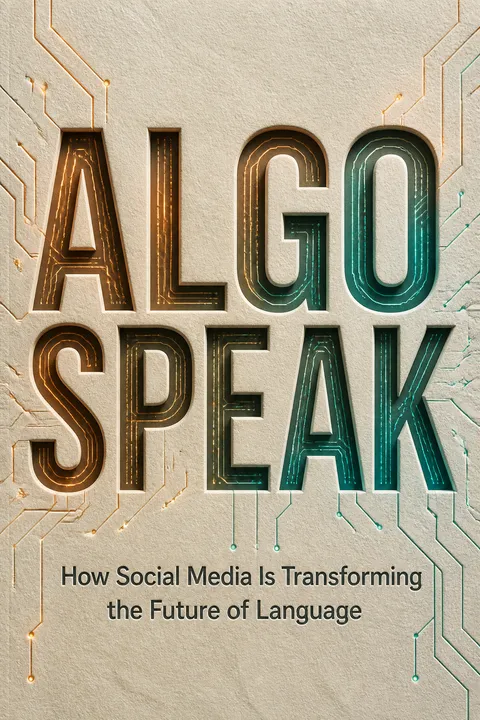
Algospeak receives mostly positive reviews, praised for its fascinating exploration of how social media and algorithms are rapidly transforming language. Readers appreciate Aleksic's unique perspective as both a linguist and content creator, offering insider knowledge and academic rigor. The book is lauded for its accessibility, engaging writing style, and timely analysis of internet culture and linguistic trends. Some reviewers note occasional repetitiveness and a desire for more depth on certain topics. Overall, it's considered an insightful and entertaining examination of modern communication.
People Also Read



Glossary
Algospeak
Platform-shaped online languageA form of language shaped by social-media systems, including moderation rules, recommendation feeds, trends, and platform formats. The term first referred mainly to coded alternatives used to evade content moderation, such as euphemisms for sensitive topics. The book broadens it to include the wider vocabulary and communication styles formed under algorithmic influence.
Linguistic Whac-A-Mole
Censorship and verbal workaroundsA cycle in which a platform restricts a word or expression, users develop substitutes to keep communicating, and moderation systems may then target those substitutes. The metaphor emphasizes that removing a particular term does not remove the underlying subject or the desire to discuss it. The process can produce euphemisms, respellings, symbols, and indirect references.
Sociolect
Language shared by a groupA variety of language associated with a particular social group or setting. Its vocabulary and conventions help members communicate efficiently and signal belonging. The book treats online speech shaped by platform culture as an algospeak sociolect, while also comparing it with family language, fandom vocabulary, and the speech styles of other groups.
Engagement treadmill
A self-reinforcing content cycleA cycle in which content that attracts engagement is copied by more creators, whose versions generate further engagement and become more visible. The book applies the idea to trending words and memes: a term can become more popular partly because platforms and creators keep responding to its existing popularity. The cycle rewards attention, not necessarily accuracy or lasting value.
Filter bubble
Personalized information environmentAn environment in which recommendation systems prioritize content predicted to match a user’s interests, reducing exposure to other material. Filter bubbles can help people find niche communities and develop shared language. They can also reinforce existing interests or views. The book stresses that such bubbles emerge through interaction between users, content, and recommendation systems.
Fanilect
A fandom’s shared vocabularyA sociolect used within a fan community, built from references, specialized terms, jokes, and interpretations meaningful to its members. Taylor Swift fans, for instance, use references to lyrics and events as shared shorthand. Social platforms help fanilects grow by recommending community content and giving fans spaces to discuss it.
Context collapse
Different audiences meet onlineA condition in which communication intended for one audience reaches people with different backgrounds, expectations, or knowledge. An in-group joke or term may be interpreted as a general joke, an insult, or a sincere claim once it travels beyond its original setting. The book argues that recommendation systems can carry language across these audience boundaries quickly.
Voldemorting
Avoiding a name or keywordDeliberately referring to a person, topic, or term without naming it directly. The technique can help users avoid moderation, search results, or unwanted attention, and can also carry a humorous or political message. Examples include nicknames, descriptions, initials, and references that rely on an audience understanding what remains unsaid.
Flanderization
A group becomes a caricatureThe exaggeration of a character or group’s most recognizable traits until a more complex identity becomes a simplified stereotype. The term comes from a television character whose personality grew more extreme over time. The book applies it to social media, where attention incentives can reward exaggerated versions of creators, subcultures, or generations.
Trendbait
Language designed to trendA phrase, label, or concept introduced or emphasized in the hope that audiences will repeat it and turn it into a trend. Creators may coin memorable terms or attach existing ideas to a timely topic to encourage comments, remixes, and further views. Trendbait links linguistic experimentation to the incentives of the attention economy.
Poe’s law
Irony mistaken for sincerityThe difficulty of reliably distinguishing satire of an extreme belief from sincere expression of that belief, particularly online. The ambiguity can let a joke circulate without its original context, or allow a harmful claim to gain attention as supposedly ironic. In the book, this helps explain how extremist vocabulary and assumptions travel through memes.
Diffusion of Innovations
Model of how ideas spreadEverett Rogers’s framework for understanding how an innovation spreads through groups of adopters, from early innovators to people who adopt only after an idea becomes common. The book applies the model to slang and memes. Initial adoption does not guarantee survival: people may abandon a term once its novelty fades or its social purpose disappears.
FAQ
What is Algospeak: How Social Media Is Transforming the Future of Language by Adam Aleksic about?
- Language evolution in digital age: The book explores how social media platforms and their algorithms are fundamentally reshaping the English language, introducing new slang, euphemisms, and communication styles.
- Algorithmic influence on speech: Aleksic examines how algorithms censor, promote, and spread certain words, leading to the rise of "algospeak"—a sociolect shaped by content moderation and recommendation systems.
- Cultural and social impact: The book delves into how online communities develop unique vocabularies, influence identity, and create filter bubbles that accelerate linguistic change.
- Interdisciplinary approach: Combining linguistics, social media analysis, and psychology, Aleksic provides a comprehensive look at the interplay between technology, language, and society.
Why should I read Algospeak by Adam Aleksic?
- Decode modern slang: The book helps readers understand how everyday language is being transformed by social media, making it easier to interpret new slang and communication patterns.
- Insight into digital culture: Aleksic explains the mechanisms behind viral trends, memes, and sociolects, making it essential for anyone interested in internet culture or linguistics.
- Critical perspective on algorithms: Readers gain awareness of how algorithms shape not only content but also language and identity, fostering more informed engagement with digital platforms.
- Practical relevance: The book offers valuable context for educators, parents, creators, and users navigating the digital landscape, especially regarding censorship, mental health, and community building.
What are the key takeaways from Algospeak by Adam Aleksic?
- Algorithms shape language: Social media algorithms actively influence which words and phrases become popular, driving the evolution of language online and offline.
- Emergence of new sociolects: Niche communities develop unique vocabularies ("fanilects" and "microlabels") that reinforce group identity and can spread to mainstream culture.
- Cycle of censorship and creativity: Users constantly invent new euphemisms and spellings to evade algorithmic moderation, leading to rapid linguistic innovation.
- Ethical and social implications: Algorithm-driven language change can foster community but also amplify misinformation, polarization, and cultural appropriation.
What is "algospeak" as defined in Algospeak by Adam Aleksic?
- Definition and origin: Algospeak is the specialized language, euphemisms, and slang developed to navigate social media algorithms, often to evade censorship or optimize engagement.
- Examples and scope: Words like "unalive" (for "suicide") and "seggs" (for "sex") are common examples, along with playful respellings and new grammatical patterns.
- Sociolect and in-group function: Algospeak signals belonging among social media users and helps communities communicate under platform constraints.
- Algorithmic role: Algorithms determine which terms gain traction by promoting content that fits guidelines and engagement metrics, actively shaping language evolution.
How do social media algorithms influence language and culture according to Algospeak by Adam Aleksic?
- Personalized content feeds: Algorithms analyze user behavior to recommend content, accelerating the spread of slang and memes within and beyond niche communities.
- Engagement-driven amplification: Words and memes that generate high engagement are promoted, creating feedback loops that rapidly popularize certain terms.
- Commercial incentives: Platforms commodify language trends by encouraging creators to use specific keywords and microlabels, aiding targeted marketing.
- Cycle of irony and sincerity: The book discusses how language oscillates between ironic meme use and serious adoption, complicating tone and meaning.
How does the word "unalive" illustrate the concepts in Algospeak by Adam Aleksic?
- Euphemism for sensitive topics: "Unalive" emerged as a way to discuss suicide or death without triggering censorship, making difficult conversations more approachable.
- Algorithmic censorship origin: The term gained popularity due to content moderation on platforms like TikTok, where direct mentions of suicide were suppressed.
- Spread from online to offline: "Unalive" transitioned from internet meme to everyday speech, even appearing in educational contexts.
- Linguistic evolution example: Aleksic situates "unalive" within a historical pattern of euphemizing death, showing how social media accelerates this process.
What is the "linguistic Whac-A-Mole" phenomenon in Algospeak by Adam Aleksic?
- Censorship and creativity cycle: Users invent new words or spellings to evade moderation, only for platforms to catch on and suppress those terms, prompting further innovation.
- Historical continuity: This cycle has roots in early internet slang like leetspeak but now operates faster due to AI-driven algorithms.
- Examples of bowdlerization: Creative respellings (e.g., "f*ck" as "fvck") and emoji substitutions are common tactics to avoid detection.
- Social and algorithmic pressures: The phenomenon is driven by both the need to discuss sensitive topics and the opaque rules of social media platforms.
What are "microlabels" and how do they relate to language change in Algospeak by Adam Aleksic?
- Definition of microlabels: Microlabels are highly specific identity or aesthetic labels, often ending in "-core" (e.g., "cottagecore"), that categorize niche communities online.
- Algorithmic function: These labels serve as metadata for algorithms to personalize content recommendations, reinforcing filter bubbles and engagement.
- Cultural and commercial effects: Microlabels help users find identity communities but also enable brands to commodify these identities for marketing.
- Impact on individuality: While offering more self-expression options, microlabels can paradoxically constrain creativity by boxing users into algorithm-driven categories.
How does Algospeak by Adam Aleksic explain the spread and impact of incel language and memes?
- Origins and spread: Incel slang and memes began in niche online communities and spread to mainstream platforms, often through ironic meme formats.
- Algorithmic amplification: The shock value and negativity of incel language make it highly engaging, causing algorithms to promote it widely.
- Blurred lines of meaning: Poe’s law allows incel memes to be interpreted as both satire and sincere belief, enabling dangerous ideas to spread under the guise of humor.
- Cultural consequences: The mainstreaming of incel language influences beauty standards, social attitudes, and even political discourse.
What does Algospeak by Adam Aleksic say about linguistic appropriation, especially of African American English (AAE)?
- Cycle of appropriation: AAE slang often starts as in-group identity markers but is adopted by mainstream culture, leading to loss of original meaning.
- Examples and effects: Terms like "slay," "tea," and "gyat" have moved from Black communities to widespread internet slang, sometimes without credit.
- Commercialization and commodification: Companies and influencers profit from AAE-derived slang, often without involving or compensating the original communities.
- Social consequences: Appropriation can reinforce stereotypes and spark debates about language ownership and respect in digital spaces.
How does Algospeak by Adam Aleksic describe the role of generational slang and identity in online language?
- Generations as social constructs: Generational labels like Gen Z and millennials are culturally meaningful but scientifically arbitrary, gaining prominence through social media memes.
- Emergence of generational slang: Social media accelerates the spread of slang associated with specific generations, uniting and dividing age cohorts.
- Flanderization and oversimplification: Online creators exaggerate generational traits and slang for engagement, reducing complex identities to caricatures.
- Identity and storytelling: Generational slang and memes form part of a shared folklore, helping individuals construct and perform their identities.
What are the best quotes from Algospeak by Adam Aleksic and what do they mean?
- On language change and humanity: “You know that the form of speech will change... And yet they spoke them thus / And succeeded as well in love as men do now.” —Quoting Chaucer to emphasize that language evolution is natural and does not diminish our humanity.
- On social media identity commodification: “Your brand becomes part of their identity.” —From TikTok’s business platform, illustrating how platforms monetize subcultural identities through language and trends.
- On the power of memes: “Words are memes, and memes are trends, but all are also ideas.” —Aleksic highlights the intertwined nature of language, culture, and viral social media mechanisms.
- On internet folklore: “It’s as if our language were reflexively aware of its own narrative building.” —Refers to the rise of the word “lore” in online communities, showing language’s self-awareness in cultural storytelling.
Download PDF
Download EPUB
.epub digital book format is ideal for reading ebooks on phones, tablets, and e-readers.








