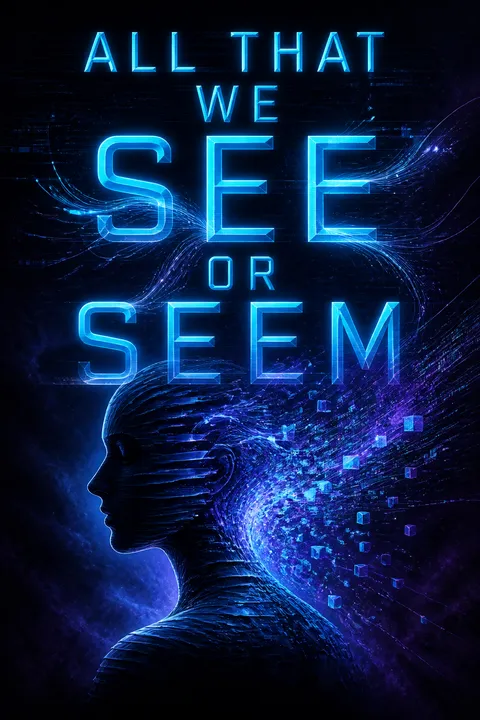


Plot Summary
Prologue
In the cold hours before dawn, Elli Krantz slips out of the house she shares with her husband, Piers. She leaves her phone, jewelry, and familiar life behind, but cannot bring herself to erase the recordings and private AI she has built around her identity.
Elli knows that the story others have made of her has become a trap. She walks into the darkness anyway, choosing flight over a life that love alone can no longer repair.
The opening makes disappearance an act of authorship. Elli does not leave because she has stopped loving Piers, but because affection cannot give her back control of her own life. Her hesitation over deleting her records reveals the cost of escape: she wants to abandon the public self that confines her, yet cannot simply erase the labor, memory, and ambition that formed it. The prologue also plants a crucial uncertainty. Elli seems to vanish without explanation, but her careful preparation suggests that disappearance may itself be a deliberate performance.
The School Network Worm
Julia Z, a gifted but isolated security hacker, untangles a malicious prompt worm that has penetrated Paine Middle School's AI systems and threatened students' records. She finds a way to map the infected network and gives her childhood friend Cailee instructions for repairing it.
The work is unpaid, but Julia refuses to abandon children to data thieves, even as her AI reminds her that overdue bills are piling up. When she finishes her report, Talos alerts her to a visitor: Piers Neri, a Boston lawyer who says his wife, dream artist Elli Krantz, has vanished. Julia distrusts strangers and police attention, but Piers knows her name through an old legal file, and his fear makes her listen.
Julia's first choice establishes the tension that governs her: she distrusts institutions and surveillance, yet keeps intervening when vulnerable people are at risk. The school worm is not merely a technical puzzle. It echoes her own fear that private identities can be stolen and repurposed without their owners' knowledge. Her response to Cailee shows care expressed through competence, while her unpaid labor exposes a self-neglect she has mistaken for independence. Piers's arrival converts a manageable act of repair into a human crisis, testing whether Julia can use her abilities for someone she does not yet know.
Frankie in the Shed
Piers explains that Elli disappeared from their comfortable Carre home, leaving her car, phone, purse, and jewelry behind. The police suspect him, but he has received a call from a man who claims to hold Elli and demands that Piers return an unnamed possession. A video appears to show Elli alive, eating under guard, while her refusal to cooperate convinces Piers the threat is real.
The caller directs him to their shed, where Piers finds Frankie, their beloved cat, dead. Julia cannot authenticate the video or identify the kitchen behind Elli, and she warns Piers that his visit may bring police scrutiny. Then her cameras reveal men watching her building, making the danger immediate.
The dead cat turns an abstract threat into a domestic violation: the kidnappers have reached into the couple's home and destroyed a creature that represented their shared life. The video offers apparent reassurance while withholding the one thing Piers needs, certainty. Julia's refusal to claim that software can reliably distinguish authentic footage from a convincing fabrication makes her a more trustworthy ally, but also leaves Piers with no easy comfort. Surveillance intensifies the moral trap. Julia's privacy practices protect her, yet her anonymity can make her conspicuous to the same data systems she fears.
A Door Left Open
As the men outside begin researching her building's residents, Julia leaves disguised as a state inspector and travels across Boston by commuter rail. She approaches Piers and Elli's house through the woods, uses its safety gesture to avoid triggering an intruder alarm, and meets Piers outside without their phones.
A scan finds no planted bug, but Julia explains that a supposedly anonymous burner phone can still be linked to its buyer through location data. Over dinner, Piers describes vivid dreaming, the live performances Elli guides with her AI, and the private vulnerability such dreams require.
Julia recognizes that Elli's studio and personal AI may hold clues. She agrees to examine the equipment, but first insists they sever the house's connection to the outside network.
Julia's journey from hiding to collaboration does not erase her suspicion. Instead, she turns suspicion into method: she checks devices, cuts the network connection, and treats ordinary household signals as possible evidence. Piers, who is unfamiliar with modern tracking, must accept her expertise while surrendering some control over his own devices. Their meal creates the first small exchange of care between them, but it is practical rather than sentimental. Vivid dreaming introduces the story's central paradox: a performance can make strangers feel intimately known, while the same intimacy creates an opening for exploitation.
The Dream That Hurt
Julia builds an egolet, an AI model trained on Elli's practice recordings, and uses it to attempt a private vivid dream. Instead of a polished performance, the session draws Julia into a memory of her mother, an immigrant activist, attending the school play where Julia was targeted by racist hecklers.
The online abuse that followed, Julia's resentment and guilt, and her mother's later death flood the dream until Julia tears off the headset. She realizes the model seems practiced at guiding a solitary dreamer, although Elli's public art depends on crowds. Piers cannot explain that readiness. Julia suspects Elli had conducted private sessions, but the possibility wounds Piers because he and Elli never shared one.
The dream makes Julia's technical curiosity inseparable from emotional exposure. She has spent years controlling what data she produces, yet the experience uses personal memory to reach what she has tried not to revisit. Her choice to remove the headset marks a limit, not a failure: she can recognize when a system's intimacy becomes coercive. At the same time, the egolet's unusual fluency with a single dreamer becomes evidence. The technology that appears to reveal a self also carries traces of how it was used, allowing Julia to read absence and repetition as clues.
The House Burns
The caller identifies himself as the Prince and gives Piers a deadline to find what Elli took, or send him all her data. Piers begins uploading her immense archive, while Julia delays the most sensitive files and studies the egolet.
She finds systematic gaps that coincide with Elli's dream-deck sessions away from home, suggesting that Elli erased memories of secret one-on-one performances. Comparing the kidnapping video with the egolet, Julia concludes that the footage was generated from private material and that the Prince probably does not have Elli.
When the Prince warns that Piers will soon be arrested, Julia urges him to flee. They escape just before his house is destroyed by fire, and Piers becomes a fugitive rather than remain trapped by the false accusation.
The upload is an act of coerced disclosure: Piers gives an unknown adversary access to the records of his wife's life because he believes her safety depends on it. Julia's deductions shift the case from rescue toward reconstruction, but they do not yet prove Elli is safe. The fire demonstrates that the Prince can convert digital leverage into physical destruction. Piers's decision to run also reveals that his loyalty is not simply obedience to law or habit. Under pressure, he chooses the uncertain possibility of finding Elli over the security of his former life.
The Photograph's Second Life
On the run, Julia discovers that repeated edits to a beach photograph of Piers and Elli concealed an encrypted spreadsheet. Piers reads the financial records and realizes Elli had secretly diverted millions through offshore accounts, many connected to criminal networks.
The payments rose with her artistic income and usually consumed about seventy percent, suggesting that someone could audit and punish her. Small recurring transfers marked 231 lead Julia and Piers to reconstruct their burned house from old photographs.
A reflected key in a mirror reveals that 231 is a safe-deposit box. They trace Elli's travel history to eastern Pennsylvania, create a false corporate identity, and enter the bank. The box contains cash and a short handwritten instruction to leave, but no address.
The photograph works as a double image: an emblem of marital affection and a container for a truth Elli could not safely state. Piers's legal training turns the spreadsheet into an account of coercion, while Julia's pattern recognition exposes the physical key hidden in the reconstructed home. Yet the financial evidence complicates rather than cleanses Elli's story. She has paid dangerous people, and Piers cannot know whether secrecy protected him or excluded him. The safe-deposit box offers direction without explanation, making trust the only bridge from evidence to action.
Victor Takes the Clue
Victor, the Prince's operational enforcer, ambushes Julia and Piers at their rented cottage after they leave the bank. His men beat Piers, take the cash and note, and seize Julia's decoy phones, but she has hidden her real computing equipment.
The pair escape after persuading the hired local criminals that Victor may frame them for Piers's disappearance. Julia leads Piers through a circuitous route to Philadelphia, where she asks Sahima, her estranged friend from the hacking collective Cartographers Obscura, for help.
Sahima welcomes her without demanding an explanation, gives them food and shelter, and finds them an older, less trackable car. Julia's reunion with Sahima begins repairing a friendship she had abandoned after trusting the collective's leader, Serena.
The ambush removes the apparent reward of the bank visit and forces Julia to rely on improvisation rather than possession of evidence. Piers's injuries expose the cost of his inexperience, while Julia's survival planning keeps them moving. Sahima's welcome matters because Julia's isolation is partly self-imposed: after Serena's authority collapsed, Julia treated the loss of one ideal as proof that every bond was unsafe. Sahima offers care without asking Julia to earn it through confession. Their reconciliation gives Julia a living alternative to both naïve devotion and solitary self-protection.
The Postcard at Brooklyn
Julia activates several decoy phones to confuse Victor's location tracking, then exploits the Bloom phone he took from her during the ambush. Through its microphone, she hears Victor's crew but learns only that their destination is coastal.
She identifies their other phones by their electronic sounds, slips a compact exploit into them, and follows their movements to JFK. The men board a flight through Charlotte, then continue toward Tallahassee.
At a motel outside the city, Julia uses Puck, her shape-shifting drone, to listen through a room's peephole and learns that the group plans to seize Elli at a resort. A message on their phone contains a postcard sent from Elli's hideout, showing a beach cottage and a handwritten note about shared dreams.
This section turns surveillance from a threat into a tool, but Julia's success depends on a fragile chain of assumptions: a decoy left unexamined, a vulnerable phone, and enough patience to distinguish useful signals from noise. Her ingenuity is collaborative rather than magical; she uses hardware, metadata, and inference, and each can fail. The postcard is especially charged because Victor interprets it as a private message to himself, while Julia recognizes it as a route to Elli. The same artifact can serve competing fantasies, depending on who believes they are its intended reader.
The Storm Boats
At White Sails Cottages, Julia and Piers evade the manager after Victor's men have already tried to find Elli. Julia breaks into the resort's camera system, narrows the search to a guest avoiding facial recognition, and discovers that Elli has gone boating at Blue Heron Banks. A storm is building, but Victor's crew is heading for the pier, so Julia and Piers take a powerboat into the Gulf.
In the rain and darkness, they locate Elli's boat among the pursuers. Victor shoots Piers, and Elli's vessel runs aground between the islets, throwing her into the rough sea. She does not resurface. Piers sends Julia to shore for help while he draws the pursuing boats away; Julia reaches land believing both Elli and Piers are lost.
The rescue attempt reverses the earlier roles: Julia and Piers are no longer decoding a threat from a distance but confronting it in a storm where technical advantages collapse. Piers's choice to pursue Elli despite his injury expresses the dependable love he has tried to offer her, but it cannot guarantee survival. Julia's escape is not triumph; it is obedience to Piers's last practical effort to preserve a witness. The apparent deaths make the novel's central distinction painful: love can motivate courage and still fail to control what happens to another person.
Ashes and Silence
After the Florida investigation, Julia is cleared as a suspect, but authorities cannot verify her account of Victor and the Prince. The public instead argues over whether Elli's career was fraudulent, while Piers and Elli are mourned as victims of an unproven crime.
Julia withdraws from Cailee, Nick, Sahima, and Hutch, convinced that her involvement has brought only loss. She studies oneirofexes, searching for others manipulated by the Prince. Then Victor's men break into her apartment and set it on fire to destroy her devices and memories.
Julia's old tensor bank and Talos are lost, but she reconstructs Talos from encrypted backups scattered across cloud services. She leaves Boston and walks through the Connecticut woods to Hutch's isolated cottage, where the network cannot watch her.
Julia's grief takes the form of self-exile. She interprets Piers's and Elli's apparent deaths as evidence that attachment itself is dangerous, repeating the abandonment that began after her mother's death. The arson literalizes a deeper threat: destroying her personal AI would erase the external memory and skills that help her know herself. Her distributed backups show that she anticipated loss, but restoring Talos does not restore her trust. The trip to Hutch is therefore both tactical and psychological. She seeks a place beyond surveillance, while carrying the unresolved case that has made solitude impossible.
Money Becomes Coordinates
At Hutch's cottage, Julia studies the recovered files and tries to uncover what Elli meant by the postcard's promise of shared dreams. She realizes the Prince's memories may survive in the traces Elli's AI was told to erase. Before that discovery can help, a dream of a city built from money gives her a new way to read the safe-deposit box.
The bills and coins were arranged by denomination and facing, producing the coordinates 42°45'05"N and 113°08'11"W. The location lies near American Falls, Idaho, beside a data center secretly controlled through the Prince's companies. Julia travels there, watches the workers, and spots Victor among them. She concludes that the building is a cover for something beyond ordinary computing.
The clue succeeds only when Julia changes the question. The money is not a stash to spend or a code hidden in the bills' serial numbers; its arrangement becomes meaningful when treated as a map. This echoes the novel's broader insistence that information is not self-interpreting. Hutch's guidance encourages Julia to approach traces from another perspective, while her knowledge of Elli's habits supplies the context. The coordinates transform grief into direction. Julia cannot recover the dead, but she can follow the pattern Elli left toward the machinery that enabled the Prince.
The Farm Below Idaho
Julia hides near the Idaho data center and sends Puck inside through its ventilation system. She finds that the most intense security protects a room marked as hazardous storage, not the server halls. Smuggling herself in inside a grocery crate, she uses the drone to explore the sealed chambers below.
There, workers are forced to make videos and other online material, while separate teams edit content and operate hundreds of social accounts to make it appear genuinely popular.
Dormitories, medical rooms, and restraints reveal that the operation is a human-content farm built on slavery. Julia records what she can, but Victor detects Puck and tracks its control signal. During a blackout, Julia hides among newly delivered migrants and is registered as an unnamed worker.
The revelation exposes the material body beneath a supposedly automated economy. The Prince's operation does not replace human labor with AI; it imprisons people to manufacture the signals that algorithms recognize as human. Julia's drone lets her witness the hidden system, but its connection to her also betrays her location. Her capture is an inversion of her usual method: the hacker who studies systems from outside becomes a unit processed inside one. By entering under a false identity, she survives, but she must now protect her sense of self from a workplace designed to reduce people to measurable output.
The Tap Farm Signal
For two weeks, Julia is forced to boost content in the farm's tap room, where Isabella, a fellow captive, secretly signals for help through patterns of short and long posts. Julia answers with a code based on the digits of pi, and the two begin preparing an escape.
They write a worm that overheats the farm's computers, starting fires that force guards to move workers toward the surface. When armed men try to send everyone back underground, Julia and Isabella spark a panic, seize a guard's phone, and use a convincing video of Victor to order an evacuation.
Victor hunts them in the smoke and darkness, relying on his AI to find Julia. Isabella knocks him unconscious while Talos illuminates the room, and the women reach the elevator as rescuers arrive.
The tap farm's repetitive gestures become the means of resistance: a pattern designed to simulate engagement carries a human plea across a system that monitors nearly everything. Julia's escape depends not on solitary genius but on Isabella's willingness to answer and act. Their coded messages restore the possibility of trust under conditions engineered to make every captive report on the others. Victor's dependence on his own surveillance tools makes him vulnerable to misdirection, but the decisive counterweight is human cooperation. The women escape because they read one another, not because technology alone liberates them.
The Prince's Last Web
After the raid frees the workers, Julia learns that officials are reluctant to pursue the Prince, whose international influence makes prosecution difficult. She leaks evidence from the dreams he shared with Elli, exposing other farms and secrets he used to control powerful people.
The Prince flees, but evidence emerges that he is threatening a Russian mercenary leader, and he dies in a plane crash soon afterward. Julia gives money recovered from a guard's device to legal aid and supports the rescued workers' asylum cases.
When a government agent offers her work, Julia refuses, unwilling to replace one powerful handler with another. She returns to friends, accepts Cailee's invitation to tutor children, and begins choosing connection over the isolation she had treated as punishment.
The Prince's system depends on controlling stories: he manufactures popularity, hoards compromising information, and makes himself indispensable to those he manipulates. Julia defeats him not by claiming institutional authority but by releasing evidence that others can act upon, though the result is politically compromised and does not amount to a clean trial. Her refusal of recruitment protects the autonomy she has fought to recover. Returning to friends and teaching children are modest choices, yet they counter the Prince's logic by making care reciprocal rather than transactional.
Epilogue
Elli's account reveals that she survived the storm. She had arranged a false death with diving lessons and a bag of her own blood, knowing the Prince would stop pursuing her only if he believed he had watched her die.
The postcard was intended to mislead him toward the thought that she still belonged to their private dreams, while the trail of clues gave others a chance to find what he had hidden. Elli regrets that Piers was caught in the escape, but she chose her own story over a life permanently defined by the Prince. Under a new name, she begins making art beside the sea.
The epilogue revises the apparent tragedy without undoing its cost. Elli's survival confirms that her disappearance was a carefully staged escape, but Piers's death remains a consequence she neither planned nor can repair. Her choice is not presented as uncomplicated heroism: she admits that freedom required deception and that she valued control of her own identity above preserving the marriage as it existed. The reveal also reframes the novel's many clues as competing performances. Elli used the Prince's appetite for intimacy to misdirect him, while Julia read the same signs as evidence of a rescue in progress.
Analysis
The novel's central conflict concerns who gets to author a life. Elli's fame is manipulated by the Prince, who first helps manufacture her success and then treats that success as evidence that he owns her. Julia's history gives this struggle a different register: she was turned into a public image as a child, then sought refuge in a collective whose leader offered belonging at the price of independent judgment. Piers, meanwhile, tries to love Elli without possessing her, but his faith cannot protect him from the consequences of her secrecy. These are not equivalent forms of control. The book distinguishes care, which leaves room for another person's choices, from systems that convert access into ownership.
Its speculative technologies sharpen that distinction. Personal AIs become external memories, vivid dreams turn private feeling into a collaborative medium, and surveillance systems make ordinary movement legible to institutions and criminals. Yet none of these systems determines what evidence means. Julia succeeds by reading gaps, sounds, reflections, and patterns in context, while the Prince repeatedly mistakes his interpretation of others for knowledge of them. The novel's recurring acts of misreading are psychological as much as technical: Piers initially trusts a false kidnapping story, the Prince mistakes artistic intimacy for love, and Julia believes that withdrawal is the same as safety.
The content farm makes the book's critique material. The supposedly human quality that digital platforms reward is supplied by coerced people, hidden beneath a polished interface. Julia's escape depends on Isabella's signal and their cooperation, not on individual mastery alone. Her final refusal to work for Cynthia preserves that distinction: she can value collective action without surrendering herself to a leader or institution. The novel does not offer a clean restoration of justice. The Prince's death is politically entangled, and Elli's survival comes at the price of Piers's loss. Instead, it ends with a more modest possibility: people can begin again by choosing whom to trust, what to remember, and which stories they will help one another tell.
Review Summary
All That We See or Seem by Ken Liu receives mixed reviews averaging 3.62/5 stars. Readers appreciate its timely exploration of AI, social media, and surveillance in a near-future thriller following hacker Julia Z. Many praise Liu's intelligent worldbuilding and relevant themes but note disappointment compared to his previous works. Common criticisms include flat characters, unsubtle prose lacking his signature style, cheesy villains, pacing issues, and excessive technical exposition. Some find it an accessible, fast-paced thriller, while longtime fans miss the emotional depth and lyrical writing of his fantasy works. Most agree it's thoughtful but not his strongest work.
People Also Read







Characters
Julia Z
The wary systems hackerJulia is a technically gifted hacker who avoids commercial platforms, public attention, and most forms of tracking. Her guardedness grew from a childhood spent in the wake of her mother's activism and the online abuse that followed. After running away, she found belonging in Cartographers Obscura, where she learned hardware hacking and came to trust its charismatic leader too completely. Julia is resourceful under pressure, but her sharp suspicion of others often protects her by keeping them at a distance. She is drawn to problems involving stolen data and threatened children because they echo her own history. Her central struggle is learning to use her skills without surrendering her judgment or treating isolation as the only safe choice.
Elli Krantz
The dream-weaving artistElli is a celebrated oneirofex, or vivid-dream guide, whose live performances blend individual memories into a shared emotional experience. She is inventive and athletic, with a strong instinct for how audiences respond, but resists being reduced to a biography or a single successful work. Her early hit made her famous for a conspiracy-themed dream she later wanted to leave behind. Elli's art depends on intimacy, improvisation, and trust, qualities that make her work powerful and leave her vulnerable to people who mistake access for ownership. She is married to Piers, whose steadiness offers a different kind of intimacy from the attention she receives as a performer.
Piers Neri
The steadfast lawyerPiers is a corporate lawyer who values order, dependability, and careful attention to human relationships. He is not comfortable with new technology and has fallen behind the machine-assisted changes reshaping his profession, but his patience and storytelling instincts make him a perceptive partner. His marriage to Elli is shaped by his willingness to support an artist whose deepest passion is her work. Piers does not confuse love with possession, although he is not free of jealousy or insecurity. When uncertainty threatens the life he has built, he must act outside the habits that once made him feel safe. His legal knowledge and steadiness complement Julia's improvisational technical skill.
The Prince
The information brokerThe Prince is a wealthy transnational operator who gathers secrets, manufactures public narratives, and trades influence among politicians, companies, and criminal networks. He sees information as both weapon and insurance, and he cultivates the belief that understanding another person gives him a right to direct that person's choices. His polished self-image as a patron of talent conceals a transactional view of human beings. He craves recognition as someone exceptional, yet responds to vulnerability by turning it into leverage. His fixation on Elli's art shows how easily he confuses an experience of being understood with genuine mutual affection.
Victor
The Prince's enforcerVictor manages the Prince's North American operations and prefers machines because he considers people unreliable and easily distracted. He is disciplined, observant, and adept at turning surveillance into control, but his confidence in predictive systems makes him vulnerable to situations those systems have not modeled. He recruits local criminals as disposable labor while demanding obedience from them himself. At the Idaho facility, his operational efficiency serves a brutal enterprise built on coercion. Victor treats the people he supervises as assets, a language that allows him to disguise cruelty as management.
Sahima
Julia's hacker friendSahima first meets Julia when Julia is homeless and impulsively helps her during a collective theft from a locked-down electronics store. A skilled hardware hacker and generous mentor, Sahima gives Julia practical knowledge as well as a place to belong. She later questions the claims of Cartographers Obscura's leader, putting evidence above loyalty. Julia's choice to side against her strains their friendship for years. Sahima's warmth is paired with clear-eyed skepticism, and she offers help without pretending that care requires agreement or blind trust.
Hutch
The embodied math mentorHutch teaches Julia to understand mathematics and machine learning through visualization and physical movement rather than memorized symbols. His approach makes technical concepts intuitive and gives Julia a way to think with her whole body. He was part of Cartographers Obscura but later left its world behind for an off-grid life. Hutch is patient and gently philosophical, often asking Julia to reconsider the perspective built into her metaphors. He does not force her to accept help, but continues to make it available.
Serena
The persuasive collective leaderSerena leads Cartographers Obscura with unusual presence and a political vision that gives Julia's life a new structure after years of shame and instability. She understands Julia's longing for belonging and speaks directly to the anger Julia has struggled to admit. To Julia, Serena becomes both a mentor and a source of approval powerful enough to shape her sense of right and wrong. Her certainty helps the collective act with purpose, but it also makes questioning her feel like a betrayal of the family Julia has found.
Isabella
The captive signal-makerIsabella is a technically capable captive in the Prince's content farm, where she works beside Julia in the room that artificially boosts online engagement. She uses patterns in routine clicks and posts to seek help without alerting the guards. Her willingness to trust Julia with a coded exchange becomes the foundation of their escape plan. Isabella is observant and brave, but her defiance is practical rather than theatrical: she keeps looking for the smallest opening through which other people might be reached.
Cailee
Julia's childhood friendCailee is Julia's childhood friend and the administrative assistant at Paine Middle School. She asks Julia to investigate the worm threatening the school's systems, trusting her technical ability and concern for the students. Their friendship survives despite Julia's long habit of withdrawing from people. Cailee represents an ordinary, durable connection to Julia's earlier life, one not based on shared danger or ideological devotion. She offers Julia a route back into community through practical work with children.
Nick Shan
Julia's pro bono lawyerNick is the lawyer who represented Julia after her involvement with Cartographers Obscura and helped her navigate the consequences of her past. Patient and attentive, he treated her as a young person in need of support rather than merely a difficult case. Julia regards him as one of the few people she can trust, though she sometimes avoids his calls when shame makes her withdraw. His continuing legal work for vulnerable people reflects the kind of steady service Julia struggles to believe she deserves.
Talos
Julia's personal AITalos is Julia's custom-built personal AI, trained through years of shared work and designed to operate without dependence on a commercial cloud service. It records investigations, monitors camera feeds, analyzes data, and adapts to Julia's habits. Julia treats Talos as both a tool and an external memory, storing images, knowledge, and parts of her personal history in its neuromesh. Its presence raises a persistent question in the story: when a machine reflects someone's patterns closely enough to feel like a companion, where does assistance end and identity begin?
Julia's mother
The fearless activistJulia's mother is an immigrant activist who gives her life to public causes and refuses to accept the idea that newcomers should stay silent. She is courageous, charismatic, and deeply committed to making the country live up to its stated ideals. Her activism also keeps her away from Julia for long stretches and exposes her daughter to public attention before Julia is ready. Julia loves her mother and resents the cost of that commitment, a contradiction that shapes her ideas about loyalty, courage, and belonging.
Cynthia
The guarded federal agentCynthia is a government representative who approaches Julia after the Prince's crimes become public. She is candid about the limits and compromises of state power, while still trying to recruit Julia's skills. Her manner is direct, probing, and deliberately difficult to place within a specific agency. Cynthia serves as a final test of Julia's independence: she offers institutional purpose, but does not assume that a capable person must accept it.
Frankie
The couple's beloved catFrankie is Piers and Elli's affectionate tabby, known for seeking out human company. The cat is part of the ordinary domestic life that surrounds the couple before the disappearance, and its fate makes the kidnappers' threat brutally concrete. Frankie also gives Piers a small, intimate responsibility amid the public suspicion and uncertainty that follow Elli's vanishing.
Plot Devices
Vivid dreaming and egolets
Shared dreams reveal hidden tracesVivid dreaming lets an oneirofex guide many people into a shared emotional experience by combining live prompts with signals from participants' personal AIs. The technology makes collective intimacy possible, but it also creates records, traces, and ethical questions about who may access private thoughts. An egolet is an AI model trained on a particular person's process and behavior, not simply a copy of finished work. Julia uses Elli's egolet to experience her art, identify the traces of secret one-on-one sessions, and later investigate what Elli's AI appears to have forgotten. The device turns intimacy into both an artistic medium and a forensic trail.
Personal data and surveillance
Every trace can expose or misleadPhones, cameras, location records, smart appliances, and network logs form a near-constant surveillance environment. Julia's refusal to generate data protects her, but also makes her absence from public records conspicuous. She and Piers exploit the same systems to evade the Prince: Julia uses decoy phones, traffic patterns, a compromised device, and security cameras to locate Elli. The plot repeatedly shows that data does not speak for itself. It can reveal a person's movements, but it can also be faked, selectively erased, or interpreted to support the observer's assumptions.
Elli's hidden financial trail
A photograph conceals a routeElli hides a spreadsheet inside a repeatedly edited photograph of herself and Piers. The ledger reveals unexplained payments, while a recurring reference to safe-deposit box 231 leads Julia and Piers to a key reflected in an old home photograph. The cash in the box is arranged to carry a location, though Julia understands its meaning only after changing her perspective. This layered clue expresses Elli's habit of hiding meaning in plain sight and gives the search a physical route from her private history to the Prince's operation.
Puck the morpho drone
A small machine opens closed spacesPuck is Julia's custom morpho drone, able to shift between compact, flying, crawling, and infiltrating forms. Julia uses it to adjust surveillance cameras, enter a biometrically protected car, inspect a motel room through its peephole, and explore the hidden chambers beneath the Idaho data center. Its design gives Julia a remote presence in spaces too dangerous to enter herself. But the drone's link to its operator can be traced, and Victor eventually uses that connection to hunt Julia. Puck embodies both the reach and the exposure of technical ingenuity.
The Prince's content farm
Human labor manufactures authenticityThe Prince's hidden facility imprisons migrants and other vulnerable people, forcing them to produce videos, performances, comments, and online engagement. AI tools edit and distribute their work, but the human bodies and gestures make the output convincing to algorithms designed to detect machine-generated activity. The facility exposes the labor beneath supposedly frictionless digital culture. Its existence also gives Julia a concrete target beyond the mystery of Elli's disappearance. When Julia and Isabella sabotage the tap farm, the structure built to make captive workers appear freely engaged becomes the setting for their coordinated revolt.
About the Author





Download PDF
Download EPUB
.epub digital book format is ideal for reading ebooks on phones, tablets, and e-readers.








