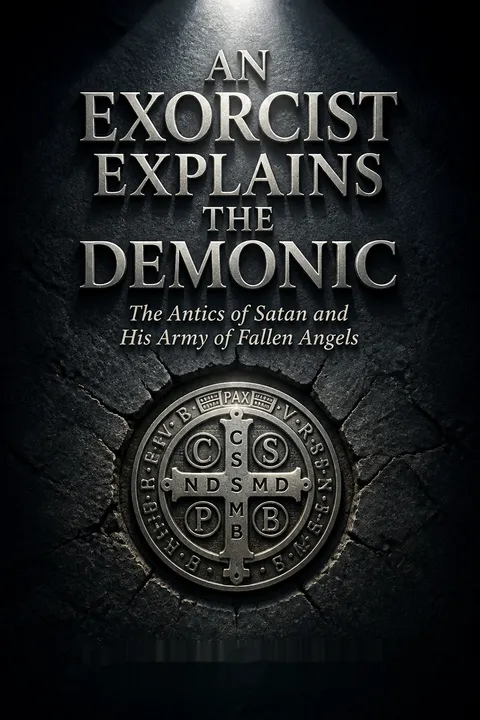


Key Takeaways
Read Amorth’s demonology through Christ’s victory, not fear of Satan.
Hope sets the frame. Amorth presents the Incarnation and Resurrection as the book’s starting point, not as a prelude to horror stories. In his Catholic account, Christ’s resurrection defeats sin and death and opens the way to communion with God. The devil’s aim is to erode hope, but no affliction, including one interpreted as spiritual, can place a person beyond divine mercy. The book’s central concern is therefore liberation and salvation, not fascination with evil.
Suffering is not proof of guilt. Amorth says that extraordinary spiritual affliction does not make its victim morally responsible. He also describes suffering as something believers may offer in solidarity with Christ, while acknowledging that innocent pain remains mysterious. That framing is intended to console, though it should not be used to tell sufferers that they must welcome pain or forgo treatment.
The choice to begin with resurrection rather than demonic spectacle changes the emotional logic of the subject. It keeps fear from becoming the book’s final authority and makes hope a theological claim about a person’s worth, not a prediction that symptoms will quickly disappear. The account of redemptive suffering can also help some believers find meaning in hardship. Its limit is practical: meaning-making should remain freely chosen. When imposed on someone in pain, it can sound like a demand to endure what should be treated or relieved.
Treat temptation as the daily battlefield, not extraordinary possession.
The ordinary struggle is central. Amorth calls temptation Satan’s ordinary action and says it affects everyone, while extraordinary afflictions concern only some people. He describes temptation as working through familiar vulnerabilities, especially pride, money, and sexual desire, and through habits of thought that make harmful choices seem harmless or attractive. His practical response is vigilance: examine what shapes attention, choose companions carefully, and form a conscience through the Gospel rather than simply adopting the surrounding culture’s standards.
Responsibility remains human. In Amorth’s theology, the devil may exploit a weakness, but the person freely chooses whether to act on temptation. That is different from possession, which he says does not make the victim morally responsible for involuntary behavior. The distinction lets the book address everyday ethical choices without treating every mistake as evidence of supernatural attack.
This emphasis has a useful parallel in behavioral science: repeated cues, social settings, and practiced responses can make some choices easier to repeat than others. Amorth’s language of discernment asks readers to notice those influences before acting. The theological model adds a moral vocabulary of responsibility and purpose. A useful caution is that not every destructive pattern reflects a simple failure of will. Addiction, trauma, illness, and material pressures can constrain choice, so moral reflection works best alongside compassionate attention to circumstances.
Beware promises of limitless freedom that turn autonomy into servitude.
Control is the seduction. Amorth portrays Satanism as an embrace of self-rule: reject every authority, do whatever you want, and treat the self as its own highest power. He argues that this promise of unrestricted freedom conceals dependence and harm. In his account, a person who consecrates himself to Satan may be promised success, pleasure, or wealth, but becomes enslaved rather than liberated.
One case makes the warning concrete. Amorth recounts a woman, Simona, who sought a successful career through a pact with Satan. She did rise at work, but later experienced episodes of intense hatred and distress. She eventually sought liberation, which, in the story, included losing the career gains associated with the pact. The anecdote expresses the book’s broader warning: a bargain that promises power may exact a human cost.
The underlying insight reaches beyond religious language: freedom is not simply the absence of limits. A choice can feel self-directed while placing someone under the control of a person, group, or compulsive desire. That makes Amorth’s critique of seductive bargains psychologically recognizable even to readers who reject his supernatural explanation. The case of Simona, however, is testimony, not controlled evidence that a pact caused her distress. Its strongest use is as a moral parable about costs and dependency, rather than proof of occult causation.
Distinguish four alleged forms of extraordinary attack before naming one.
Four categories, one caution. Amorth uses “extraordinary action” for what he understands as unusual demonic influence, distinguished from ordinary temptation. He separates it into four forms:
1. Possession: episodes in which a demon is said to control bodily actions or speech.
2. Vexation: alleged physical, emotional, relational, or work-related attacks.
3. Obsession: intrusive thoughts, perceptions, or impulses attributed to a demon.
4. Infestation: disturbances attributed to a place, object, or animal.
Cases differ. Amorth describes possession as comparatively rare and says that the other forms are more common. He tells of people who appeared well much of the time but had crises during prayer or contact with sacred objects. Such stories illustrate his categories, but the categories describe his religious interpretation, not diagnoses established by the book’s examples.
A taxonomy can make frightening experiences easier to discuss because it separates bodily episodes, mental distress, and environmental events rather than collapsing them into one label. That clarity is useful even when the reader does not accept the proposed cause. The danger is that familiar symptoms can be made to fit a supernatural category after the fact. Because these experiences can have medical, psychological, social, or environmental explanations, classification should guide careful questions, not substitute for evidence or clinical assessment.
Rule out medical causes before interpreting distress as demonic.
Start with ordinary explanations. Amorth explicitly advises people with possible signs of spiritual affliction to consult a psychiatrist first, and says he often requires a psychiatric assessment before proceeding. He recognizes that mental illness and the experiences he attributes to demons can look similar, and he endorses cooperation between priests and clinicians when the cause is unclear. In his account, treatment should be judged partly by whether it helps the person, rather than by a dramatic interpretation of symptoms.
Discernment needs restraint. Amorth recounts one woman who had received neurological treatment and had also seen exorcists. After consulting his mentor, he concluded that her problem was psychiatric rather than demonic. The example matters because the book’s own practice does not treat every unusual symptom as supernatural. It places professional evaluation before a spiritual diagnosis, despite the author’s strong belief in demonic influence.
This is among the book’s most important safeguards. Symptoms such as insomnia, intrusive thoughts, unusual perceptions, or involuntary movements are not specific to one cause, and premature spiritual labeling can delay effective care or intensify fear. A sound assessment keeps multiple explanations open and asks what evidence would distinguish them. Amorth’s framework is still vulnerable when a failed medical treatment is taken to support a supernatural account: treatment failure alone does not establish another cause. The safest reading preserves his call for collaboration and rejects certainty without adequate evidence.
Keep exorcism within trained, accountable church authority.
A formal religious rite. Amorth defines exorcism as a public prayer of the Catholic Church seeking release from demonic influence. In the practice he describes, it is performed by a priest authorized by a bishop, using the Church’s ritual and authority. He distinguishes it from prayers of deliverance, which may be offered by priests or laypeople but do not carry the same official status. He also stresses that the exorcist’s faith, training, judgment, and support matter.
The work is not instant. Amorth says some cases require only a few meetings, while others continue for years. He describes the process as uncertain and dependent on factors he cannot fully explain. He criticizes the shortage of appointed exorcists, but warns against self-appointed practitioners who charge money or promise counter-magic. In his view, prayer and church sacraments, not competing magical techniques, are the proper religious response.
The insistence on authorization and accountability serves an important protective function: it discourages isolated practitioners from exploiting people who are frightened or vulnerable. It also makes clear that, within Catholic practice, exorcism is not a do-it-yourself technique. Still, institutional authorization does not establish that a supernatural diagnosis is correct or that a ritual is clinically effective. Safeguards are strongest when they include consent, transparent limits, no financial exploitation, and continued access to appropriate medical and psychological care.
Make care communal, practical, and compassionate, never isolating the sufferer.
Do not abandon the afflicted. Amorth describes people who feel disbelieved or treated as though they are “crazy,” including by relatives and clergy. He argues that the response should include listening, patience, and a community willing to remain present. People close to the sufferer may offer prayer and practical help, while priests and clinicians contribute different forms of support. He warns that making a person’s entire life revolve around extraordinary spiritual events can isolate them further.
Restore ordinary life. Amorth’s aim is not simply to perform a rite, but to help a person return to relationships, work, and communal life. He calls for spaces where people can meet, talk, pray, and share everyday moments. This emphasis is especially important when treatment is prolonged: the sufferer should remain a family member, neighbor, or friend, not become defined only by a suspected affliction.
This ethic of accompaniment connects with trauma-informed care, where safety, trust, and agency are central to helping people recover. Ordinary companionship can counter the social withdrawal that often compounds distress, whatever its cause. The book is particularly persuasive when it insists that a person not be reduced to a spectacle or diagnosis. A further safeguard is to ensure that community support does not become pressure to accept a supernatural explanation. Compassion should make room for the sufferer’s own understanding and choices.
Use sacred practices as expressions of trust, never supernatural gadgets.
Faith is not a mechanism. Amorth recommends prayer, the sacraments, blessings, and sacred objects as resources for believers confronting evil. He describes blessed water, salt, oil, medals, and images as sacramentals: sacred signs through which the Church asks for divine grace. He repeatedly warns that they should not be treated as charms that automatically force a result. In his account, their value depends on faith and the relationship with God they express.
The distinction is practical. Amorth criticizes mixing Christian devotion with luck-bringing objects or treating prayer as a formula that compels God to act on a schedule. He presents the Rosary, prayer for the dead, and blessings as acts of trust and intercession, not guaranteed techniques. This makes his objection to magic broader than a rejection of occult rites: it is also a rejection of religious practice turned into a tool for control.
The distinction between a meaningful symbol and a mechanical guarantee is valuable across religious traditions. Ritual can focus attention, strengthen belonging, and give people a language for hope without functioning as a controllable technology. Amorth’s account is careful to resist magical thinking within Catholic practice itself. At the same time, when readers hear claims that a blessed object has protective effects, the difference between devotional meaning and a verifiable causal effect should remain explicit. That clarity helps preserve spiritual practice without encouraging false certainty.
Let love of vulnerable neighbors, not spectacle, frame judgment.
Love is the final measure. Amorth ends with Christian teaching on death, judgment, heaven, purgatory, and hell. He describes heaven as communion with God, purgatory as purification for those who die in God’s friendship but are not fully purified, and hell as a definitive separation from God. The emphasis is not on calculating another person’s fate, but on the way a life is measured by love expressed toward God and one’s neighbors.
Mercy remains central. The book holds judgment together with the hope that God is ready to forgive those who repent. Its closing moral lens is practical: the hungry, sick, and neglected are not peripheral to spiritual life. How people respond to them reveals what their faith means. Amorth’s discussion of demonic danger is therefore ultimately subordinate to a call to conversion, mercy, and care for others.
The ending redirects attention from fascination with hidden forces toward visible obligations. In ethical terms, this is a powerful test: beliefs are judged by whether they produce care for people who are easily ignored. The account of judgment also holds together moral seriousness and mercy, resisting both complacency and despair. Claims about an eternal afterlife belong to the book’s faith tradition rather than public empirical proof. The ethical demand, however, is intelligible across worldviews: treat vulnerable people as worthy of attention now.
Analysis
Amorth’s book is best understood as Catholic pastoral theology shaped by an exorcist’s casework, not as a clinical account of anomalous experience. Its structure follows a deliberate arc: Christ’s victory establishes hope, demonology explains the author’s worldview, accounts of occult practice and extraordinary affliction give that worldview practical form, and eschatology returns the reader to mercy and love. The result is less a manual for identifying demons than an attempt to interpret suffering within a religious narrative.
The text contains an important tension. Amorth urges caution, recommends psychiatric evaluation, acknowledges diagnostic uncertainty, and calls for compassionate support. These are meaningful protections. Yet many of his causal claims, including the attribution of illness, relationship breakdown, or unusual events to spells, rest on personal testimony and religious interpretation rather than independently verifiable evidence. The distinction matters because the same symptoms can arise from medical, psychological, environmental, or social causes. A reader can understand the spiritual meaning Amorth assigns to them without treating that meaning as established fact.
His account is strongest when it addresses conduct rather than supernatural mechanics. The warnings against exploitation, the insistence that sufferers not be abandoned, and the refusal to make sacred objects into automatic tools all provide a humane ethical center. The book’s portrayal of autonomy as a possible route to dependency also has wider relevance: people can mistake freedom from every limit for genuine agency. Its weaker moments come when certain cultural practices or moral positions are treated as signs of spiritual danger without evidence presented to support the link.
A careful reading therefore preserves the book’s pastoral insights while maintaining epistemic humility. Religious ritual may console and organize a community’s response, but it should not replace diagnosis or treatment. The most durable lesson is not to search every hardship for a demon. It is to meet suffering with hope, discernment, accountable care, and attention to the neighbor in need.
Review Summary
Reviews for An Exorcist Explains the Demonic are sharply divided along belief lines. Catholic readers praise its clarity, theological depth, and hopeful tone, with many finding it spiritually enriching. Critics, however, find the book internally inconsistent, repetitive, and irresponsible, particularly objecting to claims linking Harry Potter, rock music, and Halloween to demonic possession. Some note it lacks detailed case studies, reading more as a theological overview. The book's credibility largely depends on the reader's prior faith commitments.
People Also Read



Glossary
Ordinary Diabolical Action
Temptation toward sinAmorth’s term for Satan’s usual influence, understood as temptation that draws people toward sin through their desires, weaknesses, thoughts, and circumstances. Unlike the extraordinary forms he discusses, this action is presented as part of everyone’s moral struggle. The person remains responsible for choices, and the proposed response is vigilance, conscience formation, prayer, and resistance to harmful influences.
Diabolical possession
Alleged bodily controlIn Amorth’s Catholic framework, possession is an uncommon extraordinary influence in which a demon is said to control a person’s bodily actions or speech during episodes, while not possessing the person’s soul. He describes crises that may include altered speech, movements, or reactions to sacred settings. The book distinguishes this claim from ordinary temptation and says the afflicted person is not morally responsible for involuntary behavior.
Diabolical vexation
Alleged attacks on a personAmorth’s term for purported physical, emotional, relational, or occupational harms attributed to demonic action without the dominant bodily control he associates with possession. His examples include unexplained pain, injury, nightmares, and difficulties in relationships or work. The term belongs to his theological interpretation of such experiences and should not be mistaken for a medical diagnosis.
Diabolical obsession
Alleged intrusive mental influenceA category Amorth uses for intense, repetitive thoughts, perceptions, or impulses that he attributes to demonic influence. He describes experiences such as voices, frightening images, or urges to harm oneself or others, while noting that a person may remain conscious and aware. Because these experiences can resemble psychiatric symptoms, he says medical assessment and spiritual discernment should both be considered.
Diabolical infestation
Alleged disturbance of placesAmorth’s term for purported demonic influence directed at a location, object, or animal rather than primarily at a person. Reported signs in the book include unexplained noises, objects moving, appliances switching on or off, or unusual odors. Amorth recommends first checking for natural causes, then considers blessings or a local exorcism within Catholic practice.
Sacramentals
Church-blessed sacred signsIn Catholic teaching as presented by Amorth, sacramentals are sacred signs, such as blessings, blessed water, salt, oil, medals, and sacred images, through which the Church asks for spiritual effects and prepares people to receive the grace of the sacraments. They are not sacraments and are not meant to function as automatic charms. Amorth stresses that they should express faith rather than superstition.
Occultism
Practices seeking hidden forcesAmorth uses occultism as an umbrella term for practices that seek access to hidden spiritual forces through methods such as magic, divination, astrology, or spiritism. He interprets these forces within Catholic demonology and argues that attempts to control them can turn people toward Satan. This is the book’s religious account of occult practices, not a neutral classification accepted across disciplines.
Download PDF
Download EPUB
.epub digital book format is ideal for reading ebooks on phones, tablets, and e-readers.








