

Key Takeaways
Greece's mountains divided politics, while its seas connected traders.
Land constrained life. Rugged mountains separated communities, and only about 20 to 30 percent of mainland Greece was arable. Most settlements stood near the sea, which offered access to trade but also exposed sailors to storms and pirates. Farmers relied chiefly on barley, olives, and grapes, while regions with silver, timber, or fertile plains gained advantages over their neighbors.
Culture crossed borders. Ancient Greece was not one nation. Independent communities shared a language, religious practices, and festivals, while seaborne contact brought technologies and ideas from Egypt and the Near East. Greeks adapted what they borrowed rather than simply copying it. Their history therefore grew from a tension between political separation at home and cultural exchange across the Mediterranean.
Geography helps explain why Greek political unity was difficult, but it does not make fragmentation inevitable. Mountain barriers shaped the cost of travel; local institutions, rivalries, and choices determined how people responded. The sea likewise carried both danger and opportunity. This is a useful corrective to stories that treat civilization as an isolated national achievement: Greek culture was made partly through contact with older societies, then transformed by local priorities. Environmental limits created the conditions, not the script.
Minoan palaces and Mycenaean citadels rose through trade, then collapsed amid upheaval.
Palaces organized wealth. Bronze Age Minoan Crete prospered through agriculture and seaborne trade. Its palace centers stored goods and redistributed supplies, with scribes recording deliveries and allocations. On the mainland, Greek-speaking Mycenaeans built fortified centers and developed their own palace societies. Their Linear B tablets preserve the earliest written Greek known, mostly in records of goods, workers, and offerings.
Collapse had many causes. Around 1200 to 1000 B.C., Mycenaean centers were destroyed or abandoned amid wider turmoil across the eastern Mediterranean. The surviving evidence points to multiple pressures, including conflict among local powers, earthquakes, and disrupted trade. The precise balance of causes remains uncertain. These centralized economies were productive but vulnerable: when administration and supply networks failed, many people who depended on them lost their livelihood.
The contrast between palace sophistication and systemic fragility remains relevant to any complex economy. Central coordination can move resources efficiently, but it also concentrates risk: a disruption in the administrative center can affect people far beyond it. The evidence also counsels against a single-cause story. Archaeological remains reveal destruction clearly, but rarely identify who caused it or why. Historical explanation is strongest when it distinguishes what the evidence shows from what it can only suggest.
When writing vanished, oral poetry carried Greek memory through the Dark Age.
Memory survived on voices. After the Mycenaean palaces fell, Greece entered a long period of smaller settlements, reduced population, and economic hardship. The palace scribes disappeared, and knowledge of Linear B was lost. Yet stories and songs continued to pass between generations. Homeric epics later recorded in writing remembered a distant heroic past while also reflecting values from the intervening centuries.
Recovery brought new tools. Greeks adapted the Phoenician alphabet to their language by adding signs for vowels. They also increasingly used iron, which was more available in Greece than the copper and tin needed for bronze. Farming and population gradually recovered. The Olympic Games, traditionally dated to 776 B.C., offered a shared religious gathering where competitors from different communities could pursue distinction within a common Greek festival.
The loss of writing did not erase culture because social memory does not depend on archives alone. Oral traditions can preserve shared values while changing in performance, which helps explain why epic poetry could carry traces of several periods at once. But memory is not a neutral recording device. The heroic past that later Greeks inherited was shaped by what performers and audiences chose to retain. The Dark Age is thus both a period of material contraction and a reminder that cultural continuity can outlast institutions.
The polis made citizenship powerful, while reserving political voice for men.
A community became a state. A polis, usually translated as city-state, joined an urban center to its surrounding territory and organized its free local population around citizenship. Citizens shared religious obligations and, in many communities, participated in political decisions. The arrangement differed from rule by a distant king: the community itself, rather than a royal household, became the central political body.
Membership remained unequal. Citizenship gave male citizens legal standing and, depending on the city, rights to speak, vote, serve in office, and seek justice in court. Women could be citizens in a legal and religious sense, but they were excluded from political participation. Enslaved people and resident foreigners called metics stood outside citizenship. The polis widened participation among free men, but it did not make society broadly equal.
Citizenship matters not only as a set of rights but as a boundary defining who counts as part of the political community. The Greek case shows how political innovation and exclusion can develop together: participation expanded for some while the status of others remained subordinate. That tension complicates any simple claim that democracy began as universal equality. It also makes citizenship a useful lens for other societies, where formal membership, legal protection, and actual power often do not align.
Athens built democracy through conflict, while Sparta chose discipline and oligarchy.
Athens changed by stages. Solon’s reforms in 594 B.C. cancelled certain debts, freed Athenians enslaved for debt, and organized citizens into income classes. Later, Cleisthenes reorganized political life around local demes and ten tribes, weakening old elite alliances and widening participation. In the developing democracy, male citizens could debate and vote directly in the assembly; many public offices were filled by lot.
No single cause explains it. A once-popular account credited the spread of hoplite armor with forcing elites to share power. Hoplites were heavily armed infantrymen who fought in formation, but that explanation cannot account for why poorer men, too, gained political rights. Athens’ changes emerged through conflict among elites, farmers, soldiers, and poorer citizens. Sparta took a different path: a narrow political system supported by the coerced labor of helots and a society organized around military readiness.
The comparison warns against treating political systems as the automatic result of one economic or military change. Weapons and military service mattered, but they did not determine who gained a voice. Institutions emerged through bargaining, rivalry, and shifting coalitions. Athens also reveals that democratic procedures can be both direct and unequal: citizens voted themselves, yet women and enslaved people were excluded. Political participation is not a single switch; it is a contested design whose boundaries matter as much as its mechanisms.
Greek victories over Persia became the foundation of Athenian domination.
A coalition resisted invasion. After Athens supported the Ionian revolt against Persia, Persian forces attacked mainland Greece. Athenians and Plataeans defeated a Persian force at Marathon in 490 B.C. A much larger invasion followed under Xerxes. Greek states, led militarily by Sparta, resisted at Thermopylae, Salamis, and Plataea. The Athenians had built a large fleet with revenue from silver mines; its ships helped secure the victory at Salamis.
An alliance became an empire. After the war, Athens led the Delian League, a naval alliance formed to keep Persia away from Greek communities around the Aegean. Members could contribute ships or money. As more paid dues instead of maintaining fleets, Athens gained control of the alliance’s military power. When Thasos tried to leave, Athens forced it back into the league. Protection and domination became difficult to separate.
The league’s transformation illustrates a recurring security dilemma: a coalition built to defend its members can become an instrument of control when one partner holds most of the force. Athenian policy was not merely hypocrisy; leaders could sincerely believe that centralized command kept the alliance effective. Yet the allies’ loss of meaningful choice changed the relationship. The case invites a sharper question than whether the alliance was good or bad: who could challenge its leader, and what happened when protection no longer felt voluntary?
Athens staged arguments about power, even as women lacked political voice.
Theater made conflict public. At festivals for Dionysus, Athenian playwrights presented tragedies before large audiences. Plays retold myths to examine current concerns such as law, family duty, power, and justice. Sophocles’ Antigone, for example, stages a woman’s defiance of a ruler who denies burial to her brother. Comedy was more directly political: Aristophanes mocked leaders and imagined women forcing an end to war in Lysistrata.
Public voice was uneven. Women in the plays could argue forcefully, but women in Athens could not vote or hold political office. Citizen women did have legal status, property interests, and important roles in religion and household management. New teachers called sophists trained young men in public argument, while Socrates challenged their assumptions through questioning. The city’s culture explored difficult ideas, even as its political rights remained narrowly assigned.
Athenian drama functioned like public deliberation conducted through myth and exaggeration. By putting a ruler’s decision or a household’s crisis on stage, it let an audience examine conflicts that ordinary political speech could not always resolve. But representation should not be mistaken for empowerment: a fictional heroine’s eloquence did not grant real women a vote. This distinction remains important wherever cultural visibility is celebrated as evidence of political inclusion. Art can expose a social contradiction without removing it.
Athenian walls could resist Sparta, but not plague, miscalculation, and exhaustion.
The strategy had a weak point. During the Peloponnesian War, Pericles urged Athenians to avoid Spartan infantry battles, shelter behind their walls, and use the fleet to attack enemy territory. Food ships could reach the fortified harbor of Piraeus, so the strategy depended on imports. It also forced rural Athenians to abandon their homes during Spartan invasions. In 430 B.C., an epidemic spread among the crowded population inside the walls and killed many, including Pericles.
The war outlasted confidence. Athens later refused peace offers, then launched a disastrous expedition against Syracuse in Sicily. Its defeat crippled the fleet, and Sparta gained Persian money to rebuild its own navy. Athens surrendered in 404 B.C. A brief oligarchic regime followed, then democracy returned with a general amnesty. The trial and execution of Socrates in 399 showed that political bitterness survived the formal end of the fighting.
Pericles’ plan was a strategy of resilience, but resilience depends on conditions that leaders cannot fully control. The walls worked as intended against a land army, yet crowding created vulnerability to epidemic disease, and the city’s reliance on imports made naval security essential. The Sicilian expedition then added a human-made disaster to the natural one. This is a useful distinction in judging decisions under uncertainty: a coherent plan can still fail when its assumptions are fragile or when leaders keep escalating after the costs change.
Macedonia turned Greek disunity into a kingdom-wide order under Philip and Alexander.
Philip changed the balance. Decades of conflict among Sparta, Athens, and Thebes weakened the Greek city-states. Philip II of Macedonia built a more effective army, including infantry trained to fight with unusually long spears, and used diplomacy, money, and force to extend his influence. After defeating a Greek coalition at Chaeronea in 338 B.C., he organized the League of Corinth under Macedonian leadership. The city-states retained local life but lost independence in foreign affairs.
Alexander widened the world. Philip’s son invaded the Persian Empire in 334 B.C. and conquered territory from Egypt to India. He founded cities, kept many local administrative structures, and encouraged Greek settlement. His soldiers eventually refused to march farther east, and Alexander returned west before dying in Babylon in 323 B.C., without a settled successor. His conquests brought Greek and Near Eastern populations into closer contact, but his death left generals competing to control the empire.
Macedonia’s rise was not simply a triumph of better weapons. Philip exploited a political landscape in which the city-states had spent generations exhausting one another, while building an army and royal authority capable of sustained action. Alexander then combined military force with administrative pragmatism, retaining local systems when they served his rule. His career also exposes the difference between conquest and durable governance: rapid expansion can create a vast realm without resolving who has legitimate authority after the conqueror dies.
Alexander's death replaced one empire with kingdoms that spread Greek culture unevenly.
Successors became kings. After Alexander died, his generals fought over his territories. By the early third century B.C., major kingdoms ruled from Macedonia, Syria, and Egypt. Their monarchs relied on professional armies, taxes, and cooperation with local elites. Greek became a common language of administration and exchange, while new and refounded cities spread Greek institutions. Yet most people lived in rural communities and had limited contact with Greek urban culture.
Exchange did not erase difference. The Hellenistic Age brought Greek and local traditions into contact. Alexandria became a center for scholarship, while thinkers developed new approaches to philosophy, mathematics, astronomy, and medicine. Greek cults and local religions also influenced one another. The ordinary basis of life changed less: most people still farmed or performed manual labor, and many remained poor or dependent. The period ended as Rome absorbed the kingdoms, but Greek language and culture continued under Roman rule.
Hellenistic history is better understood as uneven cultural circulation than as simple Greek “influence.” Cities, royal courts, and educated elites had many opportunities to adopt Greek language and institutions; rural populations often did not. Local traditions also reshaped what Greek culture became in its new settings. The era’s striking scientific achievements coexisted with persistent poverty and labor, a reminder that intellectual flourishing does not automatically improve everyday conditions. Cultural change can be extensive while social inequality remains remarkably durable.
Analysis
The book’s central story is not a smooth rise from primitive beginnings to a democratic golden age. It is a sequence of adaptations to scarcity, political rivalry, foreign contact, and changing forms of power. Mountainous terrain helped keep communities separate; maritime trade connected them to older civilizations. Palace economies produced wealth and specialization, but their concentration of resources made them vulnerable to breakdown. After collapse, oral tradition carried cultural memory while new political forms emerged from communities rebuilding their lives.
The polis is the book’s pivotal innovation, but its promise must be described precisely. Citizenship broadened political participation for free men in ways unusual in the ancient world, yet women and enslaved people remained excluded. Athens pushed participation further than most, while Sparta organized its freedom for citizens around the domination of helots. These are not side notes to the political history. They define who benefited from each system and whose labor sustained it.
The Persian Wars briefly aligned Greek communities against an outside threat. Athenian leadership then converted that defensive coalition into an empire, showing how security arrangements can concentrate power. The Peloponnesian War exposed the cost of rivalry within the Greek world, while its outcome opened space for Macedonian rule. Alexander expanded the political and cultural map, but did not create a stable succession; the kingdoms that followed blended Greek and local traditions without transforming the conditions of most workers.
The evidence also shapes the story. Archaeology, inscriptions, coins, and later literary accounts preserve different kinds of information, and none is a neutral window onto the past. The book’s recurring attention to uncertainty is therefore essential, particularly for prehistoric collapse and the origins of democracy. Ancient Greece remains compelling not because it offers a clean model to admire, but because it makes innovation and exclusion, intellectual brilliance and coercion, political freedom and imperial power visible in the same historical frame.
Review Summary
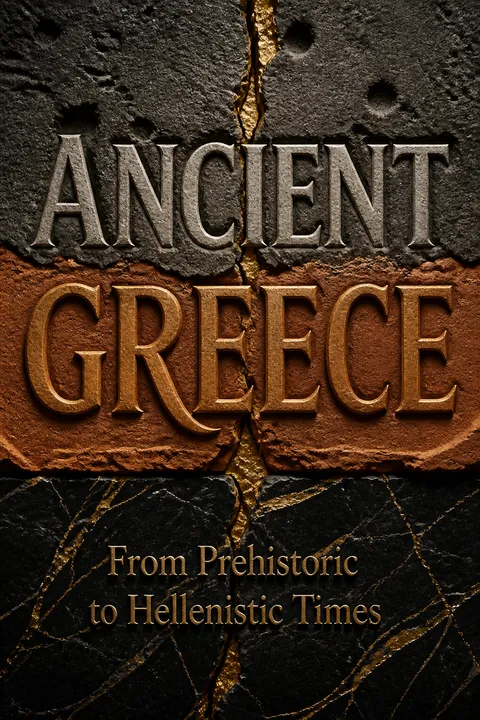
Ancient Greece is praised as an excellent overview of Greek history, from prehistoric to Hellenistic times. Readers appreciate its accessibility, comprehensive coverage, and engaging writing style. The book is noted for its chronological structure, inclusion of cultural aspects, and fair treatment of all historical periods. While some find it lacking in visual aids or detailed analysis, most reviewers recommend it as an ideal introduction for beginners or those seeking a refresher on ancient Greek history. The author's passion for the subject and emphasis on rationality and freedom of speech are particularly commended.
People Also Read


Glossary
polis
Greek city-stateA polis was an independent Greek political community that included an urban center and surrounding countryside. Its residents could live in the central settlement, villages, or isolated farms. The polis was organized around citizenship, shared religious obligations, and local political institutions, rather than around a single unified Greek nation.
synoecism
Joining settlements politicallySynoecism was the process by which separate settlements joined to form a single political community. Residents might continue living in their original villages even after one settlement became the main center. The process helped create city-states such as Sparta from smaller communities.
Linear B
Mycenaean Greek scriptLinear B was a writing system used by Mycenaean palace administrations. Its tablets record goods, workers, land, and religious offerings, rather than extended literature. The script was deciphered in the twentieth century and shown to represent an early form of Greek. Its use largely disappeared when palace society collapsed.
xenia
Guest-host obligationXenia was the customary bond between a host and a guest, including their descendants. It required hospitality and respect even when later generations met as enemies. Homeric stories present this relationship as a serious moral obligation that could override the desire to fight.
hoplite
Heavily armed infantrymanA hoplite was a citizen infantryman equipped with armor, a helmet, a shield, and a spear. Hoplites commonly fought in close formation and generally supplied their own equipment. Their military role is important to debates about how service in a city-state’s defense related to citizens’ political rights.
phalanx
Close infantry formationA phalanx was a formation of infantrymen standing in close ranks, with shields and projecting spears protecting the line. Its effectiveness depended on soldiers maintaining position and working together. Greek accounts associate the formation with hoplite warfare, although the development and spread of its tactics remain debated.
helots
State-controlled Spartan laborersHelots were conquered people, especially Messenians and Laconians, compelled to work for the Spartan community. They were not the private property of individual Spartans and could be freed only by the state. Their agricultural labor supported Spartan citizens, who devoted themselves to military training and feared helot revolt.
metics
Resident foreign inhabitantsMetics were free people who lived in a Greek city-state without holding citizenship there. In Athens they could work, conduct business, and receive some legal protections, while paying taxes and owing certain civic duties. They lacked political rights and generally could not own land without special permission.
Delian League
Athenian-led naval allianceThe Delian League began as an alliance of Greek states organized after the Persian Wars to continue resisting Persian power. Members contributed ships or annual payments, and its treasury was initially kept on the island of Delos. As Athens came to control the alliance’s fleet and finances, the league increasingly operated as an Athenian empire.
ostracism
Temporary political exileOstracism was an Athenian procedure for exiling a citizen for ten years without confiscating his property or permanently removing his rights. Citizens wrote a name on a pottery shard, and the person receiving the most votes was expelled if the vote met the required participation threshold. It was a political safeguard, not a criminal sentence.
Hellenistic
Greek and local cultural blendHellenistic describes the period after Alexander the Great’s death in 323 B.C. and before the death of Cleopatra VII in 30 B.C. It also refers to the mixed cultural world shaped by Greek-speaking rulers and settlers living among long-established populations across the eastern Mediterranean and Near East.
Koine
Common Greek languageKoine was a standardized, simplified form of Greek based largely on the Athenian dialect. It became a widely used language of administration, commerce, and culture across the Hellenistic kingdoms and beyond. The New Testament was written in Koine, which later contributed to Byzantine and Modern Greek.
FAQ
What is "Ancient Greece: From Prehistoric to Hellenistic Times" by Thomas R. Martin about?
- Comprehensive historical overview: The book traces Greek history from prehistory through the Hellenistic Age, focusing on political, social, cultural, and religious developments.
- Geographical and chronological scope: It covers mainland Greece, the Aegean, western Anatolia, Magna Graecia, and Greek settlements around the Mediterranean, with emphasis on the Archaic and Classical Ages.
- Key themes: Martin explores the evolution of city-states, democracy, art, philosophy, and the impact of figures like Alexander the Great.
- Source-based narrative: The book integrates primary sources and archaeological evidence to provide a nuanced understanding of ancient Greek civilization.
Why should I read "Ancient Greece: From Prehistoric to Hellenistic Times" by Thomas R. Martin?
- Accessible yet scholarly: Martin presents a clear, concise narrative suitable for both newcomers and those familiar with Greek history, making complex topics understandable.
- Integration of sources: The book combines literary texts and archaeological findings, offering a multidimensional perspective on Greek life.
- Critical engagement: Readers are encouraged to question interpretations, as Martin highlights the ongoing debates and uncertainties in Greek history.
- Focus on foundational themes: Key concepts such as democracy, citizenship, religion, and philosophy are explored, helping readers understand the roots of Western civilization.
What are the key takeaways from "Ancient Greece: From Prehistoric to Hellenistic Times"?
- Continuity and change: The book emphasizes both enduring traditions (like religion and family) and innovations (such as democracy and philosophy) that shaped Greek civilization.
- Political evolution: The rise and fall of city-states, the development of democracy, and the shift to Hellenistic monarchies are central themes.
- Cultural achievements: Greek art, drama, and philosophy are highlighted as reflections of societal values and historical events.
- Critical use of sources: Martin stresses the importance of interpreting ancient texts and archaeological evidence within their historical context.
How does Thomas R. Martin approach the use of sources and evidence in his study of ancient Greece?
- Primary sources focus: Martin relies on ancient texts, inscriptions, coins, and archaeological remains, urging readers to consider their context and biases.
- Secondary scholarship: Modern interpretations are used to clarify and sometimes challenge primary evidence, with suggested readings for further study.
- Interpretive challenges: The book discusses the persuasive aims and perspectives of ancient authors, highlighting the need for critical analysis.
- Balanced methodology: Martin integrates both literary and material evidence to reconstruct a fuller picture of Greek history.
What physical and environmental factors does Martin identify as shaping ancient Greek civilization?
- Fragmented geography: Greece’s mountains and islands fostered political fragmentation into independent city-states rather than a unified nation.
- Limited resources: Only a small portion of land was arable, leading to reliance on barley, olives, grapes, and maritime trade.
- Climate influence: The Mediterranean climate dictated agricultural cycles and settlement patterns.
- Resource distribution: Uneven access to timber, metals, and stone affected the wealth and power of different regions.
How does "Ancient Greece: From Prehistoric to Hellenistic Times" explain the transition from prehistory to early Greek civilization?
- Neolithic revolution: Around 7000 B.C., Greeks shifted from hunter-gatherers to settled farmers, leading to permanent villages and population growth.
- Technological advances: Early innovations included farming tools, pottery, weaving, and copper metallurgy.
- Social changes: Labor specialization and social hierarchies emerged, with gender inequality increasing due to agricultural practices.
- Cultural influences: Indo-European migrations and Near Eastern contacts introduced new languages, religious ideas, and technologies.
What are the main features of Minoan and Mycenaean civilizations according to Martin?
- Minoan civilization: Centered on Crete, known for palace economies, extensive trade, advanced metallurgy, and a relatively peaceful society.
- Mycenaean civilization: Mainland Greek culture with fortified palaces, a warrior elite, and the use of Linear B script.
- Collapse and legacy: Both civilizations fell around 1200–1000 B.C., but their achievements influenced later Greek culture.
- Cultural exchange: Mycenaeans had significant contact with Minoans and the Near East, adopting and adapting various elements.
How does Martin describe the Greek Dark Age and its significance?
- Period of decline: Following the Bronze Age collapse, Greece experienced population loss, reduced agriculture, and the disappearance of writing.
- Cultural continuity: Oral traditions preserved myths and values, maintaining a sense of identity.
- Recovery and transformation: By 900–750 B.C., population and economy revived, iron replaced bronze, and new social hierarchies formed.
- Foundation for the polis: The conditions of the Dark Age set the stage for the emergence of city-states.
What is the Greek city-state (polis), and how did it develop in the Archaic Age according to Martin?
- Political innovation: The polis was a community of free male citizens with legal equality and political participation.
- Social and geographical structure: Included both urban centers and surrounding countryside, fostering shared identity but also rivalry.
- Variety of governments: City-states developed diverse systems, from oligarchies and tyrannies to early democracies.
- Civic identity: Shared language, religion, and customs were central to the polis, distinguishing citizens from slaves and foreigners.
What are the key political developments in Athens and Sparta during the Archaic Age as presented by Martin?
- Spartan oligarchy: Sparta developed a military-focused society with dual kingship, a council of elders, and reliance on helot slaves.
- Athenian democracy origins: Reforms by Solon, Cleisthenes, and Pericles expanded political rights and established democratic institutions.
- Tyranny and conflict: Periods of tyranny, such as under Pisistratus, reflected social tensions and struggles between different political factions.
- Contrast in systems: Athens and Sparta exemplified the diversity of Greek political experimentation.
How does "Ancient Greece: From Prehistoric to Hellenistic Times" explain the causes and consequences of the Persian and Peloponnesian Wars?
- Persian Wars: Triggered by Athenian support for the Ionian revolt, leading to major battles like Marathon, Thermopylae, and Salamis, and resulting in Greek unity and Athenian ascendancy.
- Athenian empire: Post-war, Athens led the Delian League, transforming it into an empire and fueling its Golden Age.
- Peloponnesian War: Stemmed from Athenian expansion and Spartan fears, resulting in prolonged conflict, devastation, and the weakening of Greek city-states.
- Long-term impact: Both wars reshaped Greek politics, society, and set the stage for Macedonian dominance.
What are the defining features of the Hellenistic Age and Alexander the Great’s impact, according to Martin?
- Alexander’s conquests: His campaigns spread Greek culture from Greece to India, founding cities and encouraging cultural fusion.
- Rise of monarchies: After Alexander’s death, his generals established Hellenistic kingdoms blending Greek and Near Eastern traditions.
- Cultural cosmopolitanism: Greek language and culture mixed with local customs, especially in urban centers like Alexandria.
- Philosophical and scientific advances: New schools of thought and scientific achievements flourished, while most people’s lives remained rooted in traditional practices.
Download PDF
Download EPUB
.epub digital book format is ideal for reading ebooks on phones, tablets, and e-readers.








