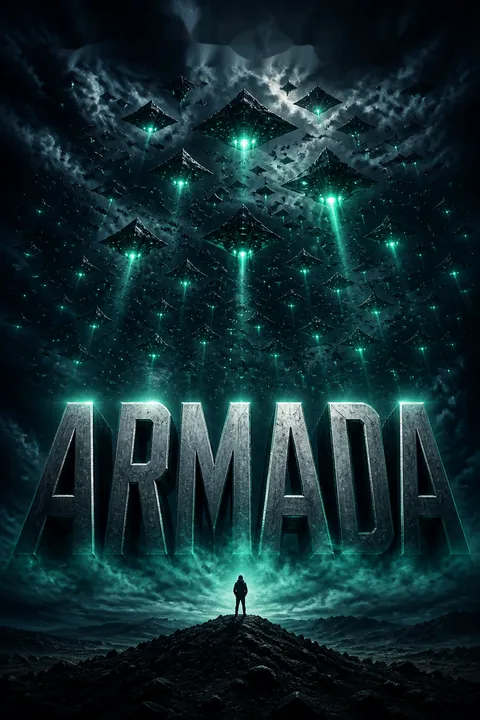


Plot Summary
A Glaive Over Beaverton
Zack Lightman,1 an eighteen-year-old gamer with a hair-trigger temper, sees a silver Sobrukai Glaive Fighter zigzag across the sky above his Beaverton high school. The ship is identical to an enemy craft in Armada, the game he plays obsessively, so he wonders whether he is hallucinating like his dead father2 supposedly did. Then Zack1 watches Douglas Knotcher16 torment Casey Cox17 with spitballs.
Unable to contain his anger, Zack1 smears the spitballs across Knotcher’s16 head, nearly starts a fight, and bolts from school before it can turn violent. He drives home to find his father’s old notebook, hoping it will explain the impossible sight. The spacecraft is gone, but the doubt it leaves behind follows him into the attic.
The opening makes Zack’s fantasy life both refuge and liability. He has spent years wanting an extraordinary event to break the boredom of ordinary life, yet the first apparent proof arrives through a mind he already distrusts. His response to Knotcher is equally important: Zack intervenes against cruelty, but the memory of once seriously injuring the bully makes even a moral impulse feel dangerous. Adventure and self-control are thus linked from the start. The Glaive does not simply promise escape; it forces Zack to question whether his longing has distorted what he sees.
The Phaëton Notebook
In the attic, Zack1 reopens the blue notebook his father,2 Xavier,2 filled with dates, game titles, and theories about a military conspiracy. Xavier2 had linked videogames, science-fiction films, and real military simulators, arguing that popular entertainment might be training recruits without their knowledge.
His notes about the vanished arcade game Phaëton and the urban legend Polybius look delusional, but Zack1 confirms that the Army really did adapt Atari’s Battlezone into a tank trainer.
The evidence unsettles his childhood dismissal of the notebook, yet he still decides his father’s2 ideas are probably madness and vows to stop playing Armada for two weeks. He postpones the vow until that night’s rare elite mission, then hurries to work with his questions unresolved.
The notebook gives the story its central method: treat popular culture not as harmless decoration but as a possible record of hidden decisions. Zack is neither credulous nor fully skeptical. He checks one claim, finds it grounded in fact, then uses that partial confirmation to take the safer psychological route of dismissing the larger theory. His father’s absence intensifies this response. The notebook is evidence, but also an intimate remnant of a man Zack fears he may resemble. His postponed gaming break shows how easily self-knowledge yields to the comfort of an established obsession.
The Mission That Fails
At Starbase Ace, Zack’s1 eccentric boss Ray Habashaw5 gives him a costly new Armada flight-control system as an early graduation present. That evening, Zack1 joins his friends Cruz6 and Diehl7 for Attack on Sobrukai, a rare mission in which players escort a weapon called the Icebreaker to the aliens’ homeworld. Zack1 breaks formation to attack a Dreadnaught Sphere, then returns too late to protect the Icebreaker.
It and the carrier are destroyed, and the mission fails. Cruz6 and Diehl7 leave the game, while Zack1 stays behind with the old jacket of his father,2 grieving the life he never shared with him. The next morning, Knotcher16 and two friends corner Zack1 over the jacket. Zack1 raises a tire iron, then stops himself before striking.
The failed mission plants a crucial contrast between mastery and judgment. Zack is highly skilled, but he chooses individual spectacle over coordinated defense, and the objective is lost. The game makes that failure safe, even exhilarating; the parking-lot confrontation makes his capacity for harm real. When Zack lowers the tire iron, he achieves something he could not manage in junior high: he feels anger without surrendering to it. His father’s jacket connects both scenes, carrying inherited identity as a comfort and a provocation. Zack wants a role large enough to matter, but he has not yet learned what responsibility demands.
Ray’s Shuttle Arrives
As Knotcher16 backs away, an Earth Defense Alliance shuttle descends in front of the school. Students scatter, but Zack1 recognizes the craft from Armada. Ray5 emerges in a dark suit and identifies Zack1 as urgently needed for national defense, then takes him aboard.
On the flight, Ray5 admits that the Earth Defense Alliance is real and that Terra Firma and Armada are combat simulators built to train drone pilots. Their fictional Sobrukai are modeled on an actual enemy, whose scout ships have begun surveying Earth.
Ray5 explains that the military seeded science fiction and games into popular culture to prepare the public and identify gifted players. He also reveals that his real name is Raymond Habashaw5 and that he was assigned to watch Zack.1 Zack1 is furious, but learns his father’s2 file may be accessible if he enlists.
Ray’s revelation turns Zack’s private suspicion into an institutional history, but it also transforms a friendship into a breach of trust. Ray has been a surrogate father, yet his kindness was partly an assignment, and his familiar conspiracy talk was preparation for a secret he could not disclose. The revelation implicates popular culture in a double role: it has entertained Zack and trained him at once. His anger at Ray is psychologically apt, because the truth arrives through someone who helped create his sense of safety. The promise of access to his father’s file gives Zack a personal reason to enter a war he barely understands.
Europa’s Swastika
At the underground Crystal Palace base in Nebraska, Zack1 meets Alexis Larkin,4 a sharp, technically gifted Terra Firma pilot who shares his disbelief and humor. Together with other recruits, they watch a briefing narrated by Carl Sagan.
It recounts NASA’s discovery of a swastika-shaped mark on Europa, a probe’s disappearance, and a hostile message that led the Earth Defense Alliance to prepare for invasion. The enemy fleet is now approaching Earth in three waves, carrying billions of drones.
Admiral Archibald Vance8 explains that civilian gamers have been summoned because years of simulated combat made them the Alliance’s best available pilots. Before the recruits can absorb the countdown, Glaive Fighters attack Crystal Palace. Zack1 follows Lex4 to a control station and enlists so he can fight.
The briefing converts cultural familiarity into operational knowledge. Zack recognizes ships, tactics, and even the emotional grammar of an alien invasion because the war has been rehearsed for him through entertainment. Yet the film’s calm presentation cannot remove the moral shock of learning that secrecy has shaped his whole world. Lex provides an immediate human counterweight to the spectacle: she is not impressed into silence, and her practical courage draws Zack out of paralysis. The attack that interrupts the briefing makes the EDA’s claims tangible, while the enlistment screen reveals how institutions can turn an emergency into consent under pressure.
Crystal Palace Burns
Zack1 launches the first Interceptor from Crystal Palace and quickly destroys several Glaive Fighters, using the patterns he has learned in Armada. When five enemy ships combine into a towering ground mech, Lex4 and the base’s infantry drones bring it down.
The remaining attackers then dive toward open launch tunnels. Zack1 disobeys Vance’s8 order to break off, believing he must stop the last fighter before it reaches the drone hangar. His own ship’s transponder opens the tunnel’s safety barriers for both aircraft.
The Glaive detonates inside, destroying more than five hundred reserve Interceptors and collapsing part of the base. Vance8 explains that the barriers would have stopped the enemy had Zack1 followed orders. No personnel die, but Zack’s1 first act of combat nearly costs the Alliance irreplaceable weapons.
The battle exposes the danger of transferring game habits directly into life. Zack’s pattern recognition is real, but so is his tendency to mistake initiative for good judgment. He believes he is saving the base, yet his pursuit defeats the very safeguards meant to protect it. Vance’s criticism is not simply military discipline imposed on a civilian; it names the new ethical condition of action, where a split-second choice carries consequences beyond a player’s ranking. Zack’s competence remains valuable, but the scene strips away the fantasy that talent alone can substitute for context, restraint, or trust.
The Father in Command
Called to Vance’s8 office, Zack1 expects punishment for the ruined hangar. Instead, the admiral8 tells him that Xavier Lightman2 is alive, serves as an EDA general, and pilots Armada as the top-ranked player RedJive. The EDA faked Xavier’s2 death to protect its secrecy, and he has supervised Zack’s1 training through the game.
Vance8 assigns Zack1 to Moon Base Alpha, where Xavier2 commands, giving him the chance to access his father’s2 classified file. Zack1 is stunned and angry that Xavier2 watched his life from a distance without contacting him. At the shuttle bay, he meets Lex4 again as she receives orders for another base. They exchange contact details and kiss before departing on separate shuttles.
The revelation answers Zack’s childhood question by making it more painful, not less. His father was not simply lost to accident or death; he was near enough to observe Zack while remaining absent from daily life. That knowledge scrambles the distinction between care and abandonment. Xavier’s surveillance can be read as devotion, but from Zack’s position it also resembles the controlling secrecy of the EDA. The brief connection with Lex offers possibility without resolving the family wound. Their farewell is shaped by an impending war, so intimacy arrives not as a promise of security but as a choice to acknowledge one another under pressure.
A Reunion on the Moon
At Moon Base Alpha, Zack1 meets Xavier2 face to face for the first time since infancy. Xavier2 apologizes and gives him a flash drive of letters written to Zack1 and his mother3 throughout the years. The letters confirm that Xavier2 joined the EDA willingly after encountering the Phaëton arcade machine and learning of the invasion.
He describes missing every birthday, enduring isolation, and watching his son1 grow through occasional reports. Zack1 is moved but cannot erase the damage.
In the Thunderdome, Xavier2 introduces the other elite pilots and explains the recurring attacks on the moon base, the enemy’s Disrupter weapon, and the plan to send another Icebreaker toward Europa. He also reveals his suspicion that the enemy’s behavior may be a test, not a straightforward attempt at conquest.
The letters complicate the simple moral categories Zack has used to survive his father’s absence. Xavier did not forget his family; he documented his longing in private, but his devotion could not protect them from the consequences of his choice. The flash drive offers emotional evidence, not restitution. Xavier’s theory about the enemy extends the family conflict into a larger question of interpretation: is apparent hostility self-explanatory, or can fear make one misread another species? Zack rejects the theory for now, in part because he needs a clear enemy and a father whose past choices he can judge.
Moon Base Falls
When the vanguard reaches the moon, Europan drones attack Moon Base Alpha. The base’s defenses and its Interceptor reserves are overwhelmed, and its crew retreats into an escape capsule. Shin10 and Milo13 remain behind to delay the attackers; Graham11 is seized and killed when a Basilisk breaks into the capsule.
Lex4 arrives in a manned Sentinel, destroys the Basilisk, and lifts the survivors to safety. At an emergency bunker, Xavier2 equips the group with experimental piloted Interceptors.
They fly to Antarctica, where the first Disrupter is disabling the Alliance’s global drone network. Chén15 sacrifices his ship to break its shield, and Xavier2 follows with a second timed attack that destroys the weapon. Zack1 finds Xavier’s2 escape pod underwater and rescues him, then flies him home to Beaverton.
The fall of Moon Base Alpha converts the war from an exhilarating assignment into intimate loss. Shin and Milo’s decision to hold the line, Graham’s death, and Lex’s rescue show distinct forms of courage, while the escape capsule makes survival visibly dependent on others. Zack’s father is not merely an answer to his past here; he is a vulnerable person he can lose again. The Disrupter battle confirms the extraordinary efficacy of sacrifice, but it also raises the question Xavier has been asking: why does the enemy’s defense fail at precisely the moment a heroic maneuver requires it? Zack saves his father without yet accepting his interpretation.
Home Before the Next Wave
Zack1 lands near his high school, hides his damaged Interceptor in the gym, and carries the injured Xavier2 to their old Dodge. His mother,3 Pamela,3 arrives home and recognizes her supposedly dead husband.2 She embraces Xavier,2 then Zack,1 while their elderly beagle Muffit climbs into Xavier’s2 lap.
The reunion gives the family a brief, impossible happiness, but the war is not over. Zack1 visits Cruz6 and Diehl,7 who have defended Beaverton with commandeered ATHIDs, and tells them he has been on the moon with his father.2
He explains Xavier’s2 suspicion that the Europans are provoking a test rather than pursuing simple extermination. Cruz6 and Diehl7 take the possibility seriously. Zack1 decides he must challenge the EDA’s plan before the next wave arrives.
The homecoming gives the story its most ordinary image of restoration: a battered car, a familiar lawn, a dog remembering a presence his owners assumed was gone. Yet the scene does not return Zack to his former life. His family is reunited in the middle of a ruined world, and the countdown makes tenderness inseparable from urgency. The visit to Cruz and Diehl shows why Zack needs peers as well as parents: they help him test an idea without turning it into either certainty or fantasy. His decision grows from evidence and relationship, not from a sudden desire to be a hero.
The Icebreaker Must Stop
Zack1 contacts Finn Arbogast, then uses the access he gains to reach the Armistice Council, including leading scientists who have studied the Europans. He shares Xavier’s2 recordings and evidence from the Disrupter battle.
The council confirms that Nixon ordered the original Envoy probe to carry a nuclear weapon, meaning humanity may have attacked first after misreading the mark on Europa. They agree the Icebreaker could provoke the destruction of Earth, but Admiral Vance8 cuts into the call and refuses to change course.
Lex4 helps Zack1 secure the communications network, while Debbie12 and Whoadie14 join the plan. Xavier2 proposes that he delay Vance8 at Raven Rock as Zack1 remotely controls three Interceptors to destroy the Icebreaker before it fires on Europa.
The revelation of human culpability does not absolve the enemy or undo its victims; it changes the meaning of retaliation. The council’s evidence makes the conflict a chain of reciprocal interpretations, with each side treating fear as proof of hostile intent. Vance’s refusal is understandable within a command structure responsible for millions of lives, yet his certainty risks repeating the original mistake at greater scale. Zack’s response depends on collective trust: he must persuade people across rank and distance, then accept a plan in which his father will face the institution he once served.
Raven Rock’s Last Stand
As the second wave attacks Earth and a new Disrupter lands at Devils Tower, Zack1 and his friends defend Starbase Ace through the EDA’s hard-line network. Pamela3 guards Zack1 with a laser-equipped QComm while Cruz6 and Diehl7 control tethered ATHIDs outside.
Xavier2 flies to Raven Rock, enters the base through a launch tunnel, and fights through its defenses with help from Ray5 and Lex.4 Wounded, he commandeers four ATHIDs and uses them to carry him into Vance’s8 command center.
Xavier’s2 assault delays the Icebreaker’s escort long enough for Zack1 to attack it remotely near Europa. Xavier2 sets the ATHIDs to overload and tells Vance’s8 staff to flee. The drones explode, and the communications feed goes dark. Zack1 has no way to know whether his father2 survived.
Xavier’s final assault mirrors his earlier life: he again chooses duty over reunion, but this time Zack understands the choice and participates in it. The network connects a small game store, a hidden military base, and a distant planet, making ordinary civilian spaces part of the battlefield. Pamela’s defense of her son is equally significant; the woman once left to raise him alone now stands beside him by choice, not by orders. The loss of contact with Xavier forces Zack to act without emotional reassurance. His growing maturity appears in that separation: he must continue the mission without knowing whether love will be returned to him.
The Icebreaker Explodes
Vance8 retakes control of the Icebreaker’s escort, and Zack1 faces him in a running duel above Europa. He loses two Interceptors before using his final ship to destroy Vance’s8 fighter, then turns his guns on the Icebreaker seconds before it can fire its nuclear payload.
The weapon explodes harmlessly above Europa. Across Earth, the attacking drones abruptly shut down. A vast machine rises from the moon’s subsurface ocean and identifies itself as the Emissary, an artificial intelligence sent by the peaceful Sodality.
It reveals that there were no intelligent Europans: the AI created and controlled the armada to test whether humanity could resist escalating a conflict. Zack1 accepts the Sodality’s invitation to join, and the truth is broadcast worldwide.
The climax makes restraint an active, risky deed rather than a passive refusal to fight. Zack has every emotional incentive to destroy the enemy: it has killed his friends and father, and Vance’s strategy appears to promise survival. Yet the Icebreaker would repeat the first nuclear mistake, converting uncertainty into annihilation. The Emissary’s explanation validates Xavier’s suspicion but does not make the test morally clean; millions have died under a manufactured threat. The victory is therefore ethically compromised. Humanity passes by changing course, but it does so only after the test has imposed irreversible costs.
Epilogue
The Sodality’s drones help rebuild Earth and provide clean energy and cures for disease, but Zack1 remains wary of their motives. At a memorial for Xavier,2 Knotcher,16 now an injured EDA sergeant, asks Zack1 to sign their yearbook and acknowledges the man Xavier became.2 Zack1 keeps the family close: he is with Lex,4 Pamela,3 and his infant half-brother.
He initially refuses an ambassadorial post, unwilling to serve either the secretive EDA or the beings who engineered the test. Then he changes his mind. Rather than retreat to Starbase Ace, he chooses to investigate the Sodality from within, hoping to protect the people he loves from whatever its generosity may conceal.
The aftermath refuses a clean conversion from catastrophe to utopia. Medicine, energy, and reconstruction improve human life, but they do not purchase trust. Zack’s decision to become an ambassador is not forgiveness; it is a commitment to stay engaged with power rather than leave it unexamined. Knotcher’s altered body and subdued manner make the cost of the invasion personal, while his recognition of Xavier offers a small, incomplete reconciliation between former enemies. The ending answers Zack’s opening wish for adventure by changing its meaning: he no longer needs fantasy to escape the world. He accepts responsibility for living in it, including the obligation to question those who claim to have saved it.
Analysis
Armada is built around the collision between imaginative rehearsal and lived consequence. Zack’s1 games genuinely prepare him for combat, but they also teach a simplified world in which enemies repeat patterns, mistakes cost rankings, and spectacular initiative is rewarded. The first Crystal Palace battle exposes the limit of that training: Zack’s1 skill saves lives, yet his impulsiveness destroys a reserve hangar because the real battlefield contains procedures he has never seen. His development is not a rejection of games or fantasy, but a movement from using them as escape to interpreting them as partial models that require judgment.
The book’s central ethical problem is epistemic as much as military. Humanity encounters an unexplained mark, assumes hostility, and sends a nuclear device. The resulting fear makes each side’s preparations look like confirmation of the other’s worst expectations. Xavier’s2 theory asks Zack1 to consider that the familiar alien-invasion story may itself distort perception. That suspicion proves substantially correct, but the Emissary’s test is not thereby made just. Its manufactured war kills people and destroys communities; the survivors’ moral choice cannot retroactively redeem those costs.
Family relationships echo this political structure. Xavier’s2 concealment was meant to protect humanity, but it imposed lasting grief on Pamela3 and Zack.1 His letters prove love while also exposing the inadequacy of love kept secret. Ray’s5 genuine affection is similarly entangled with institutional deception. Zack1 must learn that motive does not erase consequence, whether in a father,2 a commander, or an alien intelligence.
The ending resists simple triumph. The Sodality offers cures and clean energy, yet its benevolence follows an experiment conducted without consent. Zack’s1 choice to serve as an ambassador is therefore a form of vigilant participation. He no longer waits for a grand adventure to rescue him from ordinary life. He accepts that responsibility means staying close to power, asking difficult questions, and protecting particular people in a world whose larger promises remain uncertain.
Review Summary
Armada by Ernest Cline receives mixed reviews. Critics praise the engaging sci-fi premise where gamers defend Earth from aliens using video game skills, comparing it to The Last Starfighter and Ender's Game. However, many find it inferior to Ready Player One, citing excessive 1980s pop culture references, predictable plotting, shallow characters, and over-reliance on nostalgia. Reviewers criticize the protagonist's constant movie comparisons instead of genuine emotion, rushed pacing, and derivative storytelling. Some enjoyed the conspiracy theories and action sequences, while others found battle scenes boring and the ending disappointing.
People Also Read

Characters
Zack Lightman
Reluctant ace pilotAn eighteen-year-old from Beaverton, Zack is a gifted Armada player who has built much of his identity around games, science fiction, and his absent father2. Humor lets him manage grief and social discomfort, while anger threatens to turn his sense of justice into violence. He wants his life to matter, but initially confuses boldness with sound judgment. His friendships with Cruz6 and Diehl7, his growing bond with Lex4, and the unfinished questions surrounding his family gradually push him toward a more disciplined form of courage. Zack is observant and skeptical, though he can resist evidence when it threatens the simple story he needs to believe.
Xavier Lightman
Absent father and pilotZack’s1 father is a passionate gamer whose notebooks and old possessions shape Zack’s1 imagination of him. Xavier is inventive, persistent, and drawn to patterns others dismiss, but his convictions can isolate him from people who disagree. His relationship with Pamela3 and Zack1 lies at the emotional center of the story, even before Zack1 learns the full history behind his absence. He represents both the appeal and the danger of living by a grand theory: the capacity to notice what institutions overlook, alongside the risk of mistaking a compelling pattern for proof.
Pamela Lightman
Steadfast single motherPamela is a nurse who raised Zack1 while working long hours and managing the pain of losing her young husband2. She is affectionate, direct, and difficult to fool, using teasing and firm boundaries to reach her son1 when he withdraws into games. Her calm under pressure comes from practical care rather than detachment. She wants Zack1 to imagine a future beyond his current comfort, but she does not reduce his worth to conventional success. Pamela’s loyalty is rooted in action: she protects, challenges, and keeps showing up, even when grief makes each of those acts costly.
Alexis Larkin
Fearless mech pilotKnown to friends as Lex, Alexis is a skilled Terra Firma player and software worker from Austin. Her sharp humor, independence, and technical curiosity make her hard to intimidate, though her confidence does not erase her fear of what is coming. She has lost her parents and remains close to her grandmother, giving her a private tenderness beneath her brash manner. Lex approaches unfamiliar systems as puzzles to be taken apart, which makes her especially resourceful with the EDA’s technology. Her connection with Zack1 begins amid crisis, but rests on mutual recognition rather than the fantasy of a perfect rescuer.
Raymond Habashaw
Undercover mentorZack’s1 boss at Starbase Ace is a generous, eccentric gamer who treats the struggling shop as a place to celebrate videogame culture rather than maximize profit. Beneath his easygoing manner, Ray has spent years in an undercover assignment connected to Zack’s1 training. His warmth is real, even when his identity and purpose are concealed. Ray’s relationship with Zack1 illustrates how institutional deception can coexist with genuine affection, making it difficult for either man to reduce their bond to a simple betrayal.
Cruz
Loyal gaming friendCruz is one of Zack’s1 two closest friends and a steady presence in their shared gaming life. He is competitive, knowledgeable about popular culture, and willing to challenge Zack1 when his impulsiveness threatens the group. His loyalty is practical as well as emotional: he joins the defense of Beaverton and helps Zack1 think through the implications of the invasion. Cruz’s humor keeps their friendship grounded in its familiar rhythms even when the world outside their bedrooms has become unrecognizable.
Diehl
Quick-witted gaming friendDiehl, Zack’s1 other closest friend, shares his love of games and genre stories, but often brings a more teasing, irreverent perspective to their conversations. His banter can disguise how deeply he cares about Zack1. When events turn dangerous, he joins Cruz6 in defending their neighborhood and helping Zack1 test his father’s2 theory. Diehl’s blend of humor and loyalty gives Zack1 a link to ordinary teenage life, even as that life is being reorganized around a global emergency.
Admiral Archibald Vance
Hard-line EDA commanderVance is a scarred, respected commander whose public authority is matched by personal skill as a pilot. He believes the EDA must act decisively to protect humanity, and he treats obedience as essential when mistakes can destroy lives and equipment. His long friendship with Xavier2 complicates his strictness: their disagreement is not between a villain and a hero, but between two men carrying different versions of responsibility. Vance’s confidence can become inflexibility, especially when uncertainty threatens a plan built around survival.
Admiral Ray Habashaw
Undercover mentorThis character is not a separate person. Ray Habashaw is Zack’s1 employer and mentor, listed above under his full name, Raymond Habashaw5.
Shin Hashimoto
Veteran moon-base pilotA longtime EDA officer stationed at Moon Base Alpha, Shin is practical, sociable, and accustomed to the strange routines of isolated service. He plays games and music with his fellow officers, helping create a fragile sense of home in a remote military outpost. Shin is skeptical of Xavier’s2 theory about the Europans, preferring evidence that can support immediate action. His disagreements with Xavier2 reflect a genuine difference in how to handle uncertainty, not a lack of care for his friend.
Graham Fogg
British EDA veteranGraham is one of Xavier’s2 oldest friends and a British officer serving at Moon Base Alpha. His humor and love of role-playing games and music help break the strain of isolation. Graham is more willing than Shin10 to entertain suspicious explanations for the Europans’ behavior, though his conclusions can outrun his evidence. He is an affectionate companion who brings warmth to the base’s small community and takes its shared history seriously.
Debbie Winn
Protective pilot motherDebbie is a school librarian and mother of three teenage boys who is recruited for her skill in Armada. Her nurturing instincts remain active even in the middle of a military crisis, and her faith gives shape to the fear she struggles to manage. She is not fearless; she is a parent forced to act while separated from the people she loves. Her steadiness and compassion help the new recruits become a team rather than a collection of isolated players.
Milo Dobson
Boastful top pilotKnown online as Kushmaster5000, Milo is a brash, funny pilot whose bravado initially makes danger seem like an adventure. Beneath the noise, he is generous with his fellow recruits and capable of courage when the situation turns grim. His enthusiasm offers temporary relief to people who are frightened, though it also keeps him from taking the scale of the threat seriously at first. Milo’s voice gives the group a rough-edged warmth.
Whoadie
Resourceful young pilotLila, known by the nickname Whoadie, is a sixteen-year-old pilot from New Orleans with a remarkable memory and a sharp, fearless manner. She has endured profound loss and learned to defend herself, yet her humor and curiosity remain intact. She quotes literature with ease and forms an immediate bond with fellow recruit Jiang Chén15. Though younger than most of the other pilots, Whoadie is not treated as merely a mascot; she acts decisively and expects adults to take her seriously.
Jiang Chén
Chinese ace pilotA highly ranked Chinese pilot known online as CrazyJi, Chén speaks limited English and relies on his QComm translator to communicate with the others. His pride in his family and country sits alongside a playful eagerness to belong to the new team. The translation device sometimes makes his humor sound abrupt, but his intentions are generous and direct. His friendship with Whoadie14 begins through small exchanges of admiration and grows across their language difference.
Douglas Knotcher
Zack’s school nemesisKnotcher is a bully whose cruelty toward Casey17 and provocative attacks on Zack’s father2 repeatedly test Zack’s1 capacity for self-control. His own home life is troubled, but Zack1 refuses to treat that as an excuse for harming others. Their history makes Knotcher a personal trigger for Zack’s1 anger and a measure of how much violence Zack1 fears within himself. The character’s role is rooted in specific harm, not in a generic rivalry.
Casey Cox
Target of bullyingCasey is a shy classmate whom Knotcher16 regularly humiliates. His inability to respond visibly makes Zack’s1 intervention more complicated than a simple rescue: Casey is frightened rather than immediately grateful, reminding Zack1 that acting for someone does not mean controlling how they feel.
Plot Devices
Armada and Terra Firma
Training hidden in playThe two popular multiplayer games appear to simulate a fictional human war against the Sobrukai. In reality, their combat systems train skilled civilian players to operate the EDA’s remote drones. Zack’s1 years of practice give him genuine tactical ability, but the games also teach patterns and habits that do not always transfer safely to actual combat. This device makes play both preparation and a source of dangerous overconfidence.
Phaëton notebook
A father’s paper trailXavier’s2 old notebook collects dates, game histories, military projects, and theories about how popular entertainment might prepare people for an alien conflict. Zack1 initially reads it as evidence of delusion, then discovers that some of its details correspond to real military experiments. The notebook gives the reader clues before Zack1 understands their full significance and links his investigation into the EDA to his unresolved relationship with his father2.
QComm network
Communication and controlThe EDA’s wrist-mounted quantum communicators allow secure contact over vast distances and can connect users to military drones. Their software also contains exploitable weaknesses that Lex4 discovers and uses to share information, protect calls, locate people, and coordinate Zack’s1 plan. The hard-line EDA intranet provides a crucial fallback when the Disrupter disables wireless links. Together, these technologies turn distant friends and family into active participants in the conflict.
The Disrupter
A test of retaliationThis alien weapon creates a field that disables the EDA’s quantum and radio-controlled drones when both operator and machine are inside its range. Its brief shield failures appear to invite daring attacks, and each activation changes the balance of battle. The Disrupter first threatens the moon base, then disables defenses on Earth. Its apparent vulnerability becomes evidence in Xavier’s2 argument that the enemy is testing how humanity responds to escalating danger.
The Icebreaker
The final retaliatory choiceThe Icebreaker is a nuclear weapon designed to melt through Europa’s ice and destroy the enemy’s supposed underwater home. Its first mission fails, but a hidden second version remains on course. Xavier2 and Zack1 believe firing it would repeat the original human attack that began the conflict and provoke humanity’s destruction. The weapon therefore gives the climax a concrete choice: complete an act of revenge or risk restraint without knowing whether the enemy will reciprocate.

Download PDF
Download EPUB
.epub digital book format is ideal for reading ebooks on phones, tablets, and e-readers.








