

Key Takeaways
Treat success as an art built from seven conditions, not a formula.
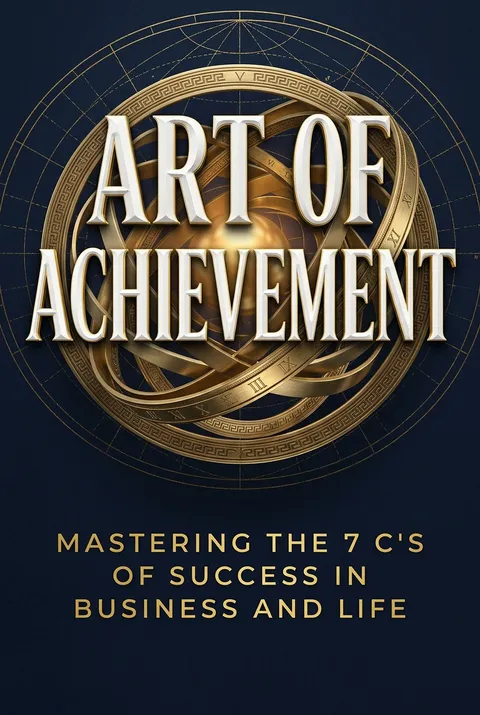
Achievement takes craft. Tom Morris describes success as something made through practiced choices, not a secret technique that guarantees wealth or fame. His seven conditions are a clear conception of the goal, confidence, concentration, consistency, commitment, character, and the capacity to enjoy the process. Together, they form a toolkit for directing effort, not a promise that fortune will cooperate. Morris defines true success as discovering, developing, and using one’s talents for the good of oneself and others.
Success has many shapes. Morris remembers his father as inventive, generous, and industrious, though his father did not feel successful. His story challenges the idea that status or money alone can measure a life. The better question is whether achievement suits one’s talents, values, relationships, and contribution.
The artistic metaphor usefully shifts attention from outcomes alone to the quality of the choices that produce them. It also makes room for different definitions of a good life, rather than treating every person as a failed version of the same celebrity or executive. The framework is strongest as a diagnostic: a stalled effort may need clearer aims, better preparation, or more integrity. It is weaker if treated as a universal causal model, since opportunity, health, discrimination, and luck can shape results independently of personal discipline.
Choose goals that fit your values, then let action teach you more.
Start with self-knowledge. Morris argues that useful goals come from examining what a person values, enjoys, and wants to change, rather than copying another person’s ambitions. He suggests a personal audit: list what to preserve and what to change, including in work and relationships. Writing or talking through these questions can turn vague dissatisfaction into clearer priorities. A larger sense of purpose helps test whether a particular goal belongs in one’s life.
Goals can be provisional. A former student moved to Nashville hoping to become a country singer. She learned that performing was not her strongest fit, but the experience introduced her to the music business and to the work of music attorneys. With further study, she built a career helping performers. The original aim was not wasted: pursuing it revealed information she could not have gained by standing still.
This view resembles learning through exploration: people often discover preferences and capacities by trying activities, not by introspection alone. It also softens the false choice between rigid planning and passive drift. A goal can provide enough direction to generate useful experience while remaining open to revision. One caution is that not every detour is affordable. Time, money, caregiving, and access constrain experimentation, so reflection should include the costs and risks of a trial, not just its possible discoveries.
Give your chosen goal a vivid image that can recruit your will.
A goal needs commitment. Morris distinguishes a fantasy, a desire, and a goal. A fantasy is an imagined possibility; a desire inclines a person toward it; a goal is a chosen commitment that begins changing behavior. He argues that goals become more motivating when imagination gives them concrete emotional force, rather than leaving them as an intellectual resolution.
Picture the work. Morris recounts swimmer Haley Scott’s return after a bus accident left her paralyzed from the waist down. Despite a grim medical prognosis, she repeatedly imagined the details of swimming again, endured operations and rehabilitation, and returned to competition 21 months after the crash. The story illustrates the role of a vivid aim in sustaining effort through hardship. It does not mean that visualization alone overcomes physical limits; her story also involved treatment, training, and persistence.
Mental rehearsal is used in performance settings because imagining a sequence can help people prepare attention and action. Morris’s distinction between wanting and committing is especially practical: a goal should show up in what someone does, not merely in what they announce. Scott’s experience is powerful, but an exceptional recovery should not become a standard imposed on people facing disability or illness. Imagination can support agency, yet it cannot guarantee an outcome or replace medical expertise and material support.
Diagnose confidence by finding the missing resource, not by demanding certainty.
Confidence has components. Morris’s Confidence Checklist examines whether someone has the power, skill, opportunity, and practical knowledge to do a task. It also asks whether the person is morally willing to do it and has the heart to persist. A lack of confidence may point to a real gap in preparation or access, rather than a character flaw. Each gap suggests a practical question: can the needed skill be learned, can a partner help, or can the opportunity be created?
Confidence is not a guarantee. Morris treats it as a condition that can make action and persistence more likely, especially when a task is difficult. He also distinguishes confidence from courage: courage is acting despite danger, while confidence is trusting that success is possible. His advice is not to ignore risk, but to examine it carefully and build a credible basis for action.
Breaking confidence into capabilities and conditions echoes the distinction between believing in oneself and having the resources to act. That distinction prevents empty encouragement from substituting for training, time, authority, or help. Confidence can also grow through small successful experiences, a principle relevant to education and rehabilitation. Still, the checklist cannot settle every uncertainty: people may accurately identify their skills yet face unpredictable markets or other people’s decisions. Confidence is best treated as informed readiness, not certainty.
Map the gap, then act before planning becomes another form of delay.
Give effort a route. Morris’s Three-fold Map asks three questions: where are we now, where do we want to be, and what path could connect the two? A person might identify low fitness as the starting point, improved health as the desired state, and regular walking as one part of the route. The map can be expanded with resources, likely obstacles, and backup plans. It should remain flexible because action reveals information that a plan made from the sidelines cannot provide.
Learn in motion. When Morris’s publisher failed to secure a television appearance for his book, he devised a playful pitch tied to back-to-school advice and sent a large inflatable figure to Regis Philbin’s building. The show invited him on. The episode shows persistence joined to adaptation, not persistence as endlessly repeating the same failed tactic. Early mistakes can also teach what to change.
The map is a compact form of problem-solving: define the present, specify a desired state, and choose a testable route. Its greatest strength is pairing preparation with feedback. In complex settings, plans are hypotheses, and action supplies evidence about whether the assumptions hold. This resembles iterative design, where a prototype teaches more than another round of speculation. Yet acting quickly is not always wise; decisions involving safety, large financial commitments, or irreversible consequences deserve more scrutiny than a low-cost experiment.
Stay true to the destination while changing the route and resisting temptation.
Consistency is not sameness. Morris uses vision consistency to mean keeping actions aligned with goals and values while adapting tactics to changing circumstances. A habit can help in one setting and become a liability in another. Likewise, an apparent exception can become a repeated pattern when people tell themselves that one small departure does not matter.
Make intentions concrete. Morris describes realizing that frequent travel was costing him family time. His original promise to be home more was too vague to guide decisions, and he continued accepting trips. He eventually set specific limits on travel and made clearer plans for time with his family. Those boundaries made his behavior more consistent with what he said mattered. The lesson is not to eliminate every lapse, but to notice it, correct course, and avoid turning it into a routine.
This distinction helps reconcile two useful but often competing ideas: habits create reliability, while adaptation preserves relevance. In behavioral science, a stated intention is often less actionable than a specific plan tied to a situation. Morris’s travel example makes the cost of vagueness visible: without boundaries, each invitation can seem like an exception. The caution is that consistency can become stubbornness when the goal itself is no longer sound. Periodic review matters as much as follow-through.
Make work matter to you before expecting enthusiasm to carry you.
Interest needs meaning. Morris presents enthusiasm as an emotional commitment supported by interest and desire. When a task feels dull, he suggests looking for a challenge, a new skill, a connection to something valued, or a larger purpose that makes the work matter. He distinguishes enthusiasm from arrogance: the energy should draw attention to the work, not demand attention for the worker.
Change the frame. Nick Campbell, an engineer at Johnson & Johnson, grew frustrated and earned a poor-attitude nickname. After reconsidering his approach, he treated coworkers as people he could serve and took more responsibility for the lab. His work became more satisfying, colleagues noticed, and he was promoted two levels. Morris’s point is that a new perspective can change the experience of a job, though it cannot make every job a good fit.
The example connects motivation to meaning and contribution, rather than to rewards alone. It also suggests that attention can alter what a person notices and chooses to do. Contemporary motivation theory similarly emphasizes agency, competence, and connection with others as conditions that support engagement. But reframing has limits. If a workplace is unsafe, exploitative, or persistently misaligned with someone’s abilities, exhortations to find meaning can obscure structural problems. Enthusiasm is valuable when it energizes worthwhile work, not when it excuses bad conditions.
Build trust through ordinary ethical choices, before high-stakes moments arrive.
Character shapes outcomes. Morris treats character as both a source of action and something formed by repeated actions. Integrity means bringing one’s principles into decisions, including inconvenient ones. He contrasts the Golden Rule, treating others as one would want to be treated, with mere reciprocity, simply returning whatever treatment one receives. The first sets a standard; the second lets another person determine one’s conduct.
Honesty can create trust. Ken Schanzer expected to become president of NBC Sports, but the job went to Dick Ebersol. Schanzer told Ebersol honestly that he was deeply disappointed, then offered his support and explained how Ebersol could help the organization. Their candid exchange became the basis of a strong professional relationship. Morris argues that fair treatment and truthful communication help people cooperate over time, while unethical shortcuts can damage both relationships and the person taking them.
Trust is not simply a pleasant by-product of ethics. It reduces the need for defensive monitoring and makes cooperation more possible. Schanzer’s response also shows how candor can coexist with generosity: acknowledging disappointment need not become sabotage. The account is a useful counterweight to the belief that every workplace rewards manipulation. Still, ethical conduct does not guarantee promotion or protection from unfair systems. Character matters both for the relationships it builds and for the standards a person refuses to abandon.
Design work you can enjoy in the doing, not only in the reward.
Enjoyment is part of the work. Morris argues that sustained achievement is harder when life is treated as a miserable interval before a distant prize. His wife makes pruning manageable by focusing on a few shrubs at a time, taking satisfaction in each finished section, and reframing the effort as exercise and saved expense. This combines smaller milestones with a more positive interpretation of the task.
Look for absorbed effort. Morris describes contentment as accepting the present without giving up on change, fulfillment as developing one’s potential, and deep satisfaction as a union of the two. He draws on the idea of absorbedness: work can be engrossing enough that attention rests on the activity itself. If work no longer offers meaning, learning, or enjoyment, he advises first trying renewal and then considering a change when the mismatch persists.
The idea that enjoyment can accompany effort challenges the assumption that worthwhile work must feel like constant self-denial. Breaking a task into manageable units can make progress perceptible, while reframing can reduce needless resentment. This resembles the conditions associated with flow, where attention is deeply engaged by a task that presents a fitting challenge. But enjoyment is not fully under individual control. Autonomy, workload, health, and workplace conditions matter; persistent misery should not automatically be diagnosed as a failure of attitude.
Treat success as a changing ascent, not a straight line upward.
Good can block better. Morris uses the image of reaching one hilltop and discovering a higher peak nearby. Reaching the next summit may require descending first, a temporary loss of comfort or performance. He calls the first hill a local maximum: a good position that is not the best available one. A company that delayed adopting new technology, and workers struggling with a new computer system, illustrate why change can initially feel like regression.
Choose change carefully. Morris left a satisfying 15-year career at Notre Dame because he wanted a different kind of growth. That does not mean every good job, relationship, or routine should be abandoned. The question is whether continuing in a particular role serves one’s overall development and contribution. Balance is also dynamic: what fits one life stage may need adjustment in another.
The local-maximum image captures a genuine problem in decision-making: familiar success can make a more promising option difficult to see, especially when transition costs arrive first. It is also a reminder that improvement may look worse before benefits emerge. The counterweight is equally important: novelty is not evidence of progress, and repeated reinvention can destroy valuable commitments. A sound decision compares the likely long-term direction with the temporary cost, while recognizing that some outcomes remain uncertain.
Analysis
Morris’s book is a practical philosophy of achievement organized around seven conditions, but its deeper argument is that success must be both effective and fitting. The framework refuses to equate accomplishment with money, fame, or relentless work. Instead, it asks whether people are using their abilities well, serving others, preserving character, and finding satisfaction in the process. This makes the book more humane than a conventional optimization manual, while giving it a clear operational sequence: choose a worthy aim, imagine it vividly, assess capability, plan, act, persist, and keep conduct aligned with values.
Its most useful tension is between commitment and revision. Goals need enough force to organize effort, yet experience can reveal that the original target was wrong. Consistency matters, but not as repetition for its own sake. Confidence matters, but not as denial of risk. Enjoyment matters, but not as an excuse to avoid demanding work. The framework works best when these are treated as balancing principles rather than independent boxes to check.
The narrative examples make abstractions memorable, from the aspiring singer who found a better role in the music business to the author’s own struggle to make family priorities concrete. They also expose a limitation: extraordinary stories can make agency appear more decisive than circumstance. Personal discipline cannot erase illness, unequal access, economic constraints, or chance. Morris acknowledges uncertainty in principle, but his success stories can still encourage readers to overestimate what willpower alone can accomplish.
A contemporary reading therefore keeps the book’s agency while adding attention to context. Goals should be personally chosen where possible, supported by real resources, and reviewed against changing conditions. The seven conditions are most valuable as questions for reflection, not as a promise that every worthwhile aim will succeed. Their distinctive contribution is to insist that success includes not only what gets achieved, but what the pursuit makes of the person and the relationships around them.
Review Summary
The Art of Achievement presents the "Seven Cs" of success: Conception, Confidence, Concentration, Consistency, Commitment, Character, and Capacious Enjoyment. Readers appreciate the book's practical approach to goal-setting and self-improvement, with many finding it insightful and motivating. The author's ability to simplify complex philosophical ideas is praised. While some readers found the content transformative, others felt it lacked novelty or practical suggestions. Overall, the book receives positive reviews for its comprehensive framework for achieving success in various aspects of life.
Glossary
The 7 Cs of Success
Seven conditions for achievementMorris’s framework for pursuing satisfying, sustainable achievement. Its conditions are a clear conception of what is wanted, confidence, concentration, consistency, emotional commitment, character, and the capacity to enjoy the process. The framework is presented as a practical toolkit, not a scientific formula or a guarantee of any particular outcome.
Three-fold Map
A route from present to goalA simple planning structure for a new undertaking. It identifies the current situation, the desired end-state, and a primary path between them. Morris recommends adding obstacles, resources, and contingency plans while keeping the map flexible, because acting and learning reveal information unavailable at the outset.
Confidence Checklist
A diagnostic for self-beliefA set of questions for identifying why confidence in a task may be weak. It examines power, skill, opportunity, practical knowledge, moral openness, and the will or heart to act. A negative answer points toward a specific preparation need, a possible collaborator, a change in circumstances, or reconsideration of the goal.
Vision consistency
Adaptable action aligned with valuesMorris’s term for remaining faithful to a goal and core values while changing tactics as circumstances shift. It is not rigid repetition of past behavior. A person or organization can revise methods, routines, and plans while preserving the deeper purpose and principles that give the effort direction.
Action Approach to Attitude
Build confidence through actionMorris’s name for developing confidence by beginning to pursue a suitable goal rather than waiting to feel completely ready. Taking directed action can create experience, familiarity, and evidence of capability. The approach complements mental preparation and competence building, but does not replace the need for training or prudent risk assessment.
True success
Talents used for shared goodMorris defines true success as discovering one’s talents, developing them, and using them in the world for the good of oneself and others. It can take different forms for different people and is not measured by wealth or fame alone. The idea emphasizes meaningful, sustainable achievement and a balanced life.
About the Author


Download PDF
Download EPUB
.epub digital book format is ideal for reading ebooks on phones, tablets, and e-readers.








