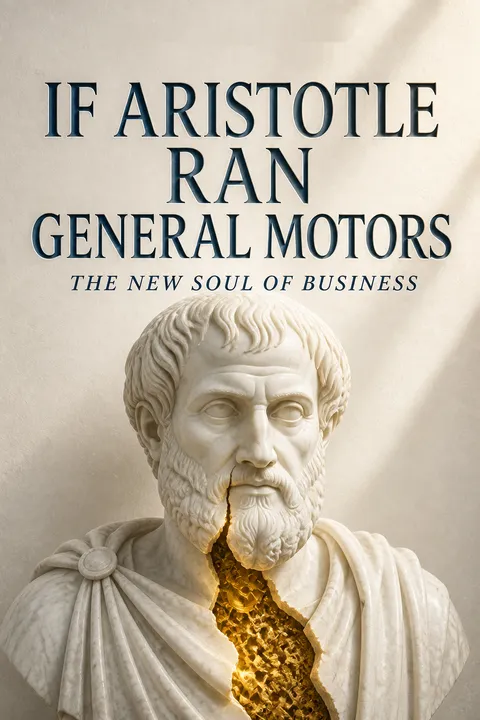


Key Takeaways
Build work around truth, beauty, goodness, and belonging, not processes alone
Look beneath the machinery. Morris opens with a golfer who misses the ball, then blames the course. Businesses do something similar when they blame competition, technology, or the economy for problems rooted in how people work together. His central claim is that lasting performance depends on human beings feeling respected and fulfilled, not on processes and incentives alone. He organizes that argument around four values: truth, beauty, goodness, and unity, or meaningful connection. Together, they address how people think, create, treat one another, and belong.
The proposal is practical, not a rejection of management tools. Reengineering and strategy can help, but they cannot keep a company healthy if its people have lost trust, motivation, or pride. Anyone can improve the conditions within their own sphere of influence.
What's useful here is the shift from diagnosing an organization as a machine to seeing it as a human system. Strategy depends on people interpreting information, coordinating effort, and choosing whether to contribute beyond the minimum. Research on psychological safety, the shared belief that a team can speak up without punishment, supports the importance of trust for learning and adaptation. Still, broad values can become decorative slogans unless translated into observable practices. A company should ask what truth-sharing, humane treatment, and belonging look like in meetings, incentives, and daily decisions.
Share hard facts early; silence turns uncertainty into rumor
Truth makes trust usable. Morris argues that withholding relevant information does not preserve calm. It invites speculation, gossip, and worst-case assumptions. He describes a manager sent to rescue troubled businesses at General Electric who began by telling employees why he was there, what the company faced, and what survival required. In his account, candid disclosure gave workers a chance to act; evasiveness fueled despair.
Jack Stack used a related approach at Springfield Remanufacturing Company, teaching employees to understand financial reports and opening the books so they could see the business's condition. Morris says that sharing knowledge can increase an organization's collective ability to solve problems. Candor still requires judgment: telling the truth with contempt turns information into a weapon, while tactful honesty respects the people who need to act on it.
This argument connects transparency to organizational learning: people closest to a problem often hold information that senior leaders lack, but they will not share it if bad news is punished. Open information can also reveal how one team's choices affect another's work. Transparency is not the same as indiscriminate disclosure, however. Raw figures without explanation can confuse or alarm, and confidential information may need protection. The leadership task is to share what people need, explain what it means, and make questions safe. That turns openness into usable knowledge rather than a performance of honesty.
Treat colleagues and customers as people, not instruments
Respect changes the relationship. Philosopher Martin Buber's distinction between I-It and I-Thou relationships helps explain Morris's point. I-It treats another person mainly as a tool for achieving an outcome. I-Thou recognizes that person's worth beyond their usefulness. This does not forbid asking for work or agreeing on a transaction; it changes whether the other person is treated as a full participant.
Morris illustrates the idea with Tom Chappell, founder of Tom's of Maine. Chappell worried that his growing company had begun treating customers chiefly as sources of revenue. Studying Buber helped him redirect the company's outlook toward respect and service. The same principle applies inside a workplace: asking an employee's considered opinion, and genuinely listening, recognizes both the person's dignity and the knowledge they can contribute.
The distinction is valuable because organizations routinely reduce people to roles: customer, employee, vendor, or cost center. Respectful treatment can improve cooperation, but it also matters independently of its business payoff. This echoes Kant's ethical demand not to treat people merely as means, while leaving room for ordinary mutual dependence. A useful caution is that personal warmth cannot substitute for fair procedures, adequate pay, or accountability. Respect is not simply a friendly tone. It includes giving people voice, accurate information, and a meaningful chance to influence decisions that affect them.
Aim beyond winning: collaborate to become your best together
Excellence has more than one scoreboard. Morris distinguishes competitive excellence, beating rivals, from comparative growth, improving against one's own past performance. He adds a third approach, the collaborative partnership model: people combine different knowledge and abilities to produce results that none could achieve alone. Collaboration is more than cooperation, which can mean simply dividing up tasks; it involves thinking together and learning from differences.
The models need not compete with one another. A team can use comparison to track improvement, competition to understand market demands, and collaboration to find better ways forward. Morris warns that a company may lead a weak field without reaching its own potential. Collaboration, guided by a clear goal and honest measures of progress, helps close that gap without making rivalry the sole source of motivation.
The model captures a productive tension in organizations. Competition can focus effort and expose complacency, while collaboration pools information and reduces duplicated work. The key is to make rivalry serve a shared purpose rather than turn colleagues into internal enemies. Diverse teams can generate better options, but difference alone does not guarantee insight: status hierarchies or poor facilitation can silence the very perspectives a team needs. Leaders must create both a clear direction and a process in which disagreement improves the work. Collaboration is an achievement of design, not a synonym for putting people in a room together.
Make work worth doing by designing for beauty and creation
The setting shapes the spirit. Morris argues that beauty is not a luxury reserved for executive retreats. People are affected by the places where they work, and an ugly, neglected environment can drain pride and energy. At Semco in Brazil, president Ricardo Semler let employees choose among possible factory sites. They then asked an artist to paint the plant and its machinery. Morris reports that productivity rose after the change.
Beauty can also come from small gestures. At Tom's of Maine, baskets of fresh fruit brightened production and warehouse areas, signaling care as well as adding color. The aesthetic dimension includes more than decor: it also includes the active satisfaction of doing a job skillfully, solving a problem elegantly, or improving a process. Workers need room to contribute creatively, not just a pleasant view while repeating mindless tasks.
The idea broadens workplace design from efficiency and safety to the emotional meaning of place. Environmental psychology suggests that light, noise, crowding, and control over one's surroundings can affect attention and well-being, so aesthetics is not merely ornamental. Yet fruit baskets or attractive walls cannot compensate for unsafe conditions, unfair treatment, or work stripped of autonomy. The stronger lesson is to involve workers in shaping their environment and methods. That gives beauty a participatory dimension: people can take pride not only in what surrounds them, but in what they help make.
Define happiness as fulfilling action, not pleasure or calm
Fulfillment requires participation. Morris considers three accounts of happiness: pleasure, inner peace, and engagement in something fulfilling. Pleasure and calm matter, but neither alone explains why a comfortable or affluent person can feel miserable, or why a demanding task can feel worthwhile. Drawing on Aristotle, Morris defines happiness as active participation in an activity that brings fulfillment.
He calls the deepest meaning of life creative love: making something valuable while acting with concern for other people. That can mean building a business, improving a service, solving a customer's problem, or offering help in an ordinary moment. This idea links meaning to work without claiming that every job is automatically meaningful. The work must contribute to something worthwhile, and people need enough room to see and shape that contribution.
This account resembles the distinction in positive psychology between fleeting pleasure and deeper engagement or purpose. It also offers a useful test for work: does the activity call on a person's abilities and connect effort to a benefit beyond mere completion? The risk is turning meaning into another demand placed on employees, as if they must find inspiration in any conditions. Meaningful work depends partly on the worker's interpretation, but also on job quality, security, and power. Employers cannot manufacture purpose with a mission statement while denying people agency in the work itself.
Treat small choices as character training, not isolated exceptions
Every choice shapes a habit. Morris draws on Aristotle's view that repeated actions form character. A decision is not only an answer to today's problem; it makes a similar response easier or harder next time. This applies to organizations too: everyday conduct, what leaders praise, tolerate, or reward, gradually becomes company culture.
Morris offers three ways to strengthen ethical judgment: spend time with wise and trustworthy people, practice care in small interactions, and cultivate a perceptive moral imagination. That imagination means picturing how a choice affects other people, rather than attending only to the consequences one prefers. The Golden Rule can help by asking decision makers to imagine themselves in another person's situation. Rules still matter, but they cannot anticipate every case or interpret themselves.
The emphasis on repetition fits behavioral science: habits become more likely when actions are practiced in stable contexts, and social norms make some choices feel ordinary. The idea also explains why seemingly minor disrespect can accumulate into a damaged culture. Still, character language should not make systemic failures look like individual defects. Codes, audits, and protections are necessary because good intentions are uneven and power can distort judgment. Empathy, too, can mislead if it assumes others want what the decision maker would want. Asking affected people directly is often the better form of imagination.
Protect ethical judgment from short-term targets and narrow self-interest
Pressure narrows the moral view. Morris identifies forces that can make decent decisions harder: pressure for immediate results, fixation on financial measures, career insecurity, conformity to group habits, and boredom that drives people toward risky excitement. A manager who postpones maintenance to hit this quarter's target may leave larger costs and hazards for others. A worker who sees colleagues mislead customers may begin to expect the same treatment internally.
These pressures shrink attention to what is convenient now or personally rewarding. Morris's countermeasure is to widen the time horizon and the circle of concern: consider future consequences, coworkers, customers, communities, and the kind of person or organization a decision is forming. This does not dismiss profit or personal interest. It argues that neither should be the only measure of what counts as success.
The diagnosis aligns with research on present bias, the tendency to overweight immediate rewards, and with the familiar problem of metrics distorting behavior when a measure becomes the whole target. Quarterly goals can help coordinate action, but they become dangerous when they reward visible results while hiding deferred maintenance, employee exhaustion, or customer harm. Long-term thinking needs institutional support, not just personal virtue: leaders must balance incentives, disclose trade-offs, and protect people who raise concerns. Otherwise, an ethical appeal asks individuals to resist pressures the organization itself continues to create.
Build jobs that meet needs for uniqueness, union, usefulness, and understanding
People need a place in the whole. Morris names four spiritual needs at work: to be recognized as a distinct person, to belong to something larger, to contribute usefully, and to understand where the work is going and why. These needs reinforce one another. A worker who can use a distinctive skill in service of a shared purpose can feel both individual agency and connection.
Morris describes a company president who invited employees to share an unknown fact about themselves. The exercise revealed talents colleagues could draw on, making collaboration more personal and informed. He also recounts realizing that his young son needed chores, not only fun, to feel like a contributor to family life. In the workplace, empowerment and clear explanations help people see that their effort matters and that they are not interchangeable parts.
These needs connect closely to self-determination theory, which emphasizes autonomy, competence, and relatedness as supports for motivation. Morris's formulation adds an explicit need for understanding and for being valued as distinct. The framework is especially useful because it shows why belonging should not mean conformity: a strong team makes room for difference while giving members a real role. Not every job can offer unlimited choice or obvious purpose, though. Managers can still explain constraints honestly, recognize expertise, and provide meaningful discretion within them.
Lead with humility and nobility to make people feel valued
Hold importance and modesty together. Morris closes with a Hasidic teaching shared with television producer Norman Lear: keep one reminder of human smallness close, and another of the world's significance to one's own life. Morris reads this as a pairing of humility and nobility. Humility makes a leader receptive to others; nobility helps people see their work as worthy of effort. Either quality alone can distort leadership: importance without modesty becomes arrogance, while modesty without purpose can become passivity.
The pairing fits the book's broader account of business as people creating structures in which others can live and work well. Leaders can embody it by listening seriously, sharing credit, and describing the human value of the work without pretending that every decision is heroic. A respected worker is more likely to bring energy and judgment to a shared task.
This is a strong closing image because it treats leadership as a balance of self-transcendence and personal responsibility. Humility can reduce overconfidence and make correction possible; a sense of purpose can counter cynicism and help people persist through difficulty. The combination also resists two common leadership caricatures, the grandstanding visionary and the self-effacing caretaker. Its test is behavioral: does the leader invite challenge, share authority, and connect routine labor to a credible public good? Purpose should elevate work, not conceal hard choices or demand unquestioning loyalty.
Analysis
Morris's argument is best read as a humanistic theory of organizational performance, not a toolkit for managers. Its central move is to connect individual fulfillment with durable business excellence: organizations work well when they respect people's needs for truth, aesthetic engagement, ethical conduct, and meaningful connection. That move brings ancient virtue ethics into conversation with current concerns about employee voice, autonomy, psychological safety, and stakeholder responsibility.
Its strength is integration. Truth without tact can injure; beauty without goodness can become cosmetic; belonging without individuality can become conformity. The four values function less like independent levers than mutually correcting dimensions. The book's stories make that abstract claim visible, from open financial books to fruit in factory spaces and the custodian whose sense of purpose exceeds his job description.
The most important qualification is that personal flourishing and corporate success do not always coincide. A company may call work meaningful while imposing costs on employees, communities, or the environment. The claim that what benefits a business benefits the wider society therefore requires scrutiny, not assumption. Stakeholder theory and institutional ethics sharpen this point: values need to be built into incentives, decision rights, labor practices, and accountability, especially where power is unequal.
A second tension concerns universality. Morris presents the four foundations as deeply human, yet workers differ in what they find beautiful, fulfilling, or unifying. The framework is strongest as a set of questions, not a uniform recipe. Leaders should ask whose truth is heard, who defines the purpose, what forms of contribution are recognized, and who bears the costs. In that form, the book remains useful: it redirects attention from techniques alone to the human conditions that let people contribute with skill, dignity, and judgment.
Review Summary
If Aristotle Ran General Motors receives mostly positive reviews for applying ancient philosophy to modern business. Readers appreciate Morris's insights on ethics, leadership, and creating fulfilling workplaces. Many find the book thought-provoking and relevant, praising its focus on truth, beauty, goodness, and unity. Some critics argue it lacks concrete examples or misrepresents Aristotle. Overall, reviewers consider it a valuable read for business leaders, offering wisdom on fostering excellence and employee satisfaction.
People Also Read









Glossary
Four Dimensions of Human Experience
Four routes to fulfillmentMorris's framework for understanding what work must engage if people are to flourish. The intellectual dimension seeks truth, the aesthetic dimension seeks beauty, the moral dimension seeks goodness, and the spiritual dimension seeks unity or connectedness. The dimensions overlap in practice and together form his account of the human foundations of sustainable excellence.
Collaborative Partnership Model
Excellence through joint creationMorris's model of excellence in which people or organizations combine their different knowledge, talents, and perspectives to achieve and understand more than any could alone. It differs from cooperation, which may only divide tasks, because collaboration includes shared thinking and mutual learning. Competition and individual improvement can support it, but do not define excellence by themselves.
Double Power Principle
Power can help or harmMorris's principle that whatever has substantial capacity to produce good also has corresponding capacity to cause harm. The principle applies to institutions, desires, and truth itself. Their power is not automatically virtuous; people must choose how to use it and consider whether its effects support truth, beauty, goodness, and human connection.
Creative Love
Creating with care for othersMorris's account of life's meaning as active, original creation guided by concern for other people. It is not merely a private feeling or sentiment. In work, it can appear in building useful structures, developing better solutions, serving customers, or forming relationships that respect people's dignity and improve their lives.
I-Thou Relation
Respect for personsMartin Buber's term, used by Morris, for relating to another person as someone with intrinsic worth rather than merely as a tool for one's goals. It allows ordinary requests and transactions, but rejects treating usefulness as the measure of a person's value. In business, it means listening, speaking truthfully, and recognizing coworkers and customers as full participants.
Four Spiritual Needs
Needs for identity and connectionMorris's account of four needs that support fulfillment at work: a sense of uniqueness, union with something larger, usefulness to others, and understanding of one's situation and purpose. They reinforce one another. A person can feel both distinctive and connected when their abilities contribute meaningfully to a shared endeavor whose direction they understand.
FAQ
What's If Aristotle Ran General Motors about?
- Philosophical Insights for Business: The book explores how ancient philosophical wisdom, particularly from Aristotle, can be applied to modern business practices to achieve excellence and fulfillment.
- Four Foundations of Excellence: It introduces four key dimensions—Truth, Beauty, Goodness, and Unity—that underpin sustainable success in both personal and corporate contexts.
- Reinventing Corporate Spirit: The author, Tom Morris, argues for a reinvigoration of corporate culture by integrating these philosophical principles into everyday business operations.
Why should I read If Aristotle Ran General Motors?
- Timeless Wisdom: The book offers insights that transcend time, drawing on the teachings of great philosophers to address contemporary business challenges.
- Practical Applications: Readers will find actionable advice on how to implement philosophical concepts in their workplaces to enhance motivation and productivity.
- Personal Growth: It encourages readers to reflect on their own lives and careers, promoting a deeper understanding of what constitutes true success and happiness.
What are the key takeaways of If Aristotle Ran General Motors?
- Four Dimensions of Human Experience: The book emphasizes the importance of Truth, Beauty, Goodness, and Unity as essential for achieving excellence in any endeavor.
- Corporate Spirit: It highlights the need for a positive corporate spirit, suggesting that businesses should be seen as partnerships for living well.
- Creativity and Meaning: The author connects creativity with the meaning of life, asserting that engaging in creative love is fundamental to both personal fulfillment and business success.
What are the best quotes from If Aristotle Ran General Motors and what do they mean?
- Simplicity and Greatness: “Nothing is more simple than greatness; indeed, to be simple is to be great.” This quote emphasizes that true greatness often lies in simplicity and fundamental truths, which can guide effective business practices.
- Meaning Over Success: “The least of things with a meaning is worth more in life than the greatest of things without it.” This highlights the importance of meaning in our work and lives, suggesting that fulfillment comes from purpose rather than mere success.
- Business as Partnership: “A business is a partnership for living well.” This encapsulates the book's core idea that businesses should focus on creating environments that promote well-being and collaboration among all stakeholders.
How does Tom Morris define the four foundations: Truth, Beauty, Goodness, and Unity?
- Interconnected Dimensions: Each foundation is interrelated, meaning that neglecting one can undermine the others, leading to a lack of overall excellence.
- Guiding Principles: They serve as guiding principles for both personal and corporate conduct, helping individuals and organizations align their actions with their values.
- Sustainable Success: By focusing on these foundations, businesses can create a more fulfilling work environment that fosters long-term success and employee satisfaction.
How does If Aristotle Ran General Motors suggest we reinvent corporate spirit?
- Focus on Human Experience: The author argues that businesses should prioritize the human experience, ensuring that employees feel valued and engaged in their work.
- Encourage Open Communication: Creating an environment where truth is respected and shared can enhance trust and collaboration among team members.
- Integrate Aesthetics: Incorporating beauty into the workplace—through design, art, and environment—can uplift spirits and improve overall morale.
What role does creativity play in business according to If Aristotle Ran General Motors?
- Creative Love: The book posits that creativity is an expression of love, and engaging in creative endeavors can lead to a more meaningful and fulfilling life.
- Problem Solving: Encouraging creativity in the workplace allows employees to develop innovative solutions and improve processes, enhancing productivity.
- Performance Beauty: The author emphasizes that beauty in performance—whether in problem-solving or teamwork—can lead to greater satisfaction and excellence in business.
How does Tom Morris define excellence in If Aristotle Ran General Motors?
- Three Models of Excellence: Morris outlines three models: the competitive victory model, the comparative growth model, and the collaborative partnership model, each with its own implications for business.
- Collaborative Focus: The book advocates for a collaborative approach to excellence, where partnerships and shared goals lead to greater achievements than competition alone.
- Holistic Development: True excellence is seen as a holistic development that encompasses personal growth, teamwork, and a commitment to shared values.
What is the relationship between truth and corporate success in If Aristotle Ran General Motors?
- Foundation of Trust: Truth is presented as the cornerstone of trust within organizations, essential for effective communication and collaboration.
- Avoiding Misinformation: The book warns against the dangers of misinformation and deception, which can erode trust and lead to corporate failure.
- Empowerment through Transparency: By fostering a culture of truth, organizations empower employees to share insights and feedback, leading to better decision-making and innovation.
How does If Aristotle Ran General Motors address the challenges of change in business?
- Embrace Change: The author encourages viewing change as an opportunity for growth rather than a threat, promoting a mindset that welcomes new challenges.
- Values-Based Leadership: Leaders are urged to ground their responses to change in core values, ensuring that transitions align with the organization’s mission and purpose.
- Creative Adaptation: The book suggests that creativity and collaboration are key to navigating change effectively, allowing teams to adapt and thrive in evolving environments.
How does Tom Morris define the moral dimension in business?
- Moral Dimension Explained: Morris describes the moral dimension as the aspect of human experience that strives for goodness and ethical behavior. It is essential for fostering healthy relationships and a thriving community within the workplace.
- Connection to Business Success: He argues that neglecting moral considerations can lead to a toxic work environment, where employees feel victimized rather than supported. Ethical practices are crucial for long-term business success.
- Human Needs: The moral dimension addresses fundamental human needs for appreciation, respect, and kindness. Meeting these needs can transform workplace culture and enhance overall productivity.
What role does spirituality play in If Aristotle Ran General Motors?
- Spirituality Defined: Morris defines spirituality as the quest for depth and connectedness in life. It encompasses the need for individuals to feel part of something greater than themselves.
- Spiritual Needs: The book identifies four spiritual needs—uniqueness, union, usefulness, and understanding—that must be nurtured in the workplace. Addressing these needs leads to a more fulfilling work experience.
- Impact on Corporate Culture: A spiritually aware corporate culture fosters unity and collaboration among employees. This can enhance morale and drive collective success.
About the Author


Download PDF
Download EPUB
.epub digital book format is ideal for reading ebooks on phones, tablets, and e-readers.








