Key Takeaways
1. Philosophy is an Active Quest for Wisdom, Not Just Abstract Thought
The word philosophy comes from linguistic roots that mean, simply “the love of wisdom.”
Beyond academic stereotypes. Philosophy isn't just for tweed-clad academics; it's a vital, practical activity for anyone seeking deeper understanding. Socrates, the original public philosopher, famously declared, "The unexamined life is not worth living," emphasizing that true living requires reflection on our core beliefs and values. This pursuit of wisdom is an intellectual adventure, akin to mental rock climbing or cartography for the soul, helping us navigate life's profound questions.
Cultivating essential skills. Engaging with philosophy sharpens three crucial intellectual skills:
- Analysis: Breaking down complex problems into manageable components, clarifying issues.
- Assessment: Evaluating competing claims for coherence, completeness, and correctness, fostering discernment.
- Argument: Constructing reasoned presentations of ideas, marshalling evidence to persuade and discover truth, rather than merely winning debates.
These skills are indispensable for navigating a world filled with conflicting information and making sound decisions.
Escaping Plato's Cave. Philosophy aims to free us from illusions, much like Plato's allegory of prisoners mistaking shadows for reality. Our beliefs act as inner maps, guiding our actions and shaping our perceptions. False beliefs, like the author's propane gas story, can have real, even physical, consequences. By questioning our assumptions and examining our worldview, we move from passive acceptance to active understanding, liberating ourselves to live in the "broader, brighter realities" beyond customary perceptions.
2. Knowledge is Justified True Belief, But Skepticism Reveals Its Foundational Limits
To know a thing, to hold that you know it, and when you do not know a thing, to admit that you do not know it, is knowledge indeed.
Defining knowledge. Philosophers traditionally define knowledge as "properly justified true belief." This means you can't know something unless you believe it, that belief must be true, and you must have a proper, non-accidental justification for holding it. Truth, in this context, is an accurate correspondence with reality, anchoring us to the way things truly are, despite relativistic claims that often confuse tolerance with an absence of objective truth.
The skeptic's challenge. Skepticism, derived from the Greek word "to inquire," challenges our claims to knowledge by questioning the reliability of our belief sources. It asks:
- How do we know memory is reliable? (Circular reasoning if we use memory to justify memory)
- How do we know testimony is reliable? (Again, circularity if we rely on testimony to justify testimony)
- How do we know sense experience is reliable? (Using sense experience to justify sense experience leads to the same problem)
These inquiries reveal that we lack independent, untainted evidence for the reliability of our most basic belief-forming mechanisms.
Radical doubt. Skeptics push further with "radical hypotheses" incompatible with our ordinary beliefs, like Bertrand Russell's "Five-Minute Hypothesis" (the universe sprang into existence five minutes ago) or Descartes' "Dream Hypothesis" (life is an elaborate dream). We cannot empirically refute these absurd scenarios, yet our everyday lives commit us to rejecting them. This highlights a profound gap: we lack empirical proof for our most fundamental assumptions about reality.
3. Rationality Embraces Basic Beliefs, Even Without Explicit Proof or Evidence
The skeptic’s questions show only that the rationality of the most basic reasonable assumptions, and so the fundamental rationality of most ordinary beliefs, cannot consist, ultimately, in having good solid evidence independently available to show their truth.
Beyond evidentialism. While evidence is crucial for most beliefs, skepticism reveals that our most foundational beliefs—like the reliability of our senses or the existence of a past beyond five minutes—cannot be supported by independent proof or evidence. This challenges "evidentialism," the view that it's irrational to believe anything without sufficient evidence. If evidentialism were strictly true, we'd be forced into an infinite regress of justifications or an absurd suspension of judgment on nearly everything.
The Principle of Belief Conservation. To navigate this, the "Principle of Belief Conservation" offers a rational framework:
- If adopting a stance (belief, rejection, suspension) on a proposition P would require rejecting or doubting a vast number of your current beliefs,
- And you have no independent positive reason to reject or doubt those other beliefs,
- And no compelling reason to adopt that stance toward P,
- Then it is most rational not to adopt that stance.
This principle acts as a "least damage" rule, allowing us to rationally reject radical skeptical hypotheses and maintain our core worldview without needing impossible proofs.
Rational faith. William James argued for "precursive faith," where it can be rational to believe beyond available evidence in "genuine options" that are:
- Live: Plausible enough to be believed.
- Forced: Not choosing is equivalent to choosing not to believe.
- Momentous: Something of great importance is at stake.
This suggests that sometimes, a measure of belief can help create the conditions for truth or reveal evidence that wouldn't otherwise be accessible, as seen in champions' self-belief or social interactions.
4. Goodness is Teleological: It's About Flourishing and Hitting Life's Highest Targets
To be good is noble; but to show others how to be good is nobler and no trouble.
Ethics as flourishing. Ethics isn't just about avoiding trouble or following rules; it's fundamentally about human flourishing, inner strength, and the deepest kind of happiness. It provides a structure that facilitates the most fulfilling freedom, rather than merely imposing constraints. The question "Am I living a good life?" probes beyond material comfort ("the good life") to ethical and spiritual fulfillment.
Defining "good." Aristotle's "teleological conception of good" suggests something is good if it successfully hits its intended target or fulfills its purpose. For humans, this means aiming at "happiness" (eudaimonia), understood as a complex state of well-being encompassing contentment, fulfillment, enjoyment, and love, achieved through personal and community excellence. Moral goodness, then, is the quality of actions, attributes, or persons that facilitates this genuine happiness and flourishing.
Virtue theory's insight. While theories like divine command, social contract, utilitarianism, and deontology offer partial insights, virtue theory provides a comprehensive framework. It posits that moral goodness centers on cultivating "virtues"—character strengths like kindness, honesty, and courage—that are essential for true happiness and flourishing. These virtues are not merely rules but settled dispositions of thinking, feeling, and acting that enable optimal human well-being, reflecting an intrinsic human nature designed for excellence.
5. True Freedom is Agent-Causation, Allowing Us to Initiate New Realities
Destiny is not a matter of chance, it is a matter of choice; it is not a thing to be waited for, it is a thing to be achieved.
The challenge to free will. Our intuitive belief in free will faces significant challenges:
- Theological: If an omniscient God foreknows our actions, are they truly free? (Answer: Foreknowledge isn't predestination; God knows what we will freely choose.)
- Logical: The Law of Excluded Middle (either P or not-P is true) seems to imply future events are already fixed. (Answer: Future truths can be true because of our free choices.)
- Scientific Determinism: The "Principle of Universal Causality" suggests all events, including our actions, are caused by prior events, making us "puppets of nature."
Critiquing traditional views. Scientific determinists define free acts as uncaused events, which they deny exist. Simple indeterminists agree on the definition but deny universal causality, equating freedom with randomness—a "freak occurrence," not a free choice. Compatibilists define free acts as those caused by inner states (desires, intentions), arguing this is compatible with universal causality. However, critics argue this merely makes us "puppets of nature," where our inner states are themselves determined by external forces, thus lacking genuine options.
Agency theory: A new perspective. Agency theory offers a compelling alternative: a free act is an event caused by an agent (a person or intelligent doer). It accepts that every event has a cause (UC(a) is true) but denies that every cause is an event (UC(b) is false). Instead, agents themselves can be initiating causes, starting new causal chains for which they are responsible. This view aligns with our intuition that we are not merely conduits of prior causes but genuine originators of action, capable of creativity and shaping our destiny within varying limits.
6. You Are a Dualistic Being: Mind and Body, Not Just a Complex Machine
The one thing in the world, of value, is the active soul.
The mind-body problem. The question "What is a person?" delves into whether we are merely complex physical organisms (materialism) or composite beings of both mind/soul and body (dualism). Historically, dualism has been the pervasive belief, reflected in practices like distinctive burial rites and the widespread belief in an afterlife, suggesting humans are fundamentally different from inanimate objects.
Arguments for dualism.
- Introspection Argument: We have direct, inner access to our conscious experience (thoughts, feelings, sensations) that is qualitatively different from any physical brain activity. A color-blind neuroscientist, despite complete brain knowledge, would still lack the subjective experience of color.
- Discernibility Argument: Minds possess properties that brains cannot (e.g., "aboutness" or intentionality, logical relations, vagueness, transcendence). If minds and brains were identical, they would share all properties, which they clearly do not.
- Platonic Argument: It's logically possible for the mind to exist without the body (e.g., disembodied existence), and for the body to exist without the mind (a corpse). If they can exist independently, they cannot be identical.
- Parapsychology Argument: Claims of telepathy, apparitions, or near-death experiences, if credible, suggest mental activity independent of the physical brain.
Critiquing materialism. Materialist arguments (man-is-an-animal, AI, brain chemistry) often fall short. While human complexity may emerge from simpler forms, this doesn't preclude the emergence of a non-material mind. The brain's dependence on chemistry doesn't mean the mind is chemistry, just as a car's function depends on gas, but the driver isn't the car. Materialist criticisms of dualism (superfluity, mystery, other minds) are also often inconclusive, as causation itself remains a mystery, and our direct experience of our own minds is not a scientific hypothesis.
7. Death's Fears Can Be Addressed, But the Question of Survival Remains Profound
Death either destroys or unhusks us. If it means liberation, better things await us when our burden’s gone: if destruction, nothing at all awaits us; blessings and curses are abolished.
Four fears of death. People fear death in various ways:
- Process of dying: The pain, suffering, and solitude of the transition.
- Punishment after death: Anxiety about a moral judgment and retribution in an afterlife.
- The unknown: The uncertainty of what, if anything, lies beyond.
- Annihilation: The terrifying prospect of total cessation of conscious existence forever.
Philosophical consolations aim to mitigate these fears, regardless of one's belief in an afterlife.
Philosophical consolations.
- Stoic Response: Focus on what's controllable (our fear, not death itself); life won't demand more than we can bear.
- Natural Process Argument: Death is a natural event, like birth, and should be accepted. (Critique: So are tornadoes, and we fear them.)
- Necessity Argument: Death is necessary for life's appreciation and evolutionary progress. (Critique: This doesn't console the individual facing extinction.)
- Agnostic Argument (Socrates): It's irrational to fear what you don't know can harm you; death might be a blessing.
- Two Eternities Argument: Our past non-existence didn't bother us, so why fear future non-existence? (Critique: The future bears down, the past recedes; they're not parallel.)
- Epicurus' Argument: "When you exist, death is not present, and when death is present, you no longer exist." (Critique: It ignores the fear of eternal deprivation.)
Materialist "immortality." Materialists offer consolations that don't involve conscious survival:
- Social immortality: Living on in children or those we've influenced.
- Cultural immortality: Living on through our works or contributions.
- Cosmic immortality: Our molecules dispersing into the universe.
- Scientific immortality: Future technology extending life indefinitely or uploading consciousness (ultimately limited by cosmic entropy).
These offer a sense of legacy or continuity but fall short of addressing the deep human desire for conscious, personal survival.
8. The Existence of God Fundamentally Shapes Our Worldview and Its Implications
It is incomprehensible that God should exist, and it is incomprehensible that He should not exist.
The great divide. The question of God's existence defines two opposed worldviews: theism (belief in a purposeful, intelligent creator) and naturalism (nature is all there is, ruled by blind forces). Theism typically posits an absolutely perfect, non-material God with attributes like omnipotence, omniscience, and omnibenevolence, who created the universe and acts within it. Naturalism sees us as temporary blips in an impersonal cosmos, without inherent purpose.
Arguments for God's existence.
- Ontological Argument: God, defined as "that than which no greater can be conceived," must exist not only in the mind but also in reality, because existence in reality is greater than existence in the mind alone. A perfect being must necessarily exist.
- Cosmological Argument: The existence of the contingent universe demands an explanation. Since it cannot be a scientific or essential explanation, it must be a personal one, pointing to a necessary, self-explanatory agent—God—who created the universe.
- Design Argument: The intricate complexity and "fine-tuning" of the universe, hospitable to life and consciousness, is more likely the product of intelligent design (theism) than blind chance (naturalism). This is often framed using confirmation theory: the existence of such a universe is more expected under the hypothesis of God.
- Religious Experience: Many individuals report profound, transformative personal experiences of a divine presence, which they interpret as direct evidence for God's existence, often transcending rational argument.
The problem of evil. The most significant challenge to theism is the problem of evil: "If there were a God, there would be no evil in the world. There is evil in the world. Therefore, there is no God." Theists respond by arguing that a morally good being can allow evil if it's necessary for a greater good or to prevent a worse evil. Theodicies (explanations for why God allows evil) include:
- Punishment Theodicy: Some evil is justified punishment for wrongdoing.
- Free Will Theodicy: God allows evil as the unavoidable price of creating free-willed beings capable of genuine love and virtue.
- Soul-Making Theodicy: Evil and suffering are necessary conditions for character development and spiritual growth, creating "higher-order goods" like courage and patience.
Ultimately, theists often appeal to an "element of mystery," acknowledging that human minds cannot fully comprehend the intentions of an infinite Creator.
9. Life's Ultimate Meaning is Found in Creative Love, Not Solely Self-Endowment
To believe in God means to see that life has a meaning.
The meaning question. The deepest existential question is not just "What is the meaning of life?" but "Is there any meaning to life at all?" This probes whether life has objective purpose, value, or importance, or if it's fundamentally meaningless. These are existentially central questions, crucial for guiding our lives beyond trivialities.
Nihilism's negative answer. Nihilism asserts that life has no meaning, purpose, or ultimate value, often stemming from a purely naturalistic worldview where "meaning" has no physical status. However, nihilism is a "negative universal existence claim" that is impossible to prove and often contradicts our intuitive sense of significance. It struggles to explain why we even bother to ask the question of meaning.
The "Do-It-Yourself" approach. Many philosophers propose that life has meaning if we endow it with meaning by pursuing chosen purposes and values. However, this "Endowment Thesis" faces limitations:
- We lack control over fundamental aspects of our lives (birth, formative circumstances, suffering, death).
- We cannot endow the entirety of our existence with meaning, only "islands of meaning" within it.
This approach, while empowering, ultimately falls short of providing meaning for life as a whole, suggesting that such comprehensive meaning might require a source beyond human control—a God.
Meaning and God. Theistic worldviews offer an unconditional "Yes" to life's meaning, rooted in a Creator God who imbued existence with objective purpose and value. This meaning is often understood as "creative love" or "loving creativity." Within this divine context, humans are free to discover, develop, and deploy their talents in alignment with this ultimate purpose, finding profound fulfillment. This objective meaning provides a framework within which our subjective efforts to create meaning become truly efficacious and significant, transforming the debate about God into one of "greatest existential significance."
10. True Success and Happiness Stem from Purposeful Self-Development and Enjoying the Journey
Happiness does not consist in pastimes and amusements, but in virtuous activities.
Beyond the "race for more." Our acquisitive culture often mistakes money, fame, power, and status for true success and happiness. These external "markers of public success" are problematic as focal goals because they are instrumentally valuable (resources) but not intrinsically satisfying. The "dissatisfaction of acquisition" is an endless, unhealthy pursuit, contrasted with the "dissatisfaction of aspiration," which fuels healthy personal growth and development.
True success: The 3-D approach. Genuine, deeply satisfying success is about:
- Discovering your positive talents (those that make a healthy contribution).
- Developing the most meaningful and beneficial of those talents.
- Deploying your talents into the world for the good of others and yourself.
This approach aligns with the idea of "creative love" or "loving creativity," providing a purpose that transcends mere external gain. It's a path to fulfillment regardless of whether one embraces a theistic or naturalistic worldview, as both suggest that chasing externals is ultimately misguided.
Mastering the Seven Cs of Success. Wisdom traditions offer universal conditions for achieving deeply satisfying and sustainable success:
- Clear Conception: A vivid vision and clearly imagined goals.
- Strong Confidence: Belief in one's ability and the endeavor's worth.
- Focused Concentration: Planning efforts and enacting the plan with flexibility.
- Stubborn Consistency: Aligning actions with goals, overcoming self-sabotage.
- Emotional Commitment: Passion for what you're doing, connecting daily tasks to core values.
- Good Character: Virtues that inspire trust, foster collaboration, and provide inner guidance.
- Capacity to Enjoy the Process: Loving the journey itself, not just the destination.
These interconnected conditions form a unified framework, emphasizing that success is less about external achievement and more about internal growth and purposeful engagement.
Happiness as virtuous activity. Happiness is not mere pleasure or peace, but an active state of being—participation in fulfilling, worthy enterprises. It's a byproduct of living in creative love, discovering and deploying your best talents for the good of others and yourself. This "3-D Approach" to life is fundamental to both success and happiness, suggesting that true joy comes from making a positive difference in the world, rooted in self-knowledge and a gracious, open spirit.
Last updated:
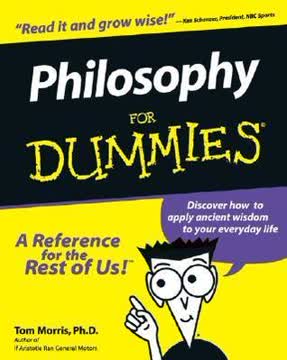
Review Summary
Philosophy For Dummies by Tom Morris receives polarized reviews (3.57/5). Most critical reviews cite extreme bias toward Christian theism, with the author allegedly dismissing atheistic and skeptical viewpoints unfairly while promoting religious perspectives. Critics complain the book functions more as religious apologetics than balanced philosophy instruction, particularly in later chapters. Positive reviews praise its accessibility, clear explanations of complex concepts, and coverage of fundamental philosophical questions. Several readers note it works well as an introductory text despite its acknowledged Christian perspective, though many feel misled by the title's promise of general philosophy coverage.