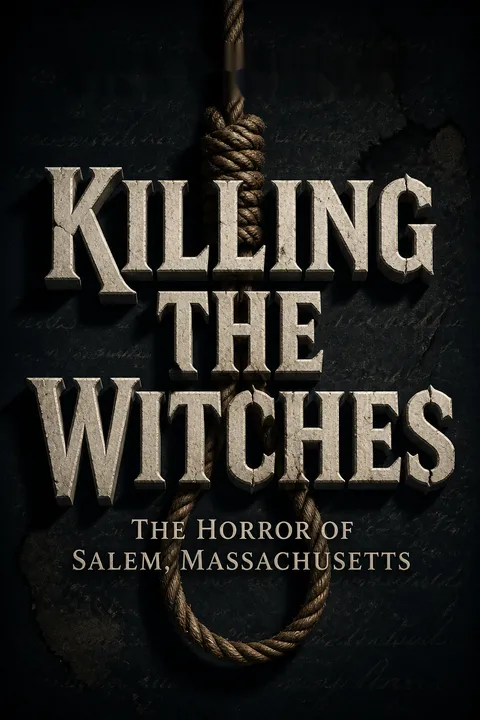


Key Takeaways
Make invisible threats answer to evidence before they command a court.
A warning from Scotland. The book opens with Dame Euphame MacCalzean, executed in 1591 after King James VI became convinced she had used witchcraft against him. The story establishes the danger of treating belief as proof: Effie’s guilt mattered less than the king’s certainty and his interest in her property.
Salem repeats the pattern. In 1692, accusers claimed witches’ spirits attacked them, and courts accepted these visions, called spectral evidence, as proof. Nineteen people were hanged, and Giles Corey was crushed to death after refusing to plead. The book’s central warning is that a supernatural explanation, once granted legal authority without reliable verification, can make suspicion lethal.
What's striking is how the book links a claim about the invisible to a practical question: who has the authority to decide what is true? Courts cannot test every belief directly, but they can require evidence that can be challenged, corroborated, and examined by more than one interested party. That discipline matters especially when accusations describe threats that cannot be seen by the accused or independently confirmed. The narrative is strongest when it shows how institutions convert conviction into verdict. Its historical storytelling should not, however, be mistaken for proof that every accuser consciously fabricated a story.
Preserve due process when fear makes shortcuts feel righteous.
The rules tilted toward conviction. The Salem Court of Oyer and Terminer was created specifically to hear witchcraft cases. Accused people had no lawyer to present a defense, and the proceedings treated a person brought to trial as presumed guilty. Spectral evidence was especially damaging: an accuser could claim a defendant’s invisible spirit had caused harm, while the defendant had no way to disprove it.
Rebecca Nurse shows the cost. Nurse was an elderly, respected church member. A jury first found her not guilty, but a judge pressed her to explain a phrase she had used. Her confusion and silence were treated as evidence, and the verdict was reversed. The process did not merely fail to protect an innocent person. It made ordinary limits, such as poor hearing, look like guilt.
Due process is not a reward for the likable or the obviously innocent. It is a way of limiting what officials may do when their certainty is strongest and their evidence weakest. Rebecca Nurse’s case exposes a procedural danger that remains recognizable: ambiguity can be interpreted against a defendant when the court has already chosen its story. Fair procedures can feel slow or unsatisfying during a crisis, but speed is not the same as accuracy. Their purpose is to keep the state from turning its own assumptions into proof.
Watch how status and private grudges shape who gets accused.
Being an outsider carried risk. Bridget Bishop was known for colorful clothes, independence, and conflict with her husband. Poor Sarah Good was described as friendless and troublesome. These reputations made it easier for neighbors to accept accusations against them. But the panic did not stay confined to marginal people. Rebecca Nurse, a respected elder, and John Proctor, a prominent farmer, were also accused once the accusations spread.
Local conflict supplied targets. The book describes disputes over land, church leadership, money, and personal relationships around Salem. Proctor opposed Reverend Samuel Parris, while the Nurse family had a property disagreement with the Putnams. These tensions do not prove that every accusation was a calculated plot. They do show how a community’s existing resentments could make a new charge seem plausible, or useful.
The shift from outcasts to respected neighbors is an important feature of the story. A system that initially targets people with little social protection can appear to be enforcing order; when the boundaries widen, the same process becomes harder for the community to ignore. Social psychology offers a useful lens here: groups often interpret ambiguous behavior through existing stereotypes and conflicts. Still, it would be too simple to reduce Salem’s accusations to revenge or property schemes. Fear, religious conviction, social pressure, and self-interest can reinforce one another without a single mastermind.
Treat confession as a product of pressure, not automatic proof.
Confessing could be a survival strategy. Tituba, Reverend Parris’s enslaved servant, admitted to witchcraft after the girls accused her. Her confession pleased the authorities and helped her avoid execution, while her testimony expanded the search for other witches. The book portrays her as gaining unusual power through the confession, though she remained imprisoned for more than a year.
Margaret Jacobs faced the same trap. At sixteen, she confessed and implicated her grandfather, George Jacobs. Later, horrified by what her testimony had done, she withdrew it, risking her own life. In Salem, denial could lead to execution, while confession and naming others might bring clemency. Under those incentives, an admission could reveal fear and desperation more clearly than factual guilt.
A confession is not a transparent window into truth. Its meaning depends on the conditions under which it is made, including the threat of punishment, the promise of leniency, and what an interrogator wants to hear. Modern research on false confessions reinforces the importance of examining those conditions rather than treating admission as conclusive. Salem also illustrates how a confession can reproduce the system that produced it: the speaker may gain temporary safety by supplying new suspects. That does not establish that every confession was false, but it makes context indispensable.
Ask who gains power or property when panic becomes policy.
The hunt created concrete incentives. The book says accused people could be charged for the cost of their imprisonment and trial, and the property of convicted witches could be seized. Sheriff George Corwin pursued Giles Corey’s land, while Thomas Putnam accused dozens of people, including people connected to local disputes. Putnam’s testimony helped send twelve of those he accused to execution, according to the book.
The governor’s position changed. William Phips initially left the trials to others. After returning from Maine, he learned that his wife had been accused. He secured her release, suspended arrests, and shut down the witch court in October 1692. Growing doubts and pressure from the Crown also mattered. The episode shows how an institution’s appetite for punishment can weaken when its powerful supporters face its consequences.
Following incentives is a useful safeguard against explanations that rely only on personal wickedness or collective madness. Property, status, and political authority help explain why some people could shape the proceedings and others could not. Yet incentives should be treated as questions to investigate, not as automatic proof of motive. Phips’s response, for example, involved concern for his wife, the colony, and the Crown’s reaction. The broader lesson is institutional: procedures need outside oversight before officials have personal reasons to doubt the machinery they have empowered.
Limit religious authority before one doctrine becomes civil law.
Dissenters challenged the theocracy. The early colonies often treated religious conformity as a condition of public order. Roger Williams argued that civil courts should not enforce church doctrine. Banished from Massachusetts, he helped establish Providence, where church and state were separate. Later, debates in Virginia over mandatory Anglican taxes and preaching brought Patrick Henry, Thomas Jefferson, and James Madison into conflict over the state’s role in religion.
The settlement was gradual. Virginia adopted Jefferson’s Statute of Religious Freedom in 1786 after years of debate. At the Constitutional Convention, Madison and others opposed government-backed religion, while some delegates wanted public support for Christian teaching. The Constitution and Bill of Rights ultimately placed limits on government power over religion. The book presents Salem as part of this history, not its only cause.
The history here is not a simple progression from intolerance to enlightenment. Religious dissenters could themselves be intolerant, and freedom expanded through conflict rather than unanimous conversion. The important institutional shift is that no single religious authority should control both doctrine and civil punishment. Political pluralism does not require citizens to agree about theology; it requires rules that let them disagree without losing legal standing. Salem offers a vivid caution, but the book’s broad line from the trials to constitutional protections is best understood as one strand in a much larger political history.
Defend the unpopular to prove the law applies to everyone.
John Adams defended the soldiers. After British troops killed five colonists in the Boston Massacre, Adams took the unpopular job of defending the accused soldiers. He argued that the trial had to be decided by evidence and law, not by the anger of the crowd. Captain Thomas Preston and most of the soldiers were acquitted; two were convicted of manslaughter and received a lesser punishment.
The defense protected legitimacy. Adams later compared the prospect of executing the soldiers unjustly with the execution of accused witches. He believed a fair trial showed that colonial justice could resist public rage. His choice did not make him popular, but it helped demonstrate that legal protections were not meant only for people whom the public liked.
The defense of an unpopular accused person is a practical test of whether a legal principle is real. If rights disappear whenever the defendant is hated, they function as favors, not rights. Adams’s role also complicates a tidy story in which colonial resistance always meant justice: a movement for liberty still needed courts capable of restraining its own anger. The book’s comparison between the soldiers and Salem is powerful as a warning about mob pressure, though the events differed in their evidence, political setting, and consequences.
Separate a reported possession from proof of its supernatural cause.
A modern case extends the book’s story. In 1949, thirteen-year-old Ronald Hunkeler experienced reported disturbances, including moving furniture, unexplained sounds, and injuries. After a Lutheran minister sought Catholic help, Jesuit priests conducted an exorcism that lasted several weeks. Their written account describes the boy’s behavior and the ritual, but the narrative does not supply independent evidence that a demon caused the events.
The case reached a mass audience. Writer William Peter Blatty learned about the exorcism and used it as the basis for his novel, The Exorcist, changing the central character to a girl. The book became a bestseller, and the film made the story famous worldwide. The episode connects Salem’s fear of invisible forces to modern religious belief and popular culture, without resolving what happened to Hunkeler.
The distinction between testimony and explanation matters in any account of extraordinary events. Witnesses may sincerely describe what they saw while disagreeing about its cause. The Jesuit records make the exorcism historically traceable as an event, but a record of a ritual is not independent confirmation of demonic possession. Nor does skepticism about that explanation invalidate the family’s distress. Keeping those claims separate allows religious meaning, human experience, and evidentiary standards to be considered without forcing them into one conclusion.
Use Salem's memory carefully when comparing modern public accusations.
The author draws a modern analogy. In the author’s note, Salem becomes a warning about reputational punishment without due process. He cites tennis analyst Doug Adler, who was fired after critics interpreted his use of guerrilla as a racial slur, and teacher Kimberly Winters, whose abuse case was dropped before a jury awarded her $5 million. The book argues that public accusation can ruin lives even without a criminal conviction.
The comparison has limits. Salem’s victims faced imprisonment and execution by government authorities. Modern public shaming, workplace discipline, and criminal prosecution are different processes, even when they raise questions about fairness. The useful connection is narrower: accusations deserve careful examination, and institutions should not treat online outrage as a substitute for evidence.
The analogy is most productive when it identifies a shared risk, punishment arriving before careful review. It becomes less persuasive when it implies that social backlash and state execution are equivalent in scale, authority, or remedy. Distinguishing those cases strengthens rather than weakens the due-process warning. Public criticism can also expose genuine misconduct, so a demand for fairness must not become a blanket defense against accountability. The key question is whether claims are investigated proportionately and whether the accused has a meaningful way to respond.
Preserve victims' names as Salem sells the spectacle of witchcraft.
The past is also a business. The afterword describes Salem as a major tourist destination, attracting about one million visitors a year and generating an estimated $100 million in annual spending. Halloween events, witch-themed shops, and entertainment invite visitors to consume the city’s past as spectacle. Memorials at Salem and Proctor’s Ledge instead preserve the names and execution dates of those killed.
Remembrance remains contested. Massachusetts began compensating victims’ families in 1711, declared witch trials unlawful in 1702, and publicly apologized in 1957. Today, descendants visit the memorials, while residents disagree over how to balance commemoration and tourism. The book’s ending asks readers to see Salem as more than a haunted attraction: the city’s prosperity rests partly on the story of real people condemned by a failed system.
Commemoration is not automatically respectful. A city can preserve names and sites while also turning suffering into entertainment, and those purposes may coexist uneasily. Memorials give visitors a chance to encounter victims as individuals rather than scenery; historical context helps prevent that encounter from becoming another simplified legend. Tourism can keep difficult history visible, but it can also soften its moral weight. Salem’s divided public memory shows that the meaning of a tragedy is not settled simply because a monument has been built or a story has become profitable.
Analysis
The book’s strongest organizing idea is that fear becomes most dangerous when a powerful institution converts belief into evidence and accusation into procedure. Its narrative moves from early European witch executions to the founding colonies, Salem’s trials, constitutional debates about religion, and a twentieth-century exorcism. That sweep gives the Salem story consequence: the central issue is not only what frightened a Puritan village, but how governments should handle claims that cannot be tested by ordinary means.
The narrative is effective because it makes procedure personal. Bridget Bishop’s reputation, Rebecca Nurse’s reversed acquittal, Margaret Jacobs’s coerced confession, and Giles Corey’s refusal to plead show how different forms of vulnerability meet the same machinery. The later story of John Adams defending British soldiers makes due process a test of civic character, not merely a technical rule.
The book’s historical argument needs careful boundaries. Salem belongs in the history of debates over religious liberty, but the path from the trials to constitutional protections is not presented as a direct causal chain. The chapters themselves show many actors, disputes, and political compromises. Similarly, the author’s comparison between Salem and contemporary reputational controversies is most illuminating when limited to the danger of punishment outrunning investigation. It is less persuasive if different kinds of harm are treated as interchangeable.
The 1949 possession narrative adds another useful distinction. A source can document that people reported disturbing events and that priests performed an exorcism without establishing a supernatural explanation. Keeping observation, interpretation, and proof separate is essential to reading the whole book. Its enduring value lies in asking how societies can take fear seriously without letting fear decide guilt.
Review Summary
Killing the Witches received mixed reviews. Many readers found the first section on Salem engaging, but criticized the book's structure, with only 45% covering the witch trials. The remaining content on American history and The Exorcist felt disjointed and irrelevant. Reviewers noted factual errors and questioned the author's intentions. Some appreciated the historical context, while others felt misled by the title. The writing style and present-tense narration were also points of contention. Overall, readers recommended caution and suggested alternative sources for Salem Witch Trials information.
Glossary
Spectral evidence
Testimony about apparitionsIn the Salem trials, spectral evidence meant testimony that an accused person’s invisible spirit, or specter, had appeared and harmed someone. Because the accused could not inspect or disprove an apparition, such claims were exceptionally difficult to challenge. The court’s acceptance of this evidence helped turn unverified experiences into grounds for conviction.
Court of Oyer and Terminer
Special witchcraft courtThe Massachusetts government created this court in 1692 to hear witchcraft cases. Its judges and grand jury examined accusations, including spectral evidence, during the Salem panic. Governor William Phips shut it down in October 1692 and replaced it with a court barred from using spectral evidence in witchcraft cases.
peine forte et dure
Pressing for a pleaAn English legal punishment used against a defendant who refused to enter a plea. In Salem, Giles Corey was subjected to it: boards and stones were placed on his chest, and more weight was added as he continued to remain silent. He died without entering a plea, preserving his property for his family.
crimen exceptum
Crime treated as exceptionalA Latin legal term for an offense considered so exceptional that authorities claimed extraordinary measures were justified in investigating or prosecuting it. The book uses the term for witchcraft in English legal tradition, where the urgency of fighting an alleged supernatural threat could excuse coercive treatment of the accused.
Mayflower Compact
Settlement governing agreementAn agreement signed by Mayflower passengers after the ship landed at Cape Cod rather than the region specified in its charter. It established a basis for governing the new settlement. The book presents it as an early response to the practical need for authority and cooperation among colonists with differing motives and beliefs.
Black Fast
Bread-and-water fastingThe name given in the book to Father William Bowdern’s practice of eating and drinking only bread and water while conducting the 1949 exorcism of Ronald Hunkeler. Bowdern used the fast as spiritual preparation during the repeated nighttime rites, which continued for several weeks.
FAQ
What's Killing the Witches: The Horror of Salem, Massachusetts about?
- Historical Account: The book provides a detailed chronicle of the Salem witch trials of 1692, focusing on the events that led to the execution of individuals accused of witchcraft.
- Key Figures: It highlights significant characters, such as accusers Ann Putnam and accused Bridget Bishop and Rebecca Nurse, exploring their motivations and actions.
- Cultural Context: The narrative delves into the societal and religious pressures of the time, illustrating how fear and superstition fueled the witch hunt.
Why should I read Killing the Witches by Bill O'Reilly?
- Engaging Narrative: Bill O'Reilly presents historical events in a compelling manner, making it accessible for readers interested in American history.
- Lessons on Fear: The book serves as a cautionary tale about the dangers of mass hysteria and scapegoating, relevant to contemporary societal issues.
- Thorough Research: O'Reilly and co-author Martin Dugard provide richly detailed research, bringing to life the historical context and personal stories of those involved.
What are the key takeaways of Killing the Witches?
- Impact of Fear: The book illustrates how fear can lead to irrational behavior and persecution, as seen in the Salem witch trials.
- Consequences of Power: It highlights the role of authority figures in manipulating public fear for personal gain.
- Human Cost: The narrative emphasizes the tragic outcomes for individuals wrongfully accused and executed.
How did the Salem witch trials begin, according to Killing the Witches?
- Initial Accusations: The trials began when young girls in Salem Village claimed possession and accused local women of witchcraft.
- Fear and Hysteria: Community fear of the supernatural and local leaders' influence exacerbated the situation, leading to widespread panic.
- Religious Context: The Puritan belief system, viewing witchcraft as a direct affront to God, played a crucial role in the trials' escalation.
What role did religion play in Killing the Witches?
- Puritan Beliefs: The book emphasizes how strict Puritanical views on sin and the supernatural created an environment ripe for witch hunts.
- Justification for Actions: Accused witches were condemned based on religious doctrine, with the belief they were in league with the Devil.
- Influence of Clergy: Figures like Reverend Parris used their religious authority to manipulate public opinion and justify the trials.
How does Killing the Witches relate to modern society?
- Cautionary Tale: The book serves as a reminder of the dangers of scapegoating and fear-driven actions, relevant to contemporary social justice issues.
- Reflection on Authority: It encourages readers to critically examine the role of authority figures in shaping public perception and potential power abuse.
- Understanding Hysteria: The narrative provides insight into how societal pressures can lead to irrational behavior, urging vigilance against similar patterns today.
What are the best quotes from Killing the Witches and what do they mean?
- “Thou shalt not suffer a witch to live.”: Reflects the religious justification for the trials, underscoring the Puritan belief system.
- “Justice plays no role.”: Highlights the arbitrary nature of the trials, where accusations often led to convictions without substantial evidence.
- “The Devil is not.”: Suggests that the true evil lies in the actions of the accusers and societal fear driving the trials.
Who were the main figures in Killing the Witches?
- Bridget Bishop: The first woman executed during the trials, accused based on dubious evidence and public hysteria.
- Ann Putnam: A key accuser whose actions fueled the trials, motivated by personal grievances and societal pressures.
- Reverend Samuel Parris: The minister of Salem Village, whose fear of losing power contributed to the witch hunt.
How does Bill O'Reilly approach the topic of witch hunts in Killing the Witches?
- Historical Analysis: O'Reilly provides a detailed analysis of the Salem witch trials, examining social, political, and religious factors.
- Personal Narratives: Includes personal stories to illustrate the lasting impact of witch hunts on individuals and families.
- Critical Perspective: Adopts a critical view on modern societal issues, urging recognition of parallels between past and present.
What is the significance of Ronald Hunkeler's story in Killing the Witches?
- Modern Exorcism: Hunkeler's experience serves as a contemporary example of demonic possession, linking historical beliefs to modern practices.
- Cultural Impact: His story became the basis for The Exorcist, resonating with broader societal fears and fascinations.
- Reflection on Evil: Prompts readers to consider the nature of evil and its manifestations in both historical and modern contexts.
How does Killing the Witches connect historical events to modern issues?
- Cancel Culture: Draws parallels between the Salem witch trials and today's cancel culture, where accusations can ruin lives without due process.
- Religious Intolerance: Discusses how past religious fervor led to persecution, mirroring modern societal intolerance.
- Social Media Dynamics: Highlights how social media amplifies accusations and hysteria, creating a modern-day equivalent of witch hunts.
What are the implications of the Salem witch trials as discussed in Killing the Witches?
- Historical Lessons: The trials remind us of the dangers of mass hysteria and fear-driven actions, urging learning from the past.
- Impact on Legal Systems: Influenced the development of legal principles regarding due process and the rights of the accused in America.
- Cultural Reflection: Encourages reflection on how societal fears can lead to scapegoating and injustice, relevant in contemporary discussions.
About the Author
Other books by Bill O'Reilly

Download PDF
Download EPUB
.epub digital book format is ideal for reading ebooks on phones, tablets, and e-readers.








