

Key Takeaways
Judge presidents by the republic they leave, not the spectacle they create
Consequence is the test. The book examines presidents as fallible people whose choices shape the country long after they leave office. Washington helped establish that a president could step down voluntarily, while Lincoln led the Union through civil war and issued the Emancipation Proclamation. Their private habits and family stories make them human, but the central question remains what their leadership did to the nation’s institutions and people.
No spotless scorecards. The presidents are judged across wars, economic crises, racial conflict, and political scandal. Some achieved lasting aims while causing grave harm. The result is a lively, often blunt tour of the presidency, not a succession of hero portraits. Its broad lesson is that national consequences matter more than charm, pedigree, or a memorable public image.
What's useful about this standard is its resistance to personality worship. Political science distinguishes a leader's popularity from institutional performance, and the two can move in opposite directions. A president may be widely admired while weakening norms, or personally disliked while making a consequential decision. The book's human details help readers see how temperament enters governing, but anecdotes alone cannot establish a presidency's full impact. Judgments are strongest when private character, policy outcomes, and institutional effects are considered together.
Presidential power is made by precedent, then tested by successors
Norms become rules. The Constitution left important questions unanswered, so early presidents helped define the office through action. Washington refused the suggestion that he become king and left after two terms, creating a powerful example of voluntary restraint. In 1801, John Adams left before Thomas Jefferson's inauguration, and power passed peacefully between opposing parties for the first time.
Succession can be improvised. After William Henry Harrison died, John Tyler insisted that he was president, not merely an acting placeholder. His position was disputed, but it became the precedent followed when later vice presidents succeeded to the office. The book shows that constitutional government depends not only on written rules, but also on whether leaders accept, extend, or resist them.
Constitutional government relies partly on conventions, meaning shared expectations that guide behavior where written law is incomplete. Washington's restraint and Tyler's assertion show how a single decision can become a template. That flexibility helps a young system adapt, but it also creates risk: a precedent can concentrate power as easily as it can limit it. The useful question is not simply whether a president can act, but whether the resulting practice strengthens a rule that successors can accept.
Slavery repeatedly turned westward expansion into a fight over the Union
Expansion sharpened the conflict. The Louisiana Purchase and later acquisitions enlarged the country, but every new territory raised the question of whether slavery could spread there. The Missouri Compromise paired Missouri, a slave state, with Maine, a free state, to preserve a political balance. It postponed a conflict without resolving its underlying cause.
Compromise had limits. The book traces the intensifying dispute through the Fugitive Slave Act, the Kansas-Nebraska Act, and the Dred Scott ruling, which denied Black people citizenship and blocked federal limits on slavery in the territories. Lincoln opposed slavery's expansion, while secession brought civil war. His Emancipation Proclamation changed the war's purpose, but Andrew Johnson's lenient Reconstruction policies left freed people exposed to violence and discrimination.
The chapters make clear that territorial growth was never just a mapmaking exercise. It forced the country to decide whose rights counted and which institutions would enforce them. This resembles a recurring political problem: unresolved moral conflicts can be displaced into procedural bargains, only to return with greater stakes. The account is strongest when it links land, representation, and slavery. Its focus on presidents also has limits, since enslaved people, Native nations, and ordinary citizens shaped these conflicts and bore their consequences.
In a crisis, sound judgment matters more than a leader's confidence
Authority requires restraint. Washington delayed confronting the Whiskey Rebellion, then sent a large militia force when violence escalated. The rebellion ended without a battle, and the federal government demonstrated that it could enforce its laws. Lincoln faced a different test at Antietam: after Union general George McClellan failed to pursue the retreating Confederate army, Lincoln removed him from command.
Decisions carry human costs. Truman authorized atomic bombs against Hiroshima and Nagasaki, then halted further use, saying he could not accept killing another vast number of civilians. The book presents these choices as tests of judgment under extreme pressure, not as easy victories. A leader must act with incomplete information, while weighing immediate danger against consequences that cannot be undone.
Crisis leadership is not synonymous with speed or force. Research on high-stakes decision-making emphasizes the value of accurate information, competing advice, and a clear account of risk. The examples here show different forms of judgment: asserting authority, replacing a failing commander, or stopping escalation. Yet history cannot replay the alternatives, so claims about what a president should have done remain partly counterfactual. Strong assessment separates documented decisions from certainty about outcomes that never occurred.
Economic choices can make one president inherit another's disaster
Policy has a long tail. The book links Andrew Jackson's decision to close the national bank, along with the requirement that public land be bought with gold or silver, to the Panic of 1837. Martin Van Buren inherited the collapse, but his refusal to take substantial action helped deepen public anger. The book also notes that Jefferson's embargo on overseas trade badly damaged the American economy before he repealed it.
Responses matter too. Herbert Hoover had warned that stock speculation was dangerous, yet opposed government intervention once the Depression struck. Franklin Roosevelt responded with a bank holiday and a wave of emergency legislation, including job programs and public works. These examples show how policy, timing, and a president's assumptions can shape who absorbs an economic shock and how quickly recovery begins.
Economic crises rarely have a single cause. Financial conditions, private behavior, international shocks, and government policy interact, often with delays that make responsibility hard to assign. The book's comparisons are valuable because they direct attention to both prevention and response. They should not be mistaken for proof that one president alone caused a depression or could have ended it. A more durable lesson is to examine how leaders identify risk, protect public confidence, and distribute the costs of failure.
Treat private character as a governing force, not presidential trivia
Personality enters policy. John Adams signed the Alien and Sedition Acts, which made certain criticism of the government punishable, in an atmosphere of intense partisan conflict. Franklin Pierce's grief, heavy drinking, and indecision formed the backdrop to his support for the Kansas-Nebraska Act, which helped ignite violent conflict over slavery. Personal troubles do not explain every decision, but they can affect judgment and stamina.
Integrity is not enough. Warren Harding's reliance on friends and political insiders created room for corruption, including the Teapot Dome scandal. Richard Nixon's approval of a Watergate cover-up ended his presidency. By contrast, Grant's personal honesty did not prevent scandals among people in his administration. Character matters, but so do oversight, sound appointments, and the ability to hold advisers accountable.
This is a useful corrective to the idea that private life is irrelevant to public office. Habits and temperament can affect attention, trust, and the choice of advisers. But there is also a danger in turning biography into diagnosis: a president's grief or drinking should not be treated as a complete explanation for policy. The stronger analysis asks what the person did, what systems enabled it, and which institutions could have caught or constrained misconduct.
The presidency is performance, and image can outlive policy
The audience keeps changing. Andrew Jackson's 1829 inauguration drew a huge crowd and a chaotic White House reception, turning popular enthusiasm into political theater. William Henry Harrison's campaign used mass rallies, slogans, and campaign merchandise. Decades later, Warren Harding spoke to Americans by radio, while Franklin Roosevelt used radio addresses to explain his policies during the Depression and war.
Visibility cuts both ways. Television shaped Richard Nixon's public image and carried the Watergate hearings into American homes. Cable news and partisan media added to the polarization described at the book's close. Public image can help a president communicate or rally support, but it can also conceal weak administration or magnify a scandal. A compelling performance is not the same thing as effective government.
Modern political communication creates a direct relationship between presidents and the public, reducing the distance once supplied by newspapers and local institutions. That access can clarify policy, as Roosevelt's broadcasts aimed to do, but it also rewards simple narratives and emotional identification. The book's campaign and media stories illustrate how performance becomes part of governing. Readers should treat popularity as evidence of connection, not as a substitute for examining decisions, results, and who benefits.
Peaceful transfer of power is the republic's real stress test
Losing must be survivable. Washington's departure and the 1801 transfer from Adams to Jefferson helped establish that presidential power could change hands without violence. The book contrasts that early precedent with the secession crisis before Lincoln took office, when southern states left the Union while James Buchanan remained president.
Certification is consequential. In its account of recent history, the book describes Donald Trump's false claims that he had won the 2020 election and the January 6, 2021, attack on the Capitol, where a crowd tried to stop certification of the result. The episode made the transfer of power more than a ceremonial question. The system depends on officials and citizens accepting legitimate outcomes, even when their side loses.
A peaceful transfer is a practical measure of democratic legitimacy. Elections do not settle every disagreement, but they establish a procedure for resolving who governs without force. The ritual matters because it signals that the office is larger than its current occupant. At the same time, institutional safeguards cannot work by themselves if political actors encourage people to reject verified results. The book's historical sweep invites comparison, while avoiding the mistake of treating every contested transition as identical.
Keep recent presidential verdicts provisional, especially when the authors disagree
The ending stays unsettled. The book's 2024 afterword says Donald Trump's and Joe Biden's legacies are incomplete. O'Reilly credits Trump with policy achievements but condemns his election denial and failure to stop the January 6 attack. Dugard also treats January 6 as disqualifying. On Biden, O'Reilly offers a sharply negative assessment, while Dugard describes a mixed record, including the Afghanistan withdrawal, public disengagement, and a bipartisan infrastructure law.
Disagreement is part of the evidence. The authors do not arrive at a shared verdict, despite the book's claim to offer assessments without spin. Their contrasting judgments make the final chapters less like a settled conclusion than a demonstration of how political loyalties and standards shape evaluation.
Recent presidents are difficult to assess because immediate experience dominates attention, while long-term effects remain unclear. Historical distance can reveal which policies endured, which claims were distorted, and which costs were overlooked. The authors' disagreement is therefore informative, not merely a flaw: it exposes the criteria behind their verdicts. Readers can use that tension to ask whether they value economic outcomes, institutional conduct, moral responsibility, or administrative competence, and whether they apply the same standard across parties.
Analysis
Confronting the Presidents is popular political history organized as a sequence of scenes, biographies, and verdicts rather than a single explanatory theory. Its central strength is scale. Moving from Washington's voluntary departure to the January 6 attack, the book makes the presidency feel both personal and institutional. Domestic habits, family grief, campaign tactics, and public crises help readers remember leaders as people making decisions under pressure. The portraits also repeatedly connect presidential conduct to lasting disputes over executive authority, slavery, race, war, and economic responsibility.
That narrative method has costs. A vivid episode can make a judgment memorable without proving that the episode represents an entire administration. The book often moves quickly from individual choices to national outcomes, although economic crises, wars, and social change have many causes. Its focus on presidents also risks giving less attention to Congress, courts, movements, and citizens who shaped the same events. Those omissions matter especially in chapters on slavery, Indigenous removal, civil rights, and economic hardship.
The promise of no spin sits uneasily beside the book's direct praise and condemnation, particularly in its treatment of living political disputes. The final essays reveal that assessments depend on chosen standards: policy results, personal behavior, respect for institutions, or national unity. That tension can be productive if readers notice it. The book is most valuable as an accessible map of presidential decisions and their human stakes, not as a neutral ranking or final authority. Its strongest invitation is to test each verdict against evidence, institutional context, and the consequences borne by people beyond the White House.
Review Summary
Confronting the Presidents receives mixed reviews, with an average rating of 4.30. Readers appreciate the overview of each president's life and tenure, finding it informative and engaging. Some praise the book's balanced approach and interesting anecdotes. However, critics point out historical inaccuracies, lack of in-depth analysis, and potential bias in recent presidential assessments. Many recommend it as a starting point for learning about U.S. presidents, while others suggest more comprehensive sources for serious study. The audiobook narration receives positive feedback.
People Also Read

Glossary
Whiskey Rebellion
Challenge to federal tax authorityA 1790s uprising by western Pennsylvania farmers who resisted a federal tax on distilled spirits. Tax collectors faced violence, and President George Washington eventually sent a large militia force to suppress the rebellion. The confrontation demonstrated that the new federal government could enforce its laws, even as Washington later pardoned two convicted leaders.
Alien and Sedition Acts
Laws restricting immigrants and criticismA group of laws passed by Congress in 1798 and signed by President John Adams. Among other provisions, the Sedition Act criminalized certain false or malicious statements about the president and government. The laws were defended as wartime protections but used against newspaper editors and political opponents, making them a major test of freedom of the press.
Monroe Doctrine
Warning against European interventionA foreign policy statement issued by President James Monroe in 1823. It warned European powers against further colonization or political interference in the Americas, while the United States pledged not to intervene in European affairs. The book presents it as a landmark statement that guided American foreign policy for generations.
Missouri Compromise
Balance between free and slave statesA legislative agreement brokered during James Monroe's presidency. It admitted Missouri as a slave state and Maine as a free state, preserving a political balance between North and South. The arrangement eased an immediate conflict over slavery's expansion but did not resolve the deeper dispute that continued as the country added territory and states.
Manifest Destiny
Belief in continental expansionA nineteenth-century belief that the United States should expand across the continent, reaching the Pacific. The book connects this idea to President James K. Polk's ambitions to acquire Texas, Oregon, and California. Expansion increased the country's territory while intensifying disputes over war, Indigenous lands, and whether slavery would spread into new regions.
Trail of Tears
Forced removal of Native peoplesThe name associated with the forced relocation of Native American tribes from lands east of the Mississippi River to territory farther west during Andrew Jackson's presidency. The book emphasizes the deaths caused by disease, exposure, and unsanitary conditions during removal. The policy transferred Indigenous homelands to white settlers and left lasting harm to Native communities.
New Deal
Roosevelt's Depression responseFranklin D. Roosevelt's program of government action to address the Great Depression. During his first months in office, Roosevelt closed banks temporarily, supported emergency banking legislation, and signed laws creating jobs and public works programs, including the Civilian Conservation Corps and Tennessee Valley Authority. The Social Security Act later established continuing support for retired workers.
Teapot Dome scandal
Bribery involving public oil reservesA corruption scandal during Warren Harding's administration involving Albert Fall, the secretary of the interior. Fall transferred control of a federal oil reserve intended for national use and secretly accepted money from private oil interests. The scandal became a defining example of the Harding administration's failure to protect public resources from political insiders.
Watergate
Break-in and presidential cover-upA political scandal that began with a 1972 break-in at Democratic National Committee headquarters in the Watergate complex. Investigations connected the burglars to President Richard Nixon's political operation and uncovered a cover-up. After recordings showed Nixon had approved wrongdoing, he resigned in 1974 rather than face likely impeachment and removal.
FAQ
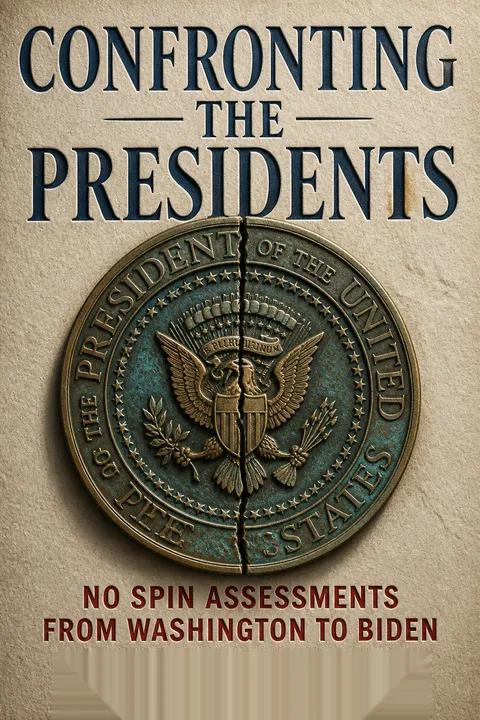
What's Confronting the Presidents about?
- Historical Assessment: The book provides a no-spin assessment of U.S. presidents from George Washington to Joe Biden, focusing on their personal lives, leadership styles, and the impact of their decisions.
- Complex Leadership: It explores the complexities of each president's character, revealing both strengths and flaws, such as corruption and personal struggles.
- Contextual Relevance: Understanding these leaders is crucial for grasping the current political landscape, especially as the nation faces divisions reminiscent of past eras.
Why should I read Confronting the Presidents?
- Engaging Narrative: Written in a direct and engaging manner, it is accessible to readers who may not be familiar with U.S. history.
- Insightful Analysis: Offers insights into the personal and political challenges faced by each president, providing a deeper understanding of their decisions.
- Relevance to Current Events: Encourages reflection on how past presidencies inform contemporary political issues.
What are the key takeaways of Confronting the Presidents?
- Diverse Leadership Styles: Each president had a unique approach to leadership, influenced by their backgrounds and historical context.
- Impact of Personal Lives: Personal struggles often influenced presidential decisions and effectiveness.
- Lessons from History: Understanding the past is essential for making informed decisions in the present, particularly in a politically charged environment.
What are the best quotes from Confronting the Presidents and what do they mean?
- “Knowledge is power. Prepare to get stronger.”: Emphasizes the book's mission to educate readers about presidential history, suggesting informed citizens are better equipped to engage in democracy.
- “The United States is essentially noble but flawed.”: Reflects the belief that while the nation has a strong foundation, it has also made significant mistakes, particularly in leadership.
- “We hope this book will help. We write it to illuminate the American pathway.”: Highlights the authors' intent to provide clarity and understanding of the American political journey.
How does Confronting the Presidents address the issue of slavery?
- Historical Context: Discusses how each president dealt with slavery, reflecting evolving attitudes throughout American history.
- Personal Views: Highlights the personal beliefs of presidents regarding slavery and how these influenced their policies.
- Consequences of Decisions: Analyzes the long-term effects of presidential decisions on slavery, including the lead-up to the Civil War.
What insights does Confronting the Presidents provide about George Washington?
- Reluctant Leader: Portrayed as initially reluctant to assume the presidency, preferring to remain a citizen farmer.
- Family Dynamics: Delves into Washington's complicated relationship with his mother, revealing personal struggles that shaped his character.
- Foundational Decisions: His presidency set precedents for future leaders, particularly regarding the balance of power.
How does Confronting the Presidents portray Abraham Lincoln's presidency?
- Crisis Management: Depicted as a leader who faced unprecedented challenges during the Civil War, balancing military action with national unity.
- Personal Loss: Discusses Lincoln's deep personal grief and how it affected his leadership.
- Legacy of Emancipation: Highlights the Emancipation Proclamation as a pivotal moment, reflecting his commitment to ending slavery.
What challenges did Ulysses S. Grant face during his presidency?
- Scandals and Corruption: His administration was marked by numerous scandals, tarnishing his reputation despite military successes.
- Reconstruction Efforts: Details his commitment to Reconstruction and civil rights for freed slaves, facing violent backlash.
- Personal Struggles: Discusses his battles with alcoholism and the toll of the presidency on his health.
How does Confronting the Presidents address the theme of political division?
- Historical Parallels: Draws parallels between past political divisions and contemporary issues, suggesting history can help navigate current challenges.
- Presidential Responses: Examines how different presidents responded to political strife, from Washington to Lincoln.
- Call for Unity: Advocates for a return to unity and understanding, emphasizing informed citizenship.
How does Bill O'Reilly assess the presidencies of Ulysses S. Grant and Rutherford B. Hayes in Confronting the Presidents?
- Grant's Achievements and Failures: Notes significant achievements like Yellowstone National Park but also corruption scandals.
- Hayes's Compromise of 1877: Describes his presidency as a time of healing post-Civil War, marked by the controversial Compromise of 1877.
- Contrasting Leadership Styles: Contrasts Grant's military leadership with Hayes's reform-oriented approach.
What role did the Great Depression play in shaping Franklin D. Roosevelt's presidency in Confronting the Presidents?
- Immediate Response: Highlights how Roosevelt's New Deal was a direct response to the economic crisis.
- Shift in Government Role: Marked a significant shift in the federal government's role, expanding its reach into economic and social welfare.
- Legacy of Leadership: Solidified his legacy as a transformative leader, restoring public confidence during a crisis.
How does Confronting the Presidents address the issue of civil rights during the presidencies of Eisenhower and Kennedy?
- Eisenhower's Cautious Approach: Initially hesitant to take strong action, but eventually enforced desegregation in Little Rock.
- Kennedy's Commitment: Faced pressure to address civil rights, leading to more decisive action and the Civil Rights Act of 1964.
- Legacy of Progress: Both presidents played crucial roles in advancing civil rights, laying the groundwork for future reforms.
About the Author
Other books by Bill O'Reilly
Download PDF
Download EPUB
.epub digital book format is ideal for reading ebooks on phones, tablets, and e-readers.








