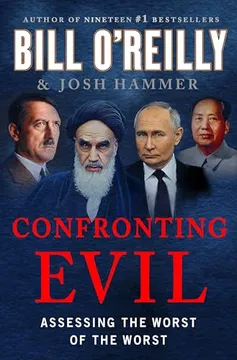


Key Takeaways
Judge evil by deliberate harm without remorse, then refuse the convenient excuse.
The book’s moral test. Its afterword defines evil as causing harm to another person without remorse. The opening account of the October 7 attack on Be’eri, an Israeli community founded in part by Holocaust survivors, makes the definition immediate: civilians are hunted, homes invaded, and families killed while perpetrators treat the violence as a triumph. The prologue argues that evil persists not only through its agents, but also when witnesses decide it is easier not to act.
Look past the alibi. The book rejects excuses based on profit, ideology, abusive childhoods, or claims that harmful conduct merely satisfies demand. Its recurring challenge is to judge what is done to people, not only how perpetrators explain it. That shifts the question from whether evil is an abstract force to whether people recognize preventable harm and respond.
The definition is powerful because it keeps moral judgment attached to human consequences rather than treating evil as a supernatural mystery. It also highlights a real problem in moral psychology: people readily excuse harm when it serves their group, livelihood, or preferred politics. Yet remorse is difficult to verify, and judging private intent can distract from evidence of public action. A useful extension is to assess both conduct and systems: what harm was foreseeable, who benefited, and what safeguards were ignored? That approach preserves moral clarity without making a person’s claimed feelings the only test.
When one ruler controls courts, guards, and truth, cruelty becomes policy.
Power without restraint. Caligula’s reign begins with public reforms and relief for the poor, then turns into arbitrary executions, humiliation of senators, and violence against people who threaten his security. His own Praetorian Guard eventually participates in his assassination, but removing him does not settle Rome’s political crisis. The chapter presents tyranny as more than a ruler’s cruelty: it is the ability to make private impulses govern public life.
A recurring pattern. Stalin’s secret police, Hitler’s SS, Mao’s party apparatus, and Khomeini’s revolutionary institutions each enforce the ruler’s authority through surveillance, imprisonment, or killing. Their systems differ, but the book’s comparison is that people become vulnerable when law enforcement, courts, and public information answer to one leader rather than operating as checks on power.
This account connects personal dictatorship to institutional design. Political science distinguishes a leader’s preferences from the machinery that makes those preferences enforceable: loyal security forces, compliant courts, and controlled information reduce the cost of repression. That is why a tyrant’s departure may not restore freedom if the coercive apparatus remains intact. The comparison also needs care. Roman imperial rule, twentieth-century totalitarian states, and revolutionary theocracies are not interchangeable systems. The strongest lesson is narrower: independent institutions make arbitrary rule harder, even when they cannot guarantee a just outcome.
Ideology can turn private ambition into public permission for atrocity.
Violence made righteous. Hitler’s racial doctrine casts persecution as national purification. Stalin’s revolutionary language presents repression as a route to a transformed society. Mao promises an egalitarian order while pursuing policies that, in the book’s account, bring famine, forced labor, and mass death. Khomeini’s revolution replaces the Shah’s dictatorship with religious rule that punishes dissent and imposes a new form of coercion.
The moral disguise. These leaders do not simply demand obedience; they give supporters a story in which harming opponents appears necessary, virtuous, or sacred. The book’s cases show how abstract goals can erase individual lives from the calculation. This is not an argument that all ideologies or religious traditions produce violence. It is a warning about any doctrine that treats human beings as expendable obstacles to a promised future.
Ideology helps coordinate large groups because it gives people shared explanations for sacrifice and shared targets for blame. Social identity research offers a useful lens: once belonging is tied to a cause, criticism can feel like betrayal, while cruelty toward an out-group can be framed as loyalty. Still, belief is not a complete explanation. Institutions, material incentives, fear, and personal ambition also shape participation. The chapter’s most durable insight is therefore about moral permission: watch for language that makes whole categories of people seem undeserving of ordinary protection.
Follow the money: respectable fortunes can rest on organized human suffering.
Profit in plain sight. The chapters on slavery and industrial wealth trace harm through businesses that appeared lawful and socially respectable. Isaac Franklin and John Armfield built a trafficking operation that sold enslaved people across the American South, separating families for profit. The book estimates that the partners sold about 100,000 people. In the later industrial era, J. P. Morgan and John D. Rockefeller accumulated enormous economic power while workers faced dangerous conditions and little protection.
Power can be challenged. Theodore Roosevelt’s administration sued Morgan’s Northern Securities combination under antitrust law, and the Supreme Court ordered it broken up. The book presents that episode as evidence that public authority can curb private power. It also links these histories to drug cartels, whose revenues depend on addiction, coercion, and violence rather than the safety of customers or communities.
The stories expose a recurring blind spot in moral judgment: visible respectability can conceal distant costs. Modern supply chains create the same analytical challenge, since consumers and investors may benefit without seeing the labor conditions or violence behind a product. Following money is a practical corrective, but wealth alone does not establish wrongdoing. The relevant questions concern methods, power, and accountability: were people coerced, were risks knowingly imposed, and could victims seek remedy? Roosevelt’s antitrust fight matters because it shows that markets require rules when concentrated power can suppress both competition and workers’ ability to object.
Terror works by teaching whole communities that resistance carries a price.
Violence beyond its victims. At Fort Pillow, Confederate forces killed Union soldiers after the fort was captured, with Black troops especially exposed to violence. The book describes the massacre as both an attack and a warning to others. After the Civil War, Nathan Bedford Forrest helped lead the Ku Klux Klan, which used murder, rape, and intimidation to undermine Black political participation and civil rights.
Fear spreads socially. Stalin’s no-retreat order threatened Soviet soldiers who withdrew without permission, while Mao’s public struggle sessions forced communities to witness humiliation and punishment. In each case, violence disciplines more people than those directly attacked. The intended audience includes the neighbor, coworker, voter, or soldier who learns that speaking up may endanger a family as well as an individual.
Terror’s political effect depends partly on its audience. Public punishment can create a chilling effect, a condition in which people avoid lawful speech or action because they expect retaliation. That makes violence a communication strategy, not merely an excess of battlefield anger. The book’s examples also show why testimony and records matter: perpetrators may try to conceal atrocities, while witnesses preserve evidence against official denial. One caution is that fear does not always produce compliance. It can also provoke solidarity or revolt, so repression is never a reliable substitute for consent.
A society’s safeguards matter most before its leaders become openly monstrous.
Complicity takes many forms. Caligula’s senators grant him sweeping authority because they fear him. Henry VIII bends religious and legal institutions to his will, while officials help prosecute Anne Boleyn and Thomas More. In the United States, pro-slavery lawmakers use the congressional Gag Rule to block debate over abolition petitions. In each scene, institutions do not merely fail to stop abuse; people inside them help make it ordinary.
Checks can still work. Roosevelt’s antitrust campaign shows a different possibility: a president, Justice Department, and court confront corporate concentration through legal process. The contrast suggests that institutions are not automatically virtuous. Their value depends on whether they can investigate power, protect dissent, and enforce rules against influential people, including those who claim to act for the public good.
Institutional safeguards are often described as technical arrangements, but their deeper function is to make power answerable to people who do not hold it. Independent courts, legislative scrutiny, and a free press create multiple opportunities to expose abuse before it becomes routine. The book’s historical portraits make those mechanisms feel concrete. Yet procedure alone is insufficient: legal systems have also enforced slavery and persecution. Safeguards need substantive commitments to equal protection, and they depend on officials willing to use them when resistance is costly.
Resistance begins when witnesses treat another person’s suffering as their concern.
Refusal has consequences. John Quincy Adams repeatedly challenged Congress’s ban on discussing slavery, even as southern lawmakers tried to silence him. His efforts did not end slavery, but they kept abolition in public debate. Decades later, the Civil War ended the institution through a conflict that killed hundreds of thousands of Americans. In another setting, Roosevelt used federal authority and antitrust law against industrial monopolies.
Memory is part of resistance. The book also recounts how reports of the Fort Pillow massacre reached the Northern press and helped shape public response. These episodes do not offer a simple recipe for victory. They show distinct forms of opposition: speaking, documenting, organizing, legislating, and, in the Civil War, fighting. The common element is refusing to treat another group’s suffering as irrelevant.
The chapter’s strongest civic insight is that attention can become an action: a witness can report, record, organize, or insist that an institution respond. Collective action research helps explain why isolated courage often struggles while coordinated efforts can change policy. At the same time, the book’s language of good people confronting bad people can simplify the slow work of coalition-building and political compromise. Resistance is not automatically effective or morally flawless. Its credibility depends on protecting the people it claims to defend and remaining open to evidence.
Removing a tyrant is not enough if the machinery of coercion survives.
Revolution can reverse the uniform. The Shah’s secret police, SAVAK, used surveillance, detention, and torture against opponents. After the Islamic Revolution, Khomeini’s regime imprisoned and executed members of the old order while building its own security apparatus. The book’s point is not that the two governments were identical, but that overthrowing an abusive ruler did not prevent new abuses.
The system can outlast its founder. Stalin’s death did not immediately dismantle the Soviet state’s instruments of repression. Mao’s death did not end one-party rule in China. The Klan survived its early leadership and reappeared across later decades. These cases caution against equating a change of leader with a change in political conditions. Accountability, legal reform, and protection for dissent matter after a regime falls, not only during the struggle against it.
Transitions are fragile because institutions, habits, and networks of advantage do not disappear when a leader does. Research on democratization often emphasizes the need to reform security services and establish credible rules for political competition. The Shah and Khomeini chapters illustrate the danger of replacing one monopoly of force with another. Yet dismantling coercive institutions is not simple: some are needed for public safety, and sudden collapse can create a vacuum. The practical goal is not a state without power, but one whose power is limited, reviewable, and answerable.
Confront harm with accountable power, not vengeance that copies the original abuse.
The book’s hard conclusion. Across its cases, the authors argue that passivity gives destructive actors room to operate and that force may be necessary to stop them. The Allied defeat of Nazi Germany and the Union victory that ended slavery are presented as instances where resistance required more than moral condemnation. The final chapter applies the argument to drug cartels, describing how violence, corruption, trafficking, and addiction devastate communities while criminal leaders profit.
Containment is not permission. The book’s case for confronting evil is strongest when action protects victims and weakens the capacity to harm. It is less persuasive if force is treated as self-justifying. A response that abandons evidence, law, or civilian protection can reproduce the logic it seeks to defeat. The principle is to act decisively, but keep the means accountable.
This is the book’s most consequential prescription and its most important tension. Inaction can leave victims exposed, while unchecked retaliation can create fresh victims and new grievances. Just-war reasoning offers a useful discipline: a protective aim does not settle whether force is necessary, proportionate, and directed at responsible parties. Those criteria do not erase the urgency of intervention; they make intervention morally distinguishable from vengeance. The chapters are most convincing when they pair moral clarity with concrete accountability, rather than presenting force as a universal cure.
Analysis
Confronting Evil is a story-driven moral history, not a systematic theory of violence. Its chapters move from Caligula and Genghis Khan through slavery, industrial exploitation, totalitarian regimes, the Iranian Revolution, Putin’s Russia, and drug cartels. The recurring structure is intimate: a scene of danger, a portrait of the person wielding power, then a wider account of the institutions and populations affected. That narrative method makes large historical claims emotionally legible, especially by showing how private decisions become public catastrophe.
The book’s central contribution is its insistence that moral attention is a civic duty. It links atrocity to three recurring motives, money, power, and zealotry, and argues that excuses and silence help destructive systems endure. The strongest chapters complicate the image of evil as a lone villain. Slave markets, secret police, legislative obstruction, corporate monopolies, and revolutionary organizations show how cruelty relies on collaborators, incentives, and structures, not only on individual pathology.
Its limitation is the same force that gives it momentum. The confident moral framing can flatten differences among periods and regimes, and the book often presents disputed historical estimates and interpretations with little visible uncertainty. The figures should be read as the authors’ claims, not as a substitute for specialist scholarship. The categories of good and evil also risk obscuring mixed motives, structural causes, and the fact that institutions can be both complicit and contested.
A careful reader can retain the book’s urgency without accepting every comparison at face value. The most useful test is not whether a leader resembles a prior monster, but whether power is unchecked, targeted groups are stripped of protection, and harms are excused or concealed. Historical memory then becomes more than remembrance: it is a way to recognize warning signs, demand evidence, and insist that efforts to stop abuse remain accountable to the people they aim to protect.
Review Summary
Glossary
Evil
Harm without remorseThe authors define evil as harming another human being without remorse. They use the term for individual acts and for organized conduct carried out by rulers, businesses, political movements, and criminal groups. The definition excludes self-defense and what they consider righteous war, making judgment of motive and context part of its application.
Relativism
Avoiding moral judgmentIn the afterword, the authors use relativism to describe resistance to making firm moral judgments about harmful conduct. They argue that people invoke context, social injustice, personal history, or market demand to excuse perpetrators. The term is used polemically, as a warning against turning explanations of wrongdoing into reasons to tolerate it.
Gulag
Soviet prison-camp systemGulag is an acronym for the Soviet agency responsible for administering forced-labor camps. In the book, it refers broadly to the prison-camp system used to detain political opponents and other people classified as enemies of the state. The authors describe these camps as instruments of state repression, where imprisonment, forced labor, and harsh conditions caused widespread suffering and death.
Zersetzung
Covert psychological harassmentZersetzung, translated in the book as corrosion, was a method of political repression used by East German state security. Rather than relying only on public arrest, it involved surveillance, isolation, threats, and interference with a target’s relationships and reputation. The chapter describes its use against theater director and activist Freya Klier, who was ultimately expelled to West Germany.
Five Olds
Targets of Maoist cultural changeThe Five Olds were old customs, culture, habits, ideas, and ways of thinking that Mao Zedong’s movement sought to eradicate. The campaign treated established traditions and institutions as obstacles to revolutionary transformation. The book connects this program to the Cultural Revolution, during which religious sites, cultural objects, books, and educational institutions were attacked or suppressed.
Foreign Terrorist Organization (FTO)
US terrorism designationA Foreign Terrorist Organization is a designation the book discusses as a potential tool of US policy against criminal or militant groups. The designation can trigger legal and financial consequences and can increase pressure on organizations and their supporters. The chapter considers its use against Mexican cartels, while also raising questions about sovereignty and the possible role of military force.
Santa Muerte
Folk saint associated with deathSanta Muerte, meaning Holy Death, is a skeletal folk-saint figure venerated by some people in Mexico and elsewhere in the Americas. The book depicts cartel leader Joaquín Guzmán praying to the figure for protection and success. The glossary notes that Santa Muerte worship blends religious and folk traditions and is not officially recognized by the Catholic Church.
About the Author
Other books by Bill O'Reilly


Download PDF
Download EPUB
.epub digital book format is ideal for reading ebooks on phones, tablets, and e-readers.








