

Key Takeaways
Use past cycles to recognize tomorrow's risks, not to predict exact dates.
History offers patterns, not calendars. Ray Dalio's central model is the Big Cycle: a country builds strength, success encourages excess, and accumulated weaknesses can lead to conflict and a new order. Debt, domestic cohesion, and international rivalry are intertwined, so their pressures can reinforce each other. The peaceful, productive stretches tend to be longer than the destructive transitions, but both belong in any realistic view of the future.
A market shock taught the lesson. In 1971, President Nixon ended the dollar's convertibility into gold. Dalio expected stocks to fall, but they rose about 4 percent as the dollar weakened. He had misread an unfamiliar event. Studying earlier currency devaluations helped him understand the move, and convinced him to investigate historical analogues before making decisions.
What's useful here is the distinction between recognizing a mechanism and forecasting its exact timing. Feedback loops can make change nonlinear: a financial shock may deepen political conflict, which then makes economic repair harder. Historical analogies help identify such interactions before they become obvious. But analogies are not laws. New technologies, institutions, and choices can alter the path, so the cycle is best used as a map of risks and possible sequences, not as proof that the same ending is inevitable.
Track the capabilities that compound into empire, not GDP alone.
Power has several engines. Dalio's eight headline measures are education, competitiveness, innovation and technology, economic output, share of world trade, military strength, financial-center strength, and reserve-currency status. They can reinforce one another: education supports invention, invention improves productivity and trade, and wealth can fund military capacity and capital markets. The currency's international role often persists after other advantages begin to fade.
The Dutch show the chain in action. A small population did not stop the Netherlands from leading through education, shipbuilding, trade, and finance. At its peak, Dalio estimates the Dutch produced about a quarter of major global inventions. The Dutch East India Company and Amsterdam's financial institutions helped turn commercial innovation into capital and influence. None of these measures alone explains a country's trajectory; their combined direction is more revealing.
This resembles systems analysis: a nation's advantage is not one score, but a network of capacities that amplify one another. The Dutch example makes the point vividly because it separates power from sheer size. Still, any index reflects choices about what counts. A measure of military strength may say little about security, while national output can rise without improving ordinary people's lives. These gauges are most useful when read alongside distribution, institutional quality, and human welfare, rather than treated as a single verdict on national success.
Remember: debt creates today's demand and tomorrow's repayment squeeze.
Credit pulls spending forward. A loan gives a borrower buying power now, and becomes an asset for the lender. When that borrowing funds productive activity, both sides can benefit. But debt service later competes with other spending, and one party's debt is another party's asset. If many borrowers cut spending or default at once, incomes and asset values can fall together, worsening the original problem.
Money changes the adjustment. Dalio describes a recurring movement from hard money, to paper claims backed by it, to expanding credit, and then crisis. Governments may respond with spending cuts, defaults, wealth transfers, or money creation. Printing money can relieve debtors, but it can also reduce the purchasing power of creditors. The long-term debt cycle often takes roughly 50 to 75 years, though conditions matter more than the calendar.
The key insight is distributional: monetary policy is not simply a technical adjustment to aggregate demand. It changes who bears losses, especially when asset purchases lift financial prices more than wages or productive capacity. Balance-sheet analysis helps reveal that transfer more clearly than headline growth figures. Yet money creation does not automatically cause runaway inflation. Outcomes depend on where new purchasing power goes, the economy's capacity to supply goods, and public confidence in the currency. The mechanism is strong; the result is conditional.
Watch debt, inequality, and shocks together before politics turns combustible.
Financial strain becomes political. Dalio's internal cycle moves from a new order, through institution-building and prosperity, into excess, intense conflict, and sometimes revolution or civil war. Its most dangerous combination is a government with weak finances, large wealth or values gaps, and a severe shock such as a depression, war, or pandemic. When resources shrink, groups fight harder over who pays and who receives support.
The estimates are warnings, not prophecies. In Dalio's historical sample, when 60 to 80 percent of selected economic red flags were present, the estimated chance of severe internal conflict was about one in six. With more than 80 percent, it was about one in three. The figures come from a limited set of past cases, not a universal law. Peaceful reform is possible, but becomes harder when factions stop trusting the rules or each other.
The framework connects macroeconomic stress to political legitimacy, a link often lost when analysts focus on national averages. A country can look prosperous while large groups experience insecurity and exclusion. The caution is that inequality does not mechanically produce civil conflict. Institutions, leadership, social trust, and credible ways to resolve disputes can absorb pressures that would otherwise become explosive. The model is therefore most valuable as a diagnostic: it directs attention to interacting vulnerabilities, while leaving room for political choices to change the outcome.
Treat reserve-currency privilege as borrowed time, not immunity.
Currency leadership outlasts its foundations. Since 1700, the book estimates, only about 20 percent of roughly 750 currencies remain, and every surviving currency has lost value. A reserve currency brings unusual borrowing power because foreign governments, businesses, and savers use it. But that privilege can encourage the issuing country to borrow beyond what its underlying economy can comfortably support.
The Dutch and British currencies illustrate the lag. The guilder remained important even as Dutch competitiveness weakened. During the Fourth Anglo-Dutch War, the Bank of Amsterdam expanded lending, lost reserves, and faced a run by depositors seeking metal. The pound later displaced the guilder. Britain's currency decline was slower: the UK devalued in 1949 and again in 1967 as debt and weak competitiveness eroded confidence. The dollar's continued dominance does not make it permanent.
Reserve currencies benefit from network effects: people use them partly because everyone else does, and that shared use can survive a long time after the issuer's relative strength changes. This helps explain why decline is often gradual, then abrupt. It also shows why currency status cannot be inferred from debt alone; liquidity, legal credibility, trade, and geopolitical influence matter. The historical pattern is a reason to monitor exposure, not a precise countdown to the dollar's replacement. Entrenched systems can adapt, and challengers must offer more than a rival flag.
When a rising rival meets a divided incumbent, small tests can compound.
International disputes lack a reliable referee. Dalio groups conflicts between countries into trade and economic, technology, capital, geopolitical, and military contests. A tariff or sanction can begin as pressure over one issue, yet retaliation may widen the dispute. The risk rises when a declining power fears that backing down will signal weakness, while a rising power seeks rules that better reflect its growing strength.
The 1930s offer a warning, not a script. Before World War II, economic conflict and protectionism developed amid depression and domestic polarization. Dalio sees some comparable pressures in US-China rivalry, especially around technology and Taiwan. In the book, written in 2021, he gives a rough, low-confidence estimate of a 35 percent chance of a major war in the following decade. He stresses uncertainty and the catastrophic cost of miscalculation, not certainty that war will occur.
This is a classic security dilemma: one side's attempt to protect itself can look like preparation to attack, prompting the other side to respond in kind. The concept helps explain escalation without assuming either party wants war. Historical comparison is valuable, but the 1930s analogy has limits. Nuclear deterrence, deep economic interdependence, and modern institutions change the incentives, even if they do not eliminate danger. Clear communication about vital interests and restraint in symbolic tests can matter as much as raw capability.
China's ascent shows how openness and incentives can remake national capacity.
Reform changed the direction of the cycle. After decades of upheaval and isolation, China began market reforms and opened to international learning under Deng Xiaoping in 1978. The shift combined state direction with market incentives, export growth, investment, and expanded education. From 1978 to 1997, the economy grew about 10 percent annually on average. By 2018, output per person was about 25 times its 1978 level, while the share living below the cited poverty line fell from 96 percent to about 1 percent.
The rise altered the global balance. China's growth drew on domestic policy, foreign investment, trade, and access to global markets. The country became a major competitor in output, exports, technology, and military power, while the United States faced the costs of debt and internal division. Dalio's historical lens helps explain why each side interprets the other's rise through different memories and interests.
China's transformation is a powerful case of institutional change and learning at scale. It also cautions against simple ideological categories: economic incentives and strong state coordination can coexist, with distinctive trade-offs. The figures show extraordinary gains, but they do not establish that every feature of the system caused those gains or that the model can be transplanted elsewhere. External demand, demographic conditions, and the starting point matter. Comparative analysis should credit the achievement without confusing one historical success with a universally replicable formula.
Build decisions to survive surprises, rather than betting on one forecast.
Protect against ruin first. Dalio's practical lesson came from a painful mistake in 1982. He expected a debt crisis to trigger a depression, bet heavily on that view, and lost enough that Bridgewater had to let its staff go. He borrowed $4,000 from his father to cover family expenses. The error taught him that central banks can contain debts denominated in their own currency by supplying money, changing the likely outcome.
Prepare for several futures. His approach is to identify unacceptable worst cases, build protection against them, diversify across bets that are not closely connected, and test assumptions with informed critics. For markets, he watches growth, inflation, risk premiums, and discount rates because changes in these drivers affect future cash flows and asset values. Diversification is not a prophecy. It is a way to remain in the game when the forecast is wrong.
This is robust decision-making rather than conventional point forecasting: choose actions that remain tolerable across multiple plausible futures. The principle applies to institutions as well as portfolios, since reserves and fallback options preserve room to respond. Diversification works best when risks are genuinely different, but crises can make previously separate assets move together. Preparation therefore requires more than spreading holdings: it also means understanding liquidity, time horizons, and which losses would permanently limit future choices.
Analysis
Dalio's most persuasive contribution is not a prediction that one empire must replace another. It is a way to connect domains that are often studied separately: public finance, currency confidence, social conflict, technological capacity, and military rivalry. His examples make feedback visible. Dutch commercial ingenuity built a financial center and a reserve currency; the resulting reach did not prevent later loss of competitiveness and a currency crisis. China's reform era shows the reverse movement, where changes in incentives and international openness helped rebuild national capacity. The recurring mechanisms are more informative than any single analogy.
The framework also has important limits. A cycle can clarify how pressures accumulate, but its staged structure may make history look more regular than it is. The cases selected are prominent empires, not a neutral sample of all political communities. Indicators such as military strength and aggregate output measure power more readily than legitimacy, security, or quality of life. Dalio acknowledges uncertainty, yet numerical scores can still create a misleading impression of precision, especially when judgments about leadership and institutional adaptability resist quantification.
A useful reading treats the model as a risk map, not a clock or a verdict. It prompts better questions: Who holds the debt? Which groups absorb monetary losses? Can institutions distribute gains broadly enough to sustain cooperation? Does a rival's defensive move look threatening from the other side? These questions connect balance-sheet analysis with political economy and strategic behavior. The deepest lesson is that national strength is not merely accumulated wealth. It depends on converting knowledge and resources into productive capacity while keeping the rules legitimate enough that people continue to cooperate. History narrows the range of surprises; it does not abolish human agency or make outcomes inevitable.
Review Summary
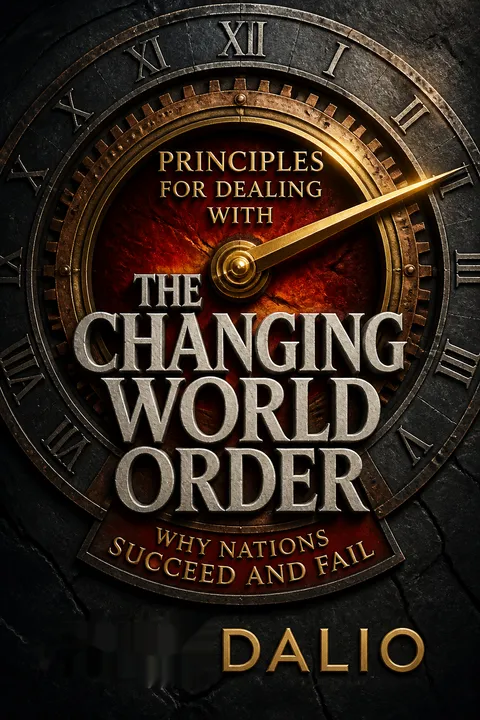
Principles for Dealing with the Changing World Order by Ray Dalio presents a comprehensive analysis of historical cycles in global power dynamics. Readers appreciate Dalio's insights into economic and geopolitical trends, particularly regarding the US-China relationship. The book's data-driven approach and long-term perspective are praised, though some criticize its repetitiveness and potential bias. While many find the content thought-provoking, opinions vary on Dalio's predictions and interpretations. The book's structure and writing style receive mixed reviews, with some finding it dense but informative, while others struggle with its verbosity.
People Also Read


Glossary
Big Cycle
Empire rise and declineDalio's model of long-term changes in a country's wealth and power. Strengths such as education, productivity, trade, finance, and military capacity reinforce one another during a rise. Success can also generate debt, inequality, overextension, and conflict, which weaken the system and can lead to a new domestic and international order. The pattern describes recurring pressures, not a fixed timetable.
Big Five
Five major forcesDalio's shorthand for the forces he considers especially consequential: the debt and capital markets cycle, the internal order cycle, the external order cycle, innovation and technological development, and acts of nature such as disease, drought, and floods. When these forces move together, their combined effect can overwhelm the influence of many smaller determinants.
Long-Term Debt Cycle
Generational debt and money cycleA recurring process in which borrowing and financial claims expand over decades until debt burdens become difficult to sustain. Authorities may restructure debts, transfer resources, or create money to relieve the squeeze. That response can weaken currency value and confidence, prompting a broader monetary reset. Dalio estimates that the cycle often spans roughly 50 to 75 years, while emphasizing that conditions matter more than elapsed time.
Internal Order and Disorder Cycle
Domestic stability and conflict cycleDalio's model of how a country's governing arrangements move between stability and breakdown. A new leadership consolidates power and builds institutions; prosperity follows, then excess and widening divisions can produce financial stress and intense conflict. If the system cannot resolve disputes, revolution or civil war may replace it. Different stages create different risks, but movement between them is not inevitable.
External Order and Disorder Cycle
International power transition cycleA recurring shift in relations between countries as established powers weaken and rising powers challenge the existing rules. Because there is no consistently powerful global authority to enforce agreements, disputes are often settled through bargaining, pressure, or tests of strength. Economic, technological, financial, geopolitical, and military contests can interact and, in severe cases, contribute to war and a new world order.
Beautiful Deleveraging
Less damaging debt reductionDalio's term for managing excessive debt in a way that reduces debt burdens without allowing a severe deflationary collapse or triggering uncontrolled inflation. It involves balancing spending restraint, debt restructuring, transfers, and money creation. The aim is to restore financial stability while supporting economic activity, rather than relying on a single adjustment that shifts excessive losses onto borrowers or creditors.
Type 1, Type 2, and Type 3 monetary systems
Three forms of moneyDalio's categories for monetary arrangements. Type 1 uses money with intrinsic value, such as metal coins. Type 2 uses claims redeemable for a hard asset, typically gold or silver. Type 3 is fiat money, whose value is not fixed to a tangible asset. Historically, pressure to create more credit can move systems toward looser forms, while loss of confidence can push them back toward hard assets.
Monetary Policy 1, 2, and 3
Three stimulus approachesDalio's labels for successive approaches to economic stimulus. Monetary Policy 1 changes interest rates to influence borrowing and spending. Monetary Policy 2 creates money to buy financial assets, commonly government bonds. Monetary Policy 3 coordinates central-bank money creation with government borrowing and spending. The sequence describes tools often used as earlier methods lose effectiveness, not a mandatory policy script.
FAQ
What's Principles for Dealing with the Changing World Order about?
- Historical Cycles: The book examines the rise and fall of empires, focusing on the cyclical nature of wealth and power dynamics. It highlights how these cycles are driven by universal principles.
- Big Cycle Framework: Ray Dalio introduces the "Big Cycle," which includes economic, political, and social factors influencing the rise and fall of nations.
- Current Global Dynamics: The book discusses contemporary geopolitical tensions, especially between the US and China, and how these dynamics may evolve.
Why should I read Principles for Dealing with the Changing World Order?
- Timely Insights: Given current global uncertainties, Dalio's analysis offers valuable perspectives on anticipating and responding to significant changes.
- Practical Application: The book provides actionable advice based on historical precedents, applicable to personal and professional life, especially in investment and economic decision-making.
- Expertise of the Author: Ray Dalio's experience as a successful investor lends credibility to his analysis, making it a valuable resource for understanding global macroeconomic trends.
What are the key takeaways of Principles for Dealing with the Changing World Order?
- Cycles of Rise and Decline: All empires experience cycles of growth and decay, influenced by economic, political, and social factors. Recognizing these cycles can help predict future trends.
- Importance of Adaptability: Nations and individuals must adapt to changing circumstances, with flexibility and a willingness to learn from history being crucial for success.
- Wealth and Power Dynamics: The book highlights how wealth and power concentration among a small elite can lead to societal tensions, emphasizing the need to address these disparities.
What are the best quotes from Principles for Dealing with the Changing World Order and what do they mean?
- "The times ahead will be radically different from those we’ve experienced in our lifetimes.": This quote underscores the inevitability of change and the importance of preparing for it.
- "Understanding history in this way also raises questions whose answers provide us with valuable clues on what the future will be like.": It emphasizes the value of historical study in informing present and future decisions.
- "The biggest thing affecting most people in most countries through time is the struggle to make, take, and distribute wealth and power.": This encapsulates the central theme of the book, highlighting the ongoing conflict over resources.
What is the "Big Cycle" as defined in Principles for Dealing with the Changing World Order?
- Definition of Big Cycle: The "Big Cycle" refers to recurring patterns of rise and decline that nations experience over time, encompassing economic, political, and social factors.
- Stages of the Cycle: Dalio outlines stages such as the rise of new leadership, periods of prosperity, and eventual decline due to internal and external pressures.
- Historical Examples: The book provides examples of empires like the Dutch, British, and American, illustrating how they followed similar patterns.
How does Ray Dalio define the long-term debt cycle in Principles for Dealing with the Changing World Order?
- Definition of the Cycle: The long-term debt cycle lasts 50 to 75 years and involves debt accumulation leading to a crisis, with stages including initial prosperity and eventual defaults.
- Stages of the Cycle: Dalio outlines six stages, from low debt and hard money to increased borrowing and crises, reflecting economic conditions and responses.
- Impact on Economies: This cycle affects both individual nations and the global economy, helping anticipate economic downturns and necessary adjustments.
How does Principles for Dealing with the Changing World Order explain the decline of empires?
- Common Themes in Decline: Dalio identifies themes like growing inequality, fiscal problems, and internal conflict, often leading to civil unrest and revolutions.
- Economic Mismanagement: Empires often face economic mismanagement, leading to excessive debt and inflation, eroding public trust and destabilizing politics.
- External Pressures: External pressures, such as military conflicts and competition from rising powers, can accelerate an empire's decline.
What are the implications of the US-China relationship discussed in Principles for Dealing with the Changing World Order?
- Rising Tensions: The book highlights increasing tensions between the US and China in trade, technology, and military domains as part of a broader struggle for dominance.
- Potential for Conflict: Dalio warns that competition could lead to military conflict, especially over issues like Taiwan, emphasizing careful management of differences.
- Global Impact: The US-China relationship affects global trade, economics, and geopolitics, making understanding it essential for anticipating future developments.
How does Principles for Dealing with the Changing World Order address the concept of monetary systems?
- Types of Monetary Systems: Dalio discusses hard currency, commodity-backed currency, and fiat currency, each with implications for economic stability and growth.
- Historical Patterns: The book outlines transitions between these systems throughout history, often leading to inflation and economic crises.
- China's Monetary Evolution: Dalio highlights China's historical experiences with monetary systems, informing current Chinese monetary policy and global finance approach.
How does Ray Dalio define populism in Principles for Dealing with the Changing World Order?
- Political and Social Phenomenon: Populism arises when ordinary people feel ignored by elites, leading to leaders who claim to represent the common man.
- Emotional Appeal: Populist leaders appeal to emotions rather than rational discourse, fostering division and conflict between factions.
- Historical Examples: The book references historical instances like communism and fascism to illustrate populism's potential consequences.
How does Principles for Dealing with the Changing World Order suggest nations can prepare for future challenges?
- Long-term Planning: Dalio advocates for strategic planning, emphasizing understanding historical patterns to inform current decisions.
- Adaptability and Resilience: Nations must be adaptable and resilient, prepared for economic downturns, social unrest, and geopolitical conflicts.
- Collaboration and Understanding: Building relationships based on respect and shared interests can help mitigate conflicts and foster stability.
How can I apply the principles from Principles for Dealing with the Changing World Order to my personal life?
- Financial Awareness: Dalio encourages assessing financial situations critically, understanding income, expenses, and debt levels for informed decisions.
- Long-term Thinking: The book promotes a long-term perspective on investments and personal goals, focusing on sustainable growth.
- Engagement in Societal Issues: Understanding wealth and power dynamics can motivate engagement in social and political issues, contributing to positive change.
About the Author
Other books by Ray Dalio
Download PDF
Download EPUB
.epub digital book format is ideal for reading ebooks on phones, tablets, and e-readers.








