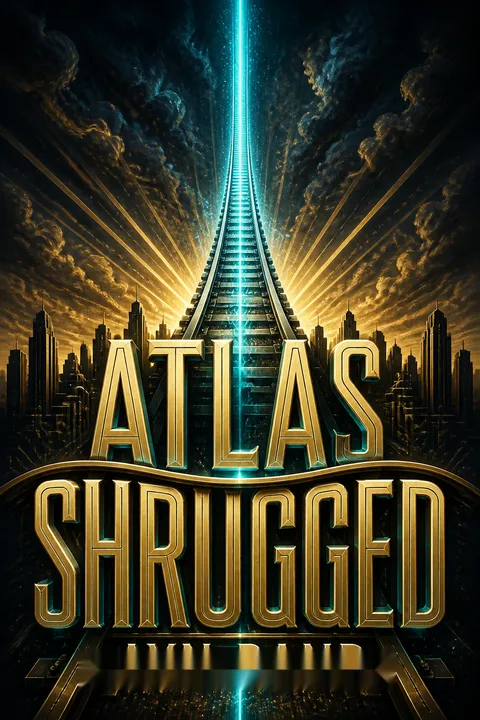


Plot Summary
The Railroad Starts Failing
Eddie Willers20 warns Taggart Transcontinental president James Taggart6 that the Rio Norte Line is collapsing, shippers are leaving, and thirteen months of promised steel from Associated Steel have produced nothing. James6 dismisses the crisis as temporary and blames the competing Phoenix-Durango. Dagny Taggart,1 his sister and the railroad's operating vice-president, has already seen the wreckage for herself.
She cancels the stalled contract with Orren Boyle15 and orders rail from Henry Rearden,2 whose new alloy has not yet been tested in service. When a broken signal strands the Comet on a siding, Dagny1 takes command and gets it moving again. Her decision begins as a repair job, but the railroad's survival now depends on her judgment.
The opening makes the crisis material before it makes it philosophical: damaged rails, missed deliveries, lost shippers, and a stalled train. Dagny responds to evidence, while James tries to substitute reassuring language for action. The contrast establishes the novel's central test of character through conduct. Competence is not a decoration here; passengers and industries depend on it. The recurring question about John Galt arrives amid ordinary failures, hinting that the breakdown has a cause beyond bad luck.
Rearden Pours His Metal
Henry Rearden2 watches the first heat of Rearden Metal flow from his furnaces after ten years of research, mining, failed experiments, and rebuilding an abandoned steel plant. He makes a bracelet from the first metal for his wife, Lillian,7 hoping to share the achievement. She mocks it as an ugly piece of industrial material, while his mother and brother Philip accuse him of selfishness for caring about work and profit.
Rearden2 gives Philip money for a social organization, but Philip insists it be anonymous because the group condemns Rearden.2 The gift leaves Rearden2 more bewildered than generous. He begins to see that his household does not value the effort that sustains it, though he still assumes their reproaches express concern for him.
Rearden's first success is paired with a private failure of recognition. He offers the bracelet as a personal token, but his family converts it into evidence against him, refusing to acknowledge what it means to its maker. His response is not yet anger so much as confusion: he assumes affection must be present even when the people around him treat his values with contempt. The scene introduces the gap between production and moral approval that will later become a political weapon.
Mexico's Empty Mines
Years earlier, James Taggart6 had persuaded the board to build the San Sebastian Line in Mexico, ostensibly to serve Francisco d'Anconia's4 copper mines and help an impoverished country. Dagny1 opposed the venture, but the railroad spent millions while neglecting repairs on its established lines.
The mines prove nearly worthless, and Mexico nationalizes them and the railroad. In New York, James6 claims credit for stripping the branch of useful equipment beforehand, though Dagny1 made those decisions. Meanwhile, the Phoenix-Durango has built a thriving Colorado business around Ellis Wyatt's17 oil.
Orren Boyle15 and James6 answer this competition by advancing a railroad alliance rule that restricts competition and protects established lines. Dan Conway of the Phoenix-Durango loses his Colorado route and chooses retirement over a destructive legal fight.
The Mexico venture exposes the difference between evidence-based investment and moralized speculation. James supports a project he cannot explain operationally, then recasts its failure as public service and claims Dagny's prudent preparations as his own. The anti-competition rule turns the lesson into policy: rather than improve the failing railroad, its leaders seek to disable a successful rival. Dan Conway's submission shows how a voluntary promise to cooperate can be turned against the very people who built something worth preserving.
Dagny Builds Her Own Line
Ellis Wyatt17 visits Dagny1 and demands reliable transportation when the Phoenix-Durango's exclusion from Colorado takes effect. He makes clear that he will not entrust his oil fields to a railroad that treats his business as a captive resource.
Dagny1 accepts the challenge and forms the independent John Galt Line, taking personal responsibility for its financing and construction. James6 agrees only after securing terms that protect Taggart Transcontinental if she fails.
Contractors vanish, suppliers delay, and officials obstruct the work; Dagny1 and Rearden2 answer each setback by finding another method, reopening an abandoned tool plant and training workers to handle the new alloy. Rearden2 designs a lighter bridge for the canyon, making the line possible on a deadline that seems impossible.
The line becomes a practical counterargument to both James's excuses and the alliance's coercion. Dagny accepts risk without pretending the railroad can be saved by goodwill alone; Wyatt requires service that earns his business, while Rearden's metal and bridge design answer concrete engineering needs. The name John Galt, attached to a project built against the prevailing mood of resignation, turns a taunt into a challenge. Each delay tests whether judgment can still produce results in an environment organized to evade responsibility.
The Bracelet Changes Hands
At a lavish party for his wedding anniversary, Rearden2 wears formal clothes among guests who mock industry, praise sacrifice, and welcome Bertram Scudder, a journalist who has attacked Rearden2 in print. Dagny1 arrives to celebrate the first Rearden Metal track, but Rearden2 treats her with cold formality, ashamed of his desire for her and still bound by his marriage vows.
Lillian7 displays the metal bracelet beside her diamonds, ridiculing the gift. Dagny1 offers her own diamond bracelet in exchange and takes the Rearden Metal chain back. Rearden2 then publicly behaves as Lillian's7 attentive husband. The gesture exposes the conflict between private value and social appearance, while Dagny1 and Rearden2 leave their feelings unspoken.
The bracelet makes competing value systems tangible. Rearden sees a chain forged from his first successful heat; Lillian turns it into a joke, then uses its exchange to expose Dagny's attachment. Dagny's refusal to treat the object as a joke is a public assertion of judgment, but Rearden's response reveals his shame and his attempt to obey a promise without examining the marriage it binds him to. The party's polished manners conceal a contest over who has the right to define what is valuable.
The John Galt Line Runs
On the opening day, every Taggart engineer volunteers to drive the first freight train, despite union warnings that the Rearden Metal rails and bridge are unsafe. The crew chooses Pat Logan by lot, and Dagny1 rides in the locomotive beside Rearden.2 The train reaches one hundred miles per hour, crosses Denver, and holds to the track as the Rearden2 bridge carries it over the canyon.
Retired railroaders and local residents line the route to salute it. At Wyatt Junction, Ellis Wyatt17 greets Dagny1 and promises more oil, while the investors celebrate without speeches. That night, Dagny1 and Rearden2 finally become lovers. The line's success gives their mutual respect a bodily and emotional meaning neither had permitted themselves to name.
The opening train joins abstract judgment to physical proof: rail, bridge, engine, and crew all perform under pressure. The public's cheering briefly restores a shared language of achievement, though the celebrants' respect is not the same as the critics' earlier consent. For Dagny and Rearden, the ride is a moment in which work and desire no longer seem opposed. Their intimacy follows the line's success because each has witnessed the other's competence in action.
Cherryl Marries the Wrong Hero
After the John Galt Line succeeds, James Taggart6 meets Cherryl Brooks,8 a young dime-store clerk who has escaped a stagnant family life in Buffalo and admires builders of great things. He lets her believe that he was the force behind the line, then courts her publicly as a democratic businessman marrying beyond his class.
At their wedding, Cherryl8 sees that his wealthy guests treat him with contempt and that his sister Dagny1 is the real object of interest. She later confronts Dagny,1 believing she must defend Jim,6 but Dagny's1 blunt indifference unsettles her. As Cherryl8 learns more about Jim's6 resentment of achievement and his hunger for undeserved admiration, her borrowed image of him collapses. She leaves the marriage and dies by suicide.
Cherryl's story shows how admiration can be manipulated when a person has few reliable models of achievement. She recognizes genuine ambition in the abstract, then mistakes James's publicity for evidence that he possesses it. His marriage campaign turns her poverty into a prop in his self-presentation. Her eventual recognition is painful because the discovery is not merely that Jim lied, but that she helped sustain the lie by treating his prestige as proof of his character.
A Motor in the Ruins
During a vacation with Rearden,2 Dagny1 drives to the ruined Twentieth Century Motor Company in Wisconsin, hoping to find machinery for a Colorado factory. The town is impoverished, its roads broken and its residents reduced to barter.
In a gutted laboratory, she uncovers part of an electric motor and a fragment of its technical description. The design appears to draw energy from the atmosphere, a breakthrough no existing engineer can reproduce. Rearden2 recognizes its extraordinary potential but doubts anyone can rebuild it without the inventor.3
Their inquiries reveal that the factory's owners adopted a system in which workers were paid according to need and judged by votes, while ability was punished. The laboratory chief, William Hastings, is dead; the brilliant young inventor3 remains unidentified.
The broken motor is both an invention and a forensic clue. Its abandonment cannot be explained by ordinary market failure alone, so Dagny and Rearden must examine the factory's human history. The town's material wreckage gives the old Starnes system a consequence visible in homes, roads, and lives. Crucially, the motor's value survives the institution that failed to recognize it, creating a mystery that asks whether the lost intelligence is recoverable.
The Producers Disappear
As Dagny1 traces the motor's inventor,3 Washington expands control over business. The Equalization of Opportunity law limits ownership, and Wesley Mouch's16 directives cap production, distribute materials by government allocation, restrict rail traffic, and freeze firms in place.
Rearden2 loses his ore mines through the law, while the new owners cannot supply him reliably. Ellis Wyatt's17 oil fields are nationalized; after the government seizes them, Wyatt17 sets them ablaze and vanishes, leaving a message that the state may take over.
Other Colorado producers, including Andrew Stockton and Lawrence Hammond, disappear from their companies. The once-busy towns begin to empty. Dagny1 sees that the laws do not merely redistribute goods; they remove the people whose work made those goods possible.
The collapse follows a clear chain: production is restricted in the name of fairness, then shortages make the restrictions more severe, until the people responsible for production withdraw. Wyatt's fire is not an accidental loss but a deliberate refusal to leave his work available for seizure. The resulting silence in Colorado demonstrates that physical assets cannot substitute for the judgment and purpose that made them productive.
The Motor's Trail Goes Cold
Dagny1 visits Hugh Akston,11 the retired philosopher whose name Francisco4 once mentioned, and asks him to identify the motor's maker.3 Akston11 confirms its scientific importance and says a young assistant of William Hastings designed it, but refuses to reveal more.
His answer also exposes the moral retreat of Robert Stadler,12 the celebrated physicist who knows the Institute's condemnation of Rearden Metal is dishonest yet will not publicly oppose it. Dagny1 hires Quentin Daniels, a young physicist who has refused government employment, to reconstruct the motor.
He accepts the work for a modest salary, insisting that he will earn a greater share only if he succeeds. Meanwhile, more skilled workers leave, and the motor's lost inventor3 remains an open question.
The search for the inventor becomes a test of whether knowledge can be separated from the conditions that allow it to flourish. Akston's refusal is not ignorance; it is a boundary, and Daniels's terms contrast sharply with the government's demand for service without consent. Stadler's silence matters because he possesses the authority to correct a false claim but protects the institution that gives his name prestige.
The Tunnel Takes the Comet
The rail system deteriorates as experienced crews and managers disappear, leaving James Taggart's6 appointees to make decisions they cannot defend. At Winston, the Comet is sent into the eight-mile tunnel behind an obsolete coal-burning engine because the available Diesel has been diverted.
Its ventilation system cannot handle the smoke. An Army freight train carrying explosives enters behind it, and the two trains collide in the darkness. The resulting blast destroys the tunnel and kills everyone aboard.
Dagny,1 who has been flying west in search of the missing inventor,3 learns that the railroad she tried to preserve has suffered a catastrophe that cannot be repaired by ordinary effort. She continues toward the mountains, following the trail of the vanished men.
The catastrophe is not a random storm or a single mechanical fault. It is the convergence of neglected infrastructure, incompetent command, and rules that divert scarce equipment from the work that needs it. The tunnel, once a triumph of engineering, becomes a sealed chamber where those failures meet. Its destruction gives literal form to the costs of treating expertise as expendable.
The Valley Behind the Screen
Following a plane she cannot explain, Dagny's1 aircraft strikes the hidden screen around a mountain valley and crashes inside it. She wakes in Galt's Gulch, where Midas Mulligan,14 Hugh Akston,11 Richard Halley, Ellis Wyatt,17 Ken Danagger,10 and other vanished producers live and work by choice. Galt3 reveals that he has organized a strike of the people whose labor sustains the outside world.
The valley's businesses trade by consent, and its residents keep their professions alive without serving the looters. Dagny1 learns that Galt3 is the inventor3 she has sought and that the cigarette marked with a dollar sign comes from the valley. Though she loves him, she refuses to take the strike oath and returns to her railroad.
The valley turns the novel's repeated disappearances into a deliberate collective action, while its hidden screen literalizes the gap between seeing an object and understanding its cause. Dagny recognizes the community's coherence, but refuses to abandon the railroad before she believes the fight is finished. Her decision is not ignorance; it is a conflict between two forms of loyalty, each grounded in the work she considers worth preserving.
Rearden Signs Under Threat
Back in the collapsing economy, Rearden2 sells his mines to Paul Larkin under the Equalization law and relies on Ken Danagger10 for coal. He continues supplying the John Galt Line and secretly sells Rearden Metal to Danagger,10 who needs it to keep mines safe. When the State Science Institute demands metal for its secret Project X, Rearden2 refuses.
Dr. Ferris19 then threatens to expose the illegal sale and implicate Danagger.10 Rearden2 yields the Gift Certificate, surrendering his metal rather than let the scandal destroy Dagny.1 He later realizes that he has let his own sense of guilt become a weapon against him. At trial, he refuses to pretend the court is just and publicly defends the right to earn his profits.
Rearden's surrender is a pivotal moral defeat, not a change of conviction. He chooses to protect Dagny, but the blackmail works because he still accepts the premise that his desire and his relationship are shameful. At trial, he refuses to lend the proceedings his cooperation, exposing how the state needs victims to validate its authority. His growing insight is that coercion relies not only on guns, but on the victim's internalized guilt.
Galt's Voice Breaks Through
After Rearden's2 trial, John Galt3 takes over a national radio broadcast intended for James Taggart6 and the government's leaders. He identifies himself and explains that the vanished industrialists have withdrawn their work rather than continue under laws that punish production and reward need. His speech challenges listeners to judge the moral code behind the crisis, not merely its latest policy.
The broadcast reaches Dagny,1 Rearden,2 and millions who have been taught to distrust their own reasoning. The government captures Galt3 soon afterward, hoping to make him lead the economy by force. Instead, it confines him in Project X, where Dr. Ferris19 and his men use an electrical torture machine to compel his cooperation.
The broadcast changes the conflict from rumor to public knowledge. Galt does not offer a policy adjustment; he names the hidden premise that connects the laws to the collapse and refuses to let the state represent coercion as consent. His capture reveals the regime's dependence on the very mind it claims is unnecessary. The torture machine is the political system reduced to its essential method: force applied when persuasion and production have failed.
The Prisoners Turn Rescuers
Dagny1 learns that Galt3 is being held at the State Science Institute and reaches the facility with Rearden,2 Francisco d'Anconia,4 and Ragnar Danneskjold.13 They overpower the guards and find Galt3 strapped to the experimental machine. Rearden,2 who once condemned Francisco4 for destroying d'Anconia Copper, now fights beside him; Francisco4 helps dismantle the apparatus, while Ragnar13 secures their escape.
Project X, the government's weapon, is destroyed during the chaos, and the power failure spreads through the city. Galt3 survives the torture. The four return toward the hidden valley, leaving the collapsing regime without its captive inventor3 or the expertise it hoped to command.
The rescue gathers the novel's principal forms of resistance into one action: Rearden's practical competence, Francisco's hidden resolve, Ragnar's force, and Dagny's willingness to cross the boundary she once refused. Their cooperation is not a merger of identical motives; each acts from a shared judgment that coercion cannot create value. The destruction of Project X also turns the state's most ambitious instrument against the system that built it.
The Last Train Stalls
With the Taggart Bridge destroyed and New York's lights going out, the last Comet crawls west on the remaining track. Eddie Willers20 has stayed aboard, trying to keep it moving after Dagny1 leaves. Its engine fails in the Arizona desert, and the crew abandons it. A caravan offers Eddie20 passage, but he refuses to leave the train, clinging to the railroad he has served since childhood.
He cannot repair the engine or reach a functioning headquarters. The Comet stands motionless beneath its dead headlight as the covered wagons disappear into the darkness. Eddie's20 loyalty preserves no institution, but it remains the final human witness to what the railroad once meant.
Eddie's fate is deliberately unresolved, and the novel refuses to turn his loyalty into a practical rescue. He is not foolish about the Comet's condition; he simply cannot make himself abandon the work that shaped his life. The frozen train mirrors the larger collapse, but Eddie remains distinct from the looters because his attachment is earned through service rather than entitlement. His solitude makes the cost of the strike visible without making him its villain.
The Valley Opens Again
In Galt's Gulch, the remaining strikers gather as the outside world loses its last systems of power and transport. Rearden2 joins Dagny,1 Galt,3 Francisco,4 and the others; he has finally understood that his own virtues were used against him when he accepted guilt for the very values that made his work possible.
The group watches New York's lights vanish and turns toward the devastated continent. Galt3 traces the sign of the dollar in the air, marking the return to a world where producers will choose their own work and bear its consequences. Dagny1 leaves with him, no longer divided between her railroad and her vision of life, and the group sets out to rebuild.
The ending resolves the opening's question of what sustains a railroad and a society: not inherited names, laws, or public claims, but the minds and choices that create and maintain them. The dollar sign shifts from a condemned mark to a chosen emblem of earned exchange. The final movement is not a restoration of the old system, but a beginning after its collapse, with the protagonists carrying their principles back into the world they intend to remake.
Analysis
Atlas Shrugged organizes its argument around a practical question: what happens when the people who know how to make things stop cooperating with a system that treats their ability as public property? Its answer arrives through events rather than abstraction alone. Dagny1 tries to keep trains moving; Rearden2 invents a metal that can do more with less; Wyatt17 makes a failing oil region productive. Each achievement is met not simply by competition, but by policies that punish success and reward claims made without corresponding work. As the system tightens, the most capable people disappear, and the institutions that remain become increasingly unable to distinguish authority from competence.
The novel's characters embody different responses to that pressure. Dagny1 and Rearden2 begin by trusting that facts and performance will eventually prevail. Their growth requires recognizing that a productive system cannot survive on private virtue alone when its participants accept a moral language that condemns their own values. Cherryl's8 tragedy provides a smaller, intimate version of the same problem: she mistakes reputation for character because she has never been taught how to judge the difference. Eddie,20 meanwhile, remains attached to the railroad even as its practical purpose disappears, revealing how loyalty can outlast the conditions that once made it meaningful.
The book's central moral conflict is therefore not simply individualism versus collectivism. It is the conflict between judgment and evasion: between people willing to identify causes, accept responsibility, and exchange value, and people who use need, pity, and public authority to avoid naming what they want. The strike turns this conflict into an experiment. By withdrawing their labor, the producers make visible the dependence that the surrounding culture denies. The ending offers a conditional hope rather than an easy restoration: a society can be rebuilt, but only if its members recognize the minds and choices on which it rests. The novel asks readers to examine not just who benefits from a system, but what kind of human conduct that system rewards and what it teaches people to call good.
Review Summary
Atlas Shrugged is a polarizing novel that elicits strong reactions. Supporters praise its defense of individualism and capitalism, while critics find it heavy-handed and unrealistic. Many readers appreciate Rand's passionate writing and thought-provoking ideas, even if they disagree with her philosophy. The book's length and repetitive arguments are common criticisms. Some view it as an influential work that shaped their worldview, while others see it as promoting a selfish and narrow-minded ideology. Despite its flaws, the novel remains a significant and controversial piece of literature.
People Also Read








Characters
Dagny Taggart
Railroad's operating forceDagny is the operating vice-president of Taggart Transcontinental, a woman who has known since childhood that she wants to run trains and build routes. She thinks in schedules, materials, and consequences, and she measures people by whether they can do the work they claim to do. Her loyalty to the railroad is neither family sentiment nor public service rhetoric; it is devotion to the human intelligence embodied in a functioning system. She is physically disciplined, emotionally guarded, and hungry for an equal mind. Her central tension is between preserving the institution she loves and refusing to let its work become an instrument for those who despise it.
Henry Rearden
Maker of Rearden MetalRearden is a self-made steel industrialist whose life is organized around difficult work, exact standards, and the satisfaction of making something real. His new alloy is the product of a decade of sustained thought and experiment. He is reserved, severe with himself, and more comfortable solving an engineering crisis than interpreting the emotional demands of his family. He initially assumes that justice and reality will speak for themselves, leaving him vulnerable to people who use his own moral seriousness against him. His relationship with Dagny1 grows from mutual professional respect, while his marriage leaves him struggling to distinguish obligation from genuine affection.
John Galt
The missing inventorFor much of the story, Galt is a name attached to a recurring question and to a vanished inventor. Those who have encountered him remember a brilliant, disciplined mind and a capacity for action, but no one can explain why he disappeared. His work in science and his interest in human purpose connect several otherwise separate mysteries. He is difficult to read because he gives little away, yet his questions force others to examine assumptions they have treated as settled. His role is defined first by absence, then by the pressure his absence places on Dagny1, Rearden2, and the failing world around them.
Francisco d'Anconia
The brilliant copper heirFrancisco inherits d'Anconia Copper and grows up as a dazzling, competitive companion to Dagny1 and Eddie20. He is capable across disciplines, restless in the face of aimless activity, and drawn to people whose minds and work deserve admiration. As an adult, he appears to have abandoned the seriousness that once defined him, becoming a notorious playboy whose public behavior confounds those who remember his promise. His charm can turn cutting, but his intelligence remains unmistakable. His bond with Dagny1 is built on shared childhood ambitions and a rare understanding that makes his apparent transformation especially difficult for her to accept.
Eddie Willers
The railroad's loyal witnessEddie is Dagny's1 childhood friend and a lifelong employee of Taggart Transcontinental. He is not a great inventor or executive, and he knows it, but he is conscientious, dependable, and deeply attached to the railroad's history and daily operation. His loyalty is personal without being possessive: he wants Dagny1 to succeed because he believes in what she is building. He often notices the decline around him before he can explain it, and he struggles to understand why people accept failures that could be corrected. His steady presence gives the story a view of how institutional collapse feels to an honest, ordinary worker.
James Taggart
President without competenceJames is Dagny's1 older brother and the president of Taggart Transcontinental. He has learned to value influence, public approval, and political access over the work of operating a railroad. He avoids clear commitments, resents people whose competence exposes his weakness, and borrows the language of social duty to justify decisions that protect his position. His manner shifts between petulance, self-pity, and brief displays of power when he senses someone else's dependence. He is psychologically dependent on the very institutions he manipulates, yet he interprets that dependence as moral authority.
Lillian Rearden
The cultivated adversaryLillian is Rearden's2 elegant, socially accomplished wife. She prefers implication to direct statement and treats refinement, reputation, and social maneuver as forms of power. Her interests are remote from Rearden's2 industrial world, and she often frames his devotion to work as a defect rather than a value. She is perceptive about the emotional vulnerabilities of others, but she uses that perception obliquely, behind wit and a carefully maintained appearance of amusement. Her marriage places her in a difficult relation to a man whose values she does not share and whose attention she cannot command by ordinary means.
Cherryl Brooks Taggart
The hopeful newcomerCherryl leaves a poor, stagnant family in Buffalo and comes to New York determined to make a life of her own. She is direct, hardworking, and drawn to people she believes have built something through courage. Her admiration is generous because she assumes that public success reflects private character. She has little experience with elite social codes and interprets kindness and attention as evidence of respect. Her vulnerability comes not from passivity, but from the distance between her honest standards and the public performances of the people she encounters.
Ellis Wyatt
Colorado's oil pioneerWyatt is the young oil producer who revives exhausted fields and builds an industrial region in Colorado. He is forceful, impatient with incompetence, and unwilling to let Taggart Transcontinental dictate the terms of his business. His demands are concrete: trains must run when his production requires them. He can be severe in confrontation, but his anger is rooted in a clear understanding of what work requires. His success makes him an essential customer, a rival to failing companies, and a visible example of what a capable individual can accomplish.
Ken Danagger
Pennsylvania coal producerDanagger is a former miner who builds a major coal company through disciplined work and practical knowledge. He speaks sparingly and regards production as a serious responsibility, especially when railroads and factories depend on his supply. He is not sentimental about business, but his commitment extends beyond his own balance sheet; he understands how a failure in one industry can cripple another. His dealings with Rearden2 are marked by blunt mutual respect rather than favors or flattery.
Hugh Akston
The absent philosopherAkston is a philosopher and former university teacher whose work once shaped brilliant young students. He is respected for his clarity and his defense of reason, yet he has withdrawn from public academic life and earns his living in a small diner. He is courteous, observant, and reluctant to hand over knowledge to those who have not earned the right to use it. His presence links the missing scientists and industrialists to a deeper intellectual history, while his plain occupation unsettles assumptions about status and purpose.
Robert Stadler
Physicist of compromised fameStadler is a celebrated physicist whose early discoveries made him one of the most respected scientific minds of his generation. He values intelligence and can recognize a genuine achievement, but he increasingly treats public relations and political expediency as unavoidable conditions of scientific work. He is capable of deep admiration and equally capable of evasion when truth threatens the institution he leads. His relationship to his former students is marked by pride, possessiveness, and an unresolved awareness of what he has permitted.
Ragnar Danneskjold
The feared sea raiderDanneskjold is a Norwegian aristocrat turned pirate, blamed for attacks on ships carrying government relief cargo. The reports describe him as disciplined, formidable, and difficult to catch. He studied philosophy in America and belongs to the same circle of brilliant students once taught by Akston11 and Stadler12. His public reputation is deliberately stark: he appears to be a criminal, yet his actions follow a purpose that the authorities and their supporters cannot explain.
Midas Mulligan
The vanished bankerMulligan was the country's most successful banker, famous for backing ventures that other financiers dismissed and for refusing applicants whose plans rested on need rather than ability. He is blunt, unsentimental, and proud of the judgment behind his investments. His sudden disappearance and orderly closure of his bank become one of the mysteries surrounding the novel's missing producers. He treats wealth as something earned through insight and risk, not as a resource to be redistributed by political claim.
Orren Boyle
The favored steel magnateBoyle leads Associated Steel, a huge concern expanded through loans, acquisitions, and government assistance. He speaks in the language of public responsibility and shared burdens, while repeatedly failing to deliver the materials his customers need. He resents efficient competitors and prefers rules that restrain them rather than demanding improvement from himself. His broad gestures and confident rhetoric conceal a dependence on political connections and a limited grasp of the practical work his industry requires.
Wesley Mouch
Washington's policy brokerMouch begins as Rearden's2 Washington representative and rises into government planning. He is skilled at shifting alliances, obscuring responsibility, and presenting arbitrary decisions as emergency necessities. His language favors flexibility and collective welfare, but he does not offer clear standards for how decisions are made. Mouch's power grows through access to the very industrialists who need protection from the policies he helps create. He is less a visionary than a broker of favors, advancing by making himself useful to whoever holds influence.
Ellis Wyatt
Colorado's oil pioneerWyatt is the young oil producer who revives exhausted fields and builds an industrial region in Colorado. He is forceful, impatient with incompetence, and unwilling to let Taggart Transcontinental dictate the terms of his business. His demands are concrete: trains must run when his production requires them. He can be severe in confrontation, but his anger is rooted in a clear understanding of what work requires. His success makes him an essential customer, a rival to failing companies, and a visible example of what a capable individual can accomplish.
Tony the Wet Nurse
The young rule enforcerKnown by a nickname given by the workers at Rearden Steel, Tony is a young Washington appointee assigned to oversee distribution of Rearden Metal. He has absorbed college doctrines that make rules seem more important than facts, yet he retains an uncertain capacity to notice when those doctrines collide with reality. His curiosity about Rearden's2 work and his discomfort with his own role reveal a person caught between an inherited vocabulary and a growing desire to act honestly.
Dr. Floyd Ferris
The Institute's political operatorFerris is a biologist by training and the public face of the State Science Institute. He is polished, socially adaptable, and skilled at presenting coercive demands as reasonable requests. He understands that public opinion can be shaped by moral language even when the facts remain untouched. Unlike Stadler12, he does not seek scientific truth as an end; he treats scientific authority as an instrument for political power. His calm manner makes his threats more disturbing because he rarely acknowledges them as threats.
Eddie Willers
The railroad's loyal witnessEddie is Dagny's1 childhood friend and a lifelong employee of Taggart Transcontinental. He is not a great inventor or executive, and he knows it, but he is conscientious, dependable, and deeply attached to the railroad's history and daily operation. His loyalty is personal without being possessive: he wants Dagny1 to succeed because he believes in what she is building. He often notices the decline around him before he can explain it, and he struggles to understand why people accept failures that could be corrected. His steady presence gives the story a view of how institutional collapse feels to an honest, ordinary worker.
Plot Devices
Rearden Metal
Innovation under siegeRearden's2 new alloy is stronger, lighter, and less costly to produce than conventional steel. It gives Dagny1 a way to rebuild the Rio Norte Line and later becomes the target of laws that restrict production and assign shares to politically favored buyers. The metal's technical advantages are visible in the trains and bridge built from it, while its ownership becomes a test of whether invention belongs to its maker or to whoever claims public need. Its story links engineering success to political conflict.
The John Galt Line
Proof by performanceDagny's1 independent railroad is built to serve the growing oil and manufacturing region of Colorado after Taggart's established system neglects it. The Rearden Metal track and bridge overcome technical and financial obstacles, then carry a freight train at a speed its critics declared unsafe. The line becomes a public demonstration of competence and a personal bond between Dagny1 and Rearden2. Later restrictions and the railroad's closure show how political controls can destroy even a proven success.
Directive 10-289
The freeze on initiativeThe directive attaches workers to jobs, prevents businesses from closing or moving, transfers patents to the state, bans new products, freezes production and spending at a past level, and fixes wages and prices. It presents immobility as emergency stability, but makes adaptation and invention illegal. As businesses fail and skilled workers disappear, officials demand further controls to address the shortages their controls have intensified. The directive is a major turning point in the economic collapse.
The Hidden Valley
A refuge for producersA concealed Colorado valley shelters industrialists, scientists, and other skilled people who have withdrawn their labor from the outside system. A screen of refracted light makes the valley appear to be impassable rock from the air. Within it, residents work for their own purposes and trade by consent. The valley provides a concrete alternative to the failing society, while forcing Dagny1 to decide whether to leave the railroad she still believes can be saved.
The Atmospheric Motor
A lost source of powerDagny1 discovers a ruined prototype of a motor designed to draw usable power from static electricity in the atmosphere. The inventor's3 unfinished notes suggest an energy revolution, but the motor was abandoned in the debris of a failed factory. The missing creator leads Dagny1 through the histories of William Hastings, Hugh Akston11, and the vanished industrialists. It represents both the extraordinary potential of an unrecognized mind and the cost of a culture that lets knowledge go to waste.
FAQ
Synopsis & Basic Details
What is Atlas Shrugged about?
- Dystopian world in decline: The novel depicts a United States in a state of decay, where the most capable individuals are burdened by a society that demands their sacrifice.
- Intellectuals on strike: The story follows the mysterious disappearance of brilliant minds and industrialists, who are secretly withdrawing their talents from the world.
- Individualism vs. collectivism: At its core, the novel explores the conflict between individual achievement and collectivist ideals, championing the former as the driving force of progress.
Why should I read Atlas Shrugged?
- Philosophical exploration: It offers a deep dive into Ayn Rand's philosophy of Objectivism, challenging readers to examine their own values and beliefs.
- Thought-provoking themes: The novel tackles complex themes of individualism, collectivism, the role of government, and the nature of human achievement.
- Epic and dramatic narrative: The story is a sweeping epic with compelling characters, dramatic conflicts, and a powerful message about the importance of the individual.
What is the background of Atlas Shrugged?
- Mid-20th century America: The novel is set in a fictionalized version of mid-20th century America, reflecting the political and economic anxieties of the time.
- Rise of collectivist ideologies: The story is a response to the rise of collectivist ideologies, such as socialism and communism, which Rand viewed as threats to individual freedom.
- Industrial and technological decline: The decaying infrastructure and failing industries in the novel mirror the author's concerns about the consequences of anti-capitalist policies.
What are the most memorable quotes in Atlas Shrugged?
- "Who is John Galt?": This recurring question symbolizes the mystery and uncertainty of the world's decline, and the search for the forces behind it.
- "I swear by my life and my love of it, that I will never live for the sake of another man, nor ask another man to live for mine.": This is the oath of the residents of the valley, encapsulating the core of Rand's philosophy of individualism.
- "The question isn't who is going to let me; it's who is going to stop me.": This quote embodies the spirit of self-reliance and the rejection of external authority, a key theme in the novel.
What writing style, narrative choices, and literary techniques does Ayn Rand use?
- Expository and didactic: Rand's writing is often expository, using long speeches and dialogues to convey her philosophical ideas directly to the reader.
- Heroic and romantic: The characters are often portrayed as larger-than-life figures, embodying Rand's ideals of individualism and achievement.
- Symbolic and allegorical: The novel uses symbolism and allegory to represent abstract concepts, such as the "looters" representing collectivist forces and the "strikers" representing individualistic achievers.
Hidden Details & Subtle Connections
What are some minor details that add significant meaning?
- The recurring image of decay: The crumbling infrastructure and abandoned buildings symbolize the decline of society under collectivist policies, foreshadowing the eventual collapse.
- The use of "looter": The term "looter" is not just a label but a constant reminder of the parasitic nature of those who seek to control and exploit the productive members of society.
- The significance of names: Names like "Rearden" (meaning "hard" or "strong") and "Taggart" (a name associated with railroads) reflect the characters' core traits and roles in the story.
What are some subtle foreshadowing and callbacks?
- Francisco's early pronouncements: Francisco's seemingly cynical remarks about the world and his own actions foreshadow his role in the strike and his true motivations.
- The discovery of the motor: The discovery of the incomplete motor at the Twentieth Century Motor Company foreshadows the existence of John Galt and the hidden valley.
- The recurring question: The question "Who is John Galt?" is not just a mystery but a constant reminder of the underlying conflict and the eventual revelation of Galt's identity.
What are some unexpected character connections?
- Ragnar Danneskjold and Hank Rearden: The pirate Ragnar's actions, though seemingly criminal, are a form of justice that aligns with Rearden's own sense of being exploited by the system.
- Francisco and John Galt: Francisco's seemingly irresponsible behavior is revealed to be a calculated strategy to undermine the looters' system, mirroring Galt's own methods.
- Eddie Willers and Dagny Taggart: Eddie's unwavering loyalty to Dagny, despite his own doubts, highlights the importance of integrity and dedication, even in the face of societal collapse.
Who are the most significant supporting characters?
- Eddie Willers: Eddie's loyalty and internal struggle provide a counterpoint to the more heroic characters, highlighting the impact of the strike on ordinary individuals.
- Ragnar Danneskjold: Ragnar's actions as a pirate challenge the established order and offer a glimpse of hope for a future free from tyranny.
- Dr. Floyd Ferris: Ferris embodies the corrupt and manipulative nature of the government, highlighting the moral bankruptcy of the looters' regime.
Psychological, Emotional, & Relational Analysis
What are some unspoken motivations of the characters?
- Dagny's need for control: Dagny's relentless pursuit of success is driven by a need to control her environment and maintain the legacy of her family, masking a deeper fear of helplessness.
- Rearden's desire for recognition: Rearden's dedication to his work is fueled by a desire for recognition and validation, which he rarely receives from his wife or society.
- Francisco's hidden purpose: Francisco's seemingly irresponsible behavior is a calculated strategy to undermine the looters' system, driven by a deep-seated commitment to his ideals.
What psychological complexities do the characters exhibit?
- Dagny's internal conflict: Dagny struggles with the conflict between her loyalty to the railroad and her growing admiration for the strikers, highlighting the tension between duty and personal values.
- Rearden's emotional repression: Rearden's stoicism and emotional repression mask a deep-seated vulnerability and a longing for genuine connection.
- Francisco's calculated detachment: Francisco's detachment and cynicism are a defense mechanism, hiding his deep commitment to his ideals and his pain at the state of the world.
What are the major emotional turning points?
- Dagny's discovery of the valley: Dagny's arrival in the valley is a major turning point, forcing her to confront the contradictions in her life and question her beliefs.
- Rearden's encounter with Ragnar: Rearden's encounter with Ragnar challenges his understanding of justice and forces him to reconsider his role in the world.
- Galt's torture: Galt's torture highlights the moral bankruptcy of the looters' regime and underscores the power of the mind over physical coercion.
How do relationship dynamics evolve?
- Dagny and Rearden's mutual respect: Their relationship evolves from a professional partnership to a deep mutual respect, based on their shared values and struggles.
- Dagny and Francisco's complex bond: Their relationship is marked by a shared ambition and a sense of betrayal, ultimately leading to a reunion based on their shared ideals.
- Rearden and Lillian's strained marriage: Their marriage deteriorates due to Lillian's superficiality and disdain for Rearden's work, highlighting the destructive nature of incompatible values.
Interpretation & Debate
Which parts of the story remain ambiguous or open-ended?
- The future of the world: The novel ends with the promise of rebuilding, but the specific details of the new society are left open to interpretation, allowing readers to imagine the implications of Rand's philosophy.
- The role of the individual: The extent to which individuals should prioritize their own interests over the needs of others remains a subject of debate, even within the context of Rand's philosophy.
- The practicality of Objectivism: The practicality of implementing Rand's philosophy in the real world is a point of contention, with critics questioning its feasibility and potential consequences.
What are some debatable, controversial scenes or moments in Atlas Shrugged?
- Galt's long speech: Galt's lengthy speech is often criticized for being didactic and interrupting the narrative flow, while others see it as a necessary exposition of Rand's philosophy.
- The portrayal of "looters": The portrayal of the "looters" as morally bankrupt and intellectually inferior is seen by some as overly simplistic and lacking nuance.
- The glorification of wealth: The novel's glorification of wealth and individual achievement is criticized for neglecting the social and economic inequalities that exist in the real world.
Atlas Shrugged Ending Explained: How It Ends & What It Means
- The rescue of Galt: The rescue of Galt by Dagny, Francisco, Rearden, and Ragnar symbolizes the triumph of individual action and the strength of their shared values.
- The return to the valley: The group's return to the valley signifies the beginning of a new society based on reason, freedom, and individual achievement.
- The dollar sign: Galt's tracing of the dollar sign in the air symbolizes the return to a society where value and achievement are celebrated, marking the end of the looters' regime and the beginning of a new era.
About the Author
Other books by Ayn Rand


Download PDF
Download EPUB
.epub digital book format is ideal for reading ebooks on phones, tablets, and e-readers.








