

Key Takeaways
Make philosophy part of management, because hidden premises still run the company.
Ideas steer decisions. The collection argues that philosophy is not an academic ornament. It supplies assumptions about what is real, how people know, what is worth pursuing, and what government may do. Those assumptions shape decisions from hiring and investment to regulation and public advocacy. John Allison, former BB&T chief executive, attributes his company’s growth from $4.5 billion to $152 billion in assets partly to its commitment to explicit, non-negotiable principles.
Make assumptions visible. The essays divide philosophy into metaphysics, epistemology, ethics, and politics: views of reality, knowledge, values, and social organization. People act on such views whether or not they have named them. The practical proposal is to examine those premises consciously rather than let contradictory habits and slogans make decisions by default.
What's striking is the analogy between an organization’s operating principles and its strategy: both guide many decisions without specifying every move. Research on organizational culture similarly suggests that stated values matter most when they shape hiring, incentives, and responses to bad news. The book is right that leaders cannot avoid assumptions about evidence and responsibility. Its stronger claim, that one comprehensive philosophy is the necessary basis of success, is less established by Allison’s company story alone. A firm can have coherent practices without endorsing a single philosophical system, and performance has many causes.
Pursue profit by creating value, not extracting it through force.
Profit can be earned. The book rejects the idea that self-interest automatically means taking advantage of others. It distinguishes producing something customers choose to buy from using fraud, political favors, or coercion to capture wealth. In the collection’s preferred model, a company earns profit by offering a product or service that customers value more than the money they pay.
Exchange can benefit both. Allison calls this the trader principle: people voluntarily trade value for value, improving their positions without treating either party as a sacrificial tool. A bank that helps clients manage money and earns fees in return illustrates the argument. The collection also distinguishes rational self-interest from short-term appetite: fraud and manipulation may pay briefly, but damage trust, judgment, and lasting relationships.
The distinction between profit through exchange and gain through coercion is analytically useful. It directs attention to how wealth is obtained, not merely how much someone has, and it aligns with the economic idea that voluntary trade can create gains for both parties. But consent alone does not settle every ethical question. A transaction may be formally voluntary while information is hidden, alternatives are scarce, or costs are imposed on people outside the deal. The book’s moral defense is strongest when paired with scrutiny of those conditions, not when profit itself is treated as proof of virtue.
Put business judgment alongside invention: ideas become wealth through organization.
Coordination creates scale. The essays challenge the view that wealth comes only from natural resources or physical labor. Business leaders choose what to produce, finance projects, assemble expertise, organize workers, and decide how to reach customers. In Atlas Shrugged, Hank Rearden develops a new metal while managing the mills that make it; Dagny Taggart judges that the metal can support a faster, more durable railroad. Their work joins technical knowledge to production and distribution.
Invention needs an organizer. The collection also recounts James Watt’s work improving and commercializing the steam engine with Matthew Boulton. Watt did not invent the original engine, but he helped make it useful across industries. The point is not that a single executive creates everything, but that judgment and organization can turn knowledge into products, markets, and wider productivity.
This account usefully restores coordination and commercialization to the story of innovation. A scientific discovery does not automatically become a reliable product; financing, production design, distribution, and feedback all matter. Modern innovation studies often describe this as a system of complementary capabilities rather than a lone inventor’s breakthrough. The book’s emphasis on the entrepreneur is a corrective to accounts that overlook management, but it can overcorrect if it implies that executives alone generate wealth. Workers, public infrastructure, accumulated knowledge, and institutions are also part of the productive chain.
Distinguish a market offer from state coercion before calling power oppressive.
Different powers work differently. The collection contrasts economic power, the ability to produce and offer goods for sale, with political power, the state’s authority to enforce rules through physical force. A company can offer a job or a product; a government can impose fines, seize property, or imprison. The essays argue that treating these as equivalent obscures the difference between persuasion and compulsion.
Ask how influence operates. In a functioning market, customers can withhold their purchases, and workers can seek other employers. By contrast, government rules apply whether or not a person consents. The distinction helps clarify why the collection opposes antitrust policies it sees as unpredictable and punitive. It does not, by itself, resolve whether market concentration, limited choices, or private misconduct require a legal response.
The contrast between an offer and a legally enforced command is foundational to political analysis. It helps prevent loose comparisons between corporate size and state authority. Yet economic dependence can constrain real choices, and some private actors can influence access to essential goods or opportunities. That does not make market power identical to state coercion, but it does make the simple choice between accepting an offer and walking away incomplete. Careful analysis asks what alternatives exist, who can change the rules, and whether remedies protect choice without granting officials arbitrary discretion.
Assess lending by risk, time, and consent, not inherited stigma.
Interest has an economic role. The book’s history follows the long condemnation of lending at interest, from Aristotle’s view that money was barren to religious prohibitions in medieval Europe. It argues that credit helped finance trade, exploration, industry, and later technologies, even while moneylenders were publicly denounced. The history also describes how lenders and institutions found ways around prohibitions, sometimes with official tolerance and sometimes at serious personal risk.
Capital has alternatives. The collection explains interest as compensation for lending funds that could have been used elsewhere, with rates also reflecting the likelihood of repayment. A lender’s decision directs capital toward some projects rather than others. This defense treats lending as potentially mutually beneficial, while acknowledging that a borrower may need access to money unavailable by other means.
The historical arc shows how moral labels can outlast changes in economic understanding. The distinction between a loan’s social value and its terms is especially important: access to credit can enable investment, while high-cost or poorly explained debt can deepen hardship. Modern consumer protection is not automatically hostility to lenders, just as deregulation is not automatically respect for borrowers. Evaluations should examine disclosure, risk, bargaining conditions, and available alternatives. The collection makes a strong case against treating all interest as inherently exploitative, but its defense is less complete when it treats voluntary agreement as sufficient evidence of fairness.
Use principles to simplify complexity, but negotiate tactics without surrendering rights.
Principles organize choices. Leonard Peikoff argues that broad principles let people handle complex situations without treating every case as entirely new. A rule such as respecting property can guide judgments across many settings, from a bank robbery to a political seizure. Without general standards, decisions risk becoming improvised responses to whichever group exerts the most pressure.
Separate ends from methods. The collection warns that yielding on a basic right can legitimize further demands, using the image of a robber who returns after receiving part of the property. Its argument is not that every business negotiation must end in refusal. Rather, it urges readers to distinguish bargaining over price, timing, or methods from conceding that another party has a right to violate basic principles.
The cognitive case for principles is persuasive: general rules reduce decision costs and make conduct more predictable. The political argument also identifies a real danger in vague exceptions that expand without clear limits. But the book’s language against compromise can blur two different things: abandoning a core commitment and making a reciprocal adjustment among legitimate interests. In law, diplomacy, and business, negotiated settlements can preserve rights precisely by defining them more clearly. The practical question is not whether to compromise, but what is being traded, who has authority to trade it, and what precedent the agreement creates.
Challenge regulatory stories with evidence, including failures of free-market rhetoric.
Trace the argument beneath the law. Several essays claim that antitrust policy can punish businesses under standards that are difficult to predict. They criticize the use of an idealized model of perfect competition, in which many conditions, such as identical products and extensive knowledge, do not match ordinary markets. The authors argue that treating this model as a practical standard can make business success itself look suspicious.
Rhetoric is not a defense. Another essay argues that conservatives often criticize government in principle but retreat when opponents blame business greed or invoke public need. The collection’s prescription is to answer those arguments directly, rather than defend capitalism only as an efficient way to serve others. Its historical and policy claims are advocacy, not a neutral account of every antitrust case or regulatory failure.
The strongest contribution here is methodological: examine the assumptions behind a regulation, its standards of proof, and the incentives it creates. A rule that is unclear can chill legitimate activity as well as deter misconduct. Still, antitrust and other regulations address real concerns, including collusion and exclusionary conduct. The existence of a theoretical model does not prove that regulators apply it mechanically, just as the possibility of enforcement error does not show that enforcement is unnecessary. Better debate distinguishes specific harms, evidence, and remedies instead of treating either business or government as inherently trustworthy.
Treat environmental claims as empirical tradeoffs, not automatic indictments of production.
Production changes nature. The environmental essays argue that human prosperity depends on using knowledge and technology to reshape the natural world. They criticize environmental arguments that treat untouched nature as valuable regardless of human needs, and they warn that predictions of scarcity can overlook innovation, substitutes, and new ways to use resources. A companion essay stresses how industrial energy supports agriculture, transport, hospitals, and sanitation. At its publication, it reports that fossil fuels supplied about 86 percent of world energy.
Compare costs and benefits. The authors question proposals that reject major energy sources while assuming renewables can replace them quickly and cheaply. They cite wind’s intermittency and the land and infrastructure needed to generate power at scale. Their challenge is to examine feasibility and human consequences, rather than treating reduced production as morally self-evident.
The collection is right that energy policy has opportunity costs, and that a proposed transition needs credible plans for reliability, materials, land use, and affordability. It also rightly rejects arguments that confuse naturalness with safety. But its portrayal of environmentalism as a unified campaign against human flourishing is too sweeping. Pollution, ecosystem damage, and climate risks can impose costs on people who did not consent to them. Sound policy needs evidence about both those harms and the costs of mitigation. Scientific uncertainty calls for calibrated decisions, not automatic deference to either precaution or production.
Reject unearned guilt while holding producers accountable for actual harm.
Examine the moral standard. In Atlas Shrugged, industrialist Hank Rearden excels at judging materials and decisions in his steel mills, yet accepts a different moral code in his dealings with people. Francisco challenges him to ask whether he is supporting people who respect his work or those who demand its proceeds as an entitlement. The collection calls this the sanction of the victim: the approval or cooperation that, in its account, victims give to a moral framework used against them.
Defend a positive purpose. The essays urge business leaders to stop apologizing for earning profits through production and voluntary exchange. They also argue that public relations built on claims of selflessness can look evasive. The alternative is to state clearly what a business does, whom it serves, and why its rewards are earned.
The idea of refusing inherited shame can help people distinguish genuine responsibility from social pressure to apologize for success. It also highlights how a company’s public language can conflict with its actual incentives. Yet moral confidence must not become immunity from criticism. A producer can create substantial value and still cause avoidable harm, mislead customers, or neglect obligations. The useful distinction is between guilt assigned merely for being successful and accountability grounded in evidence of conduct. Integrity requires both resisting unjust accusations and taking valid ones seriously.
Analysis
This collection is a sustained philosophical defense of business, not a neutral survey of business ethics. Its central move is to treat profit seeking as a moral question before treating it as an economic one. The essays argue that production depends on thought, that voluntary exchange can benefit both parties, and that a culture which treats self-interest as shameful leaves business leaders unable to defend their work. Their repeated stories of Rearden, Dagny Taggart, Watt, and the targeted lender make an abstract case memorable: ideas matter when they become decisions, factories, railways, and credit.
The strongest insight is that implicit moral beliefs shape public policy and corporate behavior. Leaders who describe profit as necessary but morally suspect may struggle to explain why their decisions deserve respect. The collection also offers useful distinctions: creation versus appropriation, market influence versus state force, and principles versus short-term improvisation. These distinctions sharpen debate even for readers who reject Objectivism.
Its weakness is the tendency to turn distinctions into binaries. Markets are not always experienced as freely chosen exchanges, and government action is not always arbitrary coercion. Information gaps, external costs, fraud, and concentrated control complicate the picture. Similarly, the environmental essays often treat a varied movement as if it shared one anti-human purpose, while the lending essay gives less attention to the conditions under which credit can exploit borrowers. Those are not small exceptions, because they affect whether the proposed moral categories fit actual cases.
The book is most useful as an argument about what business leaders need to defend: reasoning, productive achievement, clear standards, and earned reward. It is less reliable when its ideological diagnosis substitutes for case-by-case evidence. Readers can retain its demand to examine the moral assumptions behind policy while also asking whether a particular firm, market, or regulation actually meets the principles being invoked. That combination preserves the collection’s challenge without treating its preferred answers as self-proving.
Review Summary
There are no reader reviews available for Why businessmen need philosophy. The book's overall rating and number of reviews on Goodreads are not provided. Without any reviews or ratings, it's not possible to summarize reader opinions or reactions to the book's content, arguments, or writing style. The lack of review data suggests this may be a lesser-known work or one that hasn't received much attention from readers on the Goodreads platform.
People Also Read









Glossary
Objectivism
Rand’s philosophical systemAyn Rand’s integrated philosophy, described in the collection as grounded in an objective reality, reason, rational self-interest, and individual rights. It treats human life as the basis for moral values and argues that people should pursue their own happiness through productive effort and voluntary exchange, within a political system that protects individual freedom.
rational self-interest
Reasoned pursuit of one’s lifeThe collection’s ethical alternative to self-sacrifice and to impulsive selfishness. It means pursuing values that support one’s life and happiness over the long term, using reason and respecting other people’s rights. The term does not endorse fraud, exploitation, or whim-driven behavior, which the essays characterize as self-defeating rather than genuinely self-interested.
altruism
Self-sacrifice as moral idealAs the collection uses the term, altruism is the moral doctrine that a person’s primary duty is to place others’ interests above their own and to sacrifice personal values for them. The authors distinguish this doctrine from kindness, generosity, or voluntary help, which they regard as compatible with self-interest when freely chosen.
trader principle
Voluntary exchange of valuesA moral ideal for relationships in which people exchange value for value by mutual consent. Each party seeks a benefit and gives something considered worthwhile in return, rather than treating one person as a tool for another’s needs. The collection applies the principle to business, friendship, and other relationships, while distinguishing exchange from fraud or coercion.
Money-Maker
Creator of marketable valueAyn Rand’s term for a person who gains wealth through independent judgment, productive effort, innovation, and the creation of goods or services. The term emphasizes the source of wealth rather than its amount. In her contrast, a Money-Maker organizes knowledge and resources to produce values, rather than merely shifting existing wealth into their own hands.
Money-Appropriator
Acquirer of others’ wealthAyn Rand’s term for someone who becomes rich mainly by redirecting wealth produced by others, rather than creating new value. The collection gives political favors, subsidies, and deceptive business practices as examples. The contrast with the Money-Maker is intended to distinguish wealth earned through production and exchange from wealth obtained through manipulation or force.
sanction of the victim
Acceptance that legitimizes injusticeA concept from Atlas Shrugged describing the moral approval or cooperation that a victim gives to an unjust system by accepting its standards or helping sustain it. In the collection’s example, Rearden produces successfully but accepts the belief that his success is morally suspect. The concept urges people to question guilt imposed for virtues rather than actual wrongdoing.
moral-practical dichotomy
Morality opposed to practicalityThe belief that a morally right course of action is inherently impractical, or that practical success requires violating moral principles. The essay on moneylending traces this split through arguments that interest may support commerce while remaining ethically suspect. The collection rejects the split and argues that rational morality should support effective action in reality.
perfect competition
Idealized market modelAn economic model discussed in the antitrust essay, describing a hypothetical market with conditions such as many buyers and sellers, extensive knowledge, similar products, and limited barriers. The essay argues that this model does not describe real markets and criticizes treating it as a political standard. The term itself is established economic vocabulary, not a framework created by this collection.
FAQ
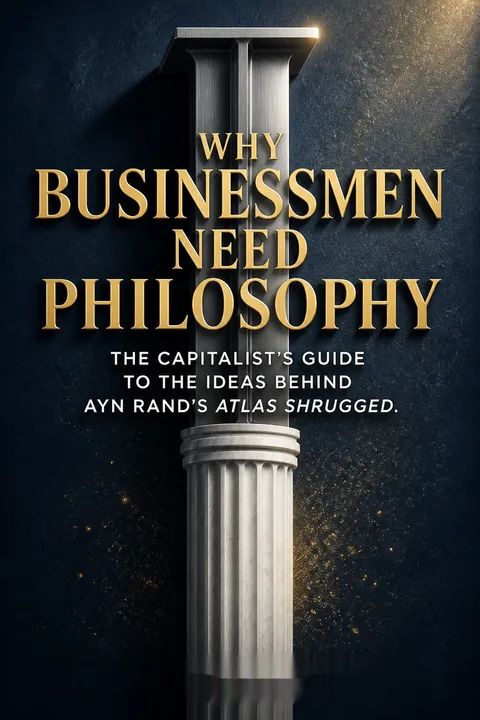
1. What is "Why Businessmen Need Philosophy" by Ayn Rand about?
- Core theme: The book is a collection of essays edited by Debi Ghate and Richard E. Ralston, presenting Ayn Rand’s argument that businessmen require a philosophical foundation to defend capitalism and their profession.
- Philosophical focus: It explores how prevailing moral codes, especially altruism, undermine businessmen and capitalism, and offers a rational, moral defense of profit-seeking and individualism.
- Contributors: The book features essays by Ayn Rand, Leonard Peikoff, Harry Binswanger, Yaron Brook, and others, drawing on Objectivist philosophy.
- Structure: Topics include the need for philosophy in business, cultural and legal attacks on businessmen, the morality of money, and practical advice for defending business values.
2. Why should I read "Why Businessmen Need Philosophy" by Ayn Rand?
- Understand business and morality: The book provides a unique perspective on the moral justification for business and profit, challenging common negative stereotypes.
- Philosophical tools: It equips readers—especially business professionals—with philosophical arguments to defend capitalism and their own interests.
- Cultural relevance: The essays address ongoing debates about capitalism, regulation, and the role of business in society, making it highly relevant for current events.
- Practical guidance: Readers gain actionable advice on how to stand up for their values and counter ideological attacks in both business and public life.
3. What are the key takeaways from "Why Businessmen Need Philosophy" by Ayn Rand?
- Philosophy is essential: Businessmen need a rational, consistent philosophy to defend themselves and their profession against cultural and legal attacks.
- Profit is moral: The pursuit of profit, when achieved through production and voluntary trade, is not only practical but also virtuous and heroic.
- Altruism undermines business: The dominant moral code of altruism, which demands self-sacrifice, is incompatible with capitalism and weakens businessmen’s ability to defend themselves.
- Stand on principle: Businessmen must reject guilt, refuse to compromise on core values, and fight for capitalism with moral certainty.
4. Who are the main contributors to "Why Businessmen Need Philosophy" and what perspectives do they offer?
- Ayn Rand: Provides the foundational Objectivist philosophy, defending rational self-interest and the morality of capitalism.
- Leonard Peikoff: Explains why philosophy is a practical necessity for businessmen and analyzes the cultural hostility toward business.
- Harry Binswanger: Compares philosophy to the CEO of life, showing how philosophical principles govern all business decisions.
- Yaron Brook, John B. Ridpath, Alex Epstein: Offer historical, legal, and economic analyses of issues like antitrust laws, moneylending, and the failure of conservatives to defend capitalism.
5. How does Ayn Rand define the role of philosophy in business and life in "Why Businessmen Need Philosophy"?
- Philosophy as CEO: Philosophy is likened to the CEO of a business, setting the fundamental principles that guide all actions and decisions.
- Branches of philosophy: Business depends on metaphysics (reality), epistemology (knowledge), ethics (values), and politics (social organization).
- Inescapable influence: Everyone operates from a philosophy, whether explicit or not, and it shapes both personal and cultural outcomes.
- Necessity for success: A rational, consistent philosophy is essential for long-term business and personal success.
6. Why does Ayn Rand argue that the profit motive is virtuous in "Why Businessmen Need Philosophy"?
- Profit as moral achievement: Profit is the reward for creating value and serving others through voluntary exchange, not exploitation.
- Distinction from profiteering: Rand separates honest businessmen from those who seek unearned wealth through manipulation or political favors.
- Historical evidence: The Industrial Revolution is cited as proof that wealth is created, not taken, and that free trade benefits all.
- Heroism in business: The pursuit of profit is portrayed as a heroic, life-affirming activity essential for human progress.
7. What is the "argument from greed" and how does Ayn Rand respond to it in "Why Businessmen Need Philosophy"?
- Definition: The "argument from greed" claims that businessmen’s pursuit of profit inevitably leads to exploitation and societal harm.
- Rand’s rebuttal: She argues this view is based on the false premise that selfishness is evil, and that rational profit-seeking is actually moral.
- Consequences: Accepting this argument justifies government intervention, which often harms productive businessmen and empowers actual exploiters.
- Moral clarity: Rand insists that profit through production is not greed, but a rational pursuit of values.
8. How does "Why Businessmen Need Philosophy" explain the negative cultural and legal treatment of businessmen in America?
- Vilification of businessmen: Businessmen are portrayed as scapegoats for societal problems and are subject to special, punitive laws like antitrust.
- Antitrust as persecution: These laws are vague and retroactive, punishing success and ability while protecting political power.
- Cultural hostility: Media, intellectuals, and politicians reinforce negative stereotypes, justifying government intervention and undermining capitalism.
- Philosophical roots: The attacks stem from altruistic and anti-reason philosophies that equate self-interest with immorality.
9. What are the philosophical origins of antitrust laws according to "Why Businessmen Need Philosophy"?
- Idealized competition: Antitrust laws are based on unrealistic models of perfect competition, where all firms are identical and no profits exist.
- Philosophical premises: These models stem from metaphysical and epistemological views that deny causality and stable knowledge.
- Altruism and pragmatism: The laws are supported by moral codes that condemn self-interest and reject absolutes, punishing productive success.
- Impact on business: The result is the persecution of successful firms and the undermining of capitalism’s moral legitimacy.
10. How does Ayn Rand distinguish economic power from political power in "Why Businessmen Need Philosophy"?
- Economic power: Defined as the ability to produce and offer values voluntarily, symbolized by the dollar.
- Political power: Defined as the government’s monopoly on force, symbolized by the gun, and backed by coercion.
- Common fallacy: Rand warns against equating economic and political power, which leads to unjust government intervention.
- Moral distinction: Economic power is based on consent and mutual benefit, while political power is based on compulsion.
11. What is the "sanction of the victims" and how does it affect businessmen according to Ayn Rand?
- Concept explained: The "sanction of the victims" is businessmen’s acceptance of guilt and self-sacrifice, which empowers their critics.
- Moral betrayal: By apologizing and appeasing, businessmen undermine their own position and betray their values.
- Root cause: This stems from accepting altruistic moral codes that demand self-sacrifice.
- Call to action: Rand urges businessmen to reject undeserved guilt and defend their right to exist and profit with pride.
12. What practical advice does "Why Businessmen Need Philosophy" by Ayn Rand offer to businessmen facing ideological and regulatory attacks?
- Embrace rational self-interest: Reject altruism and pragmatism, and adopt a philosophy that sees profit as moral and productive.
- Stand on principle: Refuse to compromise on fundamental rights and values, and defend capitalism publicly and intellectually.
- Understand bad philosophy: Learn the philosophical roots of anti-business ideas to effectively counter them with reason and evidence.
- Use moral arguments: Fight for capitalism as a moral issue, not just a practical one, and avoid emotional or false appeals.
About the Author





Download PDF
Download EPUB
.epub digital book format is ideal for reading ebooks on phones, tablets, and e-readers.








