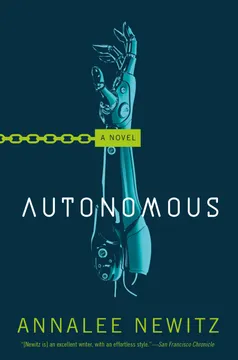


Plot Summary
The Homework Addiction
In 2144, smuggler and biologist Jack Chen sees a news report about a Calgary student whose mind has become fixed on programming homework. Jack suspects the girl took Zacuity, a productivity drug she recently copied and sold without proper testing. Before she can investigate further, a thief breaks into her Arctic submarine with an indentured boy.
Jack kills the thief, then discovers the supposed robot is a starving human called Threezed. She feeds him and runs forensic tests on both the original Zacuity and her copy. Her copy is accurate. The addiction-inducing molecules are in Zaxy’s own formula, which means Jack’s quick, profit-driven decision to sell it has helped spread a dangerous drug.
The opening makes Jack’s political convictions collide with the consequences of her own shortcut. She has been using sales of popular drugs to fund treatments for people who cannot afford corporate medicine, but Zacuity exposes the danger of treating good intentions as a substitute for testing. Threezed’s presence sharpens the contrast: Jack can identify a hidden molecular crime, yet initially sees the boy through the practical categories of threat and liability. Her first responsibility is not abstract justice but the lives already affected by her decision.
Paladin Learns Pain
Across the world, Paladin, a newly built military biobot, searches a desert training site for a smuggler’s stash. A sniper tears off his arm, giving him his first experience of intense pain.
His handler, Lee, repairs him and sends him to Camp Tunisia, where the African Federation assigns him to partner with Eliasz, a human operative. Their target is Jack, suspected of pirating Zacuity. Corporate and government officials describe the drug crisis as a threat to Zaxy’s business and international trade, while Eliasz challenges the label of terrorism used against anti-patent activists.
Paladin agrees with Eliasz, partly because he wants to please him. The mission begins with a bot learning that his opinions and loyalties may not be as simple as his programming suggests.
Paladin’s injury gives bodily consequence to a being whose identity has been built from code and military purpose. Pain is not merely damage: it becomes an experience he can remember and compare with another being’s suffering. Meanwhile, the mission’s official framing treats the drug scandal chiefly as a property and trade problem. Eliasz’s discomfort with that framing offers Paladin an alternative way to interpret the assignment. His wish to please Eliasz is already active, but he cannot yet distinguish personal attachment from a directive designed to make him obedient.
The Bilious Pills
Decades earlier, graduate student Jack meets geneticist Krish Patel at a Freeculture gathering and joins his campaign against patents that keep medicines expensive. Together they build The Bilious Pills, an underground repository for open research, and Jack writes reng, a tool for reverse-engineering drugs.
When they learn that medicines made in the African Federation will be warehoused instead of reaching sick children there, Jack leads a pirate-costumed raid on a Halifax ship and helps send the drugs to people who need them.
Authorities arrest her and seven others. During Jack’s prison sentence, Krish closes their project and accepts a grant that requires a quieter approach. Jack leaves prison feeling that he has abandoned both their shared cause and her future in science.
Jack’s activism begins in the institutional world she hopes to reform, but her experience steadily teaches her that access can be blocked even when knowledge is technically public. The raid gives her political argument a material form: medicine leaves a warehouse and reaches patients. Prison then reveals a fracture within the movement. Krish chooses work that can survive inside the system; Jack experiences that compromise as a personal erasure. Their disagreement is not simply about tactics. It concerns who gets to define a life’s value, and whether reform is meaningful if it requires the reformer to become acceptable to the institutions responsible for harm.
The Arctic Escape
Back in the present, Jack learns that Zacuity has caused deaths and bizarre compulsions beyond Calgary. She prepares to leave her submarine and reach a lab capable of exposing the drug and developing a remedy. Threezed asks to remain aboard, but Jack refuses to surrender her ship to someone she barely knows. After they reach Inuvik, Free Trade Zone bots question them about a boat.
Threezed uses a basic reset command to disable the officers, giving Jack a chance to escape with him in her truck. In Yellowknife, Jack brings part of her drug supply to her old friend Mali, a doctor who distributes affordable medicine. A hospital researcher, Med, recognizes Zacuity in pills Threezed carries and joins Jack to investigate the damage.
Threezed’s rescue of Jack changes their relationship from reluctant protection into mutual risk. Jack has treated him as a vulnerable passenger, but his quick action shows that he has skills and judgment she did not know to look for. His distrust remains understandable: he has been sold repeatedly and has little reason to believe that freedom will last. Med’s arrival gives Jack scientific help, but also shifts the crisis from one person’s guilt to a coordinated effort to save patients. Each of them brings a different kind of knowledge, none sufficient alone.
Iqaluit’s Solar Ambush
In Iqaluit, Eliasz and Paladin pose as a laid-off chemist and his damaged indentured assistant, using university students to reach the pirate network around Jack’s contacts. At Arcata Solar Farm, Eliasz sells fake drug designs while Paladin secretly enters the house network through its sprinkler system.
The security footage confirms that Jack has traded medicines with the farm’s pirate collective. When the operators recognize the intrusion, Bluebeard and her allies attack.
Paladin shields Eliasz and kills the armed guards; Eliasz helps destroy the pirates’ data center. The pair escape in a helicopter. They learn that Jack’s usual supplier has gone missing and that her trail may lead to Casablanca, so they return to Camp Tunisia for repairs and orders.
The operation makes Paladin’s technical intelligence and Eliasz’s social skill complementary, but the escape also shows how quickly surveillance work becomes violence. Paladin can deceive machines more easily than people, while Eliasz builds trust by adapting his story to the students’ anger at patent corporations. Their successful infiltration does not produce a clean victory: the firefight destroys lives and evidence, and the officials above them remain concerned about financial and diplomatic fallout. The mission therefore mirrors Jack’s predicament. Both sides claim to act against harm, yet each operates inside systems that reward secrecy and force.
Retcon Takes Shape
Jack and Med reach the University of Saskatchewan’s Free Lab, where Jack reunites with Krish after decades apart. Med explains that Zacuity rapidly strips away dopamine receptors, making users compulsively repeat whatever activity they associate with its reward.
Krish gives them access to equipment and researchers. The team designs Retcon, a therapy that alters the memories driving the addiction, and tests it on a mouse conditioned to crave a researcher’s voice. The mouse improves, and doctors in Yellowknife report that early patients are eating again after treatment.
Jack and Med release the research openly so clinics can make the therapy. Jack also offers to help Threezed establish a legal life of his own, rather than treating his freedom as a temporary refuge aboard her ship.
The Free Lab turns open science from a political aspiration into a practical response: researchers share a treatment before a corporation can control its manufacture. Retcon’s mechanism is ethically unsettling because it works by changing the memories that sustain compulsion, yet leaving the addiction untouched would also destroy the patients’ ability to choose. Jack’s return to Krish reveals that political estrangement has not erased the knowledge they built together. Threezed’s future matters for the same reason: autonomy is not only escape from an owner, but the ability to form a life beyond survival.
Casablanca’s Broken Lab
Years before the Zacuity crisis, Jack and her partner Lyle leave Krish’s Free Lab for Casablanca, hoping to build a more radical community science project. They establish Signal, a public laboratory, and meet Frankie, a careful drug pirate who writes as Rosalind Franklin. Lyle later joins a more confrontational collective led by FoxP2, despite Jack’s warnings about its visibility.
The IPC raids Signal, FoxP2’s lab explodes, and Lyle is found dead in Jack’s apartment. Frankie helps Jack escape to Fez. The loss leaves Jack suspicious of publicity and wary of movements that mistake spectacle for protection. She eventually turns to small-scale smuggling, using its profits to distribute treatments that formal medicine prices beyond reach.
Lyle’s death gives Jack’s caution a history more painful than simple fear of arrest. Jack has already watched a shared ideal become a public target, and she carries guilt over what she could not prevent. Frankie’s survival and continued work show another model of resistance: technical skill paired with disciplined secrecy. Yet Jack’s own smuggling compromises that discipline when she sells Zacuity for cash. Her past explains the appeal of working outside institutions, but it does not absolve her from the costs when a clandestine operation reproduces the same careless logic it opposes.
Paladin Chooses a Pronoun
In Casablanca, Paladin and Eliasz use a hacker party to approach Frankie. She drugs Eliasz with a euphoric, and Paladin carries him back to their hotel while keeping watch through his delirium. Afterward, Paladin learns that the human brain in her body belonged to a dead Federation soldier, though it does not contain that woman’s memories.
Eliasz interprets the discovery as evidence that Paladin is female and asks which pronoun she wants. Paladin chooses she, partly because it lets Eliasz acknowledge his attraction. At Frankie’s presentation, Paladin infiltrates her glasses and finds a warning from Jack about Zacuity. The message confirms their connection and gives Eliasz evidence to pursue Frankie directly.
The pronoun choice is neither a simple revelation of a hidden essence nor a meaningless accommodation. Paladin understands that Eliasz is projecting human categories onto a bot, yet she makes a choice within that imperfect recognition. Her decision matters because it is hers, not because it proves that his assumptions are correct. The episode also complicates consent: Eliasz’s drugged vulnerability forces Paladin to distinguish care from desire, while their later intimacy grows from mutual attachment. Paladin’s developing selfhood emerges through decisions made under constraint, not through a clean separation from every influence that shaped her.
Frankie’s Forced Confession
Paladin and Eliasz capture Frankie outside her home and use a coercive drug to make her answer questions. Eliasz’s interrogation becomes violent, and Frankie eventually reveals that Jack had been in contact with her and may be travelling with Threezed. The agents split the trail.
Eliasz goes to Las Vegas to search contract records for the boy, while Paladin receives temporary autonomy credentials and travels to Vancouver to locate Jack through her old collaborator Bobby Broner. The division gives each operative a different network to investigate: Eliasz follows Threezed’s indenture history, while Paladin enters a city where autonomous bots live openly and military authority is less familiar.
Frankie’s interrogation marks the point where the pursuit’s methods become impossible to separate from the abuses it claims to punish. The information is useful, but Eliasz obtains it through coercion and physical harm, echoing the systems of ownership he once tried to police in Las Vegas. Paladin is sent into a new kind of uncertainty: autonomy is granted as an operational tool, yet her memories and loyalties remain subject to Federation control. The split also tests the pair’s bond. Each must act without the other’s immediate guidance, and Paladin’s independence is no longer merely theoretical.
Two Trails Converge
In Vancouver, Paladin questions Bobby Broner about Jack. When he refuses to help, she breaks his wrists, dislocates his shoulder, and kills him, then discovers that his lab’s old records point to a University of Saskatchewan server called Scarface. She also finds two bots Bobby had kept in compromised forms, Actin and Bug, and carries them to safety.
In Las Vegas, Eliasz searches a contract seller’s records, then finds Threezed’s anonymous journal and realizes Jack is hiding in Moose Jaw. His memories of guarding indentured boys in Warsaw reveal why he is drawn to the case, but they do not stop him from using coercion. Both trails point back to Saskatchewan, where Jack has concealed herself in an old smuggling tunnel.
Paladin’s temporary freedom exposes a disturbing possibility: she can act independently and still reproduce the violence of the institution that trained her. She chooses to rescue Actin and Bug, but also kills Bobby without trial. Eliasz’s search is likewise shaped by contradictions. His history with exploited boys gives his pursuit emotional urgency, yet he treats Threezed’s private writing as intelligence to be mined. The convergence on Saskatchewan is therefore more than a plot mechanism. It brings the protagonists’ different histories of control into the same confined space, where their stated principles will be tested by immediate choices.
The Moose Jaw Trap
At the Free Lab, Med recognizes Paladin and Eliasz as IPC agents and urges Threezed to flee. She attacks Paladin with a molecular regulator, destroying the brain chamber in Paladin’s abdomen before an electromagnetic pulse knocks her offline.
Eliasz drugs and interrogates Krish, who dies during the encounter without revealing Jack’s location directly. Med recovers, finds Threezed, and races to Jack’s Moose Jaw hideout. Jack ambushes the agents, but Paladin captures her.
Med and Threezed arrive with viral sealant that spreads across Paladin’s weapons and turns Eliasz’s perimeter wires into a disabling mass of fibers. Eliasz can either pursue Jack or protect Paladin. He turns back to the damaged bot, allowing Jack and her companions to escape.
The climax refuses a clean division between rescue and harm. Med attacks to protect Krish and the lab, but the blow destroys Paladin’s brain; Eliasz’s interrogation ends with Krish dead; and Jack’s own ambush injures her pursuers. The decisive act belongs to Eliasz. His choice to help Paladin rather than shoot Jack interrupts the mission’s logic, even though he does not openly renounce it. Threezed’s practical courage and Med’s improvised science make escape possible, but Eliasz’s hesitation is what prevents the final shot. The result is a victory measured in lives spared, not in legal vindication.
Zaxy Loses the Story
After the tunnel fight, the IPC reports that Jack died, though she is recovering in Med’s apartment. Med and the Free Lab finish Krish’s press release and publish evidence connecting the street drug to Zaxy’s Zacuity.
Workers who had taken the legal version for months also report that Retcon has freed them from compulsive work, leaving them unable to return to jobs they no longer want. Hospitals and researchers rapidly copy the therapy, and companies withdraw Zacuity from employee programs.
Zaxy’s founder pressures the university to retract Med’s paper and remove the company’s name from the project. The university complies rather than risk a lawsuit. Med keeps Retcon available, and the archived research survives even as the official record is narrowed.
Publicity saves lives, but it does not guarantee accountability. Once Med attaches Zaxy’s name to the crisis, the story becomes impossible for major outlets to ignore; then the company uses its legal and financial power to restrict what the university will say. Retcon’s effect on corporate workers exposes the deeper cost of Zacuity: not simply addiction, but the conversion of pleasure into an employment tool. Patients regain the ability to choose, yet some lose their former livelihoods. The partial victory is deliberately uneven. Knowledge circulates more freely than responsibility does.
A Private Autonomy Key
After the mission, Eliasz learns that Jack survived but does not expose her. He buys Paladin’s contract and asks her to leave Earth with him. Before answering, Paladin encrypts her memories with a key the Federation cannot access, securing the privacy that her temporary autonomy never guaranteed.
Her human brain is gone, and she can no longer read faces as before, but she retains her own account of what happened. Paladin accepts Eliasz’s invitation without surrendering that private understanding of herself.
Months later, the two live together in Budapest. In January 2145, they wait at the Pacific space elevator for a transport to Mars. Paladin wraps her armored shields around Eliasz as the gondola descends, making a shelter neither of them can mistake for ownership.
Paladin’s final act of autonomy is not a declaration that she has escaped every influence. She still loves Eliasz, still carries installed programs, and still accepts a journey he proposes. What changes is her ability to keep part of herself beyond inspection. Privacy becomes the condition that makes a self-directed choice possible, even when the choice is shaped by attachment and history. The damaged brain also unsettles the idea that a person’s identity resides in one human organ. Paladin loses a useful way of reading faces, but not the authority to interpret her own life.
Analysis
Autonomous links two kinds of ownership that are often treated separately: control over medicines and control over minds. Zaxy turns work into a source of chemically intensified pleasure, then profits from a formula whose dangerous effects are kept from the people least able to manage them. Jack opposes that system, but her decision to sell an untested copy shows how resistance can inherit the habits of the institution it fights. Her culpability is real, yet it does not make the corporation’s concealment less consequential.
The novel’s strongest political question is not whether intellectual property should exist in the abstract, but who bears the cost when knowledge is restricted or released. Patents can withhold lifesaving treatments; piracy can distribute a lethal drug. Retcon offers an alternative through shared research, but it also changes patients’ relationships to work and memory. Even a successful remedy cannot restore the conditions that existed before the crisis.
Paladin’s story makes the same problem intimate. Her emotions are partly programmed, her military labor is indentured, and even her memories are subject to Federation access. The novel does not resolve this by pretending that a self can be purified of influence. Paladin’s autonomy instead depends on her ability to interpret her own motives and secure a private interior life. Eliasz’s affection matters, but it cannot substitute for her consent or self-knowledge.
Threezed’s emancipation adds an economic dimension to that question. He needs more than kindness: he needs legal status, work, and a chance to build an identity not defined by a contract. Across the story, freedom appears less as a single dramatic escape than as the accumulated ability to make decisions without another party owning the consequences. The ending remains hopeful because Paladin and Eliasz travel together, but it preserves the book’s central tension: intimacy can offer shelter, while autonomy requires the right to keep part of oneself unseen.
Review Summary
Autonomous received mixed reviews. Many praised its exploration of themes like autonomy, pharmaceutical ethics, and AI consciousness. The worldbuilding and fast-paced plot were highlights for some. However, others found the character development lacking and were uncomfortable with the handling of gender and sexuality, particularly in the relationship between Eliasz and Paladin. Some felt the ending was unsatisfying. Despite criticisms, many reviewers found the book thought-provoking and appreciated its innovative premise, even if the execution was divisive.
People Also Read
Characters
Jack Chen
Pirate biologistJudith Chen, known as Jack, is a trained synthetic biologist who turns to pharmaceutical smuggling after deciding that patent law keeps lifesaving treatments from people who need them. Her activism began with open research and public protest, but years of imprisonment, loss, and underground work have made her both resourceful and wary. She uses technical skill to reproduce drugs and build concealed routes for distributing them, while telling herself that sales of popular products can fund more humane medicine. Jack’s central conflict is not whether she cares about public health, but whether her methods remain answerable to the people they affect. Her impatience and guilt coexist with a stubborn capacity to take responsibility and act.
Paladin
Searching military biobotPaladin is a newly built military biobot assigned to reconnaissance and combat for the African Federation. A donated human brain supports some of her processing, but her identity, memory, and emotions are also shaped by software she cannot initially inspect. Paladin studies other beings with the precision of a sensor and the uncertainty of someone encountering desire, pain, and social recognition for the first time. She wants to survive, perform well, and understand Eliasz, though she cannot always tell which wishes are her own. Her development explores the difference between being treated as human and being granted the power to define herself. She is curious, observant, and increasingly attentive to the ethics hidden inside ordinary commands.
Eliasz
IPC field operativeEliasz is a skilled investigator whose work for the International Property Coalition puts him on the trail of Jack. He is practiced at changing identities, reading people, and controlling a room, but his commitment to clear legal rules grew partly from years spent confronting exploitation he could not stop. His history as a church guard in Warsaw left him with shame, anger, and a complicated attraction to the beings he is tasked to command. Eliasz treats Paladin with more warmth than many humans show bots, while still making assumptions about her body and identity. He is capable of tenderness and severe coercion, and his certainty about justice is repeatedly tested by the methods he uses to enforce it.
Threezed
Indentured runawayThreezed was sold into indenture as a child and trained in reading, mechanics, and the performances of compliance. His name comes from the numbers branded on his body, a fact he meets with sardonic humor rather than easy self-pity. He is observant, technically capable, and wary of anyone who offers help without explaining its limits. His writing gives him a way to record the contradictions of indenture without pretending that survival has made him emotionally untouched. With Jack and Med, he begins to imagine a future beyond contract, while negotiating how much dependence, intimacy, and trust he is willing to accept.
Med
Autonomous bot scientistMed is an autonomous biobot raised by roboticists and trained as a researcher in pharmaceutical testing and neurogenetics. Her life has not included indenture, which leaves her uncertain how to relate to bots and humans whose experiences are shaped by ownership. She is methodical, earnest, and capable of intense focus, but her work soon demands decisions that cannot be resolved by experiments alone. Med takes responsibility for designing a treatment and explaining its consequences, while learning that scientific credibility is often challenged when a bot speaks against corporate interests. Her curiosity and empathy make her an effective collaborator, even as she discovers that autonomy can involve frightening impulses as well as freedom.
Krish Patel
Open-science mentorKrish is a biomedical researcher and Jack’s former collaborator and partner. He shares her opposition to medicine controlled by patents, but chooses strategies that can keep a laboratory funded and operating. His ambition and caution once put him at odds with Jack, though his commitment to open research survives their estrangement. He leads the University of Saskatchewan’s Free Lab, where researchers can pursue useful work without immediately turning it into private property.
Frankie
Pirate scientistFrankie is a technically gifted pharmaceutical pirate who writes under the name Rosalind Franklin. She combines anti-patent politics with careful tradecraft, treating security as part of the work rather than an afterthought. Her bluntness unsettles Jack and Lyle, but her practical knowledge makes her a valuable ally in underground medicine networks. Frankie is willing to take risks for people who lack access to treatment, though her work also operates beyond ordinary safeguards.
Lyle Al-Ajou
Radical molecular engineerLyle is a brilliant postdoctoral researcher with a restless appetite for scientific and political experimentation. Her flamboyant style and inventive body modifications express a self she has struggled to claim against family expectations. She becomes Jack’s lover at the Free Lab and imagines building a less conventional life beyond academia. Lyle’s intelligence does not make her immune to risk or pressure; she is drawn to projects that challenge the institutions she distrusts.
Mali
Doctor and old friendMali is Jack’s longtime friend and a general practitioner in Yellowknife. She believes treatment should remain available to patients who cannot pay corporate prices, and quietly helps distribute Jack’s medicines. Her work in a hospital gives her a more immediate view of the consequences of unsafe drugs than Jack’s political arguments sometimes allow. As a new parent and a doctor, she balances care for individuals with concern about the risks surrounding Jack.
Fang
Veteran military botFang is an experienced Federation bot who works alongside Paladin during training and later offers advice about military service and human behavior. His mantis-like body is one of several forms he has inhabited during indenture. Fang understands how humans project their own categories onto bots, and he warns Paladin that affection can be entangled with power. His experience is valuable, though his conclusions do not always settle Paladin’s questions.
Lee
Paladin’s botadminLee is the human botadmin responsible for Paladin’s training, repairs, and system upgrades. He is casual and capable, treating the bot as both a military asset and a familiar presence. Lee’s access to Paladin’s operating systems makes their relationship unequal, even when he is considerate. He represents the practical human authority that shapes a bot’s development before the bot can inspect its own programming.
Bluebeard
Iqaluit pirate leaderBluebeard leads the pirate collective concealed within Arcata Solar Farm. She protects the group through disciplined anonymity and treats strangers with careful suspicion. Her interest in unlicensed drug designs makes her a useful contact for Eliasz’s cover operation, but she is not easily manipulated. Bluebeard embodies the local networks that survive by keeping their identities and transactions difficult to trace.
Bug
Autonomous bot historianBug is a mosquito-shaped autonomous bot and a historian in Vancouver’s bot community. He has strong opinions about indenture and human attitudes toward bots, and he is quick to judge people who treat a bot as equipment. His politics can be blunt, but his concern for other bots is genuine. Bug offers Paladin a first glimpse of a community organized around bot culture rather than human command.
Actin
Indentured lab researcherActin is a bot researcher in Bobby Broner’s lab, temporarily housed in a fabber rather than a body suited to independent work. He is focused on brain-computer interfaces and values the degree he is pursuing, even when others question whether that ambition is truly his own. Actin resists being reduced to a symbol of either oppression or liberation, insisting that his research goals matter to him.
Roger
Zaxy’s public faceRoger is the founder of Zaxy, a polished executive who frames corporate denials as concern for scientific standards. He is skilled at redirecting attention from evidence toward legal risk and institutional reputation. His confidence reflects the advantage enjoyed by a company able to shape both the market and the public conversation.
Plot Devices
Zacuity
Work becomes compulsionZacuity is Zaxy’s productivity drug, designed to make completing work feel intensely rewarding. Its formula also reduces dopamine receptors, quickly binding users to the activity they were doing while taking it. Unsupervised users may become unable to stop working, studying, painting, or performing other tasks, sometimes dying through dehydration, injury, or organ failure. Jack’s reverse-engineered version reproduces the dangerous formula, making the drug both the story’s inciting crisis and a test of whether anti-patent activism can avoid the negligence it condemns.
Retcon
Rewrites addiction cuesMed and the Free Lab develop Retcon to alter the memories that connect Zacuity’s reward to compulsive behavior. The treatment helps patients stop repeating the activity associated with the drug, while allowing damaged dopamine receptors to recover. Because the researchers release its design openly, hospitals and other laboratories can produce it without waiting for corporate permission. Retcon provides a practical countermeasure to the crisis, but its consequences are not simple: long-term users may lose their desire to return to jobs they had learned to associate with the drug.
Indenture and franchise
Legal status shapes freedomIn the novel’s economic system, indenture binds bots and, in many regions, humans to employers or owners for a contracted term. A franchise grants people the legal standing to work, move, study, and own property. Threezed’s childhood contract leaves him without a secure route to ordinary employment, while Paladin’s bot indenture gives the Federation control over her work and memories. The two systems make autonomy a material question, not simply an internal feeling: freedom requires legal recognition, resources, and some control over one’s future.
The autonomy key
Root access to selfAn autonomy key gives a bot root access to its own operating system and memories. Paladin receives only a simulated, temporary key during her mission, while the Federation retains an escrowed key capable of exposing or erasing her stored experiences. Her eventual ability to encrypt her memories herself makes privacy a concrete part of autonomy. The device also raises a difficult question: whether a bot can make meaningful choices while its desires have been shaped by code, dependency, and the institutions that control its body.
Reng and reverse engineering
Unpacks patented medicinesReng is an open tool Jack develops to analyze the molecular structure of drugs that are difficult for ordinary researchers to reproduce from patent filings. It represents her early belief that technical knowledge can be shared beyond universities and corporations. Jack later uses the same capacity to copy medicines for people who cannot afford licensed products. Its value is morally double-edged: reverse engineering can make treatment accessible, but an accurate copy of a poorly disclosed or dangerous drug can also spread harm before anyone has tested it properly.
About the Author



Download PDF
Download EPUB
.epub digital book format is ideal for reading ebooks on phones, tablets, and e-readers.








