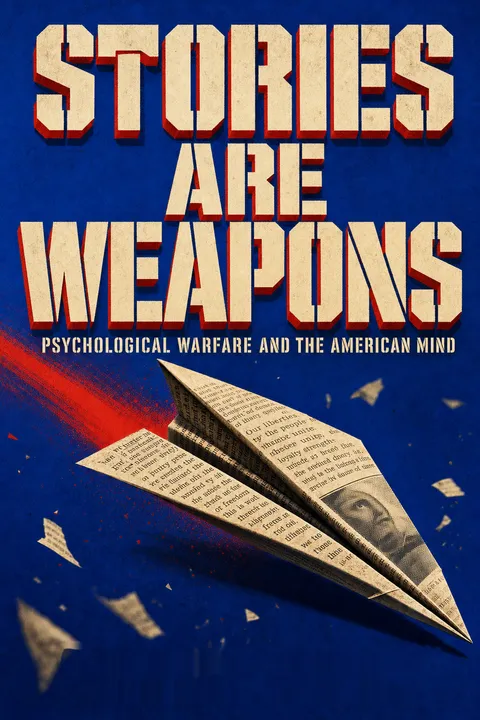


Key Takeaways
Treat stories as weapons when they turn neighbors into enemy targets.
Stories can change conduct. Annalee Newitz traces psychological warfare through Paul Linebarger, an Army strategist who also wrote science fiction as Cordwainer Smith. His work suggests that influence is not just a false statement or a slogan. A story becomes a weapon when it steers an audience’s emotions and choices, especially by dividing the world into imagined heroes and enemies. It can even use real events, rearranged to support a misleading narrative.
Intent matters. Linebarger imagined persuasion as a way to avoid bloodshed, but psychological operations can also cause fear, confusion, and social rupture without firing a shot. Newitz follows their migration from military campaigns into domestic culture wars, where Americans are treated as targets rather than fellow citizens.
What's striking is how this argument shifts attention from whether a story is fiction to what it is doing in the world. A campaign can contain accurate details and still manipulate by choosing what to emphasize, whom to blame, and which response to make feel inevitable. That makes intent and power important parts of media literacy. Still, the weapon metaphor needs limits: ordinary persuasion, satire, and political disagreement are not automatically psychological attacks. The distinction matters most when a narrative combines deception, threats, or deliberate scapegoating.
Ask who profits when a true fact is stripped of context.
Emotion can be redirected. In the 1920s, public-relations pioneer Edward Bernays linked women’s desire for freedom to smoking. His staged Easter parade made cigarettes look like a symbol of women’s independence, though smoking did not grant political or personal freedom. The campaign converted a real aspiration into a product’s sales pitch.
The stakes can be national. Decades later, Bernays worked for United Fruit in Guatemala, where reformer Jacobo Árbenz sought to redistribute unused plantation land. Bernays spread claims that communists threatened the country, helping build US support for action that culminated in the 1954 coup and restoration of the company’s land. The stories drew power from real anxieties, then redirected them toward a corporate interest.
Bernays’s career exposes a useful ethical distinction: emotional communication is not inherently sinister, but undisclosed interests can turn it into covert leverage. The question is not simply whether a message is persuasive. It is whether audiences can see who benefits, what evidence has been omitted, and what action the message is designed to produce. The Guatemala episode also cautions against treating propaganda as a clever media trick alone. When commercial influence joins state power, the consequences can include the removal of a government, not merely a change in consumer preference.
Challenge histories that make conquered peoples disappear while still alive.
Erasure can sound polite. During the Indian Wars, settlers repeated the myth that Indigenous nations had vanished, even while government forces were spending heavily to fight them. New England town histories mourned supposedly extinct tribes and, in the same accounts, described Indigenous people still living nearby. This contradiction made dispossession easier to forget and treaties easier to evade.
Resistance tells another future. In the late nineteenth century, Wovoka’s Ghost Dance offered Indigenous communities a vision of cultural renewal. US authorities treated the peaceful movement as a threat, and the panic surrounding it helped justify violence that culminated in the Wounded Knee Massacre. Buffalo Bill’s Wild West shows then turned Indigenous resistance into a marketable image of a vanishing people. The struggle was over land, and over who would be remembered as belonging there.
The example shows that historical denial does not always depend on a dramatic lie. It can work through classification: who counts as Indigenous, what forms of cultural change are allowed, and whose presence an official story treats as temporary. This is a powerful connection between memory and political rights. It also suggests why counter-memory needs more than a correction to a textbook. Communities need the authority to preserve and interpret their own histories, while the wider public must confront how seemingly ordinary local narratives can excuse dispossession.
Interrupt the chain before a viral rumor becomes a political weapon.
Targeting became intimate. Cambridge Analytica used a personality quiz to collect data from about 270,000 app users, then accessed information from as many as 87 million Facebook accounts. The firm sought to identify voters susceptible to authoritarian messages and to test tailored appeals. It also pursued voter disengagement, including messages aimed at Black voters. Separately, Russian operatives used fake groups and ads to inflame racial and political divisions, sometimes staging opposing protests in the same city.
Confusion spreads socially. The stolen Democratic emails fed conspiracy stories such as Pizzagate, whose believers eventually sent an armed man to a Washington pizza restaurant. The book’s point is not that one operation caused every outcome. It is that targeted messages can seed a narrative that ordinary users, influencers, and news outlets amplify in ways the original operators do not control.
The danger here is less a magical algorithm that reads minds than the combination of profiling, emotional testing, and network amplification. Even imperfect predictions can help campaigners discover which grievances attract attention. At the same time, claims about microtargeting should be kept proportionate: a campaign’s intent, reach, and effect are not interchangeable, and no single firm explains an election result. The enduring lesson is institutional. Platforms that sell targeted access and reward engagement make political manipulation easier to scale while obscuring who is speaking and why.
Reject claims that inequality proves some groups have defective minds.
Numbers can disguise a story. In The Bell Curve, Charles Murray and Richard Herrnstein argued that intelligence helps determine economic outcomes and that Black people were more likely to have lower intelligence scores. But their dataset used a military aptitude score, not a standard IQ measure, and the authors acknowledged that it reflected educational background. They also offered no proof that intelligence caused income differences.
Speculation filled the gaps. When comparisons between Black and white people with similar scores narrowed much of the economic gap, the authors introduced a Middle Class Values Index based on criteria such as marriage, employment, and avoiding jail. They then imagined a future in which a supposedly less intelligent underclass required state control. The data gave the narrative a scientific appearance, while the narrative supported policies against welfare and affirmative action.
This case is a reminder to inspect the bridge between measurement and conclusion. A statistic can be accurate within a dataset yet fail to measure the concept invoked, or cannot establish why a difference exists. That is a problem of construct validity and causal inference, not just political bias. Intelligence tests can predict some outcomes, but prediction does not prove innate group hierarchy or justify a policy response. The stronger the moral and political stakes, the more important it is to examine definitions, comparisons, and the assumptions hidden between them.
Treat calls to protect children as claims requiring evidence, not panic.
A familiar accusation returned. During the Cold War, officials portrayed gay and lesbian people as security risks, a campaign known as the Lavender Scare. Decades later, a Texas school district removed small rainbow stickers supporting LGBT students and put journalism teacher Rachel Stonecipher on leave after she challenged the decision. The district’s lawyer argued that the stickers could mislead students about safety, echoing older claims that LGBT adults posed a danger to children.
Moral panic has consequences. The book traces this accusation from FBI director J. Edgar Hoover’s surveillance of gay people to campaigns by Anita Bryant and the later use of groomer rhetoric. At MacArthur High, the conflict ended the school’s Gay-Straight Alliance and Stonecipher’s teaching job. The dispute was not just about classroom decoration. It narrowed which students and teachers could be visible.
Child safety deserves serious attention, which is precisely why vague suspicion should not substitute for evidence. A useful test is whether a policy responds to documented harm with proportionate safeguards, or casts an entire identity group as dangerous by definition. The Texas case illustrates how symbolic disputes can become material: clubs close, educators lose jobs, and students lose sources of support. The broader insight is not that every parental concern is manufactured. It is that public claims about risk should be scrutinized for who gets protected, who gets blamed, and what proof is offered.
Use fiction to restore agency, not merely decorate old power.
Stories can counterattack. William Moulton Marston created Wonder Woman as a feminist hero, but psychiatrist Fredric Wertham argued that comics corrupted children and threatened gender norms. Later research into Wertham’s papers found that he exaggerated and misrepresented evidence linking comics to delinquency. His campaign helped produce an industry code that restricted depictions of sexuality, crime, and women’s independence.
Representation changes the available choices. Comic writer Gail Simone documented how female heroes were often killed or injured to motivate male characters. Writers Vita Ayala and Stephanie Williams reimagined Nubia, a Black Amazon, giving her a story centered on understanding and empathy rather than an inherited role as the bad counterpart to Wonder Woman. Newitz’s examples show fiction making room for characters who were previously reduced to stereotypes or trauma.
Fiction can make an abstract system emotionally legible. Readers encounter how power feels from inside a character’s life, which may reach them differently from a policy argument or fact sheet. That does not make representation a substitute for structural change: who owns publishers, controls distribution, and receives harassment still shapes which stories circulate. Nor does a diverse cast guarantee a challenging story. The more useful standard is whether a narrative gives characters agency and complexity, rather than using inclusion as decoration or treating suffering as their only defining feature.
Recover records that let communities answer manufactured erasure.
A lost map shaped identity. Coquille tribal chief Jason Younker grew up hearing that his people had lost the map that would establish their land claims. In the 1990s, he and fellow researchers found the map in the National Archives, along with tens of thousands of related government and historical documents. The papers helped show how treaties had been obstructed and Indigenous communities pushed from their homelands.
Control of the record matters. The researchers created the Southwest Oregon Research Project and presented its material to tribes and the University of Oregon through a potlatch, a tradition of gift-giving that had been suppressed. The work became an example of Indigenous data sovereignty: Indigenous communities exercising authority over records concerning their histories. Archives cannot reverse dispossession, but evidence can support sovereignty and help descendants confirm histories that public narratives denied.
The archive is more than a storehouse of facts. It is infrastructure for communities to test official claims against documents and to decide how their own histories should be organized and shared. This reverses the old assumption that institutions outside a community should control the relevant evidence. Yet archival records are not neutral simply because they are primary sources. Government documents can preserve the categories and blind spots of the people who created them. Community interpretation, access, and control are therefore as important as locating the papers themselves.
Slow information and break amplification before rumors harden into reality.
Virality is not verification. During the 2020 election, rumors such as SharpieGate spread from a handful of influential accounts into a much larger audience. The Election Integrity Partnership tracked reports across platforms and showed how a small number of superspreaders could create a sudden surge that looked like broad public agreement. Its proposed response included faster, accurate updates from election officials and cooperation among researchers, civic groups, platforms, and government.
Add friction at multiple points. The book supports human moderators, transparent labeling, and limits on viral sharing when posts are misleading. Safiya Umoja Noble also argues for slower media: fewer algorithmic nudges, more control over data, and a pause between posting and mass circulation. No single filter can solve the problem. The goal is to give people and institutions time to check a claim before it reaches a crowd.
This approach treats misinformation as a systems problem rather than a test of individual gullibility. A correction is more credible when election workers, researchers, and platforms can share evidence quickly and openly. Friction can also protect attention, much as speed limits reduce the damage caused by mistakes on roads. But moderation carries its own risks: opaque rules can erode trust or suppress legitimate dissent. Durable interventions need clear standards, public accountability, and human review, especially when a claim is ambiguous or still developing.
Defend public places where disagreement does not cancel personhood.
Peace requires shared spaces. Newitz ends with libraries as a model for a healthier public sphere. They offer quiet, free access to information, trained librarians who help people navigate it, and places where people can meet without being forced into constant argument. At San Francisco’s Prelinger Library, unusual archives invite visitors to explore material often discarded by mainstream institutions.
Imagine workable futures. The book also points to applied science fiction, stories that use speculative worlds to test practical alternatives. Ruth Emrys Gordon imagines smaller online networks organized around shared responsibilities, such as caring for a watershed, where participants can deliberate without turning disagreement into a threat. Such visions do not settle every political dispute. They make a different kind of public life imaginable, one grounded in evidence, curiosity, and the recognition that opponents remain people.
A library offers something digital feeds often lack: boundaries, context, and permission to attend to one thing at a time. Its value is both informational and social. People can encounter disagreement without being pushed toward an instant verdict or public performance. Speculative fiction complements that model by treating institutions as designs that can be revised, not natural facts. Still, a peaceful public sphere cannot mean avoiding conflict or declaring every claim equally valid. It needs firm protections for people’s equal standing, alongside open debate about policies and evidence.
Analysis
Stories Are Weapons is a history of how American influence campaigns move between military strategy, advertising, popular culture, and domestic politics. Its most valuable move is to connect episodes that are often studied separately: Bernays’s public relations, anti-Indigenous mythmaking, Cold War psychological operations, race science, anti-LGBT campaigns, and digital political targeting. Across these cases, the mechanism is not simply lying. It is shaping the frame through which people interpret real events, then attaching that frame to an action, from buying cigarettes to distrusting neighbors or accepting exclusion.
The book also resists a purely technological account of propaganda. Radio, comic books, local histories, Facebook, and libraries all matter, but institutions and power determine how they are used. A platform’s recommendation system can accelerate a narrative; a school district or government can give that narrative authority; a community archive can challenge its assumptions. This makes the proposed remedies correspondingly social: historical repair, accountable moderation, public education, and spaces where people encounter information with context.
The central metaphor of psychological war is vivid, but it needs careful application. Calling every political disagreement a psyop would erase important differences between persuasion, manipulation, and organized intimidation. Newitz’s most persuasive cases involve identifiable patterns: groups cast as alien or dangerous, evidence distorted or strategically withheld, and threats used to change behavior. Those criteria preserve the metaphor’s analytical force without turning it into a label for any argument one dislikes.
The book’s historical examples are strongest when they show how narrative and material power reinforce each other. Stories can prepare an audience to accept policies, while policies can make the story seem true. Its closing emphasis on archives and libraries offers no quick cure for conflict. It offers something more credible: institutions that make evidence accessible, protect plural voices, and let communities contest the stories that govern their lives.
Review Summary
Stories Are Weapons receives mostly positive reviews, with readers praising its engaging exploration of propaganda and psychological warfare in American history. Many find it informative and timely, particularly in relation to current political events. Some reviewers note the book's broad scope, which covers topics from colonial times to modern social media manipulation. While a few critics feel certain sections lack depth or cohesion, most appreciate Newitz's accessible writing style and the book's thought-provoking content on the power of narratives in shaping public opinion.
People Also Read





Glossary
psyops
Psychological influence operationsA broad term in the book for actions that use communication, deception, emotional pressure, or media to influence an audience’s beliefs and behavior. Military PSYOP refers to formal operations aimed at foreign audiences, while Newitz uses lowercase psyops for a wider set of methods that also appear in advertising and domestic culture wars.
worldbuilding
Building a convincing imagined worldThe creation of coherent details, histories, institutions, and cultural cues that make an imagined setting feel real and suggest stories beyond the immediate plot. Newitz connects the technique to psychological influence because a persuasive narrative can invite audiences to complete a larger political story from suggestive fragments.
F-Scale Test
A measure of authoritarian tendenciesA questionnaire developed by researchers including Else Frenkel-Brunswik and Theodor Adorno to investigate traits associated with authoritarian politics. The researchers examined dispositions such as ethnocentrism, cynicism, and reliance on force. Newitz contrasts its effort to understand and prevent fascist persuasion with later political profiling intended to target vulnerable audiences.
false rationality
Opinion disguised as scientific factA persuasive style that uses statistics, charts, technical language, or appeals to expertise to make weak or biased claims appear objectively proven. Newitz applies the term to The Bell Curve, arguing that its quantitative presentation concealed problems with measurement and causal inference while lending authority to racial hierarchy.
stochastic terrorism
Unpredictable violence incited by rhetoricA pattern in which inflammatory public messaging makes violence against a targeted group more likely, although the specific perpetrator, time, and location cannot be predicted. The rhetoric often leaves room for deniability by presenting itself as jokes or commentary, while repeatedly portraying a group as dangerous or deserving punishment.
coordinated inauthentic behavior
Coordinated deception using fake accountsOrganized online activity in which operators use false identities, accounts, or groups to make a campaign appear to arise spontaneously from ordinary users. Such activity can seed or amplify political narratives, while authentic people may further spread the material without knowing its origin.
influence operation kill chain
Stages of a propaganda campaignA sequence of steps through which an influence campaign develops, such as collecting data, creating messages, directing audiences to online groups, and encouraging wider sharing or offline action. The concept highlights opportunities to interrupt a campaign at several points, rather than waiting until a false narrative has spread widely.
psychological disarmament
Rebuilding trust after influence campaignsThe collective work of reducing the harm caused by psychological warfare and restoring conditions for democratic communication. In the book, it includes remembering suppressed histories, recognizing weaponized narratives, supporting a fair-minded press and public education, and rebuilding institutions where people can deliberate without being treated as enemy targets.
Indigenous data sovereignty
Indigenous control of community recordsThe principle that Indigenous peoples should have authority over information and records concerning their histories, cultures, and communities. Newitz discusses the Southwest Oregon Research Project as an example: tribal researchers recovered historical documents and organized access to them in ways that supported tribal knowledge and sovereignty.
applied science fiction
Speculative stories testing practical futuresA form of speculative storytelling that uses imagined societies to explore workable responses to real problems. Rather than simply depicting catastrophe, it can test possible institutions, technologies, and policies. Newitz presents it as a way to challenge the assumption that current media systems and political arrangements are inevitable.
legitimation crisis
Loss of trust in shared institutionsA condition in which people no longer agree that basic institutions or sources of knowledge are legitimate, making shared decisions and ordinary communication difficult. Newitz uses the term to describe a danger of influence campaigns that produce so much confusion that audiences stop trusting governments, experts, journalists, and one another.
FAQ
1. What is Stories Are Weapons: Psychological Warfare and the American Mind by Annalee Newitz about?
- Exploration of psychological warfare: The book investigates how psychological operations (psyops) and propaganda have shaped American society, politics, and identity from the Indian Wars to modern digital disinformation.
- Weaponization of storytelling: Newitz reveals how stories and narratives have been used as weapons in both military and cultural conflicts, influencing public opinion and marginalizing groups.
- Historical and contemporary analysis: The book traces the evolution of psyops through key historical moments, including the Cold War, culture wars, and the rise of social media.
- Focus on resistance and healing: It also explores efforts to resist psychological warfare and proposes pathways toward psychological disarmament and rebuilding democratic public spheres.
2. Why should I read Stories Are Weapons by Annalee Newitz?
- Understanding modern disinformation: The book provides crucial context for the current flood of propaganda and misinformation, helping readers recognize how psyops tactics influence elections, social media, and public opinion.
- Historical perspective on American psyops: Newitz offers a deep dive into the overlooked history of psychological warfare in the U.S., connecting past and present tactics.
- Insight into culture wars: Readers gain a nuanced understanding of how culture wars weaponize stories to divide Americans and erode democratic debate.
- Tools for resistance and hope: The book suggests practical ways to counteract psychological warfare, including media literacy, historical truth-telling, and collective healing.
3. What are the key takeaways from Stories Are Weapons by Annalee Newitz?
- Psyops shape American life: Psychological warfare is not just a military tool but a pervasive force in culture, politics, and identity.
- Weaponized stories divide society: Narratives are used to scapegoat, deceive, and threaten, targeting marginalized groups and undermining trust in institutions.
- Resistance is possible: Through education, truthful storytelling, and collective action, it is possible to counteract the effects of psyops and rebuild a healthy public sphere.
- Healing requires systemic change: Psychological disarmament and political transformation are necessary to recover from the trauma inflicted by weaponized narratives.
4. What are the key concepts of psychological warfare (psyops) explained in Stories Are Weapons?
- Definition and evolution: Psyops involve using stories, propaganda, and misinformation to influence emotions and behaviors, evolving from military leaflets to digital campaigns.
- Storytelling and mythmaking: Psyops rely on emotional, persuasive narratives that frame groups as threats, often appealing to unconscious fears and prejudices.
- Goals and tactics: The main aims are persuasion, confusion, and harm, often escalating to threats of violence or social exclusion.
- Overlap with media and advertising: Techniques from psyops are used in advertising and political messaging, blurring lines between commercial, political, and military propaganda.
5. How does Annalee Newitz in Stories Are Weapons connect psychological warfare to American culture wars?
- Culture wars as domestic psywar: Newitz argues that today’s culture wars are a form of psychological warfare, where Americans weaponize stories against each other.
- Transfer of military tactics: Scapegoating, deception, and violent threats from military psyops are now used in culture wars to divide society and undermine democratic discourse.
- Targeting marginalized groups: Groups such as Black people, trans teens, and feminists are often singled out and delegitimized through propaganda.
- Erosion of public trust: This militarization of culture war leads to a “legitimation crisis,” collapsing trust in institutions and shared truths.
6. What historical examples of American psychological warfare does Annalee Newitz highlight in Stories Are Weapons?
- Revolutionary War propaganda: Benjamin Franklin’s fake newspaper stories undermined British morale and sowed distrust among allies.
- Indian Wars and erasure: The U.S. military used propaganda and forced assimilation to erase Indigenous nations, including the “last Indian” myth and boarding schools.
- Cold War psyops: The establishment of military psywar units, radio propaganda like Voice of America, and the work of Paul Linebarger in codifying doctrine.
- Modern digital psyops: Russian interference in the 2016 U.S. election and Cambridge Analytica’s targeted Facebook campaigns show how psyops have adapted to social media.
7. Who was Paul Linebarger and what is his significance in Stories Are Weapons by Annalee Newitz?
- Military psywar expert: Linebarger wrote the foundational U.S. Army manual on psychological warfare in the late 1940s.
- Science fiction author: Under the name Cordwainer Smith, he explored themes of mind control and psychological influence in his fiction.
- Innovator of propaganda as storytelling: He believed effective propaganda must contain a slice of truth and use nuanced, compelling stories rather than blunt slogans.
- Advocate for psychological disarmament: Despite his military background, Linebarger envisioned psyops as a tool for peace, emphasizing education and a free press.
8. How does Stories Are Weapons by Annalee Newitz address the use of psychological warfare in the 2016 U.S. presidential election?
- Cambridge Analytica’s profiling: The firm used Facebook data to create personality profiles and target voters with messages designed to activate biases.
- Voter suppression tactics: Microtargeted campaigns aimed at Black voters discouraged turnout, contributing to a decline in participation.
- Russian Internet Research Agency: The IRA amplified divisive content and conspiracy theories through fake social media accounts.
- Weaponization of social media: These efforts exploited emotional triggers and misinformation, fracturing American society and demonstrating the evolution of psyops.
9. How does Annalee Newitz in Stories Are Weapons explain the impact of racist pseudoscience and debates over intelligence in American culture wars?
- Weaponization of intelligence debates: Racist ideas about Black intellectual inferiority have been used from slavery through the “bell curve wars” of the 1990s.
- The Bell Curve as psyop: Charles Murray and Richard Herrnstein’s book used flawed data to argue for inherited intelligence linked to race, fueling anti-affirmative action policies.
- Eugenics revival: Discredited eugenics ideas have resurfaced in political rhetoric, often cloaked in scientific language.
- Resistance and resilience: Black intellectuals and communities have historically resisted these psyops, maintaining cultural identity and exposing propaganda.
10. What anti-LGBT psyops and culture war tactics are discussed in Stories Are Weapons by Annalee Newitz?
- Historical roots in the Lavender Scare: Anti-LGBT psyops began with Cold War-era purges, framing LGBT people as security risks.
- Modern case studies: The 2021 MacArthur High School “rainbow sticker purge” exemplifies how anti-LGBT campaigns target supportive teachers and students.
- Groomer myth evolution: The myth of LGBT people as “groomers” has evolved from FBI-era propaganda to current right-wing rhetoric and legislation.
- Ongoing weaponization: These tactics fuel online harassment, restrictive laws, and broader national campaigns against LGBT rights.
11. How does Stories Are Weapons by Annalee Newitz address resistance and healing from psychological warfare?
- Indigenous archival projects: Efforts like the Coquille tribe’s Southwest Oregon Research Project reclaim lost history and counter erasure, strengthening identity and legal claims.
- Science fiction counter-narratives: Authors like N. K. Jemisin use speculative fiction to expose and resist the psychological trauma of caste systems and oppression.
- Libraries as public spheres: Libraries are highlighted as models for democratic, structured communication that foster trust and psychological sovereignty.
- Applied science fiction: Storytelling that imagines just and reparative futures is presented as a tool to counter dystopian narratives and inspire constructive policy.
12. What are the best quotes from Stories Are Weapons by Annalee Newitz and what do they mean?
- “Stories are weapons. They are also, as the Coquille potlatch attests, gifts of peace.” This highlights the dual nature of narratives as tools for harm or healing, depending on their use.
- “The secret of psychological warfare is that it is not purely about vibes. It’s about politics. And the only solution to political trauma is political transformation.” This underscores that healing from psyops requires systemic, not just individual, change.
- “Psyops are pernicious because they are designed to create a mental catch-22. If you notice the psyop, your own psychological health is called into question.” This explains why recognizing manipulation is difficult and why collective support is essential.
- Quotes reinforce key themes: These statements encapsulate the book’s central arguments about the power, danger, and potential for healing inherent in storytelling.
About the Author


Download PDF
Download EPUB
.epub digital book format is ideal for reading ebooks on phones, tablets, and e-readers.








