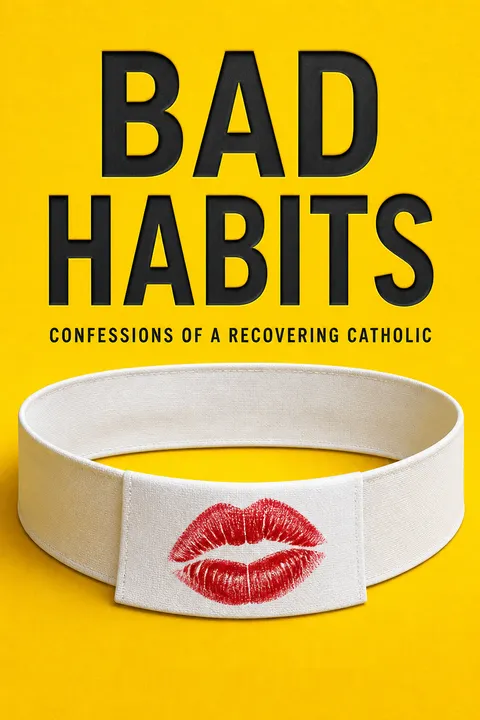


Key Takeaways
Teach faith without terror, or children turn metaphors into monsters.
Fear becomes a child's map. Before school, McCarthy recalls feeling close to God when she looked at the sky. Religious lessons about divine punishment, Hell, and Satan replaced that comfort with anxiety. At nine, she feared dying with an unconfessed sin and bought a nineteen-dollar scapular, imagining it would protect her from damnation. She also took the story of Satan as a fallen angel literally and became afraid of falling down stairs.
Children fill in the gaps. McCarthy argues that frightening religious images, taught without clear explanation, can become concrete threats in a child's mind. Her recurring panic about demons and Hell is funny in hindsight, but the fear itself was real. The book does not reject spirituality; it questions teaching belief through terror.
What's striking is how the child's imagination does not merely misunderstand doctrine; it tries to make doctrine usable, turning abstract language into physical dangers and protective objects. Developmental psychology similarly emphasizes that children interpret figurative language through the concrete experiences available to them. That makes careful explanation more than a nicety. Still, a single memoir cannot establish that religious instruction generally causes lasting harm. The more precise lesson is about method: when authority invokes eternal punishment, it takes responsibility for making the claim intelligible and for hearing the questions it provokes.
Question rules that demand obedience but cannot explain their own loopholes.
Rules invite scrutiny. At Catholic school, McCarthy repeatedly asks how children can be punished for rules they do not understand. A priest cannot explain adultery to nine-year-old Jenny, though she worries that accidentally breaking the commandment could send her to Hell. A teacher describes Limbo as the fate of some unbaptized babies, then offers little explanation for how anyone knows it exists. McCarthy later reads that the Church no longer teaches Limbo as a place, and feels betrayed by years of fear for the imagined souls there.
Authority shifts beneath her. She also challenges changing explanations of God, sin, and biblical stories. Her questions are often met with calls to have faith, which she experiences as a demand to trust the institution rather than understand it.
This section's deeper issue is epistemic trust: people can accept uncertainty more readily when leaders name it honestly than when conjecture is presented as an unchanging rule. Institutions do revise teachings, sometimes for good reasons, but revision without acknowledgment can feel like a breach of contract to those raised under the earlier account. McCarthy's childhood perspective is deliberately comic and does not capture the full complexity of Catholic theology. Even so, it makes a strong case for distinguishing settled doctrine, interpretation, and speculation, especially when the stakes are framed as eternal.
Measure devotion by conduct, not religious labels or public performance.
Goodness outlives the label. McCarthy's family welcomes George, her father's atheist friend, despite his jokes and interruptions during their religious movie nights. Her mother explains that he is kind, even though he does not share their faith. In contrast, a neighborhood girl loudly claims God's favor while insulting the McCarthys for being poor. The contrast unsettles Jenny: belief and religious display do not reliably predict generosity.
Actions make the test visible. The same tension appears when the children watch adults use alcohol and sweets to win a priest's attention, even as gluttony is condemned. McCarthy's stories expose the distance that can open between professed virtue and ordinary behavior. They also show her mother's own generosity toward people outside her faith, a quality that complicates any simple attack on religion.
The distinction between declared values and enacted values is central to moral psychology. People often judge character more reliably through repeated behavior than through identity claims, because a label can function as a signal without guaranteeing the conduct it implies. McCarthy's examples make this gap legible without requiring the reader to decide whether belief itself is good or bad. A useful caution is that hypocrisy in individuals does not invalidate a tradition's ethical teachings. It does, however, make accountability more persuasive than pious presentation.
Poverty can sharpen resourcefulness while making dangerous shortcuts look necessary.
Scarcity teaches improvisation. McCarthy's parents struggle to support four daughters. Her mother earns dinner money by offering neighbors haircuts, while her father works exhausting jobs after the savings he sent home from Vietnam were stolen by a relative. A McDonald's Monopoly promotion seems to promise the family a $25,000 escape, until they discover they mistakenly used the same game piece twice. The brief hope makes the letdown especially painful.
Need blurs the moral line. In college, McCarthy works odd jobs, runs out of money, and admits to taking food, bouncing checks, and selling unauthorized parking passes. She feels guilty, particularly about restaurant workers left without tips, but peer pressure and hunger keep pulling her back. Her stories do not excuse the harm; they show how financial pressure narrows the choices a person can see.
The memoir treats scrappiness as both inheritance and burden. Economic sociology helps explain why: scarcity consumes attention, making immediate needs harder to separate from long-term consequences. That context can deepen understanding without turning theft or deception into harmless acts. McCarthy's guilt over the waitress is especially telling because it preserves the other person's reality inside her own crisis. The larger insight is not that desperation makes every shortcut acceptable, but that moral advice becomes thin when it ignores the material conditions shaping a decision.
After a $5,000 agency scam, pursue the work, not the gatekeeper.
A setback is not a map. Determined to reach Hollywood, McCarthy pays $5,000 to Faces International after its representatives promise exposure. The agency goes bankrupt, and the promised catalog never appears. Later, a legitimate agency tells her she lacks the right commercial look. Instead of treating either rejection as a final verdict, she keeps looking for an opening. A chance to test for Playboy arrives unexpectedly, leading to work that helps her pay her parents' debts.
Change the route, not the aim. McCarthy's career then shifts beyond the sexy image she had been hired to embody. She pushes for an MTV hosting audition despite being told a Playmate would not be considered, and eventually gets the job. The story is not a guarantee that persistence pays; it is a portrait of persistence paired with adaptation.
The useful distinction is between commitment to a goal and loyalty to one gatekeeper. Career research often finds that opportunity depends on repeated attempts, networks, timing, and fit, not simply confidence. McCarthy's path illustrates the value of continuing to make bids while changing the channel through which they are made. Yet persistence can also expose people to predatory promises, as the $5,000 loss shows. The transferable lesson includes discernment: evaluate the offer, the costs, and the evidence, rather than assuming that a costly doorway must lead somewhere.
Feel pain long enough to understand it before reaching for numbness.
Numbing postpones the reckoning. After a back injury, McCarthy takes Vicodin frequently for months and experiences dependence, depression, and severe constipation. When the medication stops, emotional distress returns alongside physical withdrawal. She recognizes a familiar pattern: reaching for shopping, alcohol, or food whenever disappointment or loneliness appears.
Make room for the feeling. Her sister JoJo offers a different practice: sit privately, notice the emotion, and let it pass without immediately explaining it away or trying to suppress it. McCarthy tries this when distress rises and finds that accepting the feeling changes her relationship to it. The book presents this as a personal coping insight, not a treatment plan, and its comic framing never erases the physical risks of misusing medication.
The distinction between regulating distress and escaping it is psychologically important. Emotional avoidance can offer short-term relief while teaching the mind that difficult feelings are intolerable, which can strengthen the urge to avoid them again. Attention and acceptance may interrupt that cycle for some people. But this is not an argument to endure severe pain without help: medication dependence and injury warrant appropriate medical care. McCarthy's story is most useful as a prompt to notice when a coping tool has become the only response, not as a universal prescription to sit alone with suffering.
Let faith sustain action, but do not mistake comfort for proof.
Faith steadies a parent. When McCarthy's son Evan is diagnosed with autism, she describes feeling devastated and determined to find help. During a later seizure and cardiac arrest, she recalls hearing an inner reassurance that he would be all right. The paramedics revive him, and that experience becomes a source of faith during a frightening period of parenting, divorce, and financial uncertainty.
Hope becomes a commitment. McCarthy says she promises God to share her experience and help others. She describes Evan's progress as a reason to keep going and to seek support. These are her personal memories and interpretations. The memoir does not establish that faith caused his recovery, nor that her family's experience can predict another child's outcome.
The account distinguishes faith's psychological function from its evidentiary status. A belief that helps someone endure a crisis can be deeply consequential, even when it does not explain the crisis or prove a medical claim. In caregiving research, meaning and perceived support are often associated with resilience, but they cannot substitute for reliable clinical evidence. The memoir's emotional force comes from a mother's insistence on hope. That hope is most responsibly carried alongside individualized care, transparent evidence, and respect for families whose outcomes differ.
Choose spiritual practices by whether they deepen compassion, not fear.
Belief becomes a personal practice. After years of Catholic schooling, spiritual reading, and exploring other traditions, McCarthy concludes that no group has a perfect grip on truth. She remembers asking Mormon visitors to pray over Evan without agreeing to convert, and being moved by their faith. She also attends a sweat lodge for years, then eventually questions her belief that suffering is required for spiritual growth and stops going.
Grace returns without certainty. In the closing image, she looks up at the sky as she did as a child and feels warmth rather than fear. Her version of recovery is not a clean rejection of God. It is a move away from shame and religious competition toward love, curiosity, and respect for others' beliefs.
McCarthy's ending offers pluralism as a discipline of restraint: a person can value a practice without claiming it should govern everyone else. That stance is compatible with religious freedom and with the idea that communities can provide meaning, care, and shared ritual. It also asks for cultural care. Traditions such as the sweat lodge have particular histories and protocols, so they should not be reduced to interchangeable tools for personal improvement. The memoir's strongest standard is practical but demanding: examine whether a belief expands compassion or licenses contempt.
Analysis
Bad Habits is a comic memoir organized around a serious question: what happens when a child is taught to trust religious authority, yet repeatedly encounters rules that seem frightening, contradictory, or poorly explained? McCarthy's answer is not a systematic argument against Catholicism. It is a life story in which belief is repeatedly revised by experience: childhood terror gives way to adolescent irreverence, financial desperation, adult ambition, motherhood, grief, and a more personal spirituality.
Comedy is the book's chief instrument. Its outrageous episodes make religious fear, sexual shame, poverty, and career humiliation approachable without turning them into abstract themes. The jokes also sharpen the social critique: institutions can claim moral authority while individuals behave generously or cruelly regardless of their labels. But humor has limits. It can compress theological complexity into a child's understandably blunt account, and the memoir's anecdotes cannot stand in for evidence about all Catholics or all religious education.
The narrative's most coherent development is from externally enforced rules toward chosen responsibility. McCarthy begins as a child who wants exact instructions for avoiding damnation. She later describes decisions made under scarcity, the consequences of numbing distress, and a parental faith that helps her continue through a frightening crisis. The final standard is not doctrinal certainty but compassion and lived conduct. That movement is emotionally persuasive, though it carries a risk: personal spiritual insight can sound universal when presented as a solution. The account of Evan's autism is best read as a record of one parent's hope and experience, not proof of a general medical claim.
The book's lasting value lies in its insistence that honest questions belong inside faith, not outside it. It invites readers to keep what sustains care and belonging while challenging fear, hypocrisy, and unquestioned authority. Its conclusion is less a verdict on religion than a plea for humility: conviction should not become a license to shame or control another person's search for meaning.
Review Summary
Bad Habits receives mixed reviews, with many praising McCarthy's humor and relatable experiences growing up Catholic. Readers appreciate her honest questioning of faith and find her stories entertaining. Some criticize exaggerations and crude language. The book resonates strongly with lapsed or questioning Catholics. Many enjoy McCarthy's writing style and find her journey from devout Catholic to spiritual seeker engaging. However, some readers feel the book becomes disjointed or preachy towards the end. Overall, it's seen as a funny, quick read that appeals most to those who can relate to Catholic upbringings.
People Also Read



Glossary
AM
Reactive, distressed awarenessMcCarthy's metaphor for a lower, more reactive state of consciousness in which she feels caught in distress, self-pity, blame, or emotional avoidance. In this state, she describes reaching for distractions or numbing behaviors. AM is part of her personal radio metaphor, not a clinical or scientific category.
satellite radio
Awake, expansive awarenessMcCarthy's metaphor for a more peaceful and spacious state of awareness. She uses it to describe feeling present, connected, compassionate, and less controlled by fear or painful self-stories. The metaphor captures her subjective experience of spiritual growth, rather than a measurable psychological state.
pain body
Pain reinforced by identificationA term McCarthy takes from Eckhart Tolle to describe accumulated emotional pain that can feel like part of one's identity. In her account, guilt or victimhood can keep distress active when a person repeatedly defines the self through a painful experience. Noticing that identification is presented as a way to gain distance from the emotion.
state of grace
Peace without religious fearMcCarthy's personal description of a spiritual condition grounded in warmth, love, and connection rather than shame, punishment, or the need to prove one tradition superior. Her use is broader than a formal Catholic theological definition: it refers to feeling spiritually at ease while allowing other people their own beliefs.
FAQ
What's "Bad Habits: Confessions of a Recovering Catholic" about?
- Memoir of Jenny McCarthy: The book is a memoir by Jenny McCarthy, detailing her journey from a Catholic upbringing to becoming a Playboy Playmate and beyond.
- Exploration of Faith: It explores her relationship with Catholicism, her struggles with faith, and her eventual path to finding her own spiritual beliefs.
- Humorous and Candid: McCarthy uses humor and candid storytelling to discuss her life experiences, including her time in Hollywood and her role as an autism awareness activist.
- Personal Growth: The book highlights her personal growth and the lessons she learned along the way, making it both entertaining and insightful.
Why should I read "Bad Habits: Confessions of a Recovering Catholic"?
- Relatable Journey: Many readers may find McCarthy's journey of questioning faith and finding personal identity relatable and inspiring.
- Humor and Honesty: The book is filled with humor and honesty, offering a refreshing take on serious topics like religion and personal growth.
- Insight into Hollywood: It provides an insider's look at the entertainment industry and McCarthy's experiences as a Playmate and TV host.
- Empowerment and Faith: Readers interested in stories of empowerment and the exploration of faith will find McCarthy's narrative engaging and thought-provoking.
What are the key takeaways of "Bad Habits: Confessions of a Recovering Catholic"?
- Questioning Faith: McCarthy emphasizes the importance of questioning and understanding one's faith rather than blindly following it.
- Personal Empowerment: The book encourages readers to find their own path and embrace their individuality, even when it goes against societal norms.
- Humor in Adversity: McCarthy shows how humor can be a powerful tool in overcoming life's challenges and finding joy in difficult situations.
- Spiritual Growth: The narrative highlights the journey of spiritual growth and the importance of finding a belief system that resonates personally.
How does Jenny McCarthy describe her Catholic upbringing in "Bad Habits"?
- Strict and Confusing: McCarthy describes her Catholic upbringing as strict and often confusing, with many rules and contradictions.
- Fear of Hell: She shares how the fear of Hell and sin was a significant part of her religious education, leading to anxiety and guilt.
- Questioning Authority: From a young age, McCarthy questioned the teachings of the Church, seeking answers that were often not provided.
- Impact on Identity: Her Catholic upbringing had a lasting impact on her identity and her journey to find her own spiritual beliefs.
What role does humor play in "Bad Habits: Confessions of a Recovering Catholic"?
- Coping Mechanism: Humor serves as a coping mechanism for McCarthy, helping her navigate the challenges and absurdities of life.
- Engaging Storytelling: It makes her storytelling engaging and relatable, allowing readers to connect with her experiences on a personal level.
- Lightening Serious Topics: By using humor, McCarthy lightens serious topics like religion and personal struggles, making them more accessible.
- Authentic Voice: Her humorous approach reflects her authentic voice, showcasing her personality and perspective throughout the book.
What are some of the best quotes from "Bad Habits: Confessions of a Recovering Catholic" and what do they mean?
- "Jesus was my Justin Bieber": This quote humorously captures McCarthy's childhood adoration for Jesus, likening it to a modern-day celebrity crush.
- "I’m going to make it in Hollywood": Reflects her determination and ambition to succeed in the entertainment industry despite challenges.
- "I was a truth seeker": Highlights her lifelong quest for understanding and truth, particularly in relation to her faith and personal beliefs.
- "I’m on satellite radio": Metaphorically describes her spiritual awakening and the clarity she found in her personal journey.
How does Jenny McCarthy address her time as a Playboy Playmate in "Bad Habits"?
- Career Opportunity: McCarthy views her time as a Playmate as a career opportunity that opened doors in Hollywood.
- Controversial Decision: She acknowledges the controversy and backlash from her family and community but stands by her decision.
- Empowerment and Independence: The experience is portrayed as empowering, allowing her to take control of her life and finances.
- Reflection and Growth: McCarthy reflects on how this period contributed to her personal growth and understanding of self-worth.
What insights does "Bad Habits: Confessions of a Recovering Catholic" offer about Hollywood?
- Behind-the-Scenes Look: McCarthy provides a behind-the-scenes look at the entertainment industry, sharing both glamorous and challenging aspects.
- Navigating Fame: She discusses the complexities of navigating fame, including the pressures and expectations placed on women.
- Authenticity vs. Image: The book explores the tension between maintaining authenticity and the image-driven nature of Hollywood.
- Lessons Learned: McCarthy shares lessons learned from her experiences, emphasizing the importance of staying true to oneself.
How does Jenny McCarthy explore the concept of faith in "Bad Habits"?
- Personal Journey: McCarthy's exploration of faith is deeply personal, reflecting her journey from Catholicism to finding her own beliefs.
- Questioning and Doubt: She candidly discusses her doubts and questions about religious teachings and how they shaped her understanding of faith.
- Spiritual Awakening: The book details her spiritual awakening and the realization that faith can be personal and individualized.
- Faith as Empowerment: McCarthy ultimately views faith as a source of empowerment and personal growth, rather than fear and guilt.
What challenges does Jenny McCarthy face in "Bad Habits: Confessions of a Recovering Catholic"?
- Religious Guilt: She grapples with the guilt and fear instilled by her Catholic upbringing, which impacts her self-perception.
- Family Expectations: McCarthy faces challenges related to family expectations and the pressure to conform to traditional values.
- Career Struggles: The book details her struggles in Hollywood, including typecasting and the difficulty of breaking into the industry.
- Personal Growth: Throughout the book, McCarthy confronts personal challenges that lead to significant growth and self-discovery.
How does "Bad Habits: Confessions of a Recovering Catholic" address the theme of personal identity?
- Evolving Identity: McCarthy's journey is one of evolving identity, as she navigates different roles and expectations throughout her life.
- Authenticity: The book emphasizes the importance of authenticity and staying true to oneself, even in the face of societal pressures.
- Self-Discovery: McCarthy's experiences lead to self-discovery and a deeper understanding of who she is beyond labels and stereotypes.
- Empowerment: Her story is one of empowerment, as she learns to embrace her unique identity and live life on her own terms.
What is the significance of the title "Bad Habits: Confessions of a Recovering Catholic"?
- Play on Words: The title is a play on words, referencing both McCarthy's Catholic upbringing and her journey to break free from its constraints.
- Confessional Tone: It suggests a confessional tone, as McCarthy shares candid and humorous stories from her life.
- Recovery and Growth: The title reflects her journey of recovery and growth, as she moves beyond the limitations of her past.
- Exploration of Faith: It highlights the exploration of faith and the process of finding her own spiritual path, separate from traditional Catholicism.
Download PDF
Download EPUB
.epub digital book format is ideal for reading ebooks on phones, tablets, and e-readers.








