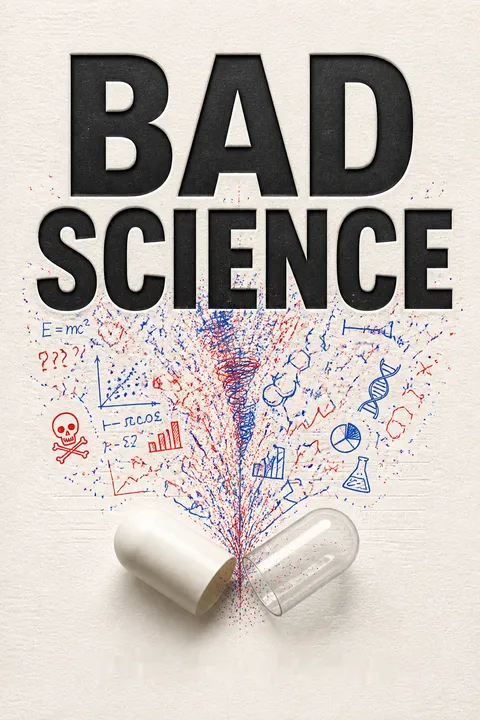


Key Takeaways
Test the claim, not the theatre surrounding it
Start with a simple test. A detox footbath turns brown even without feet in it. Goldacre explains that electricity corrodes the iron electrodes, producing rusty water; testing samples found no urea or creatinine, two ordinary waste products chosen as measurable candidates for the sellers' undefined toxins. The visible sludge was not evidence of toxins leaving the body.
Use a control. An ear candle left burning without an ear produces the same waxy residue as one placed in an ear. Brain Gym makes a different kind of spectacle, claiming that gestures affect blood flow or connect bodily circuits despite basic anatomical objections. Across these examples, the practical question is whether the effect occurs without the proposed cause.
The strength of these demonstrations is their accessibility: no advanced degree is needed to ask what would happen if the supposed cause were absent. That turns skepticism from a posture into a procedure. The limit is equally important: disproving one advertised mechanism does not settle every possible benefit of a product or ritual. A fair test should target the specific claim being made, and its result should not be stretched beyond that claim. This restraint keeps debunking from becoming the mirror image of credulity.
Require a fair comparison before calling a treatment effective
Separate treatment from recovery. Symptoms often improve on their own, especially after people seek help at their worst. That is regression to the mean, not proof that the treatment caused the improvement. In one study of 2,337 terminal cancer patients, about 1 percent lived five years; the study did not examine miracle cures, despite a newspaper presenting it that way.
Compare like with like. A sound trial assigns similar patients at random to treatment or control groups, hides assignments where possible, and reports what happened to everyone, including dropouts. More than a hundred placebo-controlled trials of homeopathy had been conducted by the book's publication; reviews of the more reliable evidence found no benefit beyond placebo. A 30C remedy is diluted so far that none of the original substance is expected to remain, but the decisive issue is still the trial result.
The central discipline is counterfactual thinking: what would have happened to these same kinds of patients without the intervention? Individual experience cannot answer that, because recovery, expectation, and treatment arrive together. Random assignment helps distribute differences between groups rather than letting a practitioner choose who receives what. Trials are imperfect and costly in attention, not always in money, so transparency matters. A negative result is not a verdict on every part of care; it is a verdict on the particular claim the comparison can test.
Treat placebo as a real response, not proof a pill works
Meaning changes outcomes. The placebo effect is not simply an inert tablet acting like a drug. It can arise from expectation, ritual, cost, colour, packaging, and the manner of the person providing treatment. In studies described by Goldacre, four placebo pills helped more than two, injections outperformed sugar pills for some symptoms, and branded packaging strengthened pain relief. Even a doctor's private expectations affected patients' reported pain.
The body participates. Placebo responses have been associated with measurable changes, including dopamine release in Parkinson's disease and altered pain responses. Sham operations have also improved some symptoms, although they did not necessarily match the genuine procedure. These findings make reassurance and therapeutic attention worth studying, while leaving the specific biological claims of homeopathic pills unsupported.
This account avoids a false choice between 'physical' and 'imagined.' Meaning can shape bodily experience without making symptoms fake, and care can help even when a product has no specific pharmacological action. That distinction could improve medicine by directing attention toward communication and trust, not just molecules. It also creates an ethical tension: a helpful ritual can become manipulation when practitioners invent diagnoses or discourage proven care. Beneficial expectations deserve careful use, not a licence to deceive.
Ask what evidence would disprove the pattern you see
Intuition spots too much. People shown a random sequence of basketball hits and misses often saw a hot streak in it. The sequence looked lumpy, even though it was random. We also tend to notice evidence that confirms a belief, explain away evidence against it, and mistake events that happen together for cause and effect.
Beliefs shape what seems convincing. In an experiment about the death penalty, supporters and opponents each found methodological flaws mainly in the evidence that challenged their existing view. Availability adds another distortion: vivid stories are easier to recall than quiet statistics. Group pressure matters too. In Asch's line experiments, many participants gave an answer that contradicted what they could see after hearing a unanimous group give that answer.
The useful question is not whether someone is biased, since the examples suggest that bias is ordinary and often invisible to the person experiencing it. The more productive question is what procedure can expose it. Scientists can assess study methods without first examining the results, and readers can ask in advance what finding would change their minds. That practice does not eliminate judgment. It makes judgment less dependent on whichever anecdote, group, or prior belief happens to be most vivid.
Do not turn a plausible mechanism into dietary advice
Mechanism is only a beginning. Nutrition commentators often move from a laboratory result or an observed association to a confident claim about what people should eat. A chemical affecting cells in a dish does not establish that a food prevents disease in humans. Likewise, people who eat olive oil may differ in income, work, stress, and sun exposure, so an association with fewer wrinkles cannot show that olive oil caused the difference.
Supplements can disappoint or harm. Antioxidants seemed promising because of theories about free radicals and observational links between antioxidant levels and health. Yet large trials overturned the simple story. In CARET, high-risk participants taking beta-carotene and vitamin A were 46 percent more likely to die of lung cancer than those taking placebo. Reviews covering roughly 230,000 people found no mortality benefit overall, with possible increased risk.
The lesson is not that biological mechanisms are useless. They help researchers form questions and decide what to test. The mistake is treating an appealing mechanism as if it already answers the human outcome question. This is especially consequential in nutrition, where foods contain many interacting components and diets travel with whole ways of life. The book's evidence also warns against collapsing ordinary healthy eating into supplement marketing. A varied diet and an isolated high-dose capsule are different interventions.
Demand complete trial records, especially when sponsors sell the result
Research can be tilted without obvious fraud. A sponsor can choose unusually healthy participants, compare a new drug with a weak dose of a competitor, emphasize surrogate outcomes, or stop a trial when results look favourable. Afterward, negative findings may stay unpublished, while positive ones appear repeatedly. A review cited in the book found industry-funded studies four times more likely to produce results favourable to the sponsor than independent studies.
Missing results distort the whole picture. Of 37 SSRI trials judged positive by the US regulator, all but one were published; 22 negative or uncertain trials were not published, and 11 were presented as positive. Registration of a trial's plan before it starts makes later changes visible and makes missing results harder to conceal. The methods and outcomes matter more than a paper's confident conclusion.
Commercial funding does not automatically invalidate a result, and the book notes that industry trials can have strong methods. The structural problem is control over which questions get studied and which findings become visible. That is why transparency is more useful than simply sorting researchers into virtuous and corrupt camps. A public record of planned outcomes lets readers distinguish a genuine discovery from a conveniently selected result. The same standard should apply to supplement firms, public agencies, and academic investigators.
Translate risk into people, not frightening relative percentages
Give the baseline. A 50 percent relative increase can mean two additional events among 100 people, if the original risk was four in 100. The absolute increase is 2 percentage points; natural frequencies make the same information concrete: six cases rather than four per 100. Without the starting risk, a dramatic percentage can mislead more than inform.
Rare events magnify false alarms. A test can be accurate yet produce many false positives when the condition is rare. In the Sally Clark trial, an expert gave a one-in-73-million estimate for two sudden infant deaths, then the court treated that rarity as evidence of murder. That confuses the probability of the evidence under innocence with the probability of innocence given the evidence. Double murder was also rare, so the figure could not decide between the explanations.
Risk communication is not a cosmetic issue. The format of a number changes what people can reasonably infer from it, especially when the outcome is frightening or rare. Natural frequencies help restore the denominator and make comparisons imaginable. But clear presentation cannot repair a badly chosen baseline or a biased study. The reader still needs to ask who was counted, over what period, and compared with whom. Precision in arithmetic is valuable only when the underlying question is sound.
Judge health scares by published evidence, not media drama
Anecdotes cannot establish a population link. The 1998 Wakefield paper described 12 children with bowel and behavioural problems; it was a case series, not a comparison showing that MMR caused autism. Later, a large Danish study followed 440,655 vaccinated children and 96,648 unvaccinated children, finding no difference in autism rates. Other research and systematic reviews also failed to support the alleged link.
Coverage reversed the evidential balance. Newspapers elevated emotional stories, celebrity speculation, and unpublished claims, while often neglecting reassuring published findings. The MMR vaccination rate fell, and measles and mumps returned in outbreaks. A different scare, the MRSA swab stories, relied on a private laboratory in a garden shed whose results were disputed by hospital microbiologists. In both cases, narrative and apparent authority outran the quality of the evidence.
The MMR example shows why media scrutiny needs to include the evidence itself, not only the motives of officials or researchers. Public institutions can fail, and conflicts of interest deserve investigation, but suspicion alone cannot identify which account is true. The stronger approach is to compare methods, scale, and replication, while reporting uncertainty without manufacturing a dramatic balance between unequal claims. The consequences also matter: a story can alter behaviour across a population even when its scientific basis is weak.
Do not prescribe a pill for a problem rooted in social conditions
The Durham fish-oil project promised a shortcut. Thousands of pupils received capsules amid extensive media attention, but there was no placebo group to separate a fish-oil effect from growing older, attention from adults, or expectations. Officials and the company promoted likely benefits before the project began, and the council later said exam outcomes had never been intended as a measure. The exercise could not answer the question it was publicized to answer.
Look beyond the bottle. The book contrasts this project with a well-conducted parenting programme that attracted little coverage. School performance and behaviour can reflect teaching, family circumstances, food access, and social inequality. The author argues that pills are attractive because they make complicated problems sound simple and purchasable, while structural changes are less marketable and harder to stage as television.
A biomedical explanation can be comforting because it gives a visible cause and a purchasable response. That does not make it wrong in every case, but it can narrow attention before alternatives are tested. The Durham example is especially revealing because the publicity itself became part of the intervention, contaminating the claim it was supposed to evaluate. Better policy asks whether a proposed measure improves outcomes, what else could explain change, and whether a less theatrical intervention addresses the problem more directly.
Pool scattered evidence before preventable deaths become accepted
Small studies can hide a lifesaving answer. Between 1972 and 1981, seven trials tested steroids for mothers at risk of premature birth. Most did not individually show clear benefit, so the treatment did not become standard practice. When researchers combined the results in a meta-analysis in 1989, the pooled evidence showed a 30 to 50 percent reduction in deaths from complications of prematurity.
Synthesis is part of treatment. A meta-analysis brings findings from multiple studies together rather than relying on a memorable anecdote or a reader's impression of separate papers. In this case, useful evidence existed before the conclusion was recognized, and babies died during the delay. The larger argument is not that medicine is always reliable. It is that medicine can correct itself when methods and results are shared, compared, and open to challenge.
The steroid story makes information management feel less abstract: evidence can be present in fragments and still fail to guide care. Pooling studies is powerful when the studies ask sufficiently similar questions and are assessed for quality, not merely added together indiscriminately. The book's emphasis on open methods therefore complements its criticism of both quackery and drug companies. Skepticism is most constructive when it builds institutions capable of finding errors and updating practice, rather than merely replacing one authority with another.
Analysis
Bad Science is an argument for evidence literacy told through a rising sequence of cases. It begins with claims that can be tested in a kitchen or classroom, then moves through homeopathy, nutrition marketing, pharmaceutical research, statistical errors, and health panics. The sequence matters: the reader first learns that science is a method of comparison, then sees what happens when that method is displaced by authority, commercial incentives, or vivid stories. The recurring question is not whether a claim sounds scientific, but what observation could distinguish it from plausible alternatives.
The book's most durable contribution is its insistence that skepticism must be procedural. Anecdotes can be sincere and still misleading; mechanisms can be plausible and still fail in people; a trial can be positive and still be unfair; and a statistic can be correct while its interpretation is wrong. These distinctions make the book useful beyond medicine, because the same reasoning failures appear whenever people infer causes from scattered experience.
Its polemical energy is both an asset and a constraint. Mockery makes abstractions memorable, and the vivid examples expose how technical language can function as camouflage. Yet the combative voice can tempt readers to treat the author's targets as obviously foolish before examining the evidence. That would reproduce the very shortcut the book criticizes. A careful reader should apply the same standards to Goldacre's own claims, distinguish an illustrative example from a comprehensive survey, and remember that the book reflects the debates and evidence available at its 2008 publication.
The book also offers a constructive alternative to blanket distrust. Medicine is not purified by denying commercial influence, nor condemned by the existence of bad practice. Its best safeguard is transparent research, fair comparison, synthesis across studies, and willingness to revise decisions. The practical outcome is not cynicism, but calibrated confidence: ask what was measured, how it was measured, what could bias the result, and what remains unknown. That habit protects patients while preserving the genuine value of scientific medicine.
Review Summary
Bad Science exposes pseudoscience and flawed medical reporting, critiquing homeopathy, nutritionists, and pharmaceutical companies. Goldacre explains the scientific method, placebo effect, and how to interpret studies. Readers appreciate his witty writing and find the book eye-opening, though some feel his tone is arrogant. The book is praised for promoting critical thinking and debunking health myths. While some find certain sections overly technical, most consider it an important read for understanding how science is misrepresented in media and everyday life.
People Also Read


Glossary
Meaning response
Effects of treatment meaningDaniel Moerman's term for the psychological and physiological effects of the meaning surrounding treatment. Expectations, rituals, explanations, packaging, and the therapeutic relationship can influence how people feel and sometimes measurable bodily outcomes. It describes more than a sugar pill's inert contents, but it does not show that a treatment's claimed specific mechanism is real.
Regression to the mean
Extreme results tend to easeA statistical pattern in which an unusually extreme result is likely to be followed by a result closer to the average, partly because chance variation does not usually repeat at the same intensity. When symptoms are worst, people often seek treatment and then improve naturally. The improvement can be wrongly credited to the treatment.
Randomisation
Assigning groups by chanceA trial method that allocates participants to treatment groups by chance rather than by a clinician's or researcher's choice. Proper randomisation helps prevent differences in patient selection from favouring one group. If allocation is predictable or inadequately described, conscious or unconscious choices can bias the comparison.
Blinding
Concealing treatment assignmentsA trial safeguard in which participants, researchers, or both do not know who received which intervention. This reduces the chance that expectations influence treatment, measurement, or interpretation. It is particularly important when outcomes involve judgment, such as pain scores or blood-pressure readings, rather than a wholly objective measure.
Meta-analysis
Pooling results across studiesA statistical method for combining results from multiple studies addressing a related question. It can reveal an overall effect that small individual trials cannot establish clearly. A useful meta-analysis must search systematically and consider the quality and comparability of the included studies, rather than simply adding every result together.
Publication bias
Positive findings appear more oftenA distortion that occurs when studies with positive or striking results are more likely to be published than studies with negative or inconclusive results. The visible research record can then make a treatment appear more effective than it is. Trial registration and publication of all results can make this bias easier to detect.
Natural frequencies
Counts with a shared denominatorA way of presenting risk using concrete counts, such as six cases among 100 people rather than a percentage increase alone. The format makes the baseline and additional cases easier to understand. It can prevent a large relative percentage from obscuring that the absolute change is small.
Prosecutor's fallacy
Confusing evidence and innocenceA reasoning error that treats the probability of evidence occurring if someone is innocent as the probability that the person is innocent given that evidence. Those are different quantities. In a case involving rare events, the alternative explanation may also be rare, so the initial probability alone cannot determine guilt.
Medicalisation
Reframing problems as medicalThe expansion of medical explanations and treatments into areas of ordinary life or social difficulty. A behaviour or hardship may be framed as a disorder with a biomedical cause and a purchasable remedy, even when social, educational, or relational factors may be central. The framing can narrow attention and increase dependence on treatment.
Hassle barrier
Scientific-looking detail deters scrutinyGoldacre's label for material that looks technical enough to discourage questioning while withholding the methods needed to judge a claim. A seller may display graphs, diagrams, or numerical results without explaining how the data were collected or what was compared. The appearance of research creates friction against scrutiny rather than enabling it.
FAQ
What's Bad Science about?
- Critique of Pseudoscience: Bad Science by Ben Goldacre critiques pseudoscientific practices in health and nutrition, focusing on misleading claims in alternative medicine and nutritionism.
- Evidence-Based Medicine: Goldacre emphasizes the importance of evidence-based medicine, highlighting the lack of scientific backing for many popular health claims.
- Cultural Commentary: The book discusses the cultural obsession with health and the media's role in spreading misunderstandings about science, leading to ineffective or harmful treatments.
Why should I read Bad Science?
- Empowerment Through Knowledge: Reading Bad Science equips you to discern between valid scientific claims and pseudoscientific nonsense, providing tools to critically evaluate health information.
- Understanding Health Claims: The book helps readers understand why common health claims, like those about homeopathy and detox diets, often fail under scrutiny, leading to better health decisions.
- Engaging Writing Style: Goldacre's humorous and engaging writing style makes complex scientific concepts accessible and enjoyable, keeping readers engaged with anecdotes and examples.
What are the key takeaways of Bad Science?
- Skepticism is Essential: Goldacre stresses the importance of skepticism when evaluating health claims, encouraging readers to question information from media and health practitioners.
- Placebo Effect Insights: The book explains the placebo effect, showing how expectations can influence health outcomes and the importance of understanding this effect in treatment efficacy.
- Critique of Alternative Therapies: Goldacre critiques alternative therapies like homeopathy and detox diets, demonstrating their lack of scientific support and potential distraction from genuine health solutions.
What are the best quotes from Bad Science and what do they mean?
- “You cannot reason people out of positions they didn’t reason themselves into.”: Highlights the challenge of changing beliefs not based on rational thought, emphasizing understanding psychological aspects of pseudoscience.
- “The ultimate aim of science is to prevent ourselves from being misled by our own atomised experiences and prejudices.”: Advocates for a systematic approach to knowledge, rather than relying on personal anecdotes.
- “Detox is a meaningless concept.”: Critiques detox diets, asserting the body's natural detoxification mechanisms, and reminds readers to question health trends lacking scientific basis.
How does Ben Goldacre define the placebo effect in Bad Science?
- Definition of Placebo Effect: The placebo effect occurs when patients experience real improvements after receiving a treatment with no therapeutic effect, influenced by their expectations and beliefs.
- Cultural and Psychological Factors: Goldacre explains that cultural and psychological factors, such as treatment presentation and context, significantly impact the placebo effect.
- Implications for Treatment: Understanding the placebo effect is crucial for evaluating treatment effectiveness, especially in alternative medicine, where perceived efficacy may be due to this effect.
How does Ben Goldacre critique homeopathy in Bad Science?
- Homeopathy's Core Principles: Goldacre explains homeopathy's principle of "like cures like" and extreme dilutions, often leaving no active ingredient in the final product.
- Lack of Scientific Evidence: The book presents studies showing homeopathy performs no better than placebo, emphasizing the lack of credible scientific evidence for its efficacy.
- Cultural Impact: Goldacre discusses homeopathy's popularity due to anecdotal evidence and testimonials, warning of dangerous health decisions based on unfounded beliefs.
What are the common misconceptions about detox diets in Bad Science?
- Detox Myths: Goldacre argues detox diets are based on the misconception that the body accumulates harmful toxins needing flushing out, while the body naturally detoxifies through the liver and kidneys.
- Lack of Scientific Support: The book highlights the absence of scientific evidence for detox diets' effectiveness, pointing out misleading claims by detox proponents.
- Cultural Obsession with Detox: Goldacre critiques the cultural obsession with detox diets, suggesting they distract from more important health issues like diet quality and lifestyle choices.
How does the media contribute to the misunderstanding of science in Bad Science?
- Sensationalism in Reporting: Goldacre discusses how media sensationalizes health stories, prioritizing headlines over accuracy, leading to misinformation and public confusion.
- Misrepresentation of Research: The book illustrates how research findings are often misrepresented, with journalists cherry-picking data to support narratives, distorting public perception.
- Impact on Public Understanding: Goldacre argues media's approach undermines public understanding of health topics, calling for responsible journalism that accurately conveys scientific findings.
What is the significance of the MMR vaccine discussion in Bad Science?
- Public Health Crisis: Goldacre uses the MMR vaccine controversy to show how misinformation can lead to public health crises, with declining vaccination rates causing disease outbreaks.
- Media's Role: He critiques media for sensationalizing flawed claims linking MMR to autism and failing to report overwhelming evidence supporting vaccine safety.
- Call for Responsibility: Goldacre emphasizes journalists' responsibility to accurately report scientific findings and the potential consequences of failing to do so.
How does Ben Goldacre address the pharmaceutical industry in Bad Science?
- Critique of Practices: Goldacre critiques the pharmaceutical industry's profit-driven motives, leading to biased research and suppression of negative findings.
- Need for Transparency: He advocates for transparency in clinical trials and publication of all results, ensuring healthcare decisions are based on comprehensive evidence.
- Balanced Perspective: While critical, Goldacre acknowledges pharmaceuticals' importance in modern medicine, arguing for a balanced approach to evaluating their role.
What methods does Ben Goldacre suggest for evaluating health claims in Bad Science?
- Look for Evidence: Goldacre advises seeking robust evidence from systematic reviews and meta-analyses, rather than anecdotal evidence or single studies.
- Understand Study Design: He emphasizes understanding study designs, like distinguishing between case-control and cohort studies, to assess claim validity.
- Be Skeptical of Authority: Goldacre encourages skepticism towards authority figures in health, urging critical evaluation of their claims and evidence.
How does Ben Goldacre suggest improving public understanding of science in Bad Science?
- Education and Engagement: Goldacre advocates for better science education emphasizing critical thinking and the scientific method, helping individuals navigate health information.
- Media Responsibility: He calls for journalists to report scientific issues accurately and responsibly, avoiding sensationalism or oversimplification.
- Public Discourse: Goldacre encourages open discussions about science and health, fostering an environment for questioning and evidence scrutiny without ridicule.
Download PDF
Download EPUB
.epub digital book format is ideal for reading ebooks on phones, tablets, and e-readers.








