Key Takeaways
1. Social Banditry: Rebellion within Peasant Society
The point about social bandits is that they are peasant outlaws whom the lord and state regard as criminals, but who remain within peasant society, and are considered by their people as heroes, as champions, avengers, fighters for justice, perhaps even leaders of liberation, and in any case as men to be admired, helped and supported.
Defining the phenomenon. Social banditry is a specific form of individual or minority rebellion found in peasant societies, where outlaws are seen by their communities not as mere criminals, but as heroes, avengers, or champions against injustice. This distinguishes them from common robbers, who prey on everyone, and from raiding communities, where victims and attackers are strangers. The crucial element is the solidarity and support bandits receive from their own people.
Universal occurrence. This phenomenon is remarkably universal and uniform, appearing across continents—from China to Peru, Europe to the Islamic world—wherever societies are based on agriculture and consist largely of peasants exploited by external powers like lords, governments, or banks. It thrives in societies transitioning from tribal structures to agrarian capitalism, or where traditional rural life resists external forces.
Modern decline. While widespread in the past, social banditry has largely become extinct in modern agrarian systems, both capitalist and post-capitalist, except in specific regions of "settler capitalism" like the USA, Australia, and Argentina. Modernization, with its efficient communications and public administration, eliminates the conditions under which such banditry flourishes, though its memory often persists.
2. Bandits as Political Actors: Challenging State Power
In doing so, banditry simultaneously challenges the economic, social and political order by challenging those who hold or lay claim to power, law and the control of resources.
Challenging authority. Banditry, by its very existence, implies a challenge to the established social order, particularly the power of states and lords. Bandits resist obedience, operate outside the law, and are potential exercisers of power themselves, making them potential rebels. This is why the term "bandit" (bandito) originally meant someone "placed outside the law."
Weakness of states. Historically, state power was limited by inadequate means of control, subjects' ability to evade authority, and a focus on direct control over only certain aspects of life. Before the 19th century, states lacked the knowledge, communication, and rapid deployment capabilities to maintain constant control over their territories, especially remote areas.
- No effective rural police force.
- No monopoly on arms.
- Limited information and transport.
Mass explosions. The history of banditry is marked by occasional mass explosions, transforming endemic outlawry into massive epidemics, or even pandemics, particularly when state power disintegrates. These periods allow freelance chieftains of armed men to enter the world of real power, sometimes even becoming founders of dynasties or republics, as seen with Emperor Tewodros II of Ethiopia or José Antonio Artigas of Uruguay.
3. The Origins of Outlawry: Marginality and Individual Defiance
If we want to understand the social composition of banditry, we must therefore look primarily at the mobile margin of peasant society.
Rural surplus population. The primary source of bandits comes from rural economies with low labor demands or insufficient employment, creating a permanent surplus population. These are often found in pastoral economies, mountainous regions, or areas with poor soil, leading to institutionalized outlets like seasonal emigration, military service, or banditry.
- Pastoralists and herdsmen.
- Landless laborers and day-laborers.
- Minifundists (farmers with too little land).
Youthful recruits. The most significant age group for bandit recruitment is young men between puberty and marriage, before family responsibilities anchor them to the land. This phase offers relative freedom and a propensity for rebellion. For example, two-thirds of Basilicata bandits in the 1860s were under twenty-five.
Individual rebels. Beyond collective categories, a crucial source of bandits are individual rebels—the "stiff-necked and recalcitrant" who refuse to submit to injustice. These are men who, when faced with oppression, choose resistance and outlawry, establishing their right to be respected by fighting back, often adopting distinctive clothing or mannerisms to symbolize their unsubmissiveness.
4. The Noble Robber: Champion of Justice and the Poor
Robin Hood is what all peasant bandits should be, but in the nature of things, few of them have the idealism, the unselfishness, or the social consciousness to live up to their role, and perhaps even fewer can afford to.
The idealized image. The noble robber, epitomized by Robin Hood, is the most famous and universally popular bandit type, serving as a champion, righter of wrongs, and bringer of justice and social equity. This image defines his role and his relationship of total solidarity with the common peasants, who admire, help, and support him.
Key characteristics: The noble robber's image is defined by nine points:
- Begins as a victim of injustice.
- "Rights wrongs."
- "Takes from the rich to give to the poor."
- "Never kills but in self-defence or just revenge."
- Returns to society as an honorable citizen.
- Admired and supported by his people.
- Dies only through treason.
- Invisible and invulnerable (in theory).
- Not an enemy of the king, but of local oppressors.
Reality and myth. While few real bandits consistently live up to this ideal, many begin their careers due to perceived injustice, like Pancho Villa avenging his sister. They are often seen as agents of justice, and some, like Luis Pardo of Peru, genuinely distributed wealth. The belief in their invulnerability, often attributed to magic, reflects the people's desire for an undefeatable champion against oppression.
5. The Avenger: Terror as a Tool of Retribution
They are heroes not in spite of the fear and horror their actions inspire, but in some ways because of them.
Beyond noble ideals. Some bandits, unlike the noble robber, practice terror and cruelty that become part of their public image, making them heroes not despite, but because of, the fear they inspire. These "avengers" are not just righting wrongs but exerting power and demonstrating that even the poor and weak can be terrible.
Ambiguous heroism. Figures like Brazil's Lampião, while celebrated as heroes, are remembered for both generosity and extreme cruelty. His legend records battles, raids, kidnappings, and torture, rather than acts of social redistribution. This blend of terror and "nobility" is also seen in Catalan bandoleros and the fictional Joaquin Murieta, who championed Mexicans against Americans.
Roots of ultra-violence. This gratuitous cruelty, while not typical of all bandits, can be explained by several factors. It may stem from the profound humiliation and inferiority experienced by oppressed groups, leading to indiscriminate retaliation or a "revolution of destruction" when no "good" world seems possible. It can also arise from the breakdown of traditional social controls, like blood-feuds spiraling out of control, as seen in Colombia's Violencia.
6. Haiduks: Organized Guerrillas and National Resistance
Neither royal nor signorial, these free haiduks were robbers by trade, enemies of the Turks and popular avengers by social role, primitive movements of guerrilla resistance and liberation.
Collective outlawry. In southeastern Europe, the haiduks (Cossacks, klephtes, haidamaks) emerged as a collective form of peasant dissidence, groups of free, armed, and combative men. They were often expelled from their lands or escaped serfdom, forming quasi-political movements that challenged authority, particularly foreign conquerors like the Turks.
Economic motives, political role. While often driven by economic hardship, the act of becoming a haiduk was termed "to rebel," making them insurrectionaries by definition. Unlike noble robbers, haiduks were more permanently cut off from peasant society, often kinless, and their cruelty was a familiar theme. Their heroism was fundamentally political, as defenders of Christians against Turks, tolerated for their services to the people.
Structured and permanent. Haiduk banditry was a more serious, ambitious, and institutionalized challenge to authority, with formal structures and organization, including elected leaders (voivodes) and standard-bearers. This permanence allowed them to be recognized as nuclei of potential liberators, inspiring hope that their "liberated areas" could expand into forces capable of toppling empires, as in the Chinese Water-Margin novel or Russian Cossack revolts.
7. The Intertwined Economics and Politics of Banditry
The more successful he is as a bandit, the more he is both a representative and champion of the poor and a part of the system of the rich.
Economic necessities. Bandits, though outside formal society, cannot exist in isolation. They need to eat, arm themselves, and spend or sell their booty, often relying on middlemen to connect them to the wider economy. Their expenditures can even stimulate the local modern sector, as they often have more cash than peasants and spend it freely.
- Middlemen for selling loot.
- Information networks for targets.
- Ransom as a lucrative income source.
Ambiguous social position. The bandit's social situation is inherently ambiguous: he is a rebel and champion of the poor, yet also acquires wealth and exerts power, inevitably drawing him into the web of the rich. This means he is "one of us" constantly becoming associated with "them," though rural isolation often allows him to maintain separate roles.
Political integration. Bandits form a nucleus of armed strength, making them a political force that local systems must accommodate. In areas lacking effective public order, local elites often find it advantageous to establish diplomatic relations or even patronize bandit groups, integrating them into local power struggles and rivalries. This can lead to bandits being formally converted into state agents, like Cossacks or dacoits, who exchange freebooting for protection duties.
8. Bandits and Revolutions: From Outlaws to Insurgents
At this point the bandit has to choose between becoming a criminal or a revolutionary.
Precursors to revolt. Social banditry, as a phenomenon of social protest, often serves as a precursor or incubator of revolt, differing sharply from the criminal underworld which views revolutions merely as opportunities for crime. Bandits, sharing peasant values and aspirations, are sensitive to revolutionary surges, and in such epochs, large numbers of peasants may join them.
Mass mobilization. When revolutions erupt, bandit activity expands and merges with broader peasant mobilizations. Local bandit leaders may attract large numbers of disbanded soldiers, deserters, or peasants seeking freedom and vengeance. This transforms outlaw bands into guerrilla units, initially indistinguishable from ordinary bandits, but now operating within a different social setting where the majority joins the unsubmissive minority.
Limited revolutionary potential. While bandits provide fighting men and leaders, their military and political potential is limited by their small unit size, lack of sophisticated organization, and narrow horizons. They are not ideologically equipped to offer a real alternative to peasants, often dreaming of a free society but ultimately aspiring to become landowners themselves, like Pancho Villa. Their contribution to modern revolutions is often ambiguous and short-lived.
9. Expropriators: Revolutionaries Adopting Bandit Tactics
Finally we must glance at what may be called ‘quasi-banditry’, that is to say at revolutionaries who do not themselves belong to the original world of Robin Hood, but who in one way or another adopt his methods and perhaps even his myth.
Modern bandit methods. "Quasi-banditry" refers to revolutionaries who, while not traditional social bandits, adopt their methods, particularly "expropriation"—robberies to fund revolutionary movements. This tactic emerged from anarchist-terrorist milieus in Tsarist Russia, later adopted by Bolsheviks, and is characterized by targeting symbols of impersonal wealth, like banks.
Ideological motivations. Figures like Francisco Sabaté Llopart, a Catalan anarchist guerrilla, exemplify this. Driven by an uncompromising dream of a world without poverty, government, or jails, he robbed banks not just for money but as a symbolic act of defiance and courage. His actions were "propaganda by action," aiming to inspire the masses.
Tragic outcomes. Despite their bravery and conviction, such expropriators often face tragic outcomes. Sabaté's career, though legendary, achieved little in practical terms, with robbery proceeds consumed by clandestine operations. His story highlights the gap between heroic individual action and the complex, organized efforts required for genuine social change, often ending in death or imprisonment.
10. The Enduring Bandit as a Universal Symbol
The bandit is not only a man, but a symbol.
Short-lived fame, enduring myth. While the personal fame of most bandit heroes is relatively short-lived in oral traditions, the bandit as a symbol endures. Robin Hood, an exception with centuries of fame, represents the archetype, but most other celebrated bandits are more recent, their legends often preserved by print media like chapbooks.
Wider appeal. The bandit myth's appeal extends far beyond its native peasant environment, influencing high culture (e.g., Schiller's The Robbers) and modern mass media (Westerns, gangster films). It taps into universal desires for freedom, heroism, and justice, resonating with those who feel constrained by civilization or unjustly treated.
Symbol of defiance. The bandit embodies a permanent emotion and role: freedom, heroism, and the dream of justice. He is admired for his bravery and defiance, standing tall in a world of subservience. This symbolic power ensures his survival in popular culture, from Brazilian cangaçeiros to Australian bushrangers, often kept alive by intellectuals, writers, and filmmakers who rediscover and reinterpret these figures.
11. Women's Diverse Roles in the Bandit World
Since bandits are notoriously given to womanizing, and both pride and status require such demonstrations of virility, the most usual role of women in banditry is as lovers.
Lovers and supporters. The most common role for women in banditry is as lovers, often leading to de facto polygyny. While anti-social bandits might resort to rape, social bandits typically avoid it to maintain popular support. Women also serve as crucial supporters, providing links to the outside world, shelter, and supplies for their kinsmen, husbands, or lovers.
Active participants. Though less common, women sometimes become active bandits themselves, even leading bands. Examples include women in Balkan haiduk ballads, Rosa Palma and Bárbara Ramos in Peru, and Martina Chapanay in Argentina. In China, a significant number of women were bandit chieftains, often driven by revenge for deceased husbands or kin.
Defiance and revenge. Women bandits are often renowned for their horsemanship, sharpshooting, and bravery, indistinguishable from their male counterparts except for their sex. In some traditions, like the Andalusian serranas, women turn to outlawry and revenge due to "dishonour," highlighting a militant reaction to injustice within traditional societies.
12. The Evolution and Persistence of Bandit Myths
Whatever it is that initially singles them out, the medium of their fame until the twentieth century was print.
Myth-making process. Bandit myths are shaped by tradition, often idealizing figures even if their real-life actions were less noble. Public opinion, including that of law enforcement, tends to focus on socially commendable aspects, especially if bandits target unpopular institutions or individuals. This selective idealization can transform a robber into a "noble bandit" within his own lifetime.
Modern adaptations. The bandit tradition adapts to new contexts. In capitalist societies, bandits target banks and railroads, becoming champions against impersonal capital. The image of the country outlaw, like Jesse James or Ned Kelly, persists, reflecting popular resentment against economic exploitation. However, this adaptation is often partial and temporary, as banditry struggles to remain relevant against more organized forms of social struggle.
Contemporary relevance. The bandit myth continues to resonate in the modern urbanized world, periodically revitalized by mass media and the personal resentments of the weak. While traditional banditry is largely extinct, its ethos of individual insurgency against injustice can be seen in some neo-revolutionary groups, though these often differ significantly in social constituency and ideological sophistication. The enduring appeal lies in the bandit's symbolic representation of freedom, heroism, and justice.
Last updated:
Review Summary
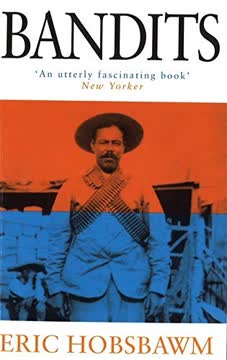
Bandits by Eric Hobsbawm examines "social banditry"—rural outlaws who become folk heroes in peasant societies. The book received mixed reviews (3.75/5). Readers praised Hobsbawm's original, wide-ranging study spanning continents and centuries, particularly the chapter on Catalan bandit Francesc Sabaté Llopart. However, many found it repetitive, overly theoretical, and lacking narrative cohesion. Critics noted its Marxist lens, limited character studies, and academic dryness. Some appreciated insights into figures like Robin Hood, Pancho Villa, and various bandits worldwide, while others felt the numerous obscure examples became tedious and the analysis insufficiently rigorous.