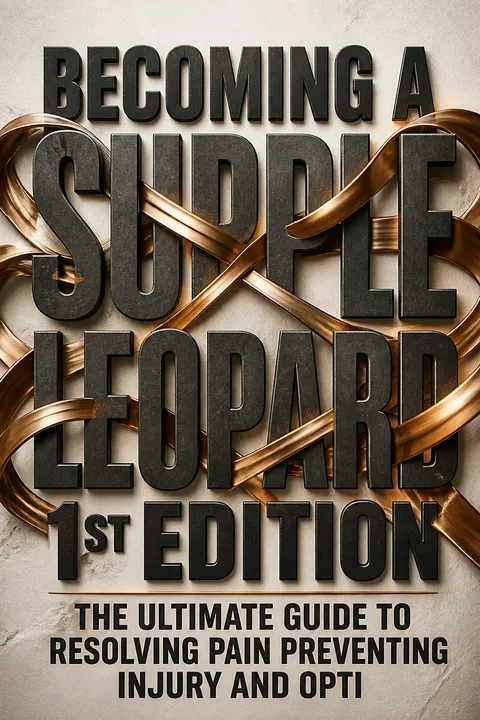


Key Takeaways
Train for usable range, sound positions, and readiness beyond the gym
Readiness, not contortion. The leopard in the title is a metaphor for being prepared to move powerfully at any moment. Humans do need warm-ups and practice, but the goal is similar: develop enough range of motion and movement control to meet varied demands without having to negotiate every action from scratch. Starrett’s system combines strength training, movement technique, and mobility work to build that capacity, rather than treating flexibility as an end in itself.
Practice transfers. A well-organized lift can teach patterns useful outside the gym. A deadlift, for instance, rehearses how to pick an object up; a controlled pull-up develops a model for stabilizing the shoulders while climbing. The book’s promise is broad, but its practical point is modest: learn positions in a setting where they can be observed and adjusted, then apply them elsewhere.
The metaphor is memorable because it shifts the aim from winning a flexibility contest to having options under pressure. That connects with a useful principle in skill learning: practice is most transferable when people understand the movement problem, not merely the equipment or choreography. The gym can provide repeatable conditions for that learning. Still, similarity is not identity. A technically sound deadlift does not automatically make every real-world lift safe, since objects, surfaces, fatigue, and urgency vary. The strongest reading is that gym practice supplies adaptable movement vocabulary, not a universal guarantee.
Brace your trunk before asking your hips and shoulders to make force
Build a stable base. Midline stabilization and organization means arranging the head, ribcage, and pelvis in a balanced position, then tightening the trunk to support it. The book treats this as the starting point for transferring force between the hips, shoulders, and limbs. Its bracing sequence uses simple cues: set the pelvis, align the ribcage above it, engage the abdomen, and organize the head and shoulders. The amount of tension should match the task, not stay at maximum all day.
Check the shape. Starrett’s two-hand rule places one hand at the lower ribcage and another at the pelvis. If the hands move farther apart, the back is arching; if they move closer, it is rounding. The check makes an abstract idea easier to notice during sitting, standing, or basic movement.
The useful insight is sequencing: trunk control can make force transmission and limb positioning easier to manage. This resembles the idea of proximal stability supporting skilled movement, while the practical cue gives learners a quick source of feedback. The risk is turning a coaching model into a rigid rule. Spinal posture naturally changes across tasks, and a neutral position is not one frozen shape for every lift, body, or sport. Bracing is best treated as a controllable strategy for demanding tasks, with breathing and comfort preserved, rather than a posture to hold continuously.
Use rotation to stabilize joints, not as a cue to wrench them
Create useful tension. The book uses torque to mean rotational force created at the hips or shoulders, often while a hand or foot stays planted against the floor or an object. In a push-up, the hands press into the ground as if trying to turn outward; in a squat, the feet exert outward force without actually turning. These actions engage surrounding muscles and can help the joints feel more supported.
Match force to demand. The book’s Laws of Torque connect the direction of rotation to whether a joint is flexed or extended. In practice, the central coaching idea is to use enough tension to resist collapse, not so much that movement becomes stiff or awkward. The author favors a mostly forward-facing foot position for squatting, while allowing a small turn-out when needed for comfort or mobility.
Torque gives athletes a reason behind familiar cues such as pressing into the floor or bending a bar. That explanation can improve self-correction because the learner has a sensation to seek, not just a phrase to obey. Yet the mechanics are more variable than a single ideal stance suggests. Body proportions, joint structure, and the particular task all affect comfortable foot and hand angles. A cue that increases useful muscle engagement for one person may create excess tension for another. The book’s own warning against maximal effort is important: stability is a means to move, not a contest in squeezing.
Watch movement quality before pain becomes the only warning
Treat training as observation. Pain, swelling, and lost range can appear after a problem has developed. The book therefore argues that ordinary training can reveal earlier clues, such as losing balance, rounding under load, or letting knees collapse inward. A deadlift can be both exercise and assessment: does the lifter hinge at the hips while keeping a controlled trunk, or find another way to complete the task?
Increase challenge carefully. A movement that looks sound with a light implement may change when speed, repetitions, load, or fatigue rise. The book describes the gym as a laboratory because coaches can adjust those demands and watch what changes. It also cautions against valuing a finished repetition over its execution. The claim that this predicts injury should be handled carefully; the method is most defensible as a way to notice and improve skill.
This shifts attention from the binary of success or failure to the process that produced the result. That is valuable in coaching, where visible movement gives both athlete and teacher something concrete to discuss. It also resembles formative assessment: challenge a skill, observe where it breaks down, then adjust instruction. The important distinction is between detecting a movement limitation and forecasting an injury. A visible fault can guide practice, but it cannot by itself establish future harm. Movement quality is useful information, not a crystal ball, and pain deserves assessment on its own terms.
Diagnose the start and finish positions, not just the failed rep
Break movement into shapes. Body archetypes are the book’s compact map of recurring shoulder and hip positions. It groups seven basic shapes, including an overhead position, a deep squat, and a lunge. A complex lift can then be examined as a transition between recognizable starting and finishing shapes, rather than as one mysterious whole.
Trace the tunnel. The tunnel concept says that the starting position influences the finish, and the finish becomes the setup for the next repetition. Starrett tells of an elite weightlifter whose overhead lockout drills were not fixing a snatch problem. The lifter’s shoulders were poorly positioned earlier in the pull, so the overhead failure was downstream of the setup. Checking the entry to the movement helped identify the more relevant restriction. This model encourages coaches to inspect the whole sequence before adding more drills.
The framework is useful because it reduces complexity without pretending movement is simple. Coaches can share a vocabulary for positions, then ask where a transition becomes unstable. That resembles systems analysis: a visible failure at the output may originate in an earlier constraint. The approach also discourages endless practice of the symptom. Its limitation is that static shapes cannot capture every timing, force, or coordination demand of sport. Archetypes are a map for locating questions, not a complete explanation of movement or proof that one tissue is responsible.
Progress from controlled basics to speed only when positions hold
Build difficulty in layers. The movement hierarchy sorts exercises by their stabilization and coordination demands. Basic, slower movements such as squats, deadlifts, and push-ups let a learner practice stable positions. Faster movements add moments when tension must be re-established. More complex lifts, such as a clean or snatch, require rapid transitions between different positions. Each stage can expose weaknesses hidden by the previous one.
Scale to the person. A coach can make a task easier by reducing load, range, or balance demands, or harder by adding speed, repetitions, or fatigue. Someone unable to hinge to the floor with a neutral trunk might first lift a bar from blocks. The goal is not to stay with the easier variation forever; it is to expand the challenge while technique remains manageable. Quality should determine when to progress, rather than a calendar or an impressive-looking workout.
The hierarchy offers a practical bridge between rehabilitation and athletic training: the same pattern can be relearned at lower demand, then tested under increasingly realistic conditions. This is compatible with progressive skill acquisition, where difficulty rises as control improves. The model’s strength is its adaptability, not the exact category labels. A movement can be technically complex for one athlete and familiar for another, and fatigue may alter risk differently across tasks. Progression therefore needs observation and judgment, not automatic advancement through a fixed ladder.
Mobilize the specific restriction, then retest the movement
Do more than stretch. The book defines mobilization as movement-based work aimed at restrictions that interfere with a position. Its checklist covers joint mechanics, sliding surfaces between tissues, and muscle dynamics. This is why it recommends choosing techniques based on a demonstrated limitation instead of performing a generic routine. If a person cannot reach a stable overhead position, the assessment should clarify whether the issue is control, range, or both.
Measure the response. Test and retest means checking the target movement before and after a technique. If a squat improves after a relevant ankle mobilization, that offers a useful sign; if it does not, the practitioner should reconsider the target. The book suggests 10 to 15 minutes of daily work, usually selecting three or four techniques and spending at least two minutes on a position. It also warns against sharp or alarming pain and advises clinical care for serious concerns.
The test-and-retest habit is the section’s strongest safeguard against ritualized self-care. It asks whether a technique changes something that matters, rather than whether it feels intense or looks sophisticated. The system also recognizes that range reflects several interacting tissues and movement control, which is more useful than blaming every limitation on one short muscle. However, an immediate change does not identify the underlying cause, and lack of change does not prove that a region is healthy. Mobility work can support movement practice, but it should not replace diagnosis when symptoms are persistent, severe, or unexplained.
Break up sitting, because the body adapts to its daily positions
Positions become practice. The book argues that the body adapts to the shapes it repeats, whether those shapes come from exercise or a desk chair. Long periods of sitting keep the hips flexed and reduce opportunities to use the legs and trunk through varied ranges. Starrett recommends standing, resetting posture, and changing positions regularly rather than assuming that a standing desk alone solves the problem. He suggests interrupting seated work every 10 to 15 minutes when possible.
Make the fix realistic. The broader point is to treat sitting and standing as movement skills, not as inherently safe or harmful categories. A person can sit in a more organized position, but remaining static for hours is still a different demand from moving. The book also connects tissue function with sleep, hydration, food, and stress, presenting recovery habits as part of the environment that shapes movement.
The emphasis on repeated positions is compelling because daily routines often accumulate more exposure than workouts do. It invites a useful question: what movement does the workday remove, and how can ordinary transitions restore some variety? The exact posture prescription matters less than avoiding the illusion that one perfect chair or standing desk cancels long bouts of stillness. The book’s stronger claims about sitting’s dangers are not necessary to make this point. Alternating positions and taking movement breaks are sensible strategies without labeling sitting itself a disease.
Make new mobility useful by practicing it in real, controlled movement
Range needs rehearsal. The book does not treat a temporary increase in motion as the finish line. After mobilizing, the person should use the available range in a relevant movement, such as a controlled squat after work on a squat restriction. This links the new position to motor control and helps reveal whether it can be maintained without compensation.
Keep the dose sensible. Mobilization should be uncomfortable at times, but not feel like tissue damage. The book favors exploring the target position, checking the result, and returning to functional strength work rather than collecting stretches. For pain, it proposes addressing the joint’s position and motion, then considering tissues above and below the painful site. That can be a useful self-care framework for minor stiffness, but it is not a universal treatment plan or a substitute for medical evaluation.
This distinction between passive range and usable range is central to turning mobility into capacity. In motor learning terms, a person needs to coordinate the newly available motion, not simply experience it while supported by a ball or band. Strength training can provide that rehearsal when the task is appropriately scaled. The caution is equally important: discomfort during self-treatment is not a reliable indicator that a technique is effective. Pain can have causes unrelated to tightness, so persistent symptoms or neurological signs require expertise rather than more pressure.
Analysis
Becoming a Supple Leopard is best understood as a coaching system, not a catalog of stretches. Its organizing idea is that movement problems become easier to address when they are made visible in repeatable tasks. The reader learns a sequence of questions: Can the trunk remain organized? Can the hips or shoulders create enough support? Does the person reach the needed positions? Does control survive load, speed, and fatigue? The book’s distinctive contribution is the attempt to connect those questions to familiar exercises, so training becomes both practice and assessment.
That design has real practical force. It gives coaches a shared vocabulary, turns vague advice such as getting tight into observable actions, and encourages progressive scaling instead of demanding advanced movement from everyone. The archetypes and tunnel metaphor help locate a problem within a sequence, while test-and-retest creates a rudimentary feedback loop. The reader is also asked to consider ordinary life, especially prolonged sitting, as part of the movement environment.
The system is clearest as a framework for coaching attention, and less secure when its mechanical explanations become universal claims. The text often presents a preferred posture or joint strategy as broadly correct, and it sometimes links faults to injury with greater certainty than movement observation alone can support. People differ in anatomy, training history, and task demands; variation does not automatically mean dysfunction. Pain is also not a precise map of tissue damage. These cautions do not erase the framework’s value, but they change how it should be used: as a structured way to observe, experiment, and adjust, not as a remote diagnosis or rigid template.
Its most durable lesson is therefore methodological. Notice the task, choose a movement that reveals relevant control, change one demand at a time, and keep what improves function. Mobility work is most convincing when it produces a measurable difference that carries into movement. When pain is severe, persistent, or unusual, professional assessment takes priority over increasingly aggressive self-treatment.
Review Summary
Becoming a Supple Leopard receives mixed reviews, with many praising its comprehensive approach to movement and mobility. Readers appreciate the detailed explanations, exercises, and techniques for improving form and preventing injuries. Some find the content life-changing, while others criticize the writing style, repetitiveness, and perceived lack of scientific backing. The book is lauded for its focus on proper mechanics and self-maintenance, but some question its one-size-fits-all approach. Overall, it's considered a valuable resource for athletes, trainers, and those seeking to optimize their movement patterns.
People Also Read








Glossary
Supple Leopard
ready movement capacityThe book’s metaphor for a person whose usable range of motion and movement control are sufficiently developed to respond to physical demands. It does not mean literal animal-like flexibility or being ready for maximal effort without preparation. It describes the long-term aim of moving effectively across sport and ordinary life.
Midline Stabilization and Organization
organized, supported trunkThe practice of aligning the head, ribcage, and pelvis in a workable spinal position, then engaging the trunk muscles to support it. In the book’s model, this organized center helps transmit force between the hips, shoulders, and limbs. Bracing intensity changes with the task rather than remaining maximal.
One-Joint Rule
move at hips and shouldersA movement principle that assigns most flexion and extension to the hips and shoulders while the trunk stays organized. The name reflects the book’s comparison of these two ball-and-socket joints as primary engines governed by similar stability principles. It guides how the author teaches hinges, squats, presses, and pulls.
Laws of Torque
rotational joint stabilityThe book’s framework for using rotational force to create muscular tension around the hips, shoulders, and other joints. A limb may rotate against a fixed hand, foot, bar, or floor to help stabilize a position. The framework also emphasizes matching the amount and direction of rotation to the movement.
Body Archetypes
recurring movement positionsA classification of seven recurring positions for the shoulders and hips, used to describe the start or finish of many exercises. Static checks of these shapes can help distinguish a control problem from a range-of-motion restriction. The framework offers a shared vocabulary, but does not capture every demand of a moving task.
Tunnel concept
start shapes influence finishesA way of assessing movement that treats setup, execution, and finish as connected. A poor starting position can limit the options available during the movement, while a poor finish may become a compromised setup for the next repetition. The concept directs attention to the whole sequence rather than only its visible failure.
Movement hierarchy
progressive movement difficultyA system for sorting movements by stability, speed, and the number of position changes involved. It moves from controlled, relatively simple exercises toward faster or more complex actions that require stability to be re-established during transitions. Coaches can use it to scale practice to a person’s current control and mobility.
Open-circuit fault
compensated unstable positionThe author’s term for a movement compensation that substitutes for a more organized position, such as a rounded trunk or collapsing knee. In the book’s mechanical model, the body still produces force, but the compensation reduces efficient support and may place extra demand on tissues. It is a coaching description, not a medical diagnosis.
Sliding surface
tissues glide over tissuesA term for the movement of skin, nerves, muscles, tendons, and connective tissues in relation to one another. The author uses sliding surface dysfunction to describe restricted gliding that may contribute to stiffness or reduced motion. Ball, roller, and compression techniques are proposed to restore movement between tissue layers.
Position of High Stability
stable movement starting pointA braced, organized position from which the book expects an athlete to create substantial support through the hips or shoulders. It is used to distinguish slower exercises that maintain tension from faster movements that temporarily lose and then recover that support. The idea helps explain the book’s progression of exercise difficulty.
FAQ
What's Becoming a Supple Leopard about?
- Comprehensive Guide: Becoming a Supple Leopard by Kelly Starrett is a detailed manual focused on optimizing human movement, resolving pain, and preventing injuries.
- Focus on Mobility: It emphasizes the importance of mobility in enhancing athletic performance and maintaining overall physical health.
- Practical Techniques: The book provides a variety of mobilization techniques and exercises that can be easily integrated into daily routines.
- Holistic Approach: Starrett combines principles of physical therapy, strength training, and mobility work to create a well-rounded approach to human movement.
Why should I read Becoming a Supple Leopard?
- Enhance Performance: The book is essential for athletes and fitness enthusiasts looking to improve their performance through better movement mechanics.
- Prevent Injuries: It offers practical advice on preventing injuries by maintaining proper movement patterns and body mechanics.
- Self-Management: Readers learn self-assessment techniques and mobilization strategies to take control of their physical health.
- Expert Insights: Written by a renowned physical therapist, it provides expert insights into the mechanics of movement and how to correct common faults.
What are the key takeaways of Becoming a Supple Leopard?
- Mobility is Crucial: Emphasizes that mobility work is essential for maintaining joint health and preventing injuries.
- Daily Commitment: Encourages a daily commitment to mobility work, suggesting at least 10 to 15 minutes each day.
- Functional Movement Patterns: Understanding and practicing proper movement patterns is vital for both athletic performance and everyday activities.
- Self-Care Practices: Regular self-care practices, such as smashing and flossing techniques, are recommended to maintain soft tissue health.
What is the bracing sequence in Becoming a Supple Leopard?
- Step-by-Step Process: The bracing sequence is a systematic approach to organizing the spine in a neutral position.
- Importance of Stability: It helps create intra-abdominal pressure, stabilizing the spine for efficient force transmission.
- Application in Daily Life: Practicing the bracing sequence can improve posture and movement quality in everyday activities.
- Foundation for Movement: This sequence is foundational for safe and effective movement during workouts and daily tasks.
How does the one-joint rule work in Becoming a Supple Leopard?
- Movement Initiation: The rule states that flexion and extension should occur only in the hips and shoulders, not the spine.
- Functional Movements: Applies to movements like squats and deadlifts, ensuring spinal stability.
- Simplifying Mechanics: Simplifies understanding of movement mechanics by focusing on the hips and shoulders.
- Injury Prevention: Helps prevent spinal injuries by maintaining stability during movement.
What are the laws of torque in Becoming a Supple Leopard?
- Torque Definition: Torque refers to the rotational force generated by the hips and shoulders.
- Creating Stability: Emphasizes generating external rotation in flexion and internal rotation in extension for joint stability.
- Practical Application: Helps create stable positions during movements, reducing injury risk.
- Essential for Movement: Understanding these laws is crucial for safe and effective movement.
What is the upstream-downstream approach in Becoming a Supple Leopard?
- Simple Mobilization Strategy: Targets muscles and tissues above and below a restricted area to alleviate pain.
- Holistic Tissue Management: Addresses the entire kinetic chain to restore function and reduce compensatory injuries.
- No Prior Knowledge Required: Can be applied without extensive anatomy knowledge, focusing on surrounding areas of discomfort.
- Effective Pain Relief: Helps restore normal function and alleviate pain through comprehensive tissue management.
How can I improve my mobility according to Becoming a Supple Leopard?
- Systematic Approach: Combines techniques to address positional and movement-related problems, soft tissue stiffness, and joint restrictions.
- Daily Maintenance: Recommends spending 10 to 15 minutes daily on mobility work to improve range of motion and resolve pain.
- Targeted Techniques: Provides specific mobilization techniques for different body areas, allowing customization based on individual needs.
- Routine Importance: Emphasizes the importance of routine maintenance for long-term mobility improvements.
What are some effective mobilization techniques from Becoming a Supple Leopard?
- Barbell Bubo: Uses a lacrosse ball attached to a barbell to target hard-to-reach areas like the first rib and shoulder.
- Shoulder Capsule Mobilization: Improves shoulder function and alleviates pain by resetting the shoulder into a stable position.
- Couch Stretch: Opens up the hips and quads, improving hip flexor mobility.
- Pressure Wave Technique: Applies pressure to tight muscles using a ball or roller to restore sliding surfaces and release trigger points.
How does Becoming a Supple Leopard address pain management?
- Pain as a Signal: Teaches that pain often signals underlying mobility issues or improper movement patterns.
- Targeted Mobilizations: Provides specific techniques to address common pain areas like shoulders, back, and hips.
- Preventative Approach: Emphasizes addressing restrictions before they lead to pain, promoting proactive body maintenance.
- Self-Assessment Tools: Equips readers with tools to identify mobility restrictions and pain sources for personalized care.
What are some common mobility restrictions discussed in Becoming a Supple Leopard?
- Shoulder Flexion and Rotation: Many struggle with overhead arm movement due to shoulder capsule tightness.
- Hip Flexion and Extension: Restrictions can lead to compensatory patterns causing pain; techniques enhance hip function.
- Knee and Ankle Mobility: Highlights importance for overall movement efficiency, addressing issues like shin splints and ankle impingement.
- Comprehensive Solutions: Offers mobilizations to improve these common restrictions and enhance overall mobility.
What are the best quotes from Becoming a Supple Leopard and what do they mean?
- "Mobility is the ability to move freely and easily.": Emphasizes mobility's essential role in athletic performance and daily life.
- "If you want to make change, you have to set your shoulders to the backs of their sockets.": Highlights the importance of proper positioning for effective movement.
- "Pain is a signal that something is wrong.": Encourages listening to the body and addressing pain as an indicator of underlying issues.
- "Your body is an adaptation machine.": Stresses that consistent practice and attention to mobility lead to improvements in movement quality.
About the Author


Download PDF
Download EPUB
.epub digital book format is ideal for reading ebooks on phones, tablets, and e-readers.








